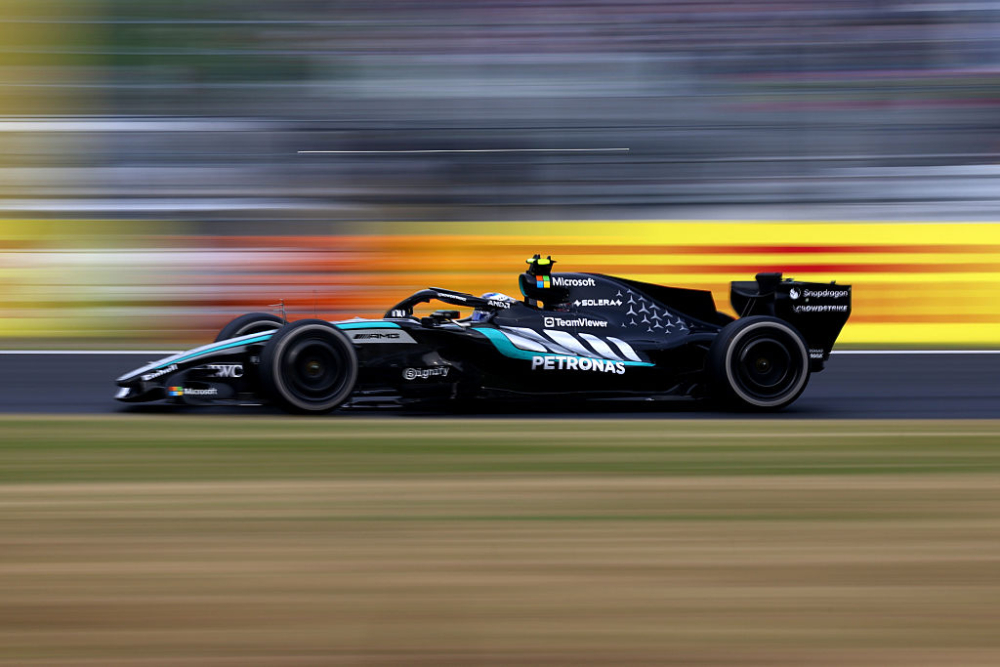
Mark Thompson/Getty Images
F1 is not all about speed, it's about the senses
For a race that featured an exciting start, a real opportunity for a team other than Mercedes to take victory, and a podium featuring three different teams after some excellent overtaking moves, the Japanese Grand Prix did not appear to resonate well with fans.
I’ve been running a poll on social media after every race to gauge the temperature of fan sentiment towards what they watched, and while the first two rounds were largely either tolerated or enjoyed – with the highest percentage voting that they didn’t like a race standing at 29% for Melbourne – Suzuka was a different matter.
At the time of writing, a little over 46% of respondents say they were not a fan of the Japanese Grand Prix, and with over 48% saying it was only OK, we’re looking at no more than six percent at present who said they loved it. The previous low – also Melbourne – was 18%.
As I’ve pointed out before, I believe a big part of that comes from the drivers’ comments. If they were all jumping out of their cars out of every session going “This is amazing, I love driving these machines and having such incredible power” with a beaming smile on their faces, the sentiment would surely be more positive.
In Japan, that didn’t happen. Unlike China, where both Ferrari drivers were effusive about their battles, there were a number that were left frustrated by harvesting issues, safety car timings, or Ollie Bearman’s crash.
But the dissent had started far earlier than that, and you could see it coming.
From Thursday, when the drivers faced the media, there were warnings that driving a qualifying lap around Suzuka was unlikely to be as enjoyable as in the past. The fact that drivers could initially harvest nine megajoules of energy per lap meant the quickest lap time would be found by slowing into corners that were previously extremely fast and challenging.
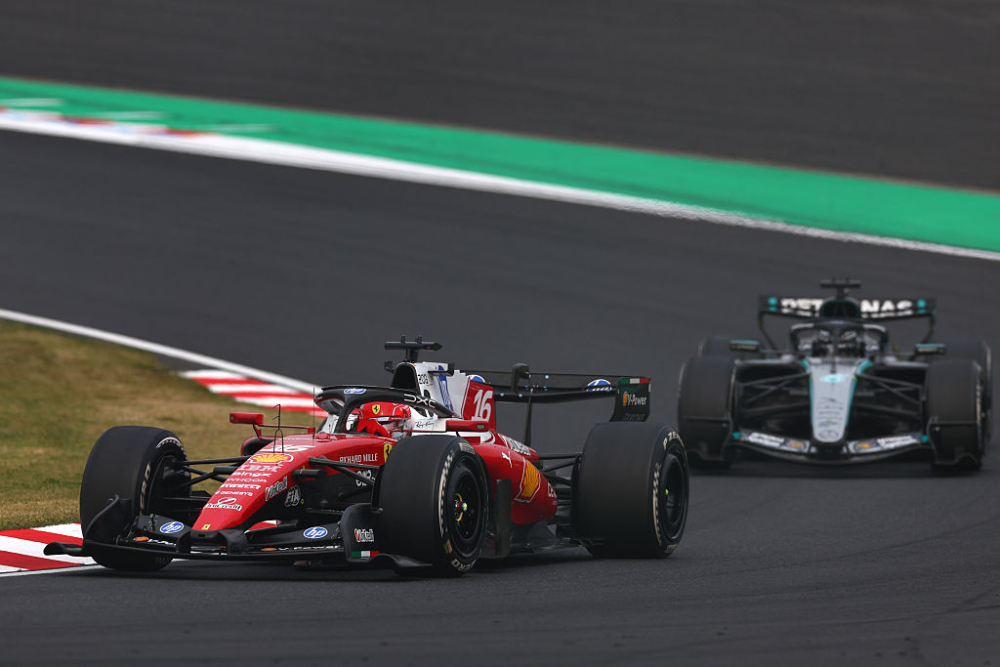
On-track battles in Suzuka didnt garner the same praise as previous rounds. Andy Hone/Getty Images
Even when that limit was reduced to eight megajoules – lessening the need for as much harvesting – it was not seen as a game-changer, but Lando Norris said of Suzuka: “It's never ruined, I don't think you can ever ruin this track”.
That didn’t stop fans getting frustrated by what they were seeing from a qualifying lap though, even if the raw numbers show there is potential in the regulations.
A lot of the anger appeared to be directed at the speed of the cars through 130R, and the super-clipping that was going on at that part of the circuit so that there would be more power to deploy out of the final chicane. Skepticism over the fact we never saw Kimi Antonelli’s pole lap onboard through that sector was understandable, but explained by a complete loss of data out of Spoon, including the camera footage (both live and recorded on the car) and his telemetry.
What wasn’t lost was the second fastest lap of qualifying from George Russell, and his telemetry tells an interesting story.
Max Verstappen’s pole position lap of 1m26.983s last year was revered as a stunning display, and thrilling to watch. On that occasion, as he pushed his car to the limits of grip, telemetry shows he turned in for 130R at 303kph (188mph), scrubbing off a little speed to take the apex at 299kph (186mph).
Russell, on a lap that was 0.3s slower than Antonelli’s pole time of 1m28.778s, turned in for 130R at 311kph (193mph) and apexed at the same speed Verstappen had 12 months earlier.
The big difference is that Verstappen’s engine note was constant, only dipping slightly through the tire scrub through the corner, in a turn that remains easily flat out even with the lower downforce of the new cars. When he stopped pinning the throttle to slow for the chicane that follows, he was still doing 300kph.
Russell, by contrast, was still losing speed from a peak of 329kph (204mph) on the preceding straight, and continued to do so to eventually drop to 276kph (171mph) by the time he hit the brakes for the chicane. Despite driving a car with far less downforce, and taking 130R at the same speed, the additional senses of deceleration versus maintaining top speed, and the engine note that goes alongside that, adds up to a thoroughly underwhelming experience.
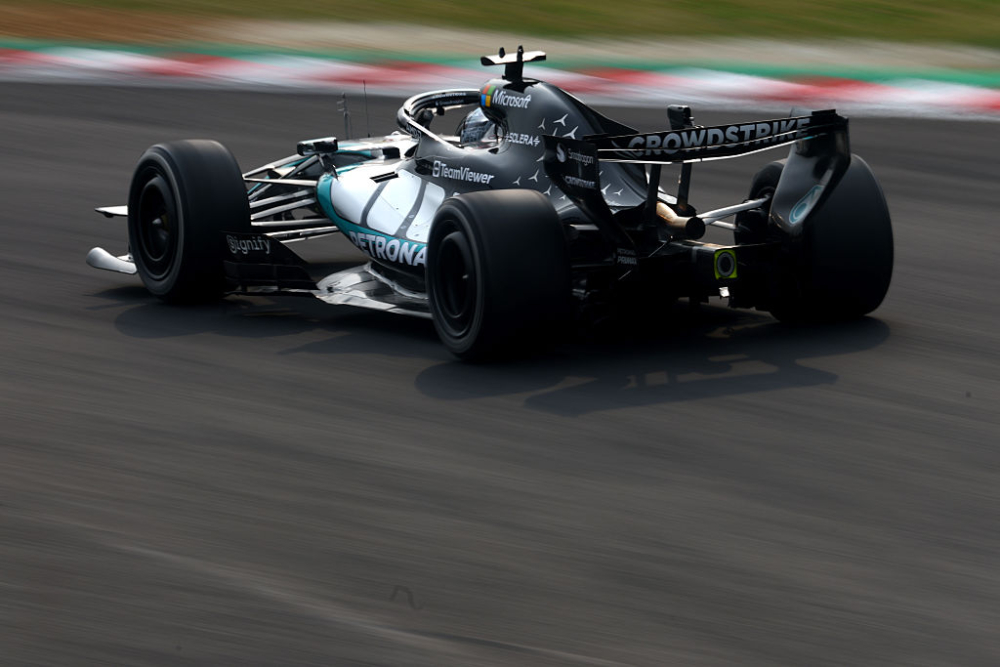
Where they were once flat-out, drivers are now losing speed. Clive Mason/Getty Images
For the drivers behind the wheel, it feels that way, too. The sensations are different, and some (not all) of the toughest corners have been diluted. Despite knowing that qualifying might not be as spectacular as in the past, and that the race could be better as a trade-off – which it was, when you compare this year’s offering to the processional race that followed Verstappen’s performance in 2025 – drivers could not hide their frustrations.
Another factor stems from their lack of control over what the power unit’s energy recovery system is doing at certain points around the lap. Charles Leclerc was particularly colorful over team radio after qualifying, because he felt that when he pushed harder and took more risks on his final Q3 lap, his reward was usually a slower lap time because the system in the background is trying to compensate for the difference in driving.
Putting more in the drivers’ hands could help alleviate some of their complaints, but if the technology even permits such a change mid-season, it would make an already extremely complex job behind the wheel even harder. And as Bearman’s crash showed – the Haas driver used Boost mode to try and overtake Franco Colapinto in an area where the Alpine was harvesting, creating a massive speed differential – there are still challenges even when the driver takes more control.
While the FIA has reiterated that a series of meetings were always planned for April to analyze the first three races and adjust certain parameters if required, any changes are likely to be trying to optimize what already exists.
Further down the line, it needs to be projected how quickly power unit manufacturers can develop their technology so that drivers can maintain a steady acceleration curve and harvest everything that’s required – whatever level that’s set at – through the existing braking zones.
Suzuka proved that going just as quickly as in the past through certain corners doesn’t matter, if the rest of the stimulants don’t support the impact of that speed. It might be the ultimate measurement tool, but racing is about more than just the outright lap time, and over the coming weeks Formula 1 has to map out how it can improve upon the potential of the new cars based on what’s been seen so far, because the reaction to Japan suggests the clock is ticking.
Presented by:


Chris Medland
While studying Sports Journalism at the University of Central Lancashire, Chris managed to talk his way into working at the British Grand Prix in 2008 and was retained for three years before joining ESPN F1 as Assistant Editor. After three further years at ESPN, a spell as F1 Editor at Crash Media Group was followed by the major task of launching F1i.com’s English-language website and running it as Editor. Present at every race since the start of 2014, he has continued building his freelance portfolio, working with international titles. As well as writing for RACER, his broadcast work includes television appearances on F1 TV and as a presenter and reporter on North America's live radio coverage on SiriusXM.
Read Chris Medland's articles
Latest News
Comments
Comments are disabled until you accept Social Networking Cookies. Update cookie preferences
If the dialog doesn't appear, ad-blockers are often the cause; try disabling yours or see our Social Features Support.