Getty Images
Ford ticking off the milestones as Hypercar development process continues
Ford Racing’s Hypercar ramp-up is continuing with the news that the Blue Oval’s first LMDh engine and hybrid system are currently undergoing dyno testing. It’s a key step towards the team’s FIA WEC top-class race debut in 2027.
Dan Sayers, the program manager, outlined the brand’s plans for the remainder of the year and into Q1 of 2027, including an extensive track-test phase ahead of the unnamed prototype’s homologation.
"It's a pretty busy time at the moment,” Sayers told reporters, including RACER. “I just got back from the States, where I was primarily there viewing the progress with the powertrain group. So the first engine has completed build, and was on the dyno, and it's been testing now for a period of time.
“It's going through the basic calibration tasks, and we are just now starting development of certain aspects for performance. So all is going well with the engine. It’s the first engine we've done in-house in terms of performance, competition, and race engine: a 5.4-litre, normally aspirated, Coyote V8.
“Then just down the road, on the same site, the hybrid system is also running on the full powertrain dyno. We're all aware it’s a spec system, but it’s important to get all of the software communications, the looms, and just make sure everything's working. Now the team are running through the hybrid system characterizations. So again, huge progress there.”
Ford hasn’t mated the two elements together yet, but that moment is scheduled for the next three to four weeks. Alongside that, Ford has been utilizing a simulator with its confirmed set of Hypercar drivers: Logan Sargeant, Mike Rockenfeller and Seb Priaulx.
“We’re completing roughly a couple of sessions each month,” he added. “Very difficult at the moment, because there's no data to correlate against. But we're running through all the systems that we can, we're proving out that the car set up with the models we have is actually behaving the way we'd expect, including the aerodynamics.”
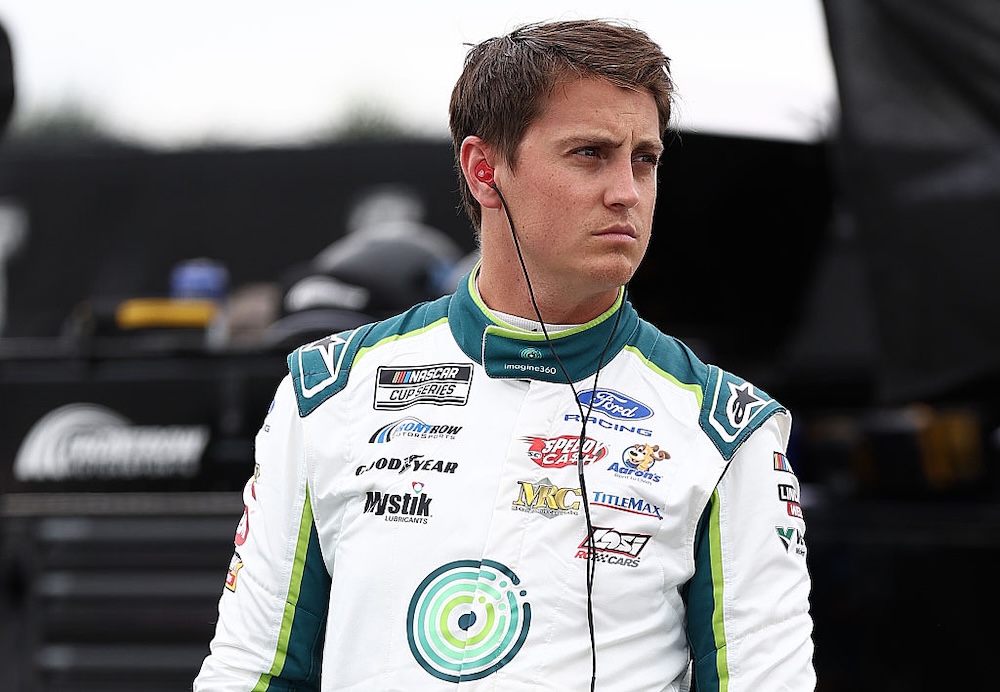
Sargeant, who is dovetailing his Ford development duties with a WEC campaign with Proton Competition in LMGT3, said his sim work, plus his input on the finer details of the cockpit and steering wheel layout for the car, have been productive.
“I've just done one sim session so far, and I feel like it went really well," he said. "It was good to see the team that was really on top of everything. We were able to run a very smooth program.
“It's still a bit of an unknown, I guess you can say. But what is good and what is important is that we're able to start implementing all the controls and the systems that we're going to have in the car, both for the engineers and for the drivers. So we're able to tick through those things, make sure that we're working, and make adjustments to those things.
“It kind of reminds me a little bit of my F1 days, being able to do all those things, and those things are really cool to be able to play with.”
Sayers stressed that the program is “exactly where I expected it to be” in terms of its timeline, with the next big milestone being the start of track testing. The first engine for that application will be built up soon, ahead of the first full car build in the next three to four months.
“The process has already started. As soon as the car build is done, we’ll roll it out in the south of France,” Sayers said. “We’ll spend a week on the rollout, debugging, that sort of thing, then we’ll start our first track test at the beginning of Q3. The whole plan is booked and confirmed, we’re pushing like hell to be ready, because if we miss one of those tests, it has a huge knock-on."
Ford is due to test across Europe initially, and aims to complete a 30-hour test before moving on to put the car through its paces in the USA, where another 30-hour run is planned in the new year. Sebring was teased as a venue on the schedule. Ford also plans to introduce a second car into the mix, alongside the build-up of its driver roster in the coming months.
Another key element of Ford’s preparations for 2027 comes in the European Le Mans Series, which gets underway next month in Barcelona. It is embedding two of its drivers (Priaulx and Rockenfeller) and a group of staff into Proton Competition’s LMP2 squad for the season, mirroring Genesis Magma Racing’s Trajectory effort with IDEC Sport last year.
The ELMS campaign will form part of the learning process for Ford’s drivers, plus its technical and operational partner, Venture Engineering, which will help run the Ford Hypercars and prep them between races at its UK-based facility.
“It’s an important program,” Sayers said. “Secondary to Hypercar, of course, but for drivers and the team to learn ACO rules, it’s important. The primary objective is just to improve everything for the WEC program, whether that be the engineering processes, the data processing, aero maps, everything we want to be ready.
“When we go track testing, we want to be ready to be plug and play; we don’t want to go to our first test developing workbooks and KPIs. It’s going to keep us race fit and refine all the processes so we’re good to go.”
In terms of staffing, a significant percentage of the Ford WEC team will be involved in ELMS.
“Probably about 80 per cent will be based in the team and ultimately go on to do the Hypercar,” Sayers said. “There are a few difficult times with the test program and race series into October, but we will try to spread the workload.
“The biggest risk is that we focus on ELMS and it detracts from the LMDh, which we can’t afford to do. The objective is not to win the championship, but we need to keep true to the fact that it’s all about preparing for LMDh.”

Stephen Kilbey
UK-based Stephen Kilbey is RACER.com's FIA World Endurance Championship correspondent, and is also Deputy Editor of Dailysportscar.com He has a first-class honours degree in Sports Journalism and is a previous winner of the UK Guild of Motoring Writers Sir William Lyons Award.
Read Stephen Kilbey's articles
Latest News

Comments
Comments are disabled until you accept Social Networking Cookies. Update cookie preferences
If the dialog doesn't appear, ad-blockers are often the cause; try disabling yours or see our Social Features Support.