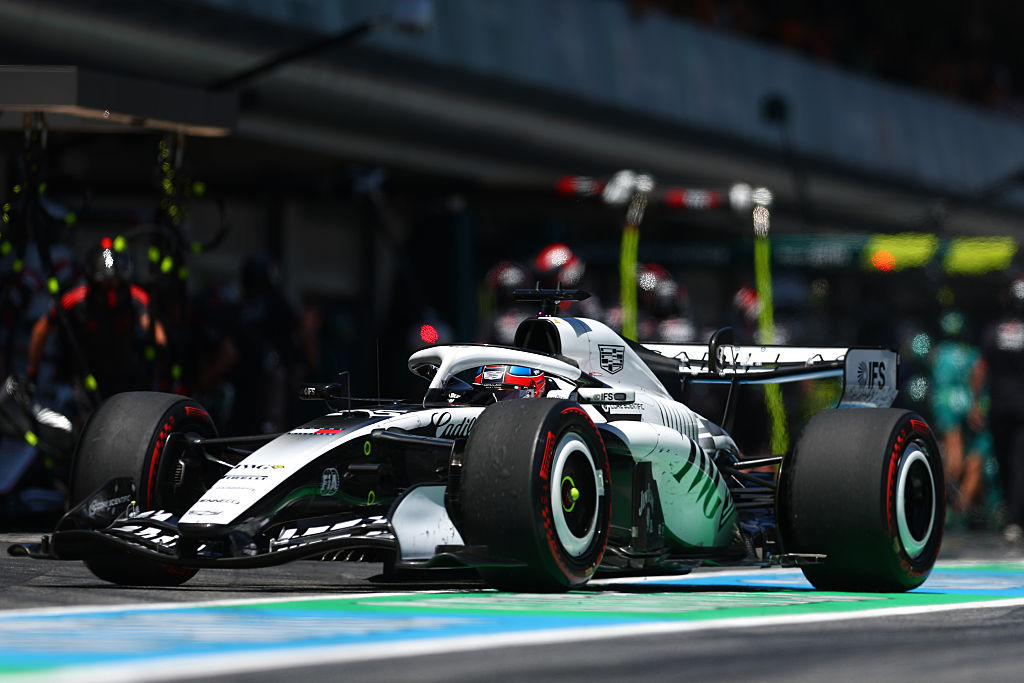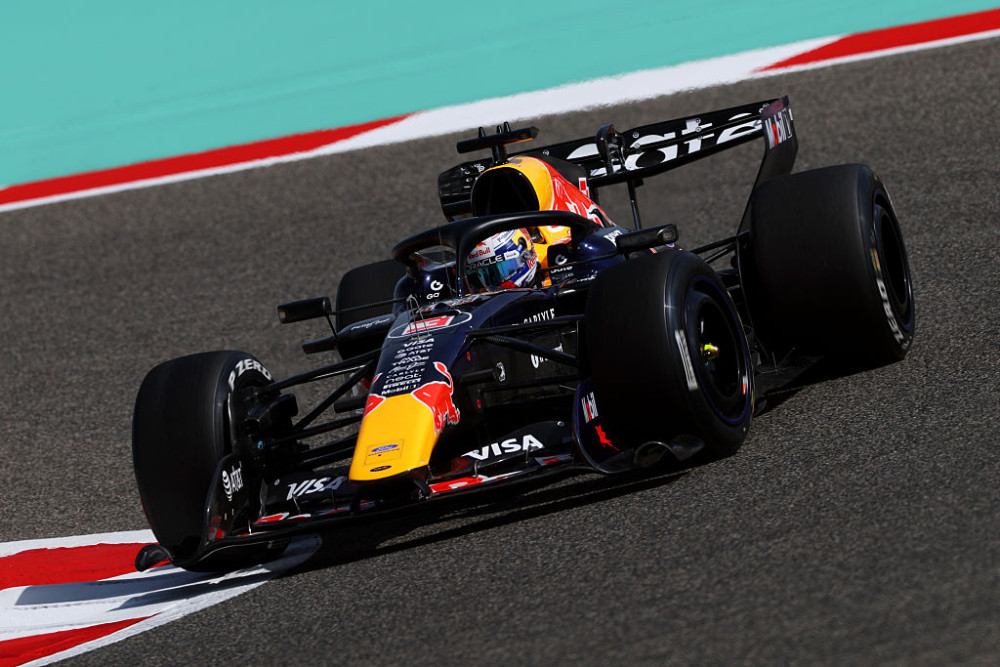
Zak Mauger/Getty Images
The balance of efficiency and entertainment with F1's 2026 rules
Max Verstappen’s denunciation of the new 2026 regulations as “not very Formula 1-like” and “anti-racing” during the first Bahrain test was exactly what the powers that be wanted to avoid. Lewis Hamilton may be the biggest name measured by global recognition and reach outside of motorsport, but Verstappen is generally regarded as today’s greatest driver so his criticisms carry enormous weight. He revels in the simple act of driving, something lying at the core of F1’s appeal, so his claim that “as a pure driver, I enjoy driving flat out, and at the moment you cannot drive like that” hit grand prix racing where it hurt by challenging its very heart.
Formula 1 as a whole has discouraged such comments, cognizant of the negative impact of criticisms when the quieter 1.6-liter V6 turbo power units were introduced back in 2014. It has adopted a back-foot strategy, with quiet pressure on stakeholders to avoid negativity combined with what appears to be a hope that it will be alright on the night when the racing starts. It doesn’t exactly scream confidence in a product that has been built around the notional 50/50 split of electrical and conventional V6 power, which it must be underlined has drawn in Audi and facilitated Honda’s return.
Add to that the talk of messy starts thanks to the length of time required to get the turbo speed in the right window for the optimal getaway, exacerbated by the misinterpreted practice start footage that circulated after the final day of testing, McLaren team principal Andrea Stella raising safety doubts and the fact that many drivers are known to share similar concerns to Verstappen even if they didn’t voice them and it’s clear F1 is in a precarious place.
In the short-term, this intrigue has a positive effect. As Alpine’s Pierre Gasly said, “I advise you to be sitting with your TV on in Australia, because it could be one that everybody remembers.” He was talking about the start concerns specifically, but his comment is equally apt for the whole weekend. However, F1 is lumbered with these regulations until the end of 2030, so any initial spike of attention risks turning to apathy if the on-track product doesn’t convince those watching that it is fundamentally still about a load of enormously talented people driving ultra-fast cars with superhuman abilities while kicking lumps out of each other.
The energy regime of these cars and their 350kW (469bhp) electric motors demands battery charging be optimized via multiple means of harvesting. The most commonly-discussed one historically is regeneration under braking, but that’s not going to get you anywhere near the 8.5 megajoules you are usually permitted to bank on a standard circuit. Bahrain is one of the higher-ranked tracks for harvesting-under-braking potential, but it also has a significant deployment demand thanks to its many straights. This means you still have to work hard to charge the battery or you will find yourself energy-starved and slow.
Other means are therefore required, including so-called super-clipping (where power-sapping harvesting while on full throttle slows the car on the straight), part-throttle recharging and lift-off recharging can and will all be utilized. Technologically, it's fascinating but far more stirring intellectually than emotionally. That’s what led to Fernando Alonso, who still hankers after the sprint-between-fuel-stops style driving that predominated early in his F1 career, to joke the Aston Martin team chef could drive the car in Bahrain’s Turn 12 right-hander.
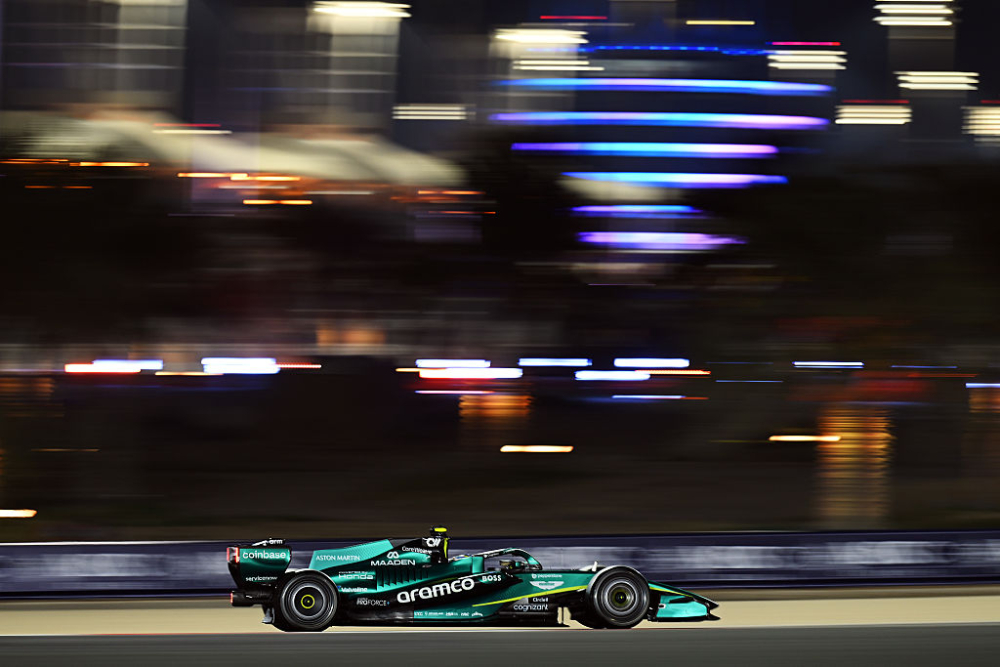
Even "the chef" can drive Bahrain's high-speed corners in F1's new cars according to Fernando Alonso. Sam Bagnall/Getty Images
“On the pure driving side, the late-90s and the early-2000s will be unbeatable in terms of driving adrenaline and pure skills from a driver point of view because you want it to drive fast in the corners and find the limits of the car,” said Alonso. “Here in Bahrain, historically Turn 12 is a very challenging corner, so you used to choose your downforce level to go Turn 12 just flat. You removed downforce until you are just flat with new tires and then in the race. So driver skill [was the] decisive factor, to go fast in laptime. Now, in Turn 12 we are like 50km/h slower because we don't want to waste energy there and we want to have it all on the straights. So to do Turn 12 instead of 260km/h at 200km/h, you [journalists] can drive the car, the chef can drive the car at that speed.”
Solving the equation to put together the fastest possible lap time has never been as simple as maximum attack in every single instant. There are always tradeoffs, and part of the driver’s art is to brake earlier than the laws of physics would allow you to while still making the corner to ensure the car behaves dynamically as you require to rotate as you require and maximize the exit. Effectively, driving is a constant balancing act, which is why chuck-it-in throttle-jockeys look spectacular but are ultimately slow. The need to look after the tires has also played a part, as even if you go all the way back to what’s recognized as the first grand prix in France back in 1906, Ferenc Szisz’s victory in a Renault was founded on the detachable Michelin rims that allowed, by the glacial standards of the time, quick wheel changes.
Efficiency has always been part of the lap time equation, with factoring that into driving while still being on the edge a skill in itself. However, F1 risks marginalizing the human contribution by making them first and foremost a servant of the energy regime. Maybe you can gain a tenth by acing a corner, but if you leave that on the table and that energy-gain gives you three tenths over the lap, then there is no longer a premium on being on the limit in the twisty bits where drivers traditionally earn their keep. None of this means they will be rolling through the turns like a mere mortal, and in some ways the aggressive downshifts and the need to drop to first gear regularly to keep the turbo speed up for slow-corner exists enhance the driving challenge, it becomes more a mental test than a visceral one.
The prospect of lift-and-coast in qualifying laps has been the subject of derision, and it’s certainly not something to shout about, but that’s less concerning than the fear that you may have to compromise cornering too often. After all, being flat out on the straights is easy enough and there is an art to lifting and coasting and judging the impact on braking, but if you are by design under the limit even when trying to minimize laptime that is going too far. That goes well beyond, say, taking it easier for tire management reasons on race stints.
However, it's not all bad. Set aside the power units and the cars themselves are a step in the right direction, and while the drivers may not like the reduction in cornering speeds resulting from the cut in downforce, this does mean the cars at times move around more and look more spectacular. The cars have a wheelbase that is 20 centimeters shorter, are 10cm more narrow and around 30kg lighter, all of which makes them more nimble. They look noticeably less clunky in person, particularly when it comes to responsiveness on turn-in, and are livelier on track. As George Russell says, these changes had a surprisingly big impact, even though he wants to reserve judgment on the wider package.
“I couldn't believe the difference of how much more agile the car feels being lighter, smaller, so that's very positive,” said Russell. “The engines are very complicated and, to be honest, probably causing more of a pain for all of the engineers than it is for the drivers. However, these two tracks, Barcelona and Bahrain, are arguably two of the easier circuits for the engines. So I don't want to say anything too early before we get to the likes of Melbourne or Jeddah, but it will be much more challenging for the engines and the energy [management] once we get there.”
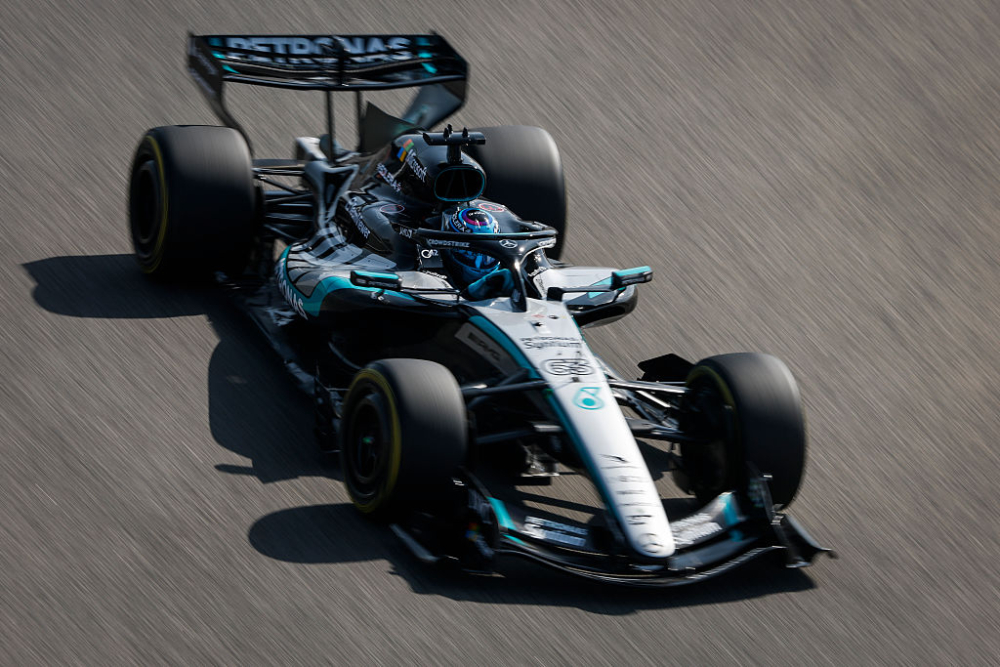
While engines have been the main talking point, George Russell points out that the cars are now more nimble. Sam Bloxham/Getty Images
There’s legitimate excitement about how the new rules impact the competitive order and what will be a fascinating technological and development battle to play out. While the MGU-K, the motor-generator that both deploys the extra 350kW and charges the battery, is likely to be very similar from manufacturer to manufacturer, the performance of the V6 engine itself and the efficiency, and cooling, of the battery will make a difference. So too will the advanced sustainable fuels that power them.
While there are certain hard limitations imposed by the combination of the laws of physics and the regulations that mean these power units must always battle the fact they are energy-starved no matter how much they improve, who knows how much better they will become over time? The importance of the technological war is always stressed when fans are surveyed, even if much of F1 falls far short in telling those stories as most involved would much rather just say how wonderful it is while being resistant to showcasing that in anything other than the most superficial way possible.
The fascination of motorsport lies in the fusion of human and machine. Formula 1 today is at the vanguard of that because unlike the majority of racing competitions, which have been forced by economic necessity to restrict technology, it is still about prototype racing cars that constantly develop. The question now is whether that balance has gone too far in one direction, with the energy demands of the 2026 cars overwhelming the ability of the driver to make the difference through what might be called more traditional skills – or, to use a crude shorthand, driving really fast.
It would be insulting to declare these cars easy to drive, but the question is whether they are difficult in the right way to best serve the core appeal of grand prix racing. Given it’s a sporting entity that has gone through a seemingly unending cycle of existential crises in the past 35 years, which is the inevitable consequence of shifting from the technology-limited cars of the first century or so of motorsport into ones increasingly framed by the regulations, we can expect plenty of soul searching and hand-wringing in the coming months. Attention will inevitably turn not just to the nature of F1’s rules for the next cycle, but also whether the situation it now faces means bringing forward the next car/engine overhaul perhaps to 2029 with a move to more old-school engines gathers momentum. In the shorter-term, while there are some potential tweaks that can be made, F1 is largely boxed-in by the decisions made several years ago.
What will decide that is the quality not just of the first race of the season, although there will be plenty desperate for Melbourne to produce a storied and dramatic race as that will buy a significant grace period, but also the 23 events that follow it. It’s all well and good talking up the cars and pressuring those involved to be on message, but the product will be laid bare for everyone to see and no amount of PR will change how those watching react to it. The perception that it is good racing - unpredictable, spectacular, exciting, full of wheel-to-wheel action - is what will count, and it remains to be seen what the average grand prix will produce in those terms.
Pleasing the drivers is not the measure for success, but it will be the fans, engaged and casual alike, that decides whether or not to buy into it. F1 faces a nervous wait for the verdict.

Edd Straw
Edd Straw is a Formula 1 journalist and broadcaster, and regular contributor to RACER magazine. He started his career in motorsport journalism at Autosport in 2002, reporting on a wide range of international motorsport before covering grand prix racing from 2008, as well as putting in stints as editor and editor-in-chief before moving on at the end of 2019. A familiar face both in the F1 paddock, and watching the cars trackside, his analytical approach has become his trademark, having had the privilege of watching all of the great grand prix drivers and teams of the 21st century in action - as well has having a keen interest in the history of motorsport. He was also once a keen amateur racing driver whose achievements are better measured in enjoyment than silverware.
Read Edd Straw's articles
Latest News
Comments
Comments are disabled until you accept Social Networking Cookies. Update cookie preferences
If the dialog doesn't appear, ad-blockers are often the cause; try disabling yours or see our Social Features Support.