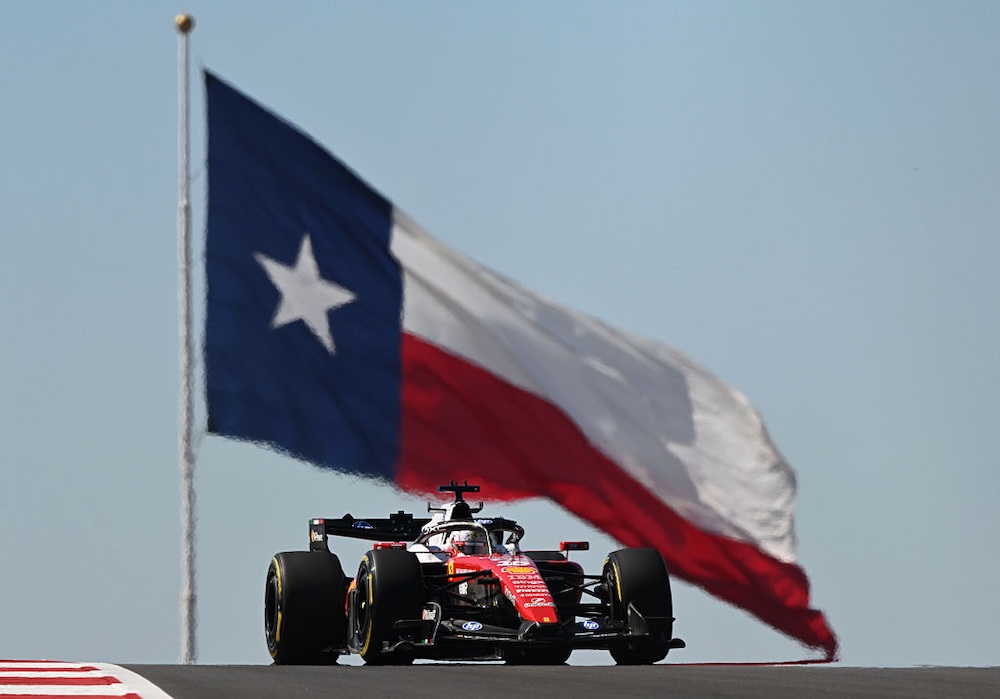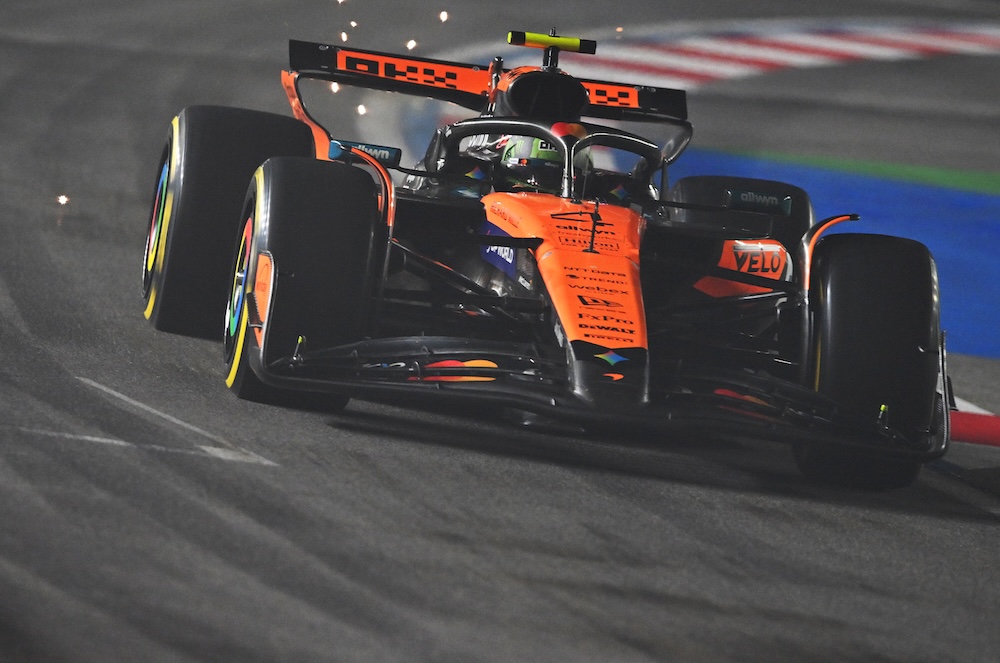
Rudy Carezzevoli/Getty Images
‘Excessive porpoising’ to blame for McLaren’s Las Vegas double-disqualification
McLaren team principal Andrea Stella has attributed the team's double disqualification in Las Vegas to unexpected porpoising that could not be addressed during the race, but expressed confidence there will be no repeat of the issue at the final two rounds of the F1 season.
Lando Norris and Oscar Piastri initially finished second and fourth in Las Vegas before a post-race inspection revealed that the skid blocks beneath both cars were under the required minimum 9mm thickness. As a result, race winner Max Verstappen goes into this weekend's Qatar Grand Prix tied for second with Piastri in the points, with Norris holding a 24 point advantage.
“What happened in Vegas was due to an anomaly in the behavior of the car, rather than it being the outcome of an excessive or unreasonable chase of performance," Stella said.
“The specific cause that led to the situation was the unexpected occurrence of extensive porpoising, inducing large vertical oscillations of the car. The level of porpoising was exacerbated by the conditions in which the car operated during the race, and it was not anticipated based on what we had seen in practice and based on the predictions of the car operating window in the race.
“Based on the data we had acquired in practice, we do not believe we took excessive risks in terms of ride height and we also added a safety margin for qualifying and the race, compared to practice, in terms of clearance to the ground. However, the safety margin was negated by the unexpected onset of the large vertical oscillations, which caused the car to touch the ground.
“The porpoising condition that the car developed in the race was also a difficult one to mitigate, as even a reduction in speed – an action that, in theory, should increase clearance to the ground – was only effective in some parts of the track but in others was actually counterproductive.
“From the early laps of the race, it was clear from the data that the level of unexpected porpoising would be a concern. We were able to monitor the situation better on Lando’s car using telemetry data, but it was made more difficult on Oscar’s car, after we lost one of the sensors we use to establish the level of grounding.
“We realized relatively soon that this level of porpoising was causing a high level of skid wear energy and this is the reason why both drivers started to take remedial actions in various parts of the circuit. Unfortunately, we also saw that, because of the car operating window and the circuit characteristics, most of these actions were not effective enough in reducing porpoising.
“The conditions we experienced last weekend and which led to the onset of porpoising and excess of grounding, compared to what was expected, are very specific to the operating window of the car in Vegas and the circuit characteristics. We have a well-established and consolidated way of setting up the car and we are confident that this will lead us to an optimal plan for the coming races, starting from the Lusail International Circuit.
“Nevertheless, we learn from every lesson and the one in Las Vegas has been able to provide some useful information about the operating window of the car and the porpoising regime.”
While McLaren goes into this weekend facing a greater threat from Verstappen than it would have had its Vegas results stood, Stella insisted the team will not change its approach to the drivers’ championship while both drivers are in mathematical contention.
“No, there is no reason to [change approach],” Stella said. “We have always said that as long as the math does not say otherwise, we would leave it up to the two drivers to fight for their chance at the final victory, and that is how it will be in Qatar.
“Let’s not forget that if someone had told us at the start of the season that we would find ourselves in this situation with two races to go, we would have signed up for it! Now we are going to fight for the double world championship with confidence and awareness of our strength.
“Our way of acting and thinking as a team, with a strong focus on performance, has brought us to where we are today, namely winning two consecutive constructors' titles and having two drivers at the top of the championship with two races to go.
“We, as a team, constantly learn from experience and we calibrate our approach all the time and we will certainly use any information gained through the situation experienced in Vegas.”
Chris Medland
While studying Sports Journalism at the University of Central Lancashire, Chris managed to talk his way into working at the British Grand Prix in 2008 and was retained for three years before joining ESPN F1 as Assistant Editor. After three further years at ESPN, a spell as F1 Editor at Crash Media Group was followed by the major task of launching F1i.com’s English-language website and running it as Editor. Present at every race since the start of 2014, he has continued building his freelance portfolio, working with international titles. As well as writing for RACER, his broadcast work includes television appearances on F1 TV and as a presenter and reporter on North America's live radio coverage on SiriusXM.
Read Chris Medland's articles
Latest News
Comments
Comments are disabled until you accept Social Networking Cookies. Update cookie preferences
If the dialog doesn't appear, ad-blockers are often the cause; try disabling yours or see our Social Features Support.