Ryan Pierse/Getty Images
The art of choosing when to race in the rain
The Belgian Grand Prix has been the scene of every kind of race, and every kind of racing emotion – wet thrillers, tense dry races, boring processions, dramatic failures, controversial penalties and tragic incidents.
When the rain started falling on Saturday night – set in for large spells of the next 18 hours – it felt like the classic venue could provide any one of the above once again.
Conditions were so bad that the Formula 3 race didn’t take place, but as the rain eased and the conditions improved, the F2 feature was able to start on time and ran cleanly until a spin and a stall at Raidillon – where there had been a number of moments but some excellent car control – for Sebastian Montoya ended it under safety car.
Shortly before the pit lane opened, the sun was out and the track dried significantly. Then some steady rain hit, and the initial formation lap behind the safety car was curtailed when the starting procedure was suspended.
Drivers reported poor visibility, but by halting proceedings it meant another heavy band of rain soaked the track, and the end result was a 90-minute delay between the initial start time and Lando Norris actually putting his foot down on a rolling start to get the race underway on a rapidly drying track.
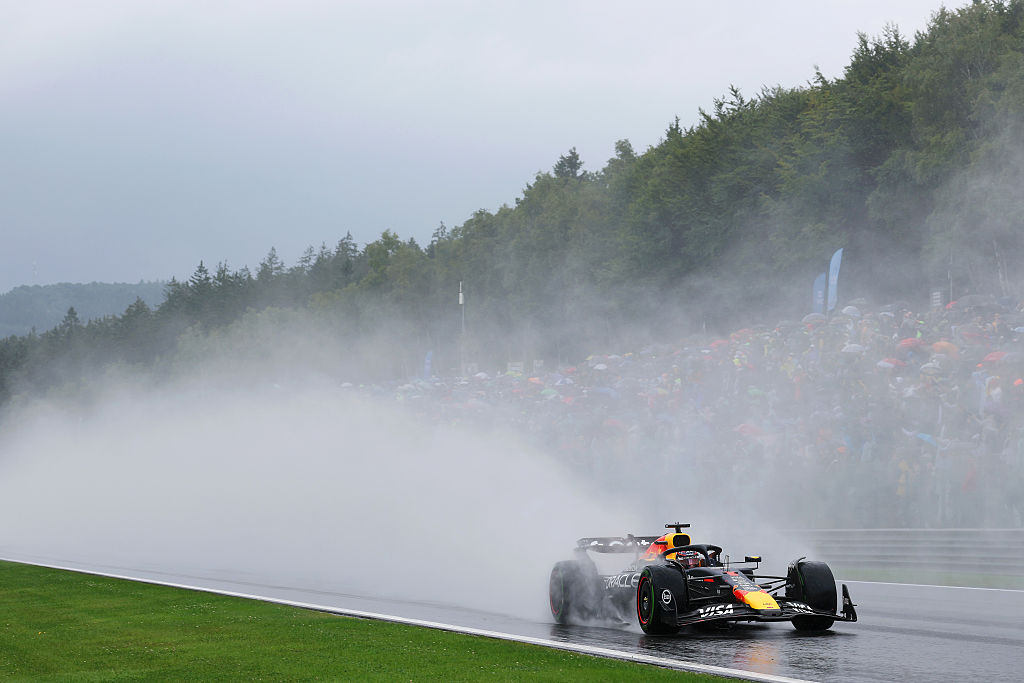
That restart came after four further laps behind the safety car, and the first two showed that there can be a good amount of spray even when the sun has been out and the track appears to be relatively dry to the naked eye. It's just the nature of current F1 cars using ground effect for the bulk of their performance and feature a rear wing designed to send dirty air upwards.
A number of fans watching at home – and no doubt many in the grandstands – were frustrated by the wait for action, and they were not alone.
“Three o’clock, straight away [is when the race should have started],” Max Verstappen said. “It was not even raining. And of course between Turns 1 and 5 there was quite a bit of water, but if you do two or three laps behind the safety car, then it would have been a lot more clear. The rest of the track was ... ready to go.
“It's a bit of a shame. Of course I knew that they would be a bit more cautious after Silverstone, but this also didn't make sense. It's better to say, ‘You know what, let's wait until it's completely dry and then we just start on slicks,' because this is not really wet weather racing for me.
“Between Turns 1 and 5 it was [poor visibility], but only for a few laps. The more you run, it will be much better, and if you can't see, you can always lift. At one point you will see.”
The problem race control has – there are always vested interests at play. Lando Norris suggested visibility wasn’t good on the initial formation lap, and later referenced the water on the pit straight to try and ensure a rolling start in the best possible conditions for himself as the leader.
Understandable, as is Verstappen’s admission that he wanted to go racing earlier because he had a wet weather setup.
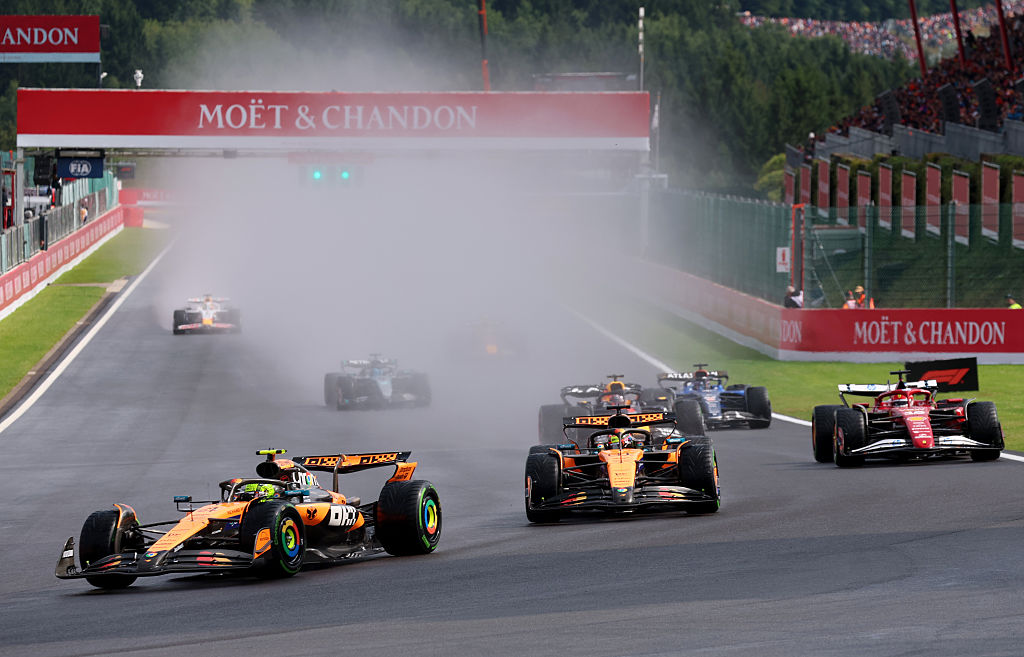
Sure, drivers could race regardless of the rain and choose to drive within the limits, but that doesn't change the one thing no one has control over currently – spray. Mark Thompson/Getty Images
“I just find it is a bit of a shame for everyone," Verstappen said. "You will never see these classic kind of wet races anymore then, which I think still can happen. I think also the rain that fell afterwards was still manageable, if we would have kept lapping anyway.
“You make all the decisions based on wet racing, so then also it just ruins your whole race a bit. But, I mean, realistically P3 would have been the highest possible. We were very close to that, but at the same time it also still highlighted our weaknesses with the car. That's something that is not so easy to fix at the moment.”
Those vested interests cloud whether the right decisions are made at the right times. At a track where F2 driver Anthoine Hubert was killed in a T-bone collision at the top of Raidillon – partly because drivers are unsighted over the crest – and Dilano Van ’t Hoff died in similar circumstances in a wet FRECA race two years ago, recent enough events have shown what the potential downsides are of increasing the risk. Essentially, it’s what each driver deems to be too much risk at any given time, and although Verstappen’s comments were not put to him directly, George Russell had a different view of opting against racing in lower visibility when there was a clear chance of getting a full race in with a longer delay.
“I mean, as a racer, you always want to get going,” Russell said. “You love driving in the rain. But the fact is, when you're doing over 200 miles an hour out of Eau Rouge, you literally cannot see anything, you may as well have a blindfold on.
“[That] isn't racing; it's just stupidity. I think considering it was clearly going to be dry from 4 p.m. onwards, I think they made the right call.”
Charles Leclerc was a little more on the fence, but made the powerful argument that it’s better to be worrying about having started a little bit too late than a little bit too soon.
“I think it's always fine-tuning,” Leclerc said. “On a track like this with what happened historically, I think you cannot forget about it. For that reason, I'd rather be safe than too early. It's a constant discussion, and we'll probably feed the people that made this decision back that maybe it was a little bit on the late side, but I wouldn't have changed anything.”
Oscar Piastri also made the point that the drivers asked the FIA to play it safer at Spa-Francorchamps in such conditions. Whether you agree with Verstappen and felt more risk was worth taking, or those that feel it’s best to err on the more cautious side, the root cause is what needs addressing.
Everyone wants to see racing in the rain. It’s what separates the very best drivers and provides the opportunity for special results. Just look at Nico Hulkenberg’s result one race ago at Silverstone.
It wasn’t grip levels that led to a chunk of the delay at Spa, it was visibility. It was the amount of spray created by F1 cars, and the direction of that spray. If it could be reduced, then racing could take place in a wider range of conditions.
2026 should see a reduction in the downforce levels of the new generation of cars, but as those are developed we’re likely to end up in a similar situation. The FIA has done research into reducing spray, and needs to continue to do so, because one of racing’s greatest arts is missed out on when the visibility prevents drivers from showing their skills.
Chris Medland
While studying Sports Journalism at the University of Central Lancashire, Chris managed to talk his way into working at the British Grand Prix in 2008 and was retained for three years before joining ESPN F1 as Assistant Editor. After three further years at ESPN, a spell as F1 Editor at Crash Media Group was followed by the major task of launching F1i.com’s English-language website and running it as Editor. Present at every race since the start of 2014, he has continued building his freelance portfolio, working with international titles. As well as writing for RACER, his broadcast work includes television appearances on F1 TV and as a presenter and reporter on North America's live radio coverage on SiriusXM.
Read Chris Medland's articles
Latest News
Comments
Comments are disabled until you accept Social Networking Cookies. Update cookie preferences
If the dialog doesn't appear, ad-blockers are often the cause; try disabling yours or see our Social Features Support.