Paul Hurley/IMS Photo
Ferrucci penalized after Detroit; keeps second place (UPDATED)
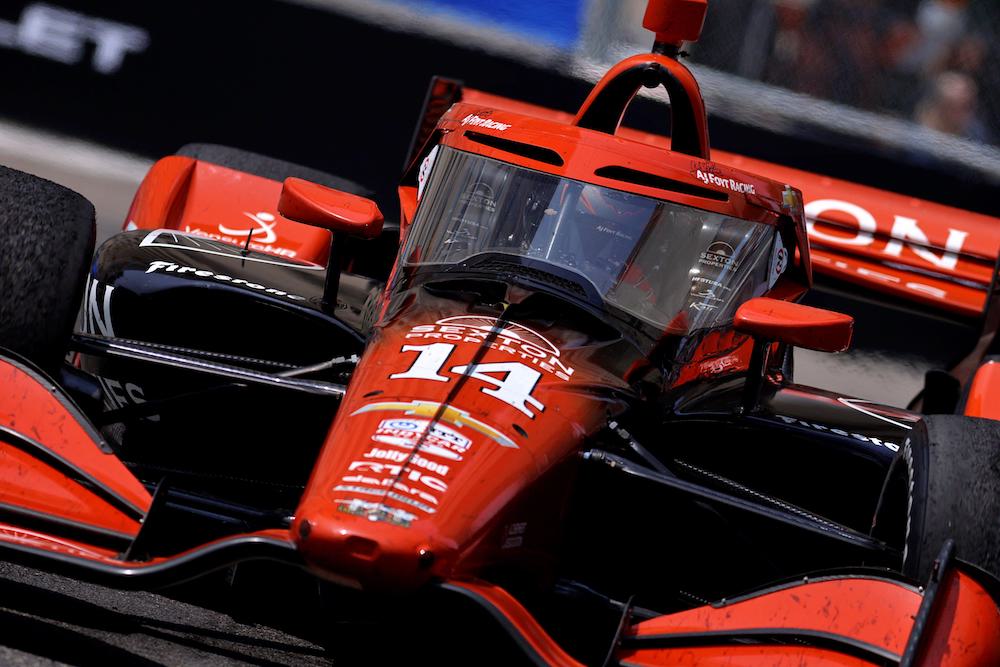
For the second race in a row, illegalities have been found via the IndyCar Series’ technical inspection process. The latest to run afoul of post-race tech is AJ Foyt Racing with the No. 14 Chevy driven to a career-best second-place in Detroit on Sunday by Santino Ferrucci.
Unlike the post-race penalties at the Indianapolis 500 where Kyle Kirkwood, Marcus Ericsson, and Callum Ilott were moved to the bottom of the results, Ferrucci will retain his position.
“The No. 14 will be allowed to keep the second-place finish; however, the entry has been fined $25,000 and will forfeit 25 championship driver and entrant points,” the series wrote. “The bonus point for leading a lap also is not awarded. The No. 14 also is ineligible for engine points and prize money associated with the race.
“During post-race inspection of car No. 14, IndyCar discovered the driver ballast needed to bring the combined weight of the driver and driver ballast to 185 pounds was underweight and not within the driver ballast weight tolerance of 0.00 to + 1.00 pounds.
“However, also during inspection, the series found the weight of car No. 14 itself was 10 pounds over the minimum weight for road and street circuits of 1,785 pounds and competed over the minimum weight requirement on-track.
“A.J. Foyt Enterprises was in violation of: Rule 14.4.2. Driver Equivalency Weight. Rule 14.4.2.2. Driver Equivalency Weight must bring the combined weight of the Driver and Driver ballast to 185 pounds. Rule 14.4.2.5. The Driver ballast weight tolerance is 0.00 to + 1.00 pounds. The Driver Equivalency Weight must be installed and secured in the designed location forward of the seatback. This location may only be used for Driver ballast.
“This rule is in place to equalize the weight of varying-sized drivers so there is no advantage based on the weight of the driver. Post-race weight determination, as implemented by INDYCAR, is a common practice after every event and in nearly all forms of motorsports to ensure an equal playing field.”
Known colloquially as the 'Danica Patrick Rule', IndyCar changed its minimum weight regulations after the diminutive driver arrived in the series in the mid-2000s when no policies were in place to balance the differing weights between drivers. It allowed teams with lighter drivers to compete with cars than ran at a lower weight, which provided a performance advantage that penalized heavier drivers.
In response, the driver weight equivalency rules were written to mandate that an entry with a smaller, lighter driver would be required to add equivalency ballast, which took the combined vehicle and driver weight into account, and for heavier drivers, little to no ballast might be required. IndyCar requires drivers, in full driving gear, to present themselves within 15 minutes of the end of each event's first practice session to be weighed; a driver could lose or gain weight between races, and the process delivers each entry the exact driver ballast weight figure to install.
In the case of Ferrucci, who rates among the smallest and lightest IndyCar drivers, the violation is centered on an insufficient amount of driver ballast being affixed in the required location, and not the running of the car below the minimum permissible weight. As presented by IndyCar, which noted the No. 14 car was 10 pounds over the minimum weight, the violation appears to be of a procedural nature.
The loss of second-place points demotes Ferrucci from 10th in the Drivers’ championship to 14th.
"We acknowledge and accept the penalty issued for being 1.8 lbs. under the required driver ballast weight," read a statement issued by the team.
"This was an unintentional oversight, and we take full responsibility for the mistake. Our car was, in fact, 10 lbs. over the minimum total weight, and the discrepancy in ballast was not intended to gain a competitive advantage.
"However, we recognize that compliance with every rule is critical to ensuring fairness in this sport, no matter how minor the deviation may seem. We are working closely with our technical team to strengthen our processes and ensure this does not happen again.
"We’re grateful for the passion and integrity of IndyCar, and while this situation is disappointing, we respect the rules that keep our competition honest and safe. Most importantly, we remain committed to racing the right way — for our fans, our partners, and our sport."
Presented by:

Marshall Pruett
The 2026 season marks Marshall Pruett's 40th year working in the sport. In his role today for RACER, Pruett covers open-wheel and sports car racing as a writer, reporter, photographer, and filmmaker. In his previous career, he served as a mechanic, engineer, and team manager in a variety of series, including IndyCar, IMSA, and World Challenge.
Read Marshall Pruett's articles
Latest News

Comments
Comments are disabled until you accept Social Networking Cookies. Update cookie preferences
If the dialog doesn't appear, ad-blockers are often the cause; try disabling yours or see our Social Features Support.