David Phipps/Getty Images
When Lotus blossomed at Indy
One day, several months after his Indy 500 win in 2018, Will Power tried to explain just how much the event means for its participants, and how it plays on the mind between races.
“It’s easy to look at the list of Indy winners and say, ‘Oh, that’s the year that guy missed out on the win, but a couple of years later he got his revenge.’ When you’re looking at it as history, you’ve got that perspective, right? But think how long those years feel for the guy who lived it?! If you drive out of the Speedway without the win, the frustration of knowing that you’ve gotta wait a year for your next chance is just terrible. And that’s for full-time drivers; we’ve got our next race in a few days. Think how a bad result at Indy feels for guys who only do the 500…”
When you think of that, it’s hard not to consider the mindset of Jimmy Clark, Colin Chapman and Team Lotus who so nearly won Indy at their first attempt, but didn’t nail it until their third. To Power’s last point, it’s rare for Indy-only entries to be of such quality that those involved in the one-off arrive at the Speedway expecting to contend for victory. But one such was Lotus. Call it arrogance, call it confidence, call it knowing all the right ingredients are there: the principal players were convinced they had a shot at slugging the opposition and glugging the milk.
And their confidence was not unfounded. In Europe, in Formula 1, Lotus’s stature was growing without check in the early 1960s. Cooper had beaten everyone to the punch with the rear-engined revolution and dominated the last years of the 2.5-liter era, Ferrari had thrashed almost all-comers in the first 1.5-liter season with its delectable 156 “Sharknose”. But that “almost” serves to highlight the exception: Rob Walker was a privateer team owner for whom Stirling Moss had scored two wins in 1960 in a 2.5-liter Lotus 18, and then two more in its 1.5-liter iteration of ’61. Had its Coventry Climax four-cylinder not been giving away 30-40hp to Ferrari’s V6, how much more might Moss have achieved? That’s how fundamentally right the Lotus was.
Dan Gurney, 30, yet possessing the sagacity of a 50-year-old, looked on from the cockpit of his Porsche F1 car and saw in Lotus a racecar manufacturer on the rise, headed by a man of imagination, inspiration and technical understanding. Chapman, Gurney felt, could devise a car to run rings around the front-engined roadsters at Indy. And proof of concept came from Cooper and Jack Brabham in the 1961 Indy 500. The rear-engined T54 qualified 17th, just 2.3mph slower than pole, despite its 168 cu.in. [2.75-liter] Climax four-cylinder producing a mere 270hp compared to the 430 emitted by the best of the roadsters’ Offenhausers.
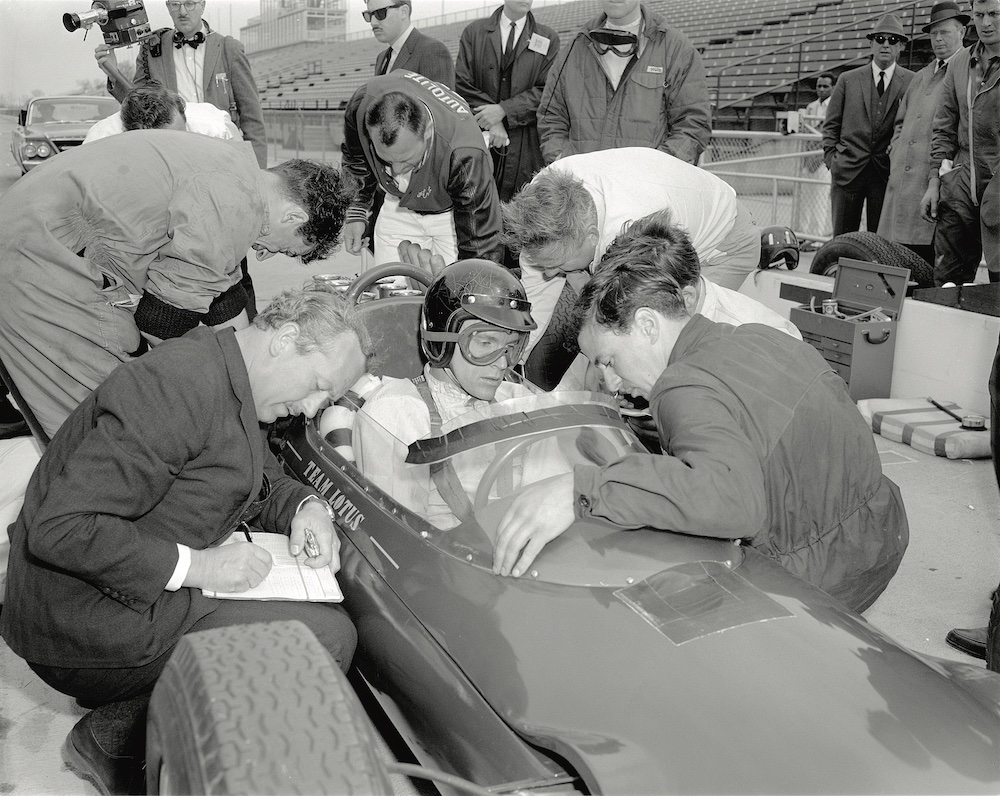
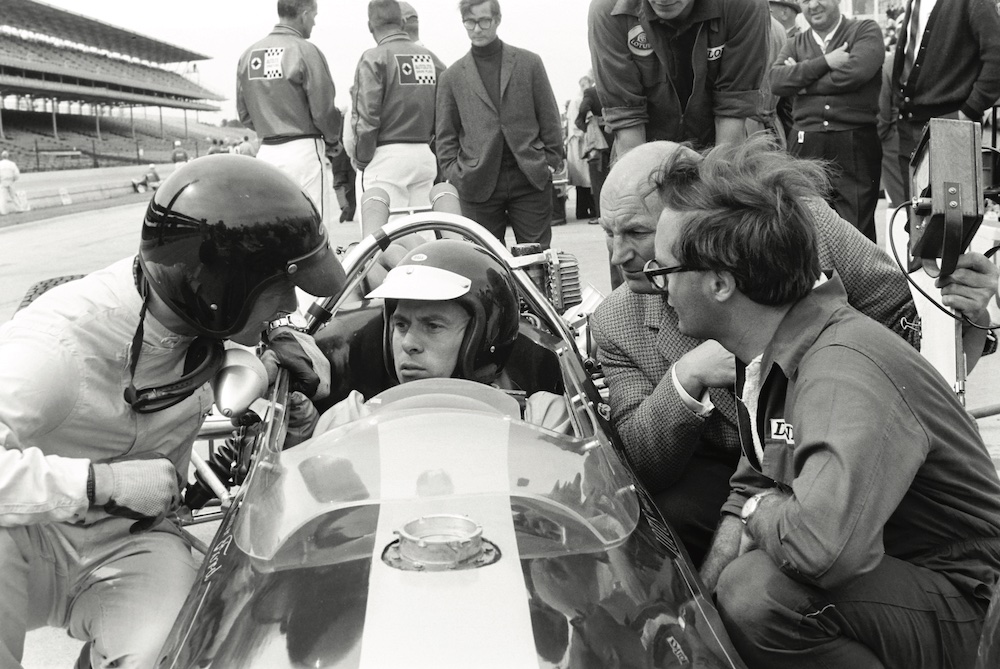
Colin Chapman and Jim Clark huddle in for some feedback from Dan Gurney in 1963. Gurney was the first to recognize Lotus's potential as an Indy 500 contender. IMS Photo
Gurney convinced himself still further by testing Mickey Thompson’s rear-engined machine, then enticed Chapman to Indy in ’62, where Dan piloted the John Crosthwaite-designed Buick-powered Thompson car to eighth on the grid. He knew that a Lotus penned by the proprietor and Len Terry would be better. The 25 was the fastest car in F1 that year, even if its frailty meant Clark was beaten to the World Championship by Graham Hill in the beefier BRM.
But however well a Lotus handled Indy’s turns, however much momentum it carried through the short chutes, to survive 200 laps it would need an engine that wasn’t straining to draft the roadsters on the 0.625-mile straights. Gurney engineered a meeting with Ford.
Chapman, his interest piqued by a new engineering challenge and the six-figure riches on offer at IMS, sent Clark and a Lotus 25 to the Speedway on a fact-finding mission following the U.S. GP at Watkins Glen. Armed now with a little experience as well as talent, Chapman and Len Terry set to work on a Lotus Indy car.
Compared with a 25, the Lotus 29 was 10 inches longer, had a five-inch longer wheelbase to accommodate a 255 cu.in. [4.2-liter] Ford V8 which pushed out 376hp, and was 136lbs heavier. Its offset suspension gave it a 56-inch track at each end, compared with the 52 front / 53 rear of the F1 car.
And so came May 1963. The Lotus 29s of Clark and Gurney (who suffered an accident in practice) qualified seventh and 17th at Indy and would start fifth and 12th respectively. And respectably. But these li’l “funny cars” didn’t seem so fast that the Not-In-My-Brickyard brigade might lose faith in the beautiful traditional roadsters. It would be race day when they started sweating it.
When early leader Parnelli Jones and the pursuing Roger McCluskey made their first pitstops, Clark went into the lead, with Gurney making it a Lotus 1-2. And they kept going and going, such was their cars’ fuel efficiency, until laps 95 and 92 respectively: barring unforeseen circumstances, they wouldn’t need to stop again, whereas the roadsters would need two more trips down pitlane…
Blushes were spared by the length of the Lotus pitstops – the rookie crews took twice as long as those practiced in the art – so that Clark emerged far behind Jones in J.C. Agajanian’s Watson-Offy, “Ol’ Calhoun.” Nor could Jimmy close the 48-second gap at the rate he needed. Who knows how much of the track’s slickness in the second half of the race was specifically down to Jones’ oil leak? No roadster ever won praise for fluid containment. So when chief steward Harlan Fengler turned a deaf ear to Chapman’s protest of the leader, Clark’s hopes of victory died. He skittered home as runner-up, 33 seconds behind Jones.
Yet it wouldn’t be long before the Lotus 29 became a winner, and convinced most of United States Auto Club’s resident aces that for Indy cars, moving the engine rearward was the way forward. At the Milwaukee Mile, Clark and Gurney qualified 1-2 and finished 1-3, split by the ever-remarkable A.J. Foyt., while at Trenton, Clark and Gurney again started 1-2 and dominated until their cars expired.
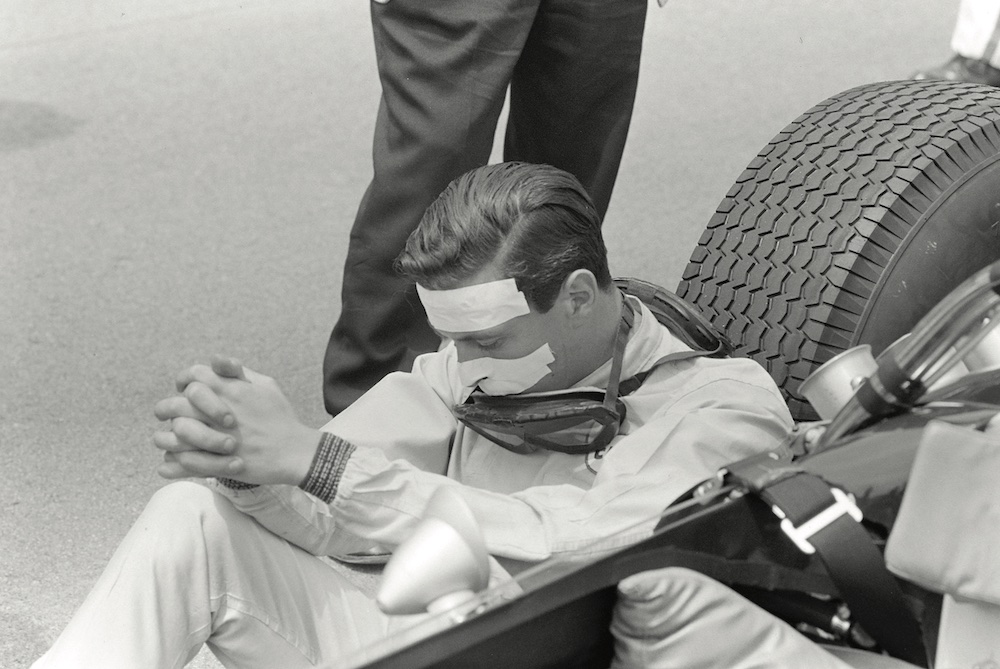
Clark takes a quiet moment ahead of the 1964 Indy 500. His new Lotus 34 was a big upgrade on its predecessor, but the Dunlop tire he's using as a backrest would contribute to his undoing in the race. David Phipps/Getty Images
Such was the advantage that Lotus had over its opposition in terms of chassis, Chapman was confident the 29’s successor could be merely an evolution for the team to resume up front at Indy come May ’64. While many teams and USAC’s traditional car builders had now seen the light and trying to emulate Lotus, their early rear-engined efforts were not yet honed to the same degree.
But while the new Lotus 34 was indeed an evolution rather than revolution, it contained a substantial engine upgrade, the Ford V8 becoming a four-cam unit with fuel-injection, bumping power up past the 400hp mark. Other changes included revised rear suspension and the replacement of the Colotti gearbox with a ZF.
But most significant – fateful, in fact – was a switch from Firestone tires to Dunlops. That made Clark and Gurney absolute outliers. Clark took pole with a record-setting four-lap average of 158.828mph – 7mph faster than Jones’s pole from ’63 – but the relative fragility of the soft Dunlops would take a toll.
Overall, therefore, Clark’s fellow front-row starters had the better tools. Bobby Marshman would start from the middle of the front-row in a year-old Lotus 29 but equipped with the new quad-cam Ford – and Firestones. The brilliant Rodger Ward, driving the brilliant A.J. Watson’s first rear-engined car from the outside of the front row, could maybe outlast the more fragile British cars and outpace the best of the roadsters, driven by Jones and Foyt, who shared the second row with Gurney.
Following the catastrophic lap two crash that claimed the lives of Davy MacDonald and Eddie Sachs, Clark led the restarted race for only a handful of laps before Marshman snatched the lead. Driving like a man possessed, ignoring the cool-it pitboard messages from his crew chief, Marshman stretched his lead to almost 90 seconds. Then he dropped to the apron while trying to put Foyt a lap down, the 29 bottomed out and tore off an oil plug to its gearbox. Oil gone, the transmission seized, and Marshman was out.
That left Clark in the lead… but he was the next retirement; his overheating Dunlops were vibrating and wobbling so much that just before quarter-distance, the 34’s left-rear suspension collapsed. As a precautionary measure, a chastened Chapman ordered Gurney into retirement after the Californian’s mid-race pitstop revealed his tires were deteriorating in a similar manner to Clark’s.
And now, with Jones also out – he dramatically bailed from his burning roadster while exiting the pits following a refueling faux pas – Foyt took charge of the second, third and fourth quarters of the race to score his second Indy 500 triumph, a full 84 seconds ahead of Ward’s “funny car.” What’s more, he had done the whole race on a single set of tires.
But Foyt was no fool: although roadsters had outnumbered rear-engined cars on the grid 21-12, he knew it was the last roll of the dice for the large, elegant, front-engined machines at the Speedway. The writing was on the wall elsewhere, too. Later in the year, he watched as Jones drove a Team Lotus 34 to wins at Milwaukee and Trenton.
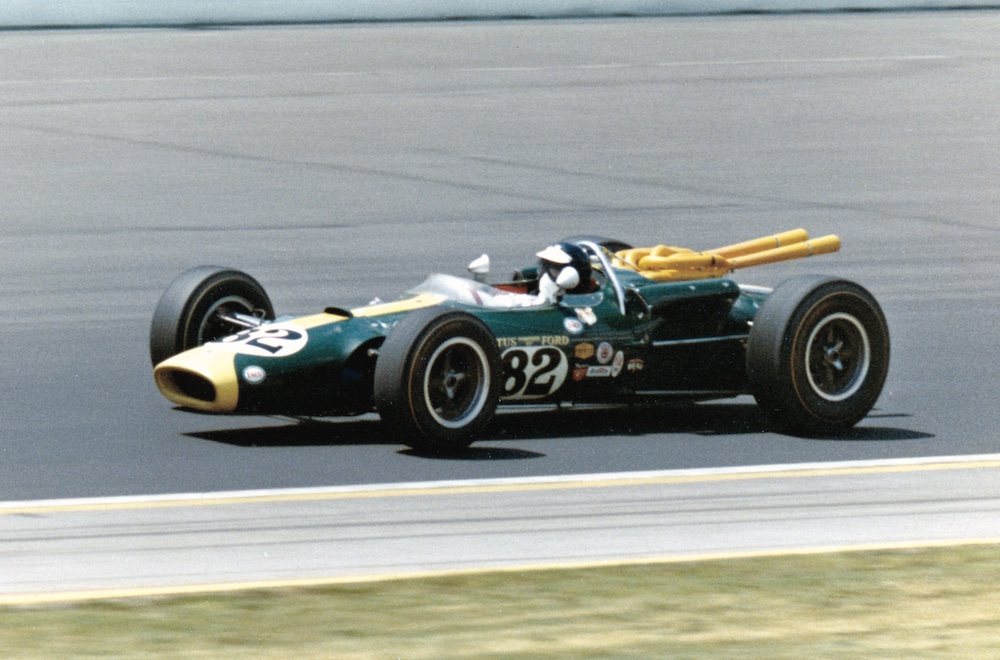
1965's Lotus 38 was the product of all the lessons Lotus had learned during its previous trips to the Speedway – and this time, Clark's rivals had no answer. IMS Photo
Chapman had learned a hard lesson at Indy in ’64, so there was no question over reverting to Firestone rubber for ’65. He and Terry were also aware they had spurred all the great teams into the rear-engine switch – just six roadsters would start the 500 in ’65 – and some were actual Lotuses or clones of Brabhams. They therefore had no choice but to move the game on by coming up with a whole new challenger.
The Lotus 38 was as fast as it was sleek. It had the same wheelbase as its predecessors, but was six inches longer, eight inches wider, and sat very asymmetrically on suspension arms that afforded it a four-inch wider track. Underneath the rattlesnake orgy of exhaust pipes again sat a Ford quad-cam V8 but now drinking methanol (a USAC stipulation following the horror of ’64) and producing 500hp.
Clark’s qualifying speed was an impressive 160.729mph, but he was beaten to pole by Foyt in a year-old Lotus 34, whose four-lap average was 161.233. Gurney, in his own All American Racers 38, gave Lotus a front-row lockout. On the second row were rookie Mario Andretti in a Brabham-based Brawner, Jones in Agajanian’s Lotus 34 and Billy Foster in one of Rolla Vollstedt’s creations.
None of this mattered much to Clark. He took the lead at the start, conceded it to Foyt on lap two, retrieved it on lap three, and thereafter only dropped off the top of the scoring pylon during his first pitstop. Delivered by the legendary Wood Brothers of NASCAR fame, the stop was impressively slick, and was one of the keys to Clark’s domination of the race. He led 190 of the 200 laps, beat Jones into second by nearly two minutes and set a record average speed of 150.633mph. Oh, and his efforts produced winnings of $166,621.
Skipping F1’s Monaco GP had cost Clark and Lotus nothing in terms of money and little in terms of ultimate accolades. They still won six of the 10 F1 races that year to clinch Jimmy his second World Championship… which earned him the equivalent of around $37,000.
That surely was part of the draw for Clark and Lotus to return to IMS for a fourth time in ’66. Again pipped to pole, this time by that Andretti kid who’d finished third and as Rookie of the Year 12 months earlier, Clark was unhappy with his car’s handling throughout the month. In the race he spun twice but kept it off the walls and eventually led 66 laps. Officially.
Or maybe 76… including the last one. To this day, there are Indy veterans who insist that USAC’s official scoring was erroneous, and that Lloyd Ruby’s retirement and Jackie Stewart’s late-race demise had left the lead in the hands of Clark, not Graham Hill, who was declared the winner. As in ’63, Clark took the disappointment like the champ he was.
Lotus’s fall from grace was rapid thereafter. The 38 was thoroughly outpaced by ’67 and Clark’s car burned a piston on race day just a few laps after new teammate Hill suffered the same fate in his mediocre Lotus 42. Joe Leonard’s turbine and all-wheel-drive 56 flamed out a few laps from home while leading in 1968, completing a tragic six weeks for Lotus in which it had lost its talisman Clark and his replacement for Indy, Mike Spence. And then in ’69, the AWD but conventionally powered 64 proved a failure that put Andretti in the wall during practice. Chapman grumpily withdrew the cars, and Team Lotus was gone from the Speedway. Forever.
Yet the marque had left its mark, and the revolutionaries’ mission was complete long before they, in turn, were overthrown.
Presented by:

David Malsher-Lopez
David Malsher-Lopez is editor-at-large for RACER magazine and RACER.com. He has worked for a variety of titles in his 30 years of motorsport coverage, including for Racer Media & Marketing from 2008 through 2015, to which he returned in May 2023. David wrote Will Power’s biography, The Sheer Force of Will Power, in 2015. He doesn’t do Facebook and is incompetent on Instagram, but he does do Twitter – @DavidMalsher – and occasionally regrets it.
Read David Malsher-Lopez's articles
Latest News
Comments
Comments are disabled until you accept Social Networking Cookies. Update cookie preferences
If the dialog doesn't appear, ad-blockers are often the cause; try disabling yours or see our Social Features Support.