Chris Owens/IMS Photo
Drivers lack consensus over best way to deploy hybrid in Indy 500 qualifying
What’s the smartest way to use the 60 extra horsepower delivered by IndyCar’s energy recovery system during qualifying this weekend for the Indianapolis 500? It’s a question without anything close to a common answer.
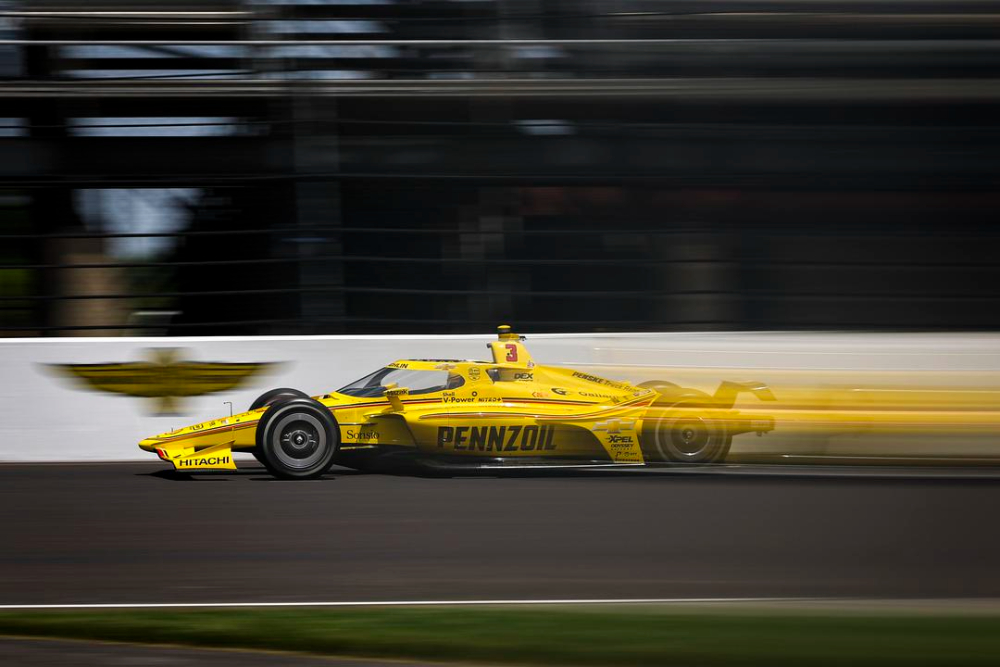
Drivers have gone out with fully-charged energy recovery systems and used them once during their four-lap qualifying simulations; some who’ve used the single hit of power have waited until the third lap to deploy the extra acceleration coming out of Turn 4 while others have waited until the fourth corner on the fourth lap to get the benefit of the boost to sprint to the finish line. We’ve also seen deployment out of Turn 2, with wind direction being a factor in the decision.
Others have skipped the full-burst method, where the 60hp is unleashed in approximately four seconds, and opted for another solution allowed by the IndyCar Series where the charge is released in a slower manner – a smaller amount of boost spread over a sustained time – that has lasted anywhere from a half-lap to an entire lap.
And we’ve seen a select few, namely the Team Penske drivers, harvest and deploy during their qualifying simulations – risking a slight loss of speed from the mechanical drag created during the charging process – which showed no apparent signs of diminishing their average speeds.
Third lap. Fourth lap. Turn 4. Turn 2. Full boost. Half-lap trickle boost. Full-lap trickle boost. Regen and deploy. As of Friday night, there was no consensus within Chevy or Honda camps, much less between teams, which was reinforced by the fact that five-time Indy polesitter and 2008 race winner Scott Dixon wasn’t going to bed early to be rested for a hectic day of first-round qualifying.
The six-time IndyCar champion spent his night at Honda Racing Corporation US’s Indianapolis campus on its large driver-in-the-loop simulator to run through qualifying hybrid boost usage options and pick what might – with "might" being the operative word – prove to be the best plan among the numerous approaches at their disposal.
“There's a ton of different scenarios,” Dixon told RACER. “Every team runs a ton of simulation. We did a ton on Monday with different scenarios. There's ones that we think we know are good. But it's going to really determine during your run, but you’re gonna have to really forecast a little bit.
When it was done right on Fast Friday, the release of hybrid power made a meaningful difference in lap speed. Watching how teams choose to deploy will be a new aspect to the broadcast on FOX, and as Dixon says, it’s in the human side and how teams elect to use the 60hp and when that will decide whether it has a solid impact.
“But then also be ready to change up what you're thinking with the wind and how gearing could change,” he added. “It’s not one way that works the best across all conditions. There’s gonna be a lot of adapting and I think it's going to be easy to mess up.”
Presented by:
Marshall Pruett
The 2026 season marks Marshall Pruett's 40th year working in the sport. In his role today for RACER, Pruett covers open-wheel and sports car racing as a writer, reporter, photographer, and filmmaker. In his previous career, he served as a mechanic, engineer, and team manager in a variety of series, including IndyCar, IMSA, and World Challenge.
Read Marshall Pruett's articles
Latest News
Comments
Comments are disabled until you accept Social Networking Cookies. Update cookie preferences
If the dialog doesn't appear, ad-blockers are often the cause; try disabling yours or see our Social Features Support.