Paul Webb archive
From the vault: Ironing out Lola’s kinks
It was the fall of 1982 and Mario Andretti was restless. Formula 1 was in his rear-view mirror and Indy car racing again occupied his every thought. But the 1978 F1 World Champion had grown tired of being a hired gun with no choice of weapons.
"I didn’t feel comfortable in the Patrick situation, I was just a visitor," recalls Andretti, referring to his tenure with Pat Patrick’s team in 1981- ’82. "I wanted to have a situation where I had more say in the direction of the team. I was resuming my Indy car career full-time and I had a long time ahead of me. The one thing that kept me motivated was that I wanted to do something different, no status quo."
What transpired was anything but routine and turned out to be the genesis of one of Indy car racing’s most storied teams. It was a melting pot of celebrity, creativity and a little calamity, mixed in with hard work, talent and the original odd couple.
When Can-Am folded, Paul Newman and Carl Haas were car owners without a series. Haas asked Newman if he wanted to join forces and start a team in Championship Auto Racing Teams for ’83. The actor said no.
Haas then asked if having Mario as the driver made a difference? Newman was in.
"I had befriended Carl because Michael was running one of his Super Vees, and it was an opportunity for me to bring in Paul because I knew he was a racer," explains Andretti. "March was dominating then and I said, ‘Let’s bring Lola back.’"
Haas was Lola’s USA distributor, and Lola founder Eric Broadley had designed the Indy 500-winning car back in 1966.
"We went to a Japanese restaurant in Michigan – Paul, Carl, Eric, Tony Cicale and myself – and made the plan. Eric said it was almost too late [fall of 1982] to have a car for ’83, but he agreed to do it."
Cicale was a 2-liter Can-Am driver who’d designed a 5-liter Can-Am car for VDS in 1980, but also had wind tunnel experience.
"Mario wanted someone with technical experience, but I wasn’t an engineer, per se, and at that time there really weren’t any race engineers at the track," recalls Cicale. "He came to my house and we started talking racing. I told him I didn’t know anything about engineering or setting up a car, but I knew aerodynamics and was familiar with wind tunnel testing. And Mario was keen on having that as an advantage."
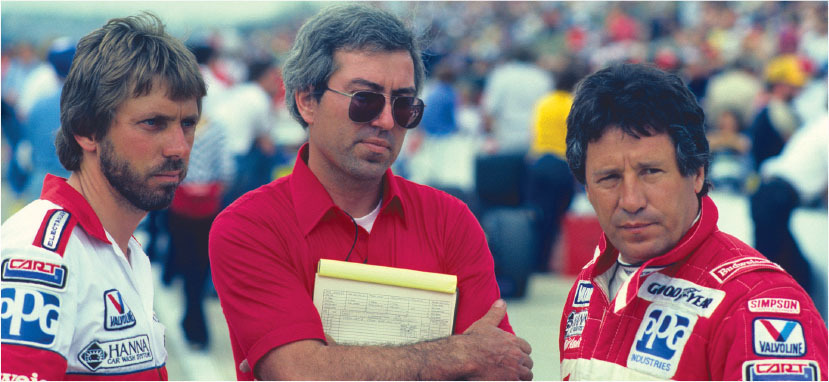
Mario Andretti convinced Tony Cicale (right) to come onboard at the start of Newman/Haas Racing’s Lola journey. Paul Webb archive
Obviously on the ground floor of ground effects from his F1 Lotus days, Andretti could see Indy’s future before most.
"Tony knew aerodynamics and I thought he’d be fresh air," says the 1969 Indy victor, who hadn’t officially won an Indy car race since ’78. "There was so much development to be done and I thought we’d learn together. He was an intuitive guy and I knew I’d be able to communicate with him. I couldn’t see any risk in Tony, he grasped things so quickly."
With Newman bringing Budweiser as the sponsor (there was a massive press gathering in New York City to announce the partnership), Darrell Soppe was hired as chief mechanic, along with Bernie Ferri, Bob Skein, Butch Dennison, Joe Flynn, Kenny Bova and 22-year-old John Tzouanakis.
But before the car ever turned a wheel, there were storm clouds forming.
"I went to England in November ’82 to meet Eric and look at the car, except there was no car," says Cicale. "There was no drawing and no wind tunnel model. I asked where the car was. He said to look at the Formula 3 car because it would be based on that design. I said, ‘You are kidding?’ and he said, ‘No, it’s a fine car. I’ll swoop it here and I’ll swoop it there,’ and I thought, ‘What have I gotten myself into?’
"Eric was in charge of the design, he despised wind tunnels and it was too late for me to have any influence to do it properly. It had to be delivered in January or February. I was a realist and I was concerned.
"The first car was delivered in February. Everyone looked at it and knew it was a piece of junk. Nobody had to say anything. It was ugly, very un-Lola like. Lolas always looked cool and this was atrocious."
And even more hideous to a trained eye.
"When we removed the bodywork, we realized the springs were mounted outboard and protruded into the very critical diffuser exit space," Cicale recalls. "Instead of going up and over the centerline of the gearbox, the exhaust system bulged into each of the underwings.
"The outboard dampers were supported by a single shear with a 4ft-long aluminum angle iron which bolted to the transmission housing. It looked like Lola bought the structural aluminum support at the local hardware store! From our perspective it was clearly under-sized, but Eric assured us that he’d run the numbers and it was not a heavily-loaded component, so we loaded up the truck and headed for Phoenix."
Then it ran even worse than it looked…
"Our first test at Phoenix was meant to be three days and we stayed for five weeks because it was a disaster," says Tzouanakis.
Cicale can laugh about it now, but what he saw that first day wasn’t funny. He recalls: "Mario’s coming down the pit straight on his warm-up lap and his left-front tire is six inches off the ground. The aluminum I-beam on the right-rear had collapsed and he was going 40mph at most.
"I said, ‘Eric, you said this had load capacity,’ and he said it must have been off by a small factor. He wondered if there was any angle iron in the truck, and there was on the ramps we used to load the cars. He said we’d bolt it to the right side of the car to reinforce it, because the left side has no load whatsoever.
"Mario goes back out, comes right back in and says something is wrong with the car and he was afraid to do a warm-up lap.
"We looked and the left-rear is all buckled in. So we took all the angle iron off the ramps and bolted it all the way around so Mario could practice. We were 30mph off the pace and that’s when Bernie [Ferri] named the car Pig 1."
It lived up to the name at Indy, Milwaukee and Cleveland, but Andretti didn’t panic.
"That first car was a flexy flyer, no ground effects, so it was really difficult on ovals," he says. "At Indy, Eric asked if the car was ‘jacking,’ and I asked what the hell that meant? We changed the roll center about 30 times and we needed more downforce. Everyone was stressed.
"But you’ve got to dance, whether you like the music or not, and we just kept plugging. We had no other option. I was under no illusion, but I was looking at the long-term and I felt confident that we’d prevail."
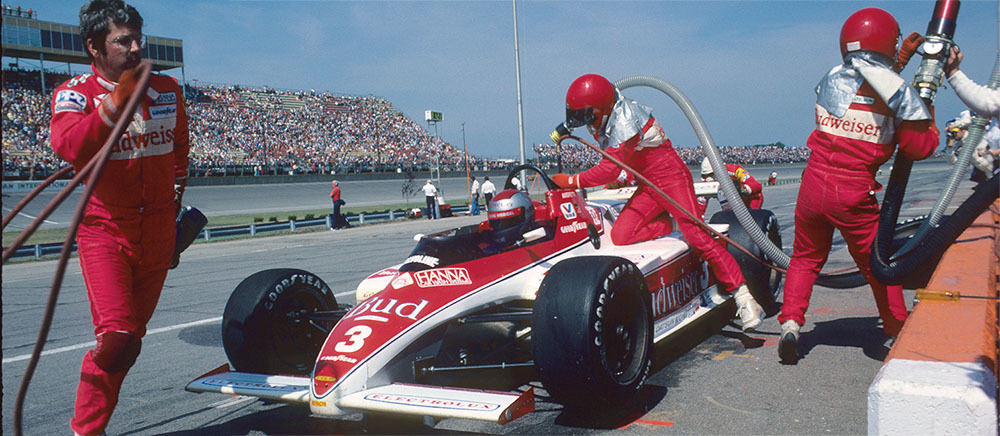
Constant development by Mario and engineer Tony Cicale turned the 1983 Lola into a podium fixture by season’s end. Paul Webb archive
For all its shortcomings, the Lola T700 found victory lane at Road America in late July, the sixth race of the season. "We finally won at Elkhart Lake because we had that car just right and wound up third in points," says Andretti, who scored another win at Las Vegas in October.
"Tony worked day and night. I loved his spirit. He wanted to win immediately. It was as good a situation as I could have wanted."
Cicale credits Andretti with any success that season, but knew things had to change.
"The car had very poor aerodynamics and very little torsional stiffness," he says, "so it was frightening on ovals. Mario knew the importance of rigid structure and good aero. But Mario being Mario, he somehow made it acceptable.
"I had no clout with Eric or Carl, but Mario had control of Carl, and Paul was also very vocal and brought the Budweiser money. Mario said unless we fixed the problems with the Lola, we’d switch to March in ’84, but we made enough progress from mid-season to stay."
The 1984 Lola, the T800, was a totally different animal as Broadley acquiesced to Mario and modern technology.
"Eric was very set in his ways, but he was smart, too. It took a while to convince him about wind tunnels, but he became a believer," says the three-time USAC national champ who scored his first and only CART title in ’84 with six wins, eight poles and 572 laps led. "I brought in Nigel Bennett because he dealt with ground effects at Lotus and he understood torsional stiffness, and that second car was half carbon and half aluminum. It was a championship car."
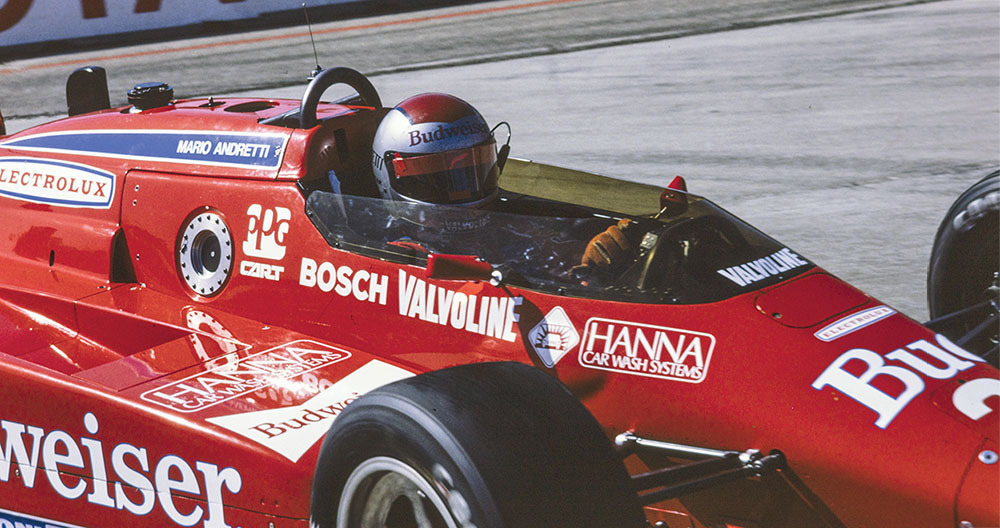
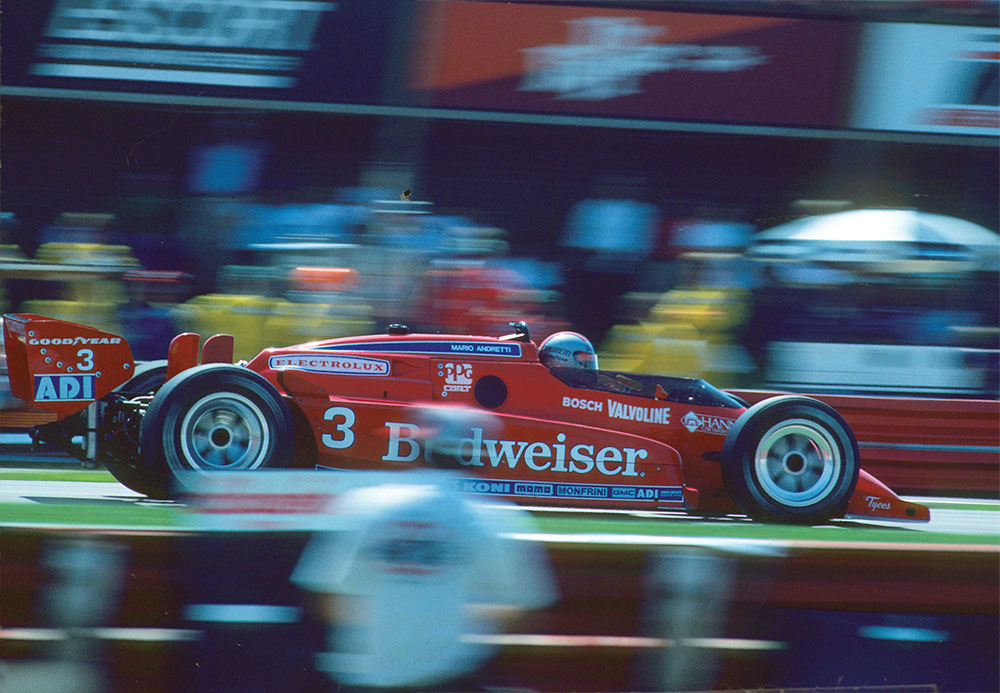
Mario Andretti heads to victory in the 1984 Grand Prix of Long Beach – one of six wins in a title-winning season. Paul Webb archive
The Newman/Haas partnership would go on to win 105 races and seven more Champ Car titles during the next 28 years as the famous actor who loved racing and his cigar-chomping partner who loved making money left their mark.
"Carl was the salesman, Paul was the cheerleader, and Mario pulled it all together," says Tzouanakis, who stayed with the Chicago-based team until 2013. "They always gave us what we needed, let us do our jobs. It was a pleasure to work for them."
Cicale treasures the memories, saying: "I learned so much from Mario. He was so good, so motivated, and his leadership was amazing. He didn’t tell people, but convinced them it was the right direction. He was so gracious, and not an elitist. Back then you designed a car, built it, delivered it and raced it. There wasn’t much data and that’s probably how it should still be."
For his part, Andretti adored his owners and the legacy he helped create.
"It was all about pursuing your dream and it provided the ultimate satisfaction for me," he says. "Then Michael came in and kicked butt and it was a great time. Newman/Haas Racing became my house and my family for 12 years, the longest I spent anywhere in my career, and there was a reason: I felt productive and I got results."
Robin Miller
Robin Miller flunked out of Ball State after two quarters, but got a job stooging for Jim Hurtubise at the 1968 Indianapolis 500 when Herk's was the last roadster to ever make the race. He got hired at The Indianapolis Star a month later and talked his way into the sports department, where he began covering USAC and IndyCar racing. He got fired at The Star for being anti-Tony George, but ESPN hired him to write and do RPM2Nite. Then he went to SPEED and worked on WIND TUNNEL and SPEED REPORT. He started at RACER when SPEED folded, and went on to write for RACER.com and RACER magazine while also working for NBCSN on IndyCar telecasts.
Read Robin Miller's articles
Latest News
Comments
Comments are disabled until you accept Social Networking Cookies. Update cookie preferences
If the dialog doesn't appear, ad-blockers are often the cause; try disabling yours or see our Social Features Support.