NASCAR/Getty Images
From the vault: Bobby finally checks the box
On May 23, 2011, Bobby Allison stood before a full house in downtown Charlotte, N.C., to be inducted into the NASCAR Hall of Fame. There was much to say and not enough time, really, to say it all. Allison, a member of the second class to enter the hall, had led a life and career so star-crossed that his story would confound even the brightest novelist.
In the audience was Junior Johnson, knighted the year before as one of the first hall members. In a long-ago season, at the height of their powers, Allison and Johnson had teamed to win 10 NASCAR Cup Series races. It was 1972, and Allison drove Johnson’s cars to 25 top-five finishes in 31 races, a remarkable run of consistency.
Johnson, his team members, and racing in general could see a bright future for the partnership of one of NASCAR’s smartest car owners and one of its toughest drivers. Allison, however, could not. So he left Johnson at the end of the season, a dissatisfied winner, a driver who through much of his career would leave a sure thing in pursuit of a surer thing.
"I did drive for Junior Johnson for a year," Allison told the crowd. "Really, really should have stayed there. But I had some guy come along and tell me he really knew where a brighter moon was, or a bigger pot of gold, or something like that. Down the road I went…"
Allison turned toward Johnson.
"Junior, I apologize," he said.
In the 13 seasons after Allison’s departure, Johnson’s team won six Cup championships – three with Cale Yarborough and three with Darrell Waltrip. Many, including Allison himself, believe he would have added many wins and multiple championships to his record if he’d stayed with Junior. Richard Petty amassed seven championships and 200 wins, but one veteran mechanic believes that had the Allison-Johnson partnership remained intact beyond that single season, "It would have been King Bobby and not King Richard."
Allison bounced from place to place and from team to team like a desperado seeking shelter. He won 11 races at the vaunted Holman-Moody Ford team in 1971 – and left. He was a star in that special season with Johnson – and left. He won 14 races with veteran team owner Bud Moore – and left. He kept looking for the perfect alchemy, for the combination that would satisfy his unique needs, meet his tough demands and put him in charge.
Allison stepped into Cup racing in 1961. Two decades later, he’d won 65 Cup races, but no championships. One of the best drivers of not only his generation but of all time, Allison departing the sport of stock car racing without a championship would have been like Robert De Niro retiring without an Oscar or Mickey Mantle heading home without a World Series title.
But could he stick with one team long enough to build the chemistry generally necessary for extended success? Could he get out of his own way to allow the cards – and the cars – to fall into place? Could he finally storm the castle gates?
Oddly, the positive answers to those questions began to show themselves in 1982 at an unlikely place – DiGard Racing. Seven years earlier, Bobby’s younger brother, Donnie, had driven for DiGard, and that partnership ended in acrimony and in financial disaster for Donnie. But Bobby needed a place to land after driving in 1981 for Harry Ranier’s team and finishing second in the points race for the fourth time. It was clear that DiGard had issues, but it also had respected engine builder Robert Yates and a smart young crew chief, Gary Nelson. After some initial debate with team owner Bill Gardner, Allison signed on.
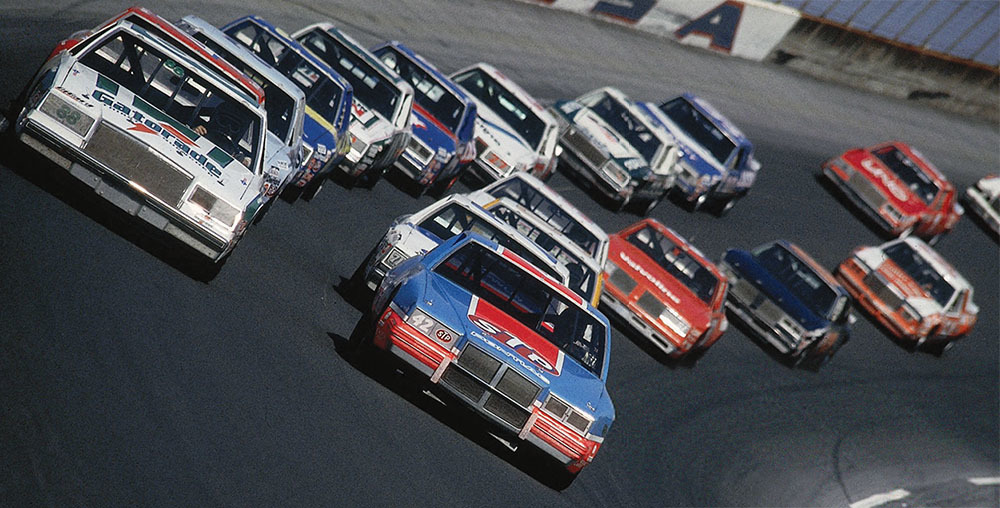
Bobby Allison (alongside Richard Petty) heads the high line during the 1982 Daytona 500. Allison would lead 147 of 200 laps on the way to his second of three wins in NASCAR’s biggest race. NASCAR/Getty Images
In 1982, Allison won eight times. But Waltrip, his constant nemesis, won 12 times for Junior Johnson and passed Allison late in the year to win the championship. For the fifth time, Allison was runner-up. His failure to win the title gnawed at him. But he approached the 1983 season with confidence, despite having reached his 45th birthday in the off-season and facing the unspoken truth – that his best racing years were behind him. Meanwhile, Waltrip, having won the championship the previous two seasons in the cars Allison unceremoniously left behind at the Johnson shop, still loomed as The Man to Beat.
"We had a really good run in 1982 and just missed the championship," Nelson said. "In the off-season, we tried to analyze how we could have done better. We had some tracks we dominated, but then we looked at the short tracks, and Darrell just killed us there. We decided to step up our short-track program. In ’83, we won Richmond [the season’s second race], and that got us going."
In the early-season stretch, Allison finished second at North Wilkesboro, third at Martinsville and second at Nashville, underlining the team’s new short-track strength. Then he won at Dover to move into the points lead, a spot he held the rest of the year.
Waltrip, predictably, challenged hard in the second half of the season, but Allison won consecutive races at Darlington, Richmond and Dover in September to reestablish his team as the title favorite. At season’s end, he had a 47-point edge over second-placed Waltrip, and the elusive championship finally came home to Alabama. As a bonus, Allison had beaten his nemesis – a high point for Bobby in their long-running feud.
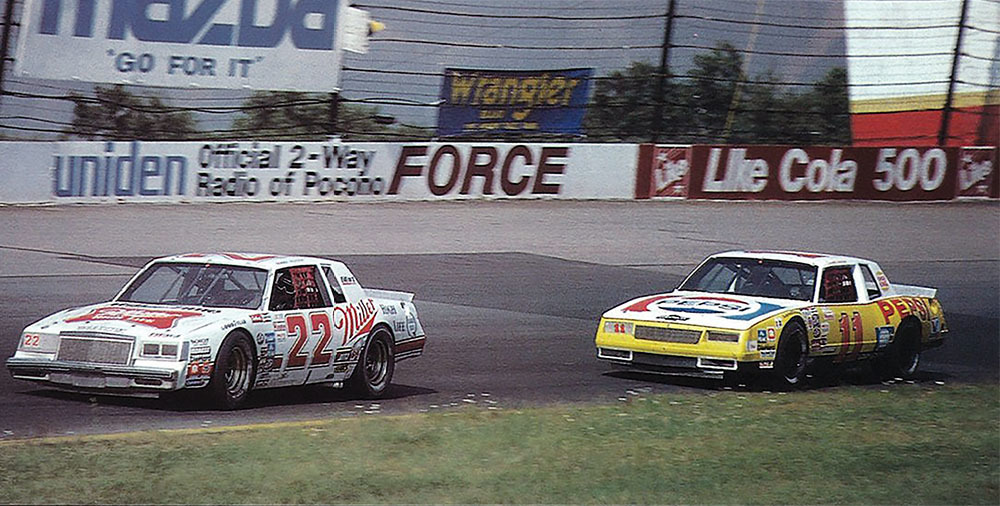
Bobby Allison vs. Darrell Waltrip (above, 1-2 at Pocono in 1983) was a defining rivalry in early 1980s NASCAR. NASCAR/Getty Images
"Bobby and I were great friends," Waltrip said. "Our families went to races together. He taught me everything I knew about a racecar. That was before I got competitive. Then I started beating him, and that changed the dynamics a lot. I’m sure it made him very happy that he won it and I was second."
Additionally, Allison had proved he could stay with one team long enough to reach the ultimate success. Yet Waltrip, of all people, said he understood Allison’s tendency to pack his toolbox and move on.
"He was a perfectionist," said Waltrip. "When you build cars and know cars like he did and the car is not perfect, then you complain a lot. That’s probably the reason he jumped around a lot. Guys wouldn’t listen to him.
"It worked at DiGard. Bobby liked Gary, and it clicked for them. And Bobby did everything in his power to beat me for the championship. You didn’t have to try to get into Bobby’s head. He was in it himself. Bobby always thought everybody was against him, and that’s how he raced. I guess that year they kept him under control."
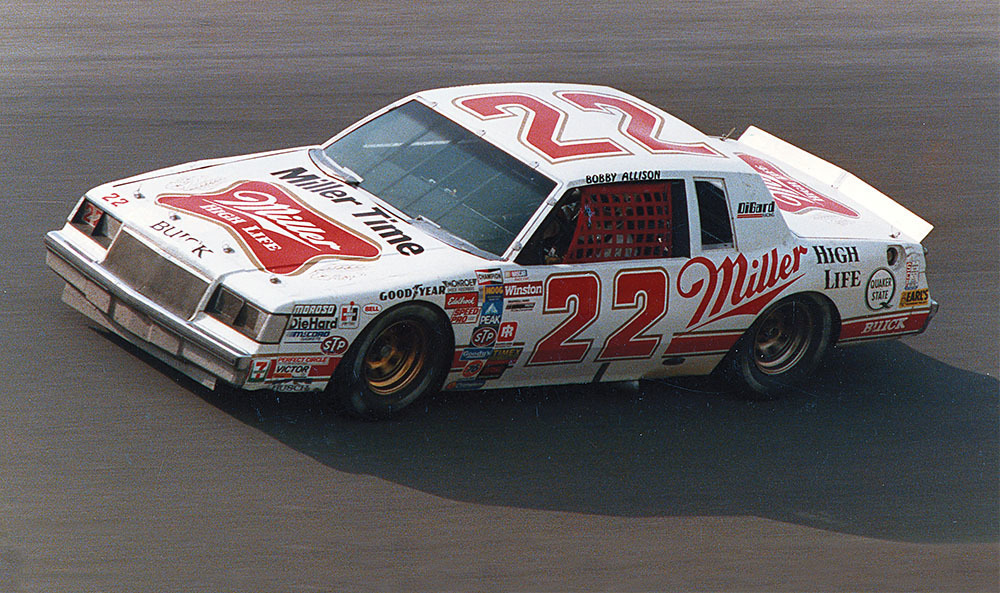
A car swap early in the season was a key to Allison’s success, Nelson said. The DiGard team opened the year running Chevrolets, but Johnson controlled much of Chevy’s Cup Series input in that year and was first in line for parts, pieces and dollars. DiGard switched to Buicks in the fourth race of the year.
"The Buick Regal was a great little racecar, but Junior switched to Chevrolet at the start of 1983 because Chevrolet had more money than Buick," Waltrip said. "I had a terrible time adjusting to that car. I wrecked in the first race at Daytona. I kept telling Junior that I just couldn’t drive the car, that it was too loose."
Months into the season, with Waltrip still struggling, Johnson consulted with longtime car builder Banjo Matthews, and they came up with modifications to the Monte Carlo. "The changes were exactly what we needed," Waltrip recalled. Over a 14-race stretch ending the season, Waltrip finished in the top five 12 times, the sort of dazzling consistency the point system of that period loved. But it was too late to catch Allison.
"That Buick was a killer car," Waltrip said. "I mean, I’d won 24 races in it. Bobby took advantage of it. He and Gary and DiGard – they just whipped us that year."
There are those in the racing community who will tell you that Bobby Allison was a better car builder than driver. That’s a seemingly wacky statement about a man who won 84 Cup races and used his spare time to travel around the country outrunning the hotshot locals on dozens of short-track Saturday nights.
But it’s true – Allison knew the inner workings of a racecar better than most drivers because he’d built so many. He spent long nights in his crowded shop in Hueytown, Ala., tinkering with designs and shocks and springs and chassis variations, ultimately gaining a clear understanding of the things that made cars go fast, especially the challenge of keeping speed through the turns. He was a pioneer in the concept of front steer, a steering linkage design that put steering rods in front of the axle center line in a car’s front-end geometry, which generally gave cars an easier run through corners.
"Some drivers didn’t care as long as the gas pedal and the brake pedal worked, but Bobby wanted to know the workings," said Mike Hill, a former Junior Johnson crew chief. "I watched him bring those front-steer cars into Cup racing. Junior and I were standing on a wall at Richmond Raceway and watched Bobby drive off into a turn in a front-steer car. I said, ‘If he ever gets that worked out, he’s going to be tough in the center of the turn.’ And he did."
Allison later said of his one-and-done ’72 season with Johnson: "He and I just didn’t communicate. It was sad for me and sad for us. He wanted to communicate through [crew chief] Herb Nab instead of one-on-one."
Hill had on-the-ground experience with Allison and the driver’s ability to match car setups with a wild variety of track configurations and surfaces. Allison could drive through the back gate at some backwater track he’d never seen and post the hot time within a few practice laps.
In the 1970s, Allison flew his small plane to Cup races at Michigan International Speedway. It wasn’t unusual for Allison, Cale Yarborough and David Pearson to land their planes on the speedway backstretch and park them in the infield for the weekend.
"Bobby had a race on Saturday night in Fort Wayne, Indiana," said Hill, who was working for driver Cecil Gordon’s team at the time. "He came by in the Michigan garage and asked if I wanted to go along and help him with his car. I met him at the airplane after the work in the garage area was over. He backed the plane up into the second turn and let it go. Here we go bouncing down the backstretch. The ‘Norton’ sign at the end of the backstretch kept getting bigger and bigger and I didn’t think we were going to make it. At the last second he pulled it up into the air.
"We got to Fort Wayne. Bobby’s car from Alabama was already there. They had a match race set up between Bobby and Dick Trickle – sort of a North vs. South thing – and Bobby beat him. He was great on those little tracks – knew everything about those cars and how to make them go."
Nelson, who would become NASCAR’s Cup Series director after a successful career on pit road, said he entered the DiGard partnership with Allison knowing the driver’s reputation for conflict.
"I saw a very talented driver, and I wanted to get the most we could get as soon as we could," he said. "We made it last, and we made it work.
"We went back and forth. I wanted to follow what seemed to be working. If the car setup needed to be stiff, the tires would tell you that. If the car needed a softer suspension, the tires would tell you. Bobby’s style was to go to the record book and make the setup the same as it was the last time. We would go back and forth on philosophy quite a bit, but we had success both ways. Somehow we found a happy medium and made it work."
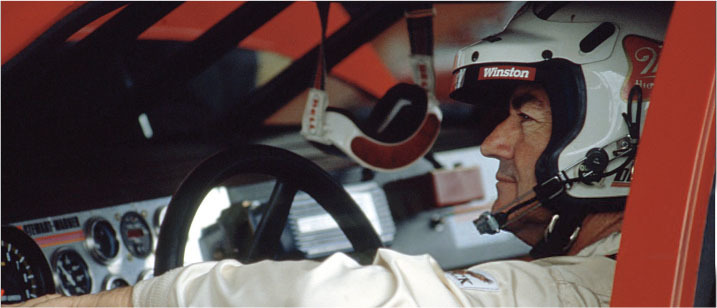
Allison was 45 years old and a near-20-season Cup veteran when he finally landed the title. NASCAR/Getty Images
And Bobby Allison, at the ripe old racing age of 45, checked the final box on his wish list.
"I know it all bothered him," Nelson said. "Some of the comments were that Bobby had driven for 21 years for 21 car owners. But, in our second year with him, he finally had what was probably what he’s been needing his whole career – some consistency within a group, and building on that."

Mike Hembree
Read Mike Hembree's articles
Latest News
Comments
Comments are disabled until you accept Social Networking Cookies. Update cookie preferences
If the dialog doesn't appear, ad-blockers are often the cause; try disabling yours or see our Social Features Support.