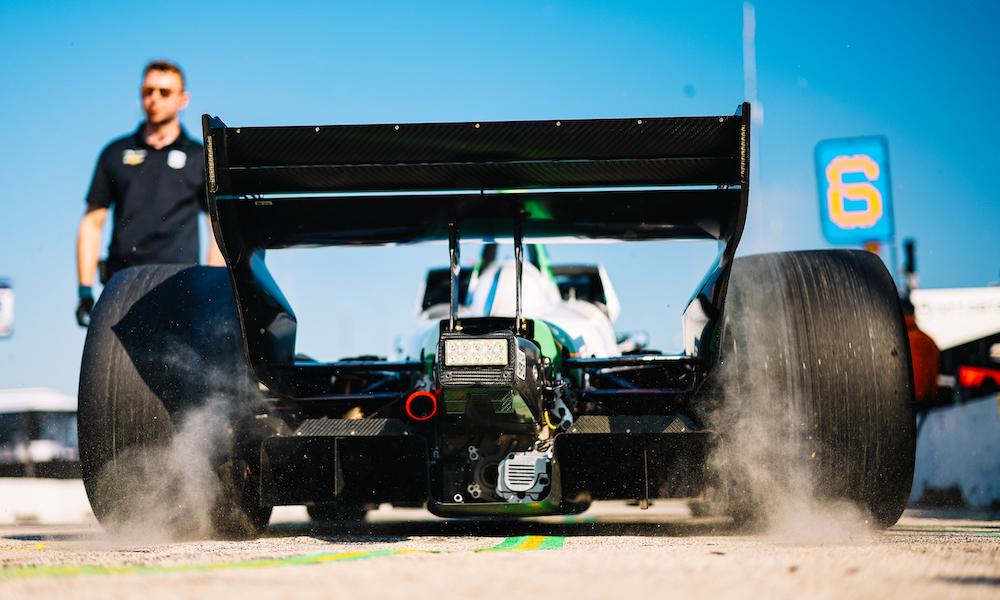
Joe Skibinski/IMS Photo
Honda’s ‘fightback’ plan for the IndyCar manufacturers' battle
Every car company goes into a new season of racing with the same goals: Win the manufacturers’ championship, win the series’ biggest race, and see the drivers' champion crowned in a car carrying your badge.
Honda Racing Corporation US achieved one of its three IndyCar Series goals in 2024 with Chip Ganassi Racing’s Alex Palou, who won his third championship in four years with a 2.2-liter twin-turbo V6 Honda motor. But for the second year in a row, the Indianapolis 500 went to arch rival Chevrolet and Team Penske’s Josef Newgarden and the most coveted achievement also went to Chevy as the Bowtie earned its third straight manufacturers’ title after capturing 10 wins from 17 races.
With Chevy set to try and complete a sweep in 2025 by defending its two championships and adding the drivers’ title, HRC president David Salters and his team are tasked with holding onto the drivers' crown while trying to reclaim the two big victories taken by its rival.
The "fightback," which is how Salters refers to the challenge ahead, is Honda’s present reality.
“Hats off to our competitor. That's why we do this. So hats off to them,” Salters told RACER. “We've been in that position they're now in. There's one response which involves a lot of work of trying to get back there, so we've got amazing men and women working hard over the winter in this fightback, and you've got to just take a deep breath. What we're going to do is improve. I saw a lovely quote from LeBron James who was asked, ‘How's it going to go?’ And he said, ‘I can't tell you, it's sport, isn't it?’
“We know what our goals are, but we can’t say how it will end. But what I can tell you is, every day, we're going to try and improve ourselves, and that's the spirit of our men and women. We know we need to do a bit better. It was not a disastrous season – we won the drivers’ championship and all that sort of stuff – but we're there to fight and we'll see where we get to. I'm sure the others are doing the same.”
Like each racing team that spends the offseason chasing ideas on how to improve their performance for the upcoming championship, HRC has a process for seeking gains in power, torque, fuel efficiency, and reliability. But what it doesn’t have is one of Chevrolet’s engines to tear down and try and find the secrets that delivered the Indy 500 and manufacturers’ championship.
Developing its 2.2-liter twin-turbo V6 motor in isolation -- just as Chevy does with its engines -- is standard, so what’s the process for identifying paths to pursue based on what it was missing last year?
“We have weekly engineering meeting where we regroup and we talk about all the things that have happened,” Salters said. “After each race, we do a competitor analysis, so IndyCar provide a telemetry feed of car speed, engine RPM, and all that sort of stuff. And if you get smart with that, you can look at the performance of the competitor. What used to happen is, you used to get TV channels and or apps and scrape the video, basically. So, lots of people beavering away trying to get on-board footage or apps and scraping the data from that became quite a resource and a bit of a waste of money.
“So then, many years ago, it first started in F1 where someone said, ‘Well, why don't you just publish the telemetry channel of car speeds and all that?’ And then, because everyone does what others do, it started happening in IndyCar. So typically, IndyCar publishes the telemetry channel of the speeds of the cars and other data channels, and we can then deduce, with our clever people, things like how do you accelerate off corners? How do you go around the corner? What happens at the end of the straight? Indeed, you're trying to figure out what is power, and what is drag, or aerodynamics, and there's different ways of teasing that out.
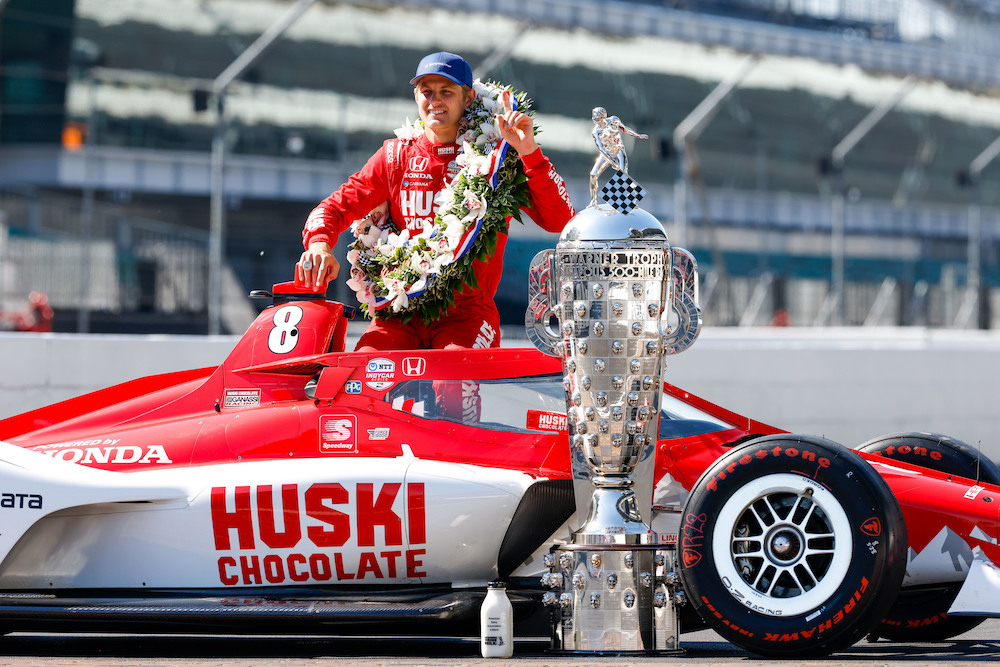
Marcus Ericsson gave Honda its most recent Indy 500 win in 2022. Brett Farmer/Motorsport Images
"So, long story short, we do data analysis. Same in every company, I'm sure. We put quite a lot of effort into it, because it's how you got better, it's how you spend your dollars. So we try to do quite an artful analysis to see where we're okay and where we're not OK. Where do we need to improve the performance in the end? It's a vehicle, it's a sum of parts. But which bit do we work on? Which bit do the teams work on? Because it's always a mixture of how the tires are behaving, how the engine is behaving, how the aero is behaving, driver behavior, traction. All those things are going to make a racing car go or not go.
"So we do a lot of competitor analysis. We have tools to do that. We look at it and go, ‘Oh, we're good there, or we suck there, and if we suck, we're going to try and do something about that.’”
One example is street courses, where Honda won three out of four in 2024. Low-end acceleration is key to launching off of slow, sharp-radius turns, and Honda’s record last season would suggest initial torque delivery was an asset. Using the shared telemetry feed, quantifying the performance of its best cars and the leading Chevys exiting hairpins and tight corners would likely confirm an advantage was held by Honda.
But the same can’t be said for IndyCar’s fastest track, the 2.5-mile Indianapolis Motor Speedway, where Chevy-powered cars dominated the event in May with a sweep of the front row in qualifying and in the final results with a decisive 1-2 finish. Beyond what the final results revealed, it’s the data analysis that drives both auto companies to set their research and development programs to address weaknesses.
Even so, it’s not an entirely straightforward process.
“All very easy to say to follow the data, but because it's a mixture of parts, sometimes it's not clear why there is a performance gain,” Salters said. “It can be a mixture of things, because often things are combinations. But we will work on that, and we'll try and give focus on how we apply ourselves.
“And then after that, we’ll look at our resources, budgets, people, all that sort of stuff, what we're allowed to change, and then we try and figure out, what can we do to give the biggest bang for the buck relative to that competitor analysis, to make us more competitive?”
The greatest challenge facing HRC and Chevy is the age of IndyCar’s engine formula. Having debuted in 2012, there isn’t much left to find on the performance side after 13 seasons of continuous refinement of the same motors, and that makes a fightback by either company a daunting task to attempt. With no needles remaining in the haystacks, the search for hundredths of a second in lap time improvements is a costly and at times fruitless hunt.
“That is a challenge, but that's just an excuse, isn't it?” Salters said. “We've had some pretty stout times. Doesn't matter. Control, Alt, Delete. The lovely bit of this business, or the soul-destroying bit -- depends which view you want to take -- is the start of every season, you delete what happened before because it doesn't matter what you've done in the past. It matters what you're about to do, race by race.
“You could say with the state of the current stuff; it's a bit long in the tooth. It gets harder and harder, but OK, that's the same for everybody. So let's get on with it and see what we can do.”
Presented by:
Marshall Pruett
The 2026 season marks Marshall Pruett's 40th year working in the sport. In his role today for RACER, Pruett covers open-wheel and sports car racing as a writer, reporter, photographer, and filmmaker. In his previous career, he served as a mechanic, engineer, and team manager in a variety of series, including IndyCar, IMSA, and World Challenge.
Read Marshall Pruett's articles
Latest News
Comments
Comments are disabled until you accept Social Networking Cookies. Update cookie preferences
If the dialog doesn't appear, ad-blockers are often the cause; try disabling yours or see our Social Features Support.