Graeme Murray/Red Bull Content Pool
Rare air: How Red Bull’s ‘Showrun’ program takes F1 to extremes
A quick look at the history books will show Red Bull Racing's RB7 as one of the greatest cars to ever race. With 18 poles from 19 starts, 12 victories, 10 fastest laps, and a drivers' and constructors' title double, it’s very much an icon.
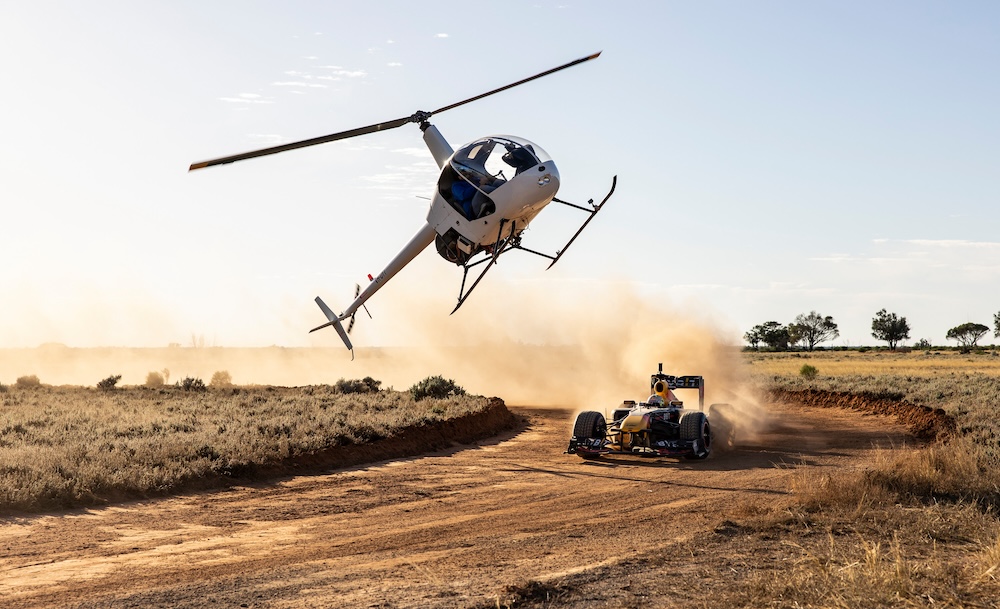
Yet despite that stellar track record, it’s probably going to be more fondly remembered for things like doing donuts atop of the Burj Al Arab in Dubai, bombing down a ski slope in Austria, or traversing the Australian Outback.
Since 2012, a pair of RB7s -- along with an RB8 which joined them in 2018 -- have taken on a second life as the stars of Oracle Red Bull Racing’s "Showrun" program. It’s a unique promotional approach to Formula 1 that’s been seen by countless people across the world, but between its recent stops in Chicago and Nashville, the team gave RACER a rare insight into the inner workings of the operation.
The RB7 replaced the RB1 as Red Bull’s toy of choice, which ended its Showrun life sporting a bodykit to help it resemble a 2009-10 car. While from the outside, the RB7 of today still looks identical to how it raced in 2011 -- save for an updated livery and some minor alterations to the sidepods to aid cooling -- if you peel away the skin, you’ll find more substantial tweaks to the machine that took Sebastian Vettel to his second world title.
“We’ve got the RB7s that we use for show events and the filming side of things, and with those cars we sanitized them a lot in taking lots of bits and pieces off them, more to make them more reliable or to make them easier to maintain,” Red Bull’s heritage chief mechanic Greg Borrill tells RACER. “If it was just a race car, for example, we’d be bashing bits and pieces off them left, right and center, but we’ve taken some stuff off to make them a lot easier and more reliable to run.
“That loses a lot of the downforce that the car was originally designed with, so for track running we’ll use an RB8. The RB8 is pretty much taken straight from the racetrack in the fact that the diffusers all still intact; brake ducts, inlets, front wing, rear wing… it’s all very much a race car, so whenever you’re on track the driver’s got a lot more confidence in the car and knows what it’s going to do.”
That "sanitation" means that the RB7’s defining feature has had to take a hike. Sort of. Vettel recently got back behind the wheel of one for a run at the Nurburgring, where he was quick to note that the car’s famed blown diffuser that helped him and Red Bull carve out a dominant streak in the early 2010s was not present on the car.
“Well, technically it did still have the blown diffuser,” Borrill points out. “All the exhaust system and the floor, more or less, was still there, but what it didn’t have was the engine maps that you’d need to run to enable the blown diffuser to work properly, because then you’re looking at gasses still coming through when you’re off throttle and all that sort of business.
“They’re a lot more harsh when you’re running those sorts of maps and require a lot more upkeep on the engine side of things, but also from a car point of view.”
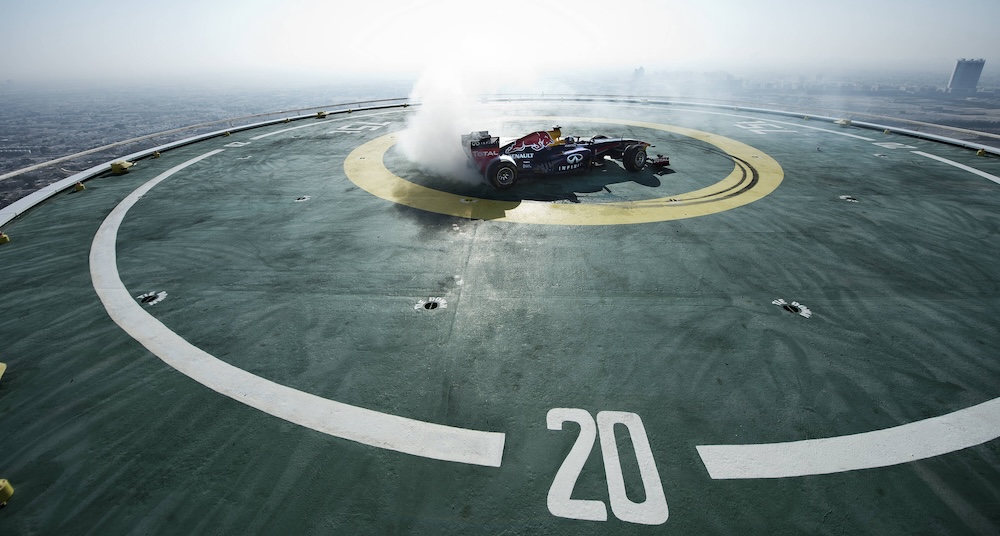
David Coulthard takes a Red Bull to extremes on the helipad of the Burj Al Arab hotel in Dubai. Naim Chidiac/Red Bull Content Pool
Speaking of harsh, Red Bull’s high jinks in the hands of regular demo drivers Patrick Friesacher and David Coulthard put the RB7 through a torrent of abuse, but when the race drivers get involved, that’s turned up another notch.
“That is generally when they catch fire, they don’t tend to give much of a hoot about it,” Borrill says with a smile. “The difficult thing with the cars is, with what we’re doing, we’re generally in confined spaces, we don’t have much speed, we’ve got a lot of high RPM because we’re doing donuts, we’re doing burnouts, we’re doing crowd-pleasing stuff, which is kind of what we’re here for. But because we don’t have the speed out of the car, we don’t have the airflow over the car, [so] we don’t have the cooling.
“On the 7s and 8, we have fitted radiator fans to try and help with the fact we’re doing this sort of stuff. They’re fully integrated onto the radiators and they’re controlled on the steering wheel with a rotary switch by the driver, so he can switch them on and off as he requires.
“Obviously a standard F1 car doesn’t have fans fitted to the radiators or anything like that, but being an F1 car, we still have limits of what we can drive to.
“Water temperature is our biggest tell, so the dashboard of the car has the water temp readout, and we’ve got maximum of what it can be before the driver has to cool down the engine -- so no donuts, no burnouts, just a couple of cool laps up and down to get the temperature back under control and into a level where or into a range where we’re happy for him to go again.”
The biggest victim of the RB7’s diet, though, is the KERS. Eliminating the electrification element not only helps ease-of-use, but is a safety precaution as well -- and it goes some way to explaining why Red Bull has persevered with decade-plus-old machinery for its fun and games.
“You quite simply take the KERS system off the car,” Borrill explains. “You couldn’t do it nowadays with the current cars -- the ERS and everything like that is fully integrated into the whole car -- but with 7 and 8 it was simply a matter of being able to remove it. We’re operating with a lot less people in environments that are far more harsh than a race circuit, certainly less controlled than a race circuit.
“If we have any issues and the KERS system is fitted, we’re looking at possibly putting public or marshals who know less about the systems in a bit more danger. So we remove it for that aspect. But it just makes the car a lot simpler to run, as well.”
While the modern breed of F1 cars might be wildly complex, RACER can reveal that one of the latest generation will be joining the RB7s and RB8 in Red Bull’s Show Run fleet imminently -- a 2022 RB18 -- although it’ll be going through an even more dramatic transformation than the venerable present trio.
“We will be looking at a different power unit for that rather than what it was raced with,” Borrill says. “It’s very complicated -- you can’t simply take the ERS system off -- and also the cars themselves are a lot more complicated than the 7 and 8. It’s one of the reasons why we’ve used the 7 and 8 for so long, because they’re so easy to use.
“So we are looking at replacing that power unit with something else. It’s yet to be decided even what it’s going to be, but it’s still essentially going to be an RB18 for the rest of the car. So it’ll look like an RB18; it might sound something like an RB18.”
In the meantime, the deafening V8s will remain, with the help of Renault which, despite what the stickers on the engine cover tell you, is still very much involved with Red Bull’s running of older machinery.
“It’s really good -- they’ve got a great team that we work with and have been working with since we started the program,” Borrill says of the team’s ongoing relationship with its previous engine supplier behind the scenes. “We obviously still rely on the original manufacturer’s input, and they still come away with us on each event to support us and they will continue to do so while the program continues. We still rely on their expertise to help us do what we need to do.”
While Red Bull itself gets to enjoy endless amounts of fun with its projects, the engine manufacturer’s input in the background isn’t all work and no play. Typically, before it turns a wheel at a public event, the RB7 breaks into song with a 2.4 liter rendition of "We Are The Champions," "Seven Nation Army," or one of a number of national anthems.
With all the talk of simplifying the cars, turning them into future Rock and Roll Hall of Fame nominees might sound like the most difficult part of the operation, but it’s a relatively simple procedure helped, in part, by Microsoft Office.
“It’s actually quite simple,” Borrill reveals, adding that they recently explored adding more tunes to the RB7 songbook. “It’s basically an Excel sheet that we have on the control side of things, and within that Excel sheet you match the hertz note of each song note, and correspondingly you can match that same hertz reading to the RPM of the engine and then you marry it altogether to make the whole track. That’s put into code, uploaded onto the ECU, then essentially you press ‘play’ when the car’s fired up and it does its thing.”
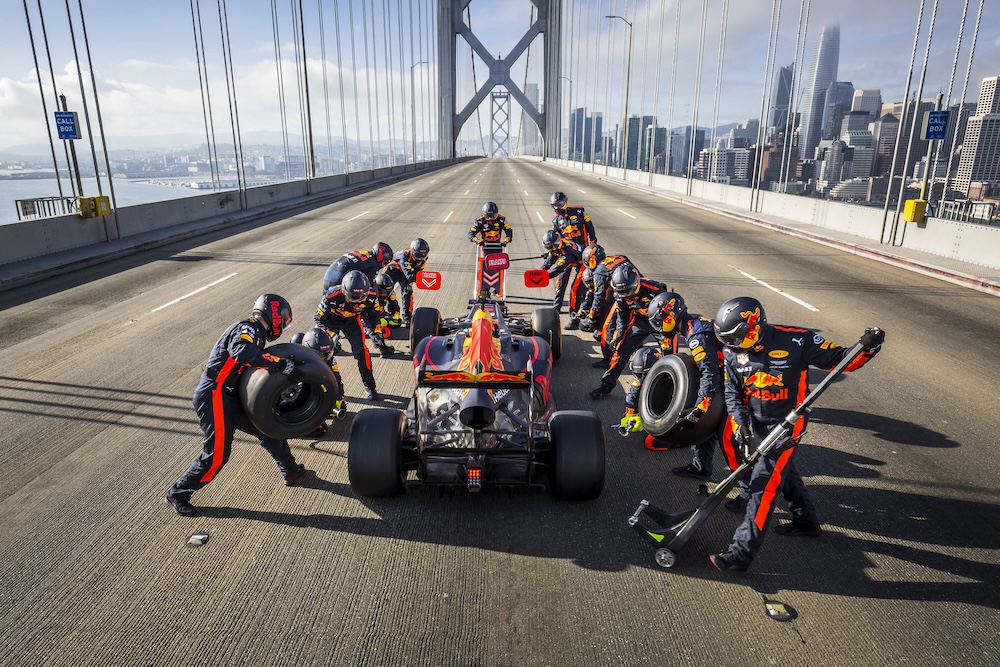
Red Bull Racing scales down its operation for Showrun, but the “skeleton crew” still has plenty of work to do, like this pit stop on San Francisco’s Bay Bridge. Garth Milan/Red Bull Content Pool
When it comes to staffing, Red Bull sticks to the reduce and simplify theme of the cars themselves, typically taking around 10 people -- roughly 10 percent of the staff the team has at a grand prix -- to each demonstration or filming outing.
“We operate in pretty different environments to the race team, we’re not just set up at a racetrack,” Borrill says. “But generally, the sort of generic procedures are still the same in terms of operating the car.
“It’s the same sequence in terms of fire-up and bits and pieces like that. We use the same basic structure of car crews in that we have a No. 1 mechanic that oversees the car, making sure that we’re built to the same spec and that we hit any sort of deadlines that we’ve got and they cascade information down to No. 2s and then we’ve got a power unit engineer, a controls engineer, the truckie… so, in that sense we operate in the same way that the race team does to operate an F1 car.”
Making the thing go might be the same, but the environments in which it happens vary wildly. Each event, while perhaps appearing small compared to a grand prix, is a massive undertaking, and there are few limits to what the team is willing to do.
“I think the biggest thing is, although we know what we’re doing, from one event to the next we could be running on gravel, we could be running on snow, ice, across a beach… it’s not straightforward running on tarmac or a circuit or anything like that, so it’s always tricky to understand what we need to do with the car to make it work best in the environment that it’s in, but we’ve got pretty good at that over the years,” says Borrill. “Obviously we’ve been doing it a long while now, the team’s quite adaptable, the cars have been really, really good, they do what we need them to do and we know how to operate them.
“When we go racing we have a set schedule, a set routine that you go through and you’re running your car on the circuit -- with everybody else, obviously, but that’s sort of where your communication is ending.
“But when you go away on an event, you could be anywhere -- city centers, on top of skyscrapers, whatever; it’s so varied. Then you’re organizing not only the team and the driver, and the car, you’re then speaking to production crews or local authorities to close off roads, [and] local markets for what their plan is -- you’re talking to a lot of different people a lot of the time to try and reach the same common goal at the same point. You’ve got a lot of different variables that you’re trying to pull together.
Oscar Cooper, the team’s senior Red Bull relations and event manager, adds: “We want to be doing stuff which challenges the norm, or make people go, ‘I didn’t think that was possible,’ and definitely we want to have the blue sky thinking, like, ‘Hey I’ve got this crazy idea -- is it possible?’
“I think the limitation that we have is just the car itself. Ultimately it’s an F1 car -- there’s certain things it just can’t do, so we always have to manage that. We also don’t want to break it. We’ve refitted some different things on the back of the car to have some different mounts if we’re pulling something along; we’ve created bespoke front wings and things like that.
“We can do that with enough lead time, but some ideas are just too far-fetched,” he adds, highlighting the regular request to run the RB7 on water is one that won’t be featuring in a Red Bull video any time soon.
Looking back over the years of Red Bull’s Showrun antics, Borrill says “being able to achieve all that and the team just being so adaptable and just taking whatever’s thrown in front of us” is what he’s most proud of, but he does recall the team's full pit stop on the Bay Bridge in San Francisco in 2018 as a personal highlight of the program.
“We had a rolling road block of all the traffic behind us,” he recalls. “It was pretty cool; we did about five takes of it, and there was a helicopter coming off the side of us as well, filming everything that was going on.”
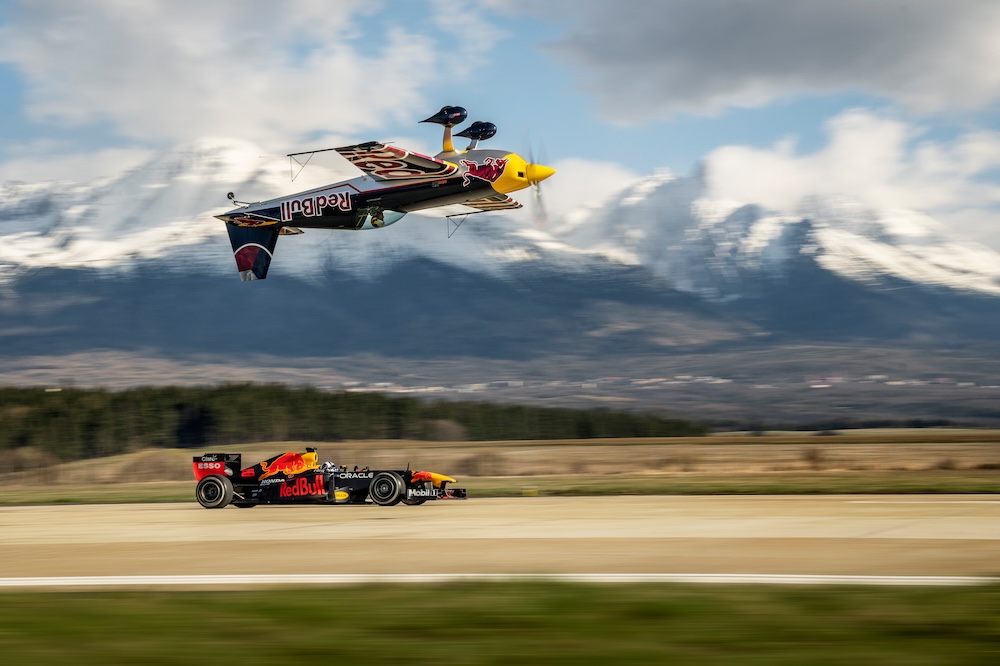
David Coulthard and Martin Sonka perform a stunt during the filming of Czech & Slovak F1 Road Trip and provide a "Pinch-me moment" for Red Bull's Oscar Cooper. Jan Kasl/Red Bull Content Pool
For Cooper, “what I love about doing these is every single one is unique -- we’re always trying to create something new or unique when we do a filming project.
“One of my first projects was in the Czech Republic, where we flew the plane upside-down above the car down a runway, and that was just an amazing moment to think, ‘Yeah, this is what we can do as a brand, this is what we can do with our car.’ I really enjoyed that one -- that was a very ‘pinch me’ moment. It was super-cool.
“Even things like closing down Fifth Avenue in New York to do a pit stop, that type of stuff, putting the car in those big locations and doing something like that is always great.”
The Red Bull Showrun program’s MO isn’t just about stunts and gimmicks, but about taking F1 to places that might not have a grand prix of its own, whether that’s cities in F1 host nations -- like Chicago or Nashville -- or countries like Greece, Ireland, Romania, or Thailand which have never had an F1 grand prix at all. It’s effectively providing a service for F1 as a whole. While its audience continues to grow thanks to the likes of Netflix’s "Drive To Survive" and a constantly expanding social media presence, Red Bull gives fans real-world exposure in a way other teams can’t.
“Part of the brief is to go to places which don’t have an F1 touchpoint, somewhere which doesn’t have a race or a market where it’s much harder to actually go a race or get tickets,” explains Cooper. “We have around 20 events a year where we’re taking an F1 car to places where people might have never seen on in real life or even heard one, and it’s great for the sport because it’s engaging people with what F1 is and what it’s about, and also for us as well. We want to be connecting with that audience, we want to be showcasing what the sport can do, what the cars can do, and I think that’s really awesome, to be able to facilitate that.
“When you see their faces when they hear the car fire up, it’s super-unique, and in the world now where F1 is such a large part of that, you forget that there’s still a lot of people that don’t have access to the sport. So at least this is one of the ways that we can help reduce that, or give a new opportunity for people to see the car.
“We have flexibility: where do we want to go? And I think that ties in with what we want to do as a team, as well. We’re trying to reach new people and new places via the race team itself, our Showrun program, via our digital channels, but ultimately we want to just showcase to people what we can do as a team and what the F1 world is about. It’s a privilege to do it.”
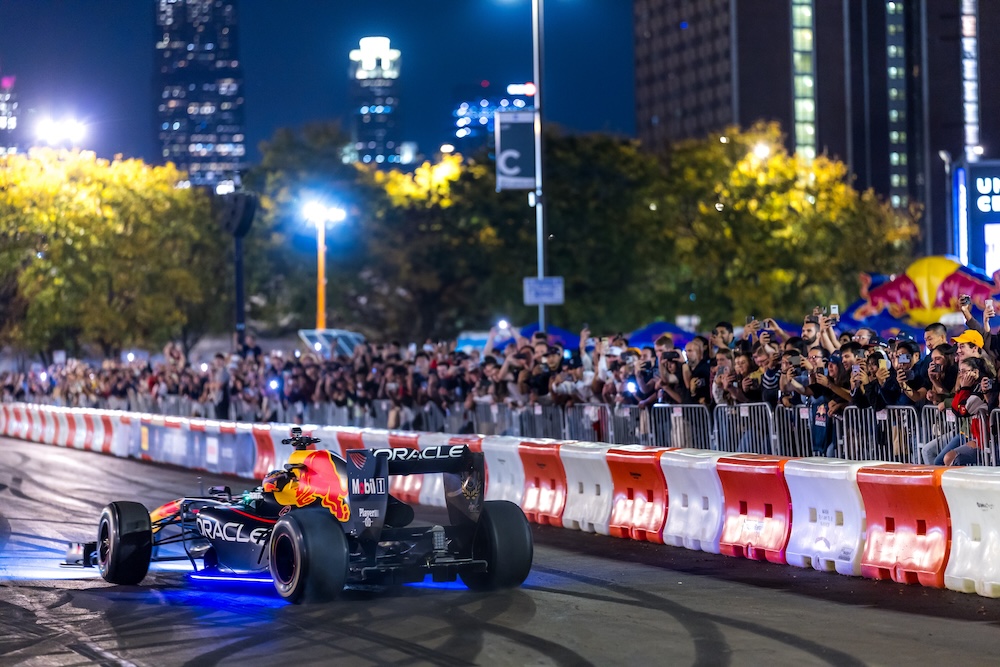
Along with promoting the Red Bull brand, Showruns help to bring F1 to people who might otherwise never experience it first-hand. Al Arena/Red Bull Content Pool
F1’s 2024 race schedule was announced back in July, but for Red Bull's Showrun team, the plan for next year is still being worked on. Each project, be it a short film or demonstration in front of fans, takes six to nine months to plan.
“In terms of the whole cycle of the year, usually we know around this time now when the business planning is happening, we have a good indication of what to expect next year, and then we begin planning from the beginning of the year for all of them,” Cooper explains. “It’s a long lead-up.
“Ultimately the first thing is planning how and when the car is going to get there. Sometimes we try and link up the car movements across a few different countries to try and save the costs of freight and things like that, so it's a bit of a jigsaw puzzle to map that all together.
“It’s unconventional to be driving an old F1 car around and capturing videos and showruns. It’s a challenge for us in terms of delivering those projects, but also it’s great to work with the local markets to do that.”
It might be unconventional -- you won’t see the likes of McLaren or Ferrari taking any of their historic assets off road or up mountains for the sake of entertainment -- but it’s the Red Bull way. The company’s crazy escapades aren’t destroying museum-worthy pieces of history, but rather adding another chapter to their stories, suggests Borrill.
“Now and again I do wince a little bit when I see these cars doing donuts here there and everywhere and you’re so close to walls and all that sort of business,” he says. “But the reality is, over a race season your chassis is your mainstay component of the car; everything around the car changes anyway, whether it be servicing, upgrades, or even accident damage.
“When you talk about the history of the car, more than anything, I look at it as the actual main survival cell of the car, and in that sense, the chassis that we’ve got here are the chassis that we’ve finished racing with and then we’ve done all of the show events with. We haven’t necessarily destroyed anything; I think what it’s done is it’s just given those cars another life.
“So they’ve got their racing history, then they’ve got a great history of being a show car as well, so if anything I think you’ve probably only enhanced it because you’ve just given it another story.”
There is a sliver of sentimentality within Red Bull, however, with the team now looking to preserve some of its history as well as playing with it.
“We’ve got the two 7s and the 8s that we run on a regular basis, but also what we’re doing is restoring all of our fleet in the museum at the moment,” Borrill says. “We’ve got a car from every year in the museum, but they’re not all absolute runners. Our task now is to make all of them as close to a runner as we possibly can, including fitting PUs wherever we can from original suppliers – which is proving difficult, admittedly.
“When we go back to RB1, RB2, RB3, we weren’t maybe quite so good at archiving all of the parts back then, and trying to re-engineer is quite a time-consuming job. But we fired up the RB1 though. We completed that a few months ago, fired up the old Cosworth V10 in that, which was pretty cool. A bit of a blast from the past.
“We’re into RB2 now. Again, it’s quite tricky, but we’ve got a PU for that one, and then going forwards we’re into RB3, 4, 5, they’re going to be a little bit tricky. After that, we got a little bit better at things so hopefully we’ll be in a position sometime in the near future, we should have a lot more cars that are full runners.”
Dominik Wilde
Dominik often jokes that he was born in the wrong country – a lover of NASCAR and IndyCar, he covered both in a past life as a junior at Autosport in the UK, but he’s spent most of his career to date covering the sliding and flying antics of the U.S.’ interpretation of rallycross. Rather fitting for a man that says he likes “seeing cars do what they’re not supposed to do”, previously worked for a car stunt show, and once even rolled a rally car with Travis Pastrana. He was also comprehensively beaten in a kart race by Sebastien Loeb once, but who hasn’t been?
Read Dominik Wilde's articles
Latest News
Comments
Comments are disabled until you accept Social Networking Cookies. Update cookie preferences
If the dialog doesn't appear, ad-blockers are often the cause; try disabling yours or see our Social Features Support.