The RACER Mailbag, March 1
Welcome to the RACER Mailbag. Questions for any of RACER’s writers can be sent to mailbag@racer.com. Due to the high volume of questions received, we can’t guarantee that every letter will be published, but we’ll answer as many as we can. Published questions may be edited for length and clarity. Questions received after 3pm ET each Monday will appear the following week.
Q: Any "Travis Pastrana to run the Indy 500" rumors, fresh from his Daytona one-off?
Shawn, MD
MARSHALL PRUETT: Not that I’ve heard of or would expect. I know Travis was in the mix as a possible driver during the ill-fated 2011 Las Vegas $1 million IndyCar race, but since then, with all of the broken bones and concussions and other maladies, he seemed to be super-content with completing his first and last Daytona 500. And to be fair to him, it would take a good while to master an IndyCar on an oval at 235mph. I’m not saying a Cup car is a piece of cake, but attempting something at the Indy 500 as someone who hasn’t done a lot of oval racing in recent years would be wildly ambitious.
Q: All the discussion about not getting the 2.4L and going hybrid got me thinking about how IndyCar ended up with a 2.2L V6 in the first place. I realize small-displacement, high-strung engines have been popular in circuit racing, but it seems like auto manufacturers have concluded that 500cc per cylinder is the ideal size with an under square bore. There are two-liter inline fours and three-liter inline sixes everywhere, and has been for a long time. That can't be by chance and must have an optimal combustion chamber design and the lowest possible friction loss.
For a little extra power/torque some bump up the displacement. Ford has the 2.3L turbo inline four and Chevy has the turbo 2.7L inline four, for instance. Chrysler now has an awesome twin-turbo 3L inline six and Mazda just came out with a 3.3L. What factors drove IndyCar to settle on a small V6 over an inline four of the same size or a larger straight six? To be clear, I'm not advocating for a four-cylinder, but a straight six would be cool. Minus the extra length I don't see any downsides. It should be better balanced, lighter, and have less parts. Wouldn't the manufacturers want this?
Dave from MN
MP: IndyCar spoke with the interested auto manufacturers back in 2010 as the new chassis and engine formulas were being developed, and actually, the original plan for the turbo V6 formula was 2.4 liters, but soon after that was announced, it was reduced to 2.2 liters as the slightly smaller displacement was seen as better for marketing and as a better number that fit the production car offerings they had.
The turbo V6 formula also called for identical mounting points for all engines, and did not allow for anything other than six cylinders in a V configuration, so that ended any thoughts of inline, boxer, or rotary motors. These are all items that Chevy, Honda, and Lotus agreed to and, in some cases, heavily steered, so there was buy-in from start to finish on the formula we have today being what it is.
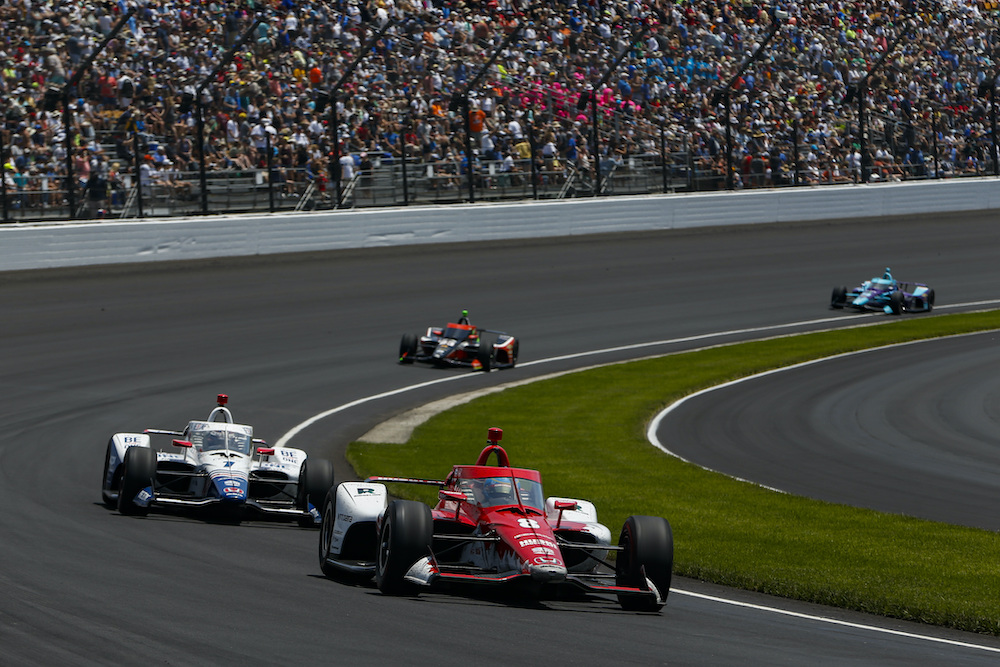
Q: Have you heard any talk about possibly outlawing the "dragon" move that Marcus Ericsson and Simon Pagenaud used at Indy in recent years? I recall several drivers saying they thought it might be impossible to beat after last year's race.
Stu
MP: I can only hope it will be resigned to history going forward as I hated it the first time I saw it done to that degree with Simon, but after asking the series whether it will be outlawed, I’m told there are no changes to ban the weaving and blocking coming in May.
IndyCar has no plans to slay the dragon at Indy anytime soon. Jake Galstad/Motorsport Images
Q: Any chance we'll get the LED panels back with the driver's name prominently displayed? And perhaps, wait for it, use them as a billboard to promote the series and add the money saved to the Leaders Circle pot?
Peter Carey, San Bruno, CA
MP: Bless you, Peter. Unlikely before we go to a new chassis in 2057. What if we asked IndyCar to mandate the installation of a small vertical piece of pipe on top of the roll hoops so teams could install those big poles with flags like you see in truck beds of the support vehicles at NASCAR races, but the flags would have the drivers’ faces and numbers and names on them? I think we have a non-LED winner here. And if every car was required to carry them, each car would carry the same aerodynamic disadvantage, so it would be a wash. Make it so, Jay Frye!
Q: Being a SoCal native who has seen the rise and fall of numerous racetracks throughout my racing lifetime, what’s your valued take on what’s next at Auto Club Speedway? The future with our venue is as tight-lipped as it comes. Any insight here is highly appreciated.
Denny Valdez
MP: I know next to nothing, other than what I learned in a video today where it was said the track won’t be on NASCAR’s 2024 calendar as its revisions -- whatever they end up being -- wouldn’t be completed in time for Cup to return and race next year. I’ll be honest -- it’s not a track I’ve heard of in relation to IndyCar making a future return, so with that in mind, I haven’t paid too much attention.
The one track that I have heard of as a possible venue for IndyCar, although it’s said to be slim odds, is good old Circuit Gilles Villeneuve in Canada. I haven’t been there in forever -- the 2000 Formula 1 race, I think, where I was engineering an Atlantic car -- and would love for us to add a second stop north of the border.
Q: This is quote from another publication concerning F1: "We will never go electric," said Stefano Domenicali in an interview with Italy's Il Sore 24 Ore. Instead, the Italian said that F1 will hedge its future on a "clean, zero-emission petrol" that it is reportedly developing for an anticipated 2026 rollout.” To me, this appears to be a very short-sighted way to look at the future, I would hope IndyCar looks at this as an opportunity to knock F1 down a notch or two.
Mike, Chicago
MP: Echoing what we’ve written a few times recently, I’d look for IndyCar to do as its auto manufacturers call for in the future, and like Domenicali, I don’t expect IndyCar to go all-electric anytime soon. General Motors has targeted 2035 for being fully electric, so what does that mean for IndyCar? If Chevy’s still involved, I’d imagine some hard conversations about what would be relevant for them to race will be front and center. If GM no longer sells vehicles with internal combustion engines, why would it spend tons of money to compete with an ICE in IndyCar, or any other series?
Dumb of Domenicali to say "never" but he clearly can’t see a future where the ICE isn’t involved. I don’t want to see the ICE disappear in IndyCar, ever, but it would be silly to say "never" when we don’t know what the automotive world will look like 10 or 15 years from now.
Q: How much longer before the Mailbag emailers stop complaining about what IndyCar did wrong during the offseason and can start complaining about what IndyCar did wrong during the actual season? The offseason is long and cold.
Genuinely enjoy everyone's work at RACER.
NK, Aurora, IL
MP: Party on Wayne, and party on, Garth. It’s funny; IndyCar’s owners read the Mailbag each week (or, more likely, have the critical items supplied to them in a written brief) and bellow whenever there’s something uncomplimentary submitted and responded to by yours truly. At some point, they just might realize that the Mailbag, for decades, has been the sounding board for IndyCar fans to air their grievances, share their excitement and passions, and expressed everything in between. If IndyCar is doing great things, it’s reflected in the Mailbag with overwhelming positivity. And if IndyCar is doing dumb things, of which it did in rapid fire during most of the offseason, the submissions and tone veers negative.
The Mailbag is a reflection of IndyCar’s fans, plain and simple, which they seem to conveniently forget and focus more on trying to kill the messenger.
We’re nearly a month out from the last gaffe with taking from the teams’ Leaders Circle contracts, but since then, it’s been one positive after another.
So I’m with you here; I hope it’s nothing but smart decisions and business developments for the rest of the year. By nature, I’m a glass-half-full guy. Fingers crossed that the Mailbag is warm and happy for the rest of the year. And by nature, I’m also not a delusional idiot (OK, that’s debatable), so there’s no way it’s all puppy dogs and rainbows going forward, so we’ll handle the rough patches with honesty when the series stumbles and keep rooting for them to succeed.
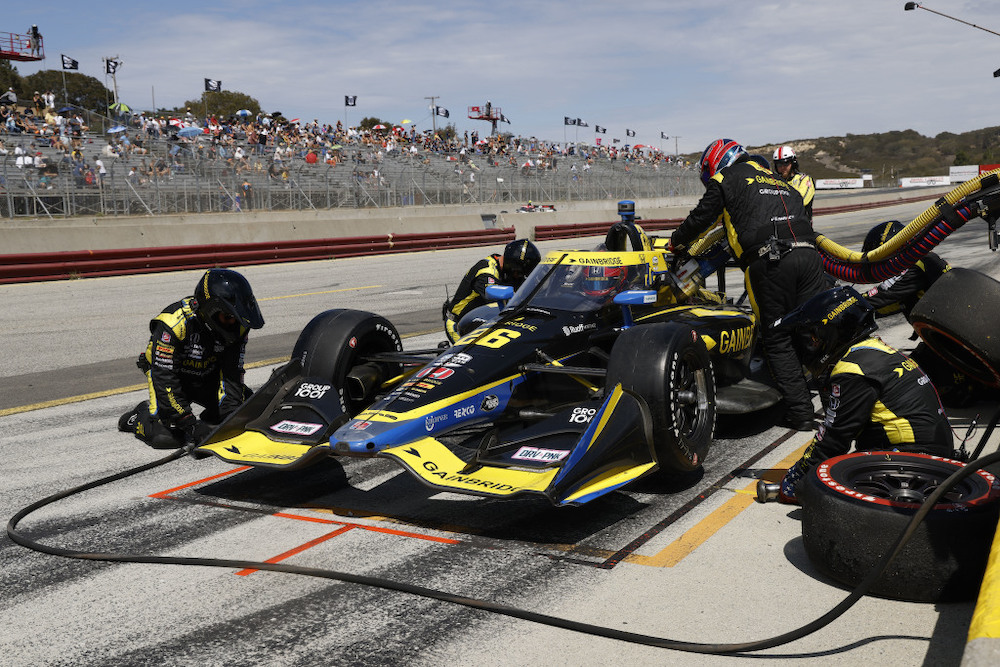
Q: Notwithstanding that Monterey County pays $1.5 million sanction fee to IndyCar every year for what is essentially a broadcast postcard for the Monterey Peninsula (and actually gets a quantified return on their investment), the opening helicopter shot always shows an empty grandstand, as opposed to say, St. Pete, where hundreds of waving hands greet the viewer. Kevin Lee is sure the fans are hiding under the oak trees, which is common in California.
I think of how Laguna could “make the grandstand great again.” Here are some thoughts: The grandstand had its best days with MotoGP. I’m sure you remember Tom Cruise and Katie Holmes on the platform above the pits holding court. That provided grandstand ticket holders a focus point that distracted from the poor sightlines and blurring passage of bikes or race cars on the straight. That could be accomplished with maybe two Jumbotrons above the pit lane which would allow a better context and focus on the race, reducing the boredom factor that can set in.
Also, though this is the pleasant Monterey Peninsula, the sun at green flag is always above and just behind, baking us lightweights. I think a seasonal shade structure would really help make a more comfortable experience. Removal of the old bridge has opened sightlines towards Andretti Hairpin, but the Arrow hospitality center blocks most of that view anyway. Laguna is a wonderful walk-around track, but I don’t think an empty grandstand is the best look for the season finale.
Paul, Carmel Valley, CA
MP: I love the idea of a roof over the main grandstands, and also wonder what Laguna might do to add some thematic options to help fill those stands. How about splitting them into team-based sections? Andretti team/driver fans in Section A. Arrow McLaren fans in Section B, and so on, and work with the teams to promote the special sections to help fill them out. Buy a ticket to Ganassi’s Section C and get a signed CGR flag to wave or something similar… Sit with legends -- Mario Andretti will visit the Andretti section for a few laps during the race… Penske legend and champion/Indy 500 winner Danny Sullivan will visit the Penske section and sign autographs and take pictures from laps XX to XX, etc.
There’s all kinds of fun stuff that could be done, and I’m in agreement; having been to many CART IndyCar races where the main grandstands are full, it would sent a powerful message if today’s IndyCar could show the teams, sponsors, and viewing audience that the primary place where we judge crowd size and event health is packed.
Time to give the Laguna Seca grandstands some love. Motorsport Images
Q: Now that it has been decided to stay with the existing engine for several more years, are Honda and Chevy planning to increase their engine supply and support for the regular season and for the Indy 500 in the future?
I understand that they are losing money on the current engine leases, but it seems as if the growth of the IndyCar field for both the regular season and the Indy 500 is constrained due to Honda and Chevy engines. Both companies have been great partners for IndyCar. Why can’t both companies commit to maybe 16 or 17 engine leases for the regular season, and up to 20 for the Indy 500 if there was demand? This would be an additional two or four engines for the season above what they provide now, and three or four above the current Indy 500 amount.
Due to the expected arrival of the new engines, both companies had probably did their last-time buys for components and didn't want to end up with excess inventory at the end of last season. But with the current engines now to be used for several more seasons, they have had to ramp production or component buys back up.
Since there seems to be desire for several new teams to join the series for the season or for Indy 500 one-offs, I would hope IndyCar management is working with both Chevy and Honda to add a bit to their engine support programs for the good of IndyCar.
Do you have an insight into what next year might look like? Also, what is your guess on the car count for the 500 this year? Anything above 33?
Rod, Fresno, CA
MP: Not a lot to add to what you’ve put together. Both manufacturers began ramping down their 2.2L ordering a while ago, so they’re having to recommission new items -- some that take six months or more to be delivered -- to keep the motors in play beyond 2023. That means Chevy and Honda won’t be turning the Indy 500 entry list up to accommodate 37 combined cars.
We already have 33 in place, so from what I’m told, there might be a 34th if one or two possibilities get their programs in order, and if they do, it would be a case of whomever is ready first would likely grab that final motor. Stretching out to 35 would be a big surprise, and if we ultimately close the entry list with 33, I won’t be shocked.
As for next year, there should, in theory, be a greater possibility of supporting 35-36 entries.
Q: How often does the screen on the aeroscreen need to be replaced?
Dick Mason, Crawfordsville, IN
MP: Unless it’s taken a hard hit from debris and its manufacturer PPG and/or IndyCar say the aeroscreen laminate must be retired, they aren’t an item that gets replaced due to mileage. Teams apply a base protective tear-off layer and then apply multiple layers on top of that which get removed as necessary, and with that in mind, the tearoffs keep the aeroscreen fresh and in service for a year or more. Minus damage requiring a change, they aren’t considered a consumable item according to the crew chiefs I’ve spoken with.
Q: In the recent Mailbag there were comments about the tight confines of the L.A. Coliseum race, and of the possibility of making it a points-paying race. My take is… different.
As it is, I think the Coliseum Clash is hideous. But my solution is quite simple: First, forget any thought of making it part of the regular season. Then, have every Cup team buy a Legends car and paint it in the same livery as their Cup car. Run the Legends cars in the Coliseum instead of the Cup cars, in an otherwise identical Clash format. Same heats-semifinal-feature program, same Cup drivers, same
Cup teams.
It would be far more interesting, it would have far better racing, and I think that everybody, from fans to drivers, would enjoy it more.
OK, I can think of one fly in the ointment: Legends car bodies were designed to resemble vintage Chevrolets and Fords. So it might be advisable to knock off a copy of a 1930s Toyota AA, but how hard could that be?
Bob in NJ
KELLY CRANDALL: If you wanted to throw any and all ideas at the wall as to how NASCAR could turn the Busch Light Clash into a points race, you’d need a new wall. I hope you have good insurance or a contractor. This idea, however, doesn’t seem feasible for two reasons. First, you want teams to spend more money for a one-off race as well as do additional work? Good luck with that. Second, this idea would mean 35 of the 36 points races would be run with one car and rules while the other would have different rules, cars, etc. You might have trouble getting people to buy into that. A points race at the Coliseum would be a terrible idea and I’m hoping NASCAR is listening to drivers and others who aren’t in favor.
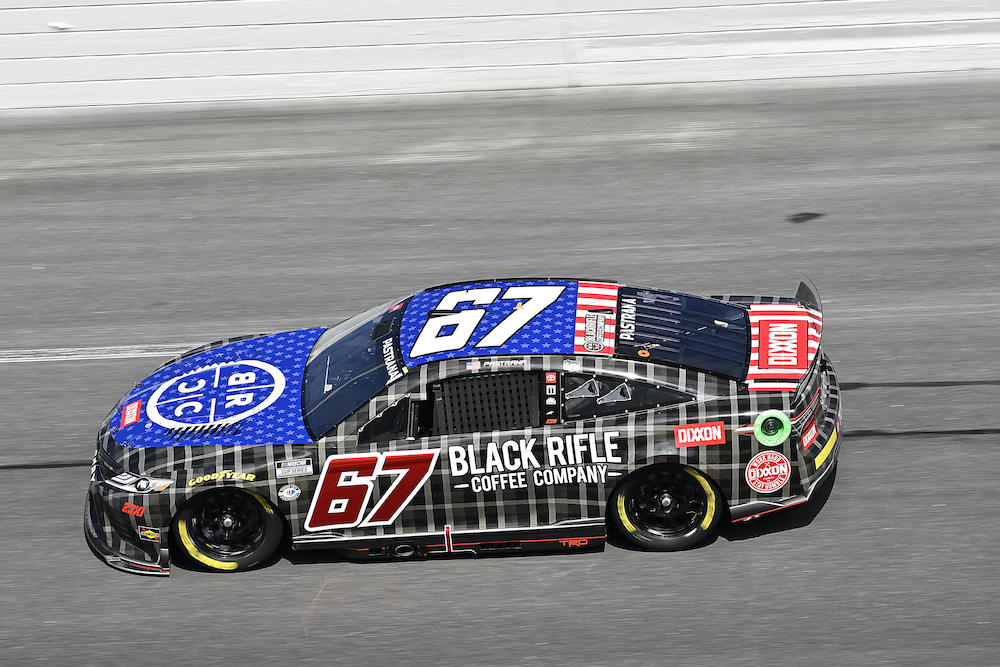
Q: Travis Pastrana got wrecked at the end of the Daytona 500, then remarked, "the car is not a complete write-off, so the kid’s college fund is intact."
I assume he was joking, but are there contracts where drivers share at least some financial responsibility if the race car is damaged?
Brian, Ohio
KC: Every driver contract is different, and some teams might have clauses that a driver is responsible or has to work in the shop if they wreck their stuff. Some younger drivers have been known to do that because they felt bad for their guys and wanted to show they were a part of the team. In Pastrana’s case, it was a unique situation. Pastrana said after he qualified for the Daytona 500 that he felt fortunate to be there and he was going to pay for any crash damage he suffered during Speedweeks.
You break it, you buy it. John Harrelson/Motorsport Images
Q: I found Don from California’s question about “what value did Haas bring to F1?” in last week’s Mailbag to be spot-on. For me, Haas has been an incredibly disappointing venture outside of its first two-three seasons when it punched above its weight and seemed to be steadily progressing. It seems to me it entered the series with the "goal" of being a consistent midfield runner. Unlike the proposed Andretti/Cadillac team, Haas didn’t bring any new manufacturers to the party, opting instead to buy customer engines from Ferrari. I can’t recall the last time an F1 team that used customer engines from a manufacturer that also has a factory team (Ferrari, Mercedes) have any significant success.
The fact that it is an American team in name only since, as far as I’ve heard, it has never expressed any desire to partner with an American manufacturer or even consider an American driver, is also uninspiring. Then, it basically tanked the 2021 season to prep for 2022 when great things were supposed to be coming. Lastly, the whole Nikita Mazepin escapade was a joke. Taking the Russian oligarch money even though Mazepin was clearly not up to the task of being an F1 driver was an embarrassment. I thought Gene Haas was a billionaire industrialist? He could find no other options for funding? Am I off base in my perception? What is your assessment of the team as it enters its eighth season?
Rod, Houston
CHRIS MEDLAND: If I’m honest Rod, I think both yourself and Don are being extremely harsh on Haas! It’s so easy to look at things through today’s lens when prospective new teams are desperate to come in and there’s loads of commercial interest, but when Haas came in, F1 wasn’t nearly as popular or lucrative. At that point, no new team had survived for 20 years -- Stewart Grand Prix (1996) is the last new team to still be on the grid before Haas, and even that required selling multiple times to evolve into Red Bull.
It had to do something different to establish itself, and then was still in a more robust position than Williams, for example, through the pandemic. Using Williams as the benchmark, that’s also a customer team that takes its power unit and gearbox from another team (Mercedes) and has actually been moving more towards the Haas model in recent years by taking more components rather than less.
Most teams on the grid are customers -- big names such as Aston Martin and McLaren among them -- and that used to be less of an issue. The last customer team to win titles was Red Bull with Renault -- it’s only been the Mercedes V6 dominance that really made it so much harder to achieve, and F1 has been trying to prevent that being the case moving forward.
Andretti also wouldn’t be bringing a manufacturer in the way it might appear to some. It would be a Renault customer, but Cadillac says it intends to offer its own IP to aspects of the 2026 PU so that it’s more than just a badging exercise (Red Bull and Ford is pretty similar, with Ford’s input mainly being around the battery technology and the rest a naming partnership).
Mazepin was one of a long line of drivers who have the door opened by money, and if anything I’d say Haas has been impressive in how quickly it ditched the Mazepins and now has two extremely experienced strong drivers for performance reasons and not marketing ones. It was smart business -- the team was going to take a while to turn around, so why spend millions on drivers who would be in an uncompetitive car when you could take millions to help build a better one more quickly?
With a new (U.S.) title sponsor, I’d say Haas is heading pretty solidly in the right direction, but look at all the midfield teams -- it’s a massive gap to the top to bridge, and they're all fighting each other but so far off the likes of Red Bull.
I don’t want to seem like I’m disagreeing with everything you say though Rod (and Don!), because where I think you’re right is I don’t yet see the ambition to move the team forward any further than the midfield. The way it’s currently structured will make winning championships almost impossible, and the team will need to evolve and expand to be able to target those sorts of results, but I haven’t ever really heard that be the aim.
However much financial and commercial sense it might make, when you’re entered in a sporting championship, you want everyone to aspire to winning it one day.
Q: Several questions on the FIA's speech restriction in the sporting code, and the recent update and clarifications to the rule.
Did the update to the regulations to include "in violation of the general principle of neutrality" and corresponding clarifications solve the underlying concern, or is it just an attempt to pacify those who have been complaining?
Speaking of the "principle of neutrality," I don't see it anywhere in the FIA statutes (as it was stated by the FIA when defending the change). Am I missing something? Am I wrong in drawing conclusions that this greater interest in neutrality and "harmonious relations with national authorities" may be a result of new FIA leadership and/or F1 race venues that might be perceived as less harmonious?
I do see the FIA statutes take a distinctly non-neutral approach in that they "shall promote the protection of human rights and human dignity, and refrain from manifesting discrimination." Do you expect any drivers to use this language to argue that their speech at race events supporting these various causes is appropriate?
And finally, how dare the FIA ban speaking for #MePersonally?
Bakkster, the General Principal of Neutrality
CM: The update certainly didn’t solve the underlying concern, which is the threat of sporting sanctions for a wide range of statements. And you’re also right that “neutral” or “neutrality” doesn’t exist in the statutes.
As you’ve pointed out, the closest point is Article 1.2 where it says: “The FIA shall promote the protection of human rights and human dignity, and refrain from manifesting discrimination on account of race, skin color, gender, sexual orientation, ethnic or social origin, language, religion, philosophical or political opinion, family situation or disability in the course of its activities and from taking any action in this respect. The FIA will focus on underrepresented groups in order to achieve a more balanced representation of gender and race and to create a more diverse and inclusive culture.”
I absolutely believe that 1.2 could provide drivers with a counter argument, but the issue is the FIA has explicitly said they need prior approval. So it’s not necessarily saying it will take exception with what they say, it’s with the fact that it wasn’t pre-approved…
F1 CEO Stefano Domenicali has made clear he is happy to back the drivers up to a certain point, and a line does have to be drawn somewhere, so I expect it to remain a gray area that is constantly open to interpretation. Which means we’ll be talking about it for a while, but I think the drivers are united to the extent that they will continue to speak up when they feel it is warranted and back each other doing so.
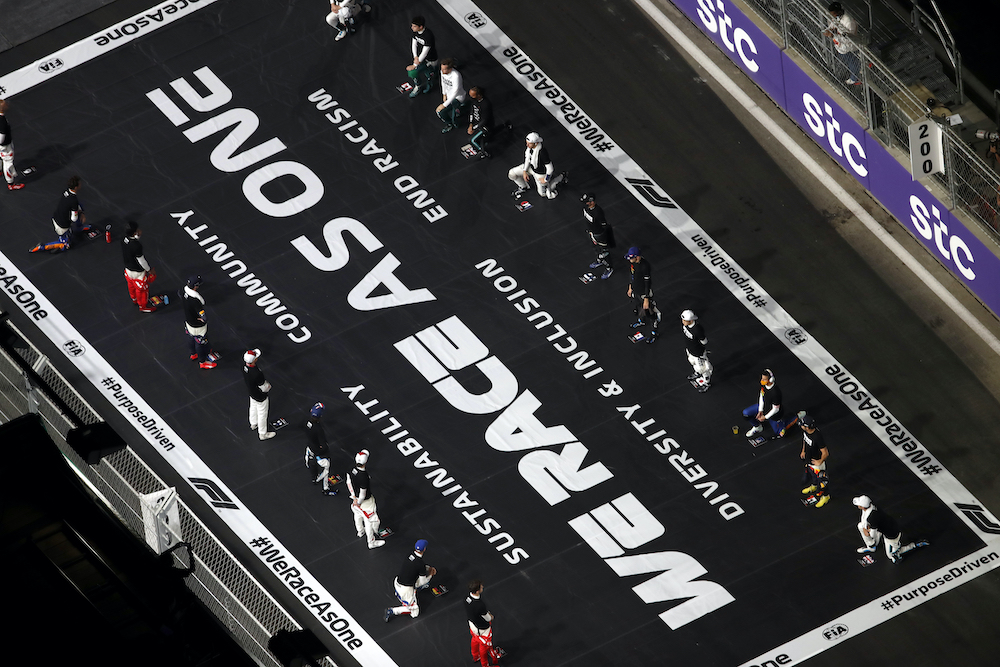
They'd better be kneeling on the FIA-approved knee. Zak Mauger/Motorsport Images
THE FINAL WORD
From Robin Miller' Mailbag, March 5, 2014
Q: I have a bunch of old VHS tapes with the CART races from the 1990s and after reading a story in Car and Driver from 2010 about Paul Tracy, I pulled out and watched Phoenix from 1993. What I noticed most was the cars seemed much faster but the speed differential between the Penske cars and the rest of the field was unbelievable. We all know the story of PT crashing with two laps on the field, but what I did not realize was Emmo crashed out a few laps later. He said that something broke, but is that really true? Sam Posey and Uncle Bobby said about Paul that as soon as you lift and lose traction the back end of the car spins around. Mario went on to win, which was his last win.
Then on to Long Beach, where PT said he fell off his mountain bike but we now know he crashed racing shifter karts with Mark Smith. PT seemed to know that if he did not perform in that race, his chances were slim on keeping his ride. He then gets a flat tire, passes Mansell and wins the race! An incredible drive.
My questions are 1) Was it ever proved or admitted that the Penske cars were using traction control? 2) How volatile was Roger and PT’s relationship? I guess as long as you make it to victory lane, all is forgiven. I’m a huge PT fan and watched his entire career starting in Indy Lights, but as exciting as he was, there were many disappointments, too. What do you think his real potential might have been if he learned some patience and savvy, a la Rick Mears? Speaking of Indy Lights, is it true that Vince Neil ran a few races?
Jim Doyle
ROBIN MILLER: Tracy should have won the championship in ’93, he led the most laps and tied Mansell for victories with five but had seven DNFs. But we loved him because he could be brilliant or brain-dead all in the same race, and his passes alone were worth the price of admission. The Captain farmed him out and then brought him back but they were oil and water, much like Penske and Tom Sneva. As for traction control, we always thought that was between Honda and Toyota, much later in the ’90s. Yes, Neil did run some Lights races and Derek Daly touted him as the next Senna (just kidding).
Marshall Pruett
The 2026 season marks Marshall Pruett's 40th year working in the sport. In his role today for RACER, Pruett covers open-wheel and sports car racing as a writer, reporter, photographer, and filmmaker. In his previous career, he served as a mechanic, engineer, and team manager in a variety of series, including IndyCar, IMSA, and World Challenge.
Read Marshall Pruett's articles
Latest News
Comments
Comments are disabled until you accept Social Networking Cookies. Update cookie preferences
If the dialog doesn't appear, ad-blockers are often the cause; try disabling yours or see our Social Features Support.