The RACER Mailbag, November 2
Welcome to the RACER Mailbag. Questions for any of RACER’s writers can be sent to mailbag@racer.com. Due to the high volume of questions received, we can’t guarantee that every letter will be published, but we’ll answer as many as we can. Published questions may be edited for length and clarity. Questions received after 3pm ET each Monday will appear the following week.
Q: I really enjoyed this year’s Idemitsu Mazda MX-5 Cup. Seems like a lot of bang for your driving buck. Is there a lot of "liberal interpretation of the rules," aka cheating, or is it as tightly policed as is advertised? In my experience, it wouldn’t be racing if someone wasn’t looking to bend the rules as much as they thought they could get away with. What do your paddock spies tell you?
David Kincaid, Vancouver, BC
MARSHALL PRUETT: It provides the closest racing you’ll find, which should offer a guide to how it’s policed. When you have insanely close racing in a spec series, it usually means its rules are being upheld. The series takes technical compliance as seriously as any other professional organization.
I was fortunate to field an entry during the MX-5 Cup’s inaugural season in 2006 with my friend and co-owner/driver Larry Webster, and it was a blast. As soon as I can find a 3XL MX-5 seat, I’m driving in the series.
Q: It's been reported by you and others that Colton Herta’s contract extension includes a huge rise in his salary, supposedly making it twice as much as the next highest-paid IndyCar driver’s. It's no secret that IndyCar salaries have been rising over the years and now every driver on the grid can honestly say they're getting paid some amount -- something that couldn't be said just years ago. But for Andretti to give Colton such a high salary jump in such a short time… does that mean trouble for the rest of IndyCar?
In the NFL, if a player becomes the highest-paid person in his position, it won't be long until someone else tries to top that amount. This also raises the salaries of not only the stars and starters, but backups and third stringers as well. Can something like this happen in IndyCar? Or will it be like F1 where there are those who make huge boatloads of money and those who belong on smaller teams that don't even make a million dollars a season?
Tom, Milwaukee, WI
MP: Thanks, Tom, yes, I believe we were the first to share that little nugget on Herta’s big salary bump. The $7m per year I’ve heard for Colton is closer to a CART-era Michael Andretti Newman/Haas Racing/Texaco than any other drivers that come to mind since. But I’m not worried about it breaking the bank elsewhere.
It should, hopefully, lead to increases for all of the best drivers who are currently in the $2m-$3.5m range, but Herta’s rumored salary is a serious outlier for what the Penskes and Ganassis and McLarens are going to pay. I’d frame Herta’s salary around his unique value to the Andretti team. For all he represents to them, with the added possibility of becoming Andretti’s lead F1 driver if that comes to pass, this is a wise investment.
Looking to the future, Andretti Autosport has just one proven front-runner within its ranks, and that’s Colton. We hope Grosjean and Kirkwood and DeFrancesco find their way to podiums and victory lanes, but for the coming years, Herta’s the only one of the four to prove he’s capable of leading Andretti to the places where the team’s reputation belongs.
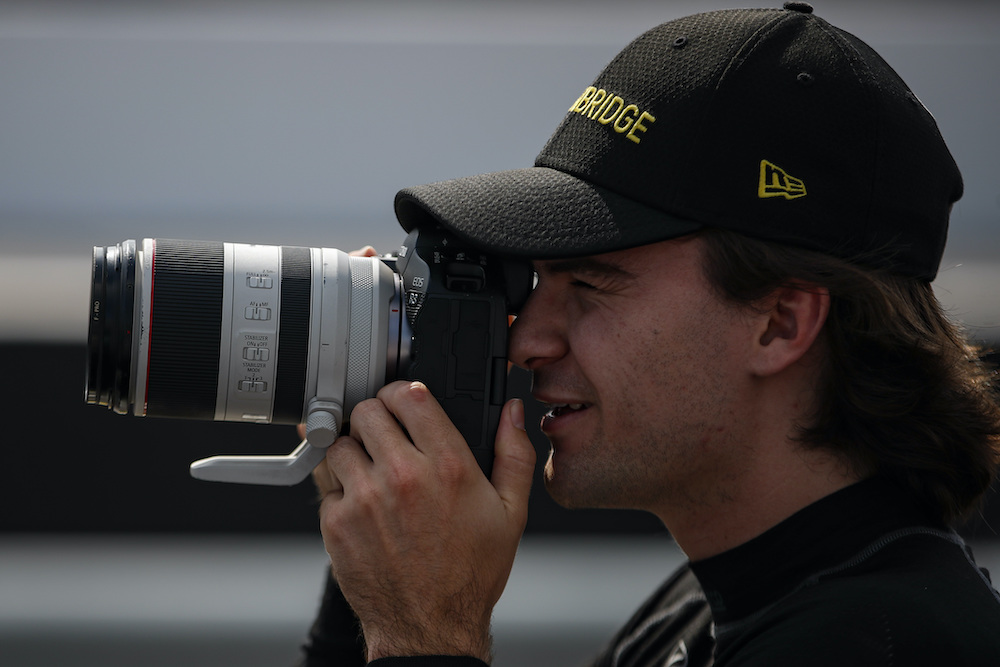
Photographers complain about how much their gear they have to lug around, but Herta's carrying a four-car team on his shoulders. Jake Galstad /Motorsport Images
Q: I thought that your response/comment(s) in the previous Mailbag to the question regarding Roger Penske's reduction of the Indy Lights champion’s prize money was on point. Yes, by all means, open-wheel fans need to thank Penske for his purchase of IMS and the series and his stewardship through the pandemic. The upgrades at IMS were great. But frankly, I enjoyed the race just as much when I had to pee in a wooden trough lined with roof shingles inside an old wooden shack in the infield as much as I do now in the newly-upgraded restrooms.
Penske runs a corporation with 60,000+ employees that generates somewhere between $14 and $17 billion a year in income. Inarguably, a damn successful businessman. But like you, in his IndyCar management, I had hoped for a lot more at this point.
Why haven't we seen a long-term plan from Penske Entertainment for taking IndyCar to the next level? Or as you commented, where is the mission statement for growth?
The fact that nearly every other major racing series seems to have emerged from the pandemic with aggressive plans, new venues and exciting announcements reflects negatively on IndyCar's apparent status quo positioning. Upgraded bathrooms are nice. Cutting prize funds and racing the same old schedule once again doesn't instill a whole lot of excitement, nor growth in the fan base. Thus far, I’m thankful for the great racing, but increasingly disappointed no one knows about it.
Jim, Indy
MP: In recent months, I’ve thought back to former IndyCar president Derrick Walker and how he was given the freedom to develop a long-term plan for the series. Sitting in on his post-Indy press conference at Detroit in 2014 where the introduction of aero kits for 2015 was made, it was a refreshing take on where IndyCar could head. It had speed increases at Indy, engine developments, and all manner of high-aspiration items on the menu spread out for the next six or seven years, I believe.
The series told us what they wanted to be and spelled it out in clear, year-by-year increments as a road map for us to follow. I’m not saying that I believed every item on that timeline would materialize, but at least it spoke to the type of boundary-pushing spirit that propelled IndyCar forward since its formation in 1911. Granted, team owners soon turned on Walker and the support he had from the Hulman George family disappeared, but that was normal back then.
So, who are we, what are we, and where are we going today? I know IndyCar president Jay Frye is always full of big ideas. But will the new series owners get behind him and let him produce an aspirational road map of his own?
Q: I see a lot of comments from sports car drivers, particularly the factory hotshots, about how much they love racing in IMSA. When they get assigned to the WEC or something else, invariably something surfaces about how they want to come back to the U.S. to race in IMSA. Nick Tandy comes to mind as an example, and I just read a comment by Felipe Fraga about it, but it seems pretty consistent. What is it about IMSA that European sports car drivers seem to like so much vs the WEC or DTM or other series?
Ben
MP: It’s a very strict and over-regulated environment in the WEC. It’s not like IMSA doesn’t have 1000 rules of its own, but there’s a friendlier experience to be had for its participants. Warmer paddock, warmer pit lane, led from the top by IMSA president John Doonan, the nicest person you’ll find in charge of a major racing series.
Q: I attended the USGP at COTA on Saturday for practice, qualifying and a few vintage F1 cars running. That was it for the whole day, and the place was darn near packed. Sunday, it looked completely filled up. I don't get it. Why is the place filled up with people?
It just does not compare at any level with the sounds, competition and speeds of IndyCars. I stand down in Turn 1 at Indy on Carb Day every year and it literally takes your breath away. I just don't sense that with the current F1 cars. What am I missing?
Gary Alexander, Round Rock, TX
MP: Hard to stack the incomparable experience of seeing and hearing and feeling cars explode through Turn 1 at Indy at 240mph to anything F1 might offer at COTA. As for what you’re missing, hey man, F1’s the cool new thing, haven’t you heard? (That’s actually been around since 1950.)
Today, the cars are crazy-fast. The drivers are treated like rock stars. Fans are kept at a distance, which tends to create an air of exclusivity and importance for the subject matter. And since the average person likes to be included in and associated with cool new things, F1 has exploded here at home. But I get the reason behind your skepticism. Only the delusional believe F1’s on-track product is spectacular. It has its high points, of course, but the average race is a test of one’s attention span.
If it weren’t for the world’s longest F1 pit stop at COTA when things went sideways for Verstappen, it would have been a snoozer, but he overcame the deficit, retook the lead, and natural order was restored. And then you have Sunday’s Mexican GP, which was a fairly typical affair: Tune in for the start, acknowledge the person leaving Turn 1 in the lead will most likely be the winner, watch as non-Red Bull teams try various strategies that don’t end up working to alter the outcome, and hail the almighty Verstappen and his all-conquering RB18 in the end.
We did the same thing with Mercedes and Hamilton before that, and Vettel and Red Bull before that, etc. F1’s new car/formula for 2022 has given us more passes behind the leader, but with a 70-percent win rate for Max through 20 of 22 races, I’m finding it hard to pinpoint how things have really changed at the sharp end of the field. Last year, Max won "just" 10 of 22 in the final season of the previous formula. Look back to 2020, and with his unstoppable Mercedes W11, Lewis won 11 of 17, or 65 percent of all the races. The year before, it was a modest 11 from 21…
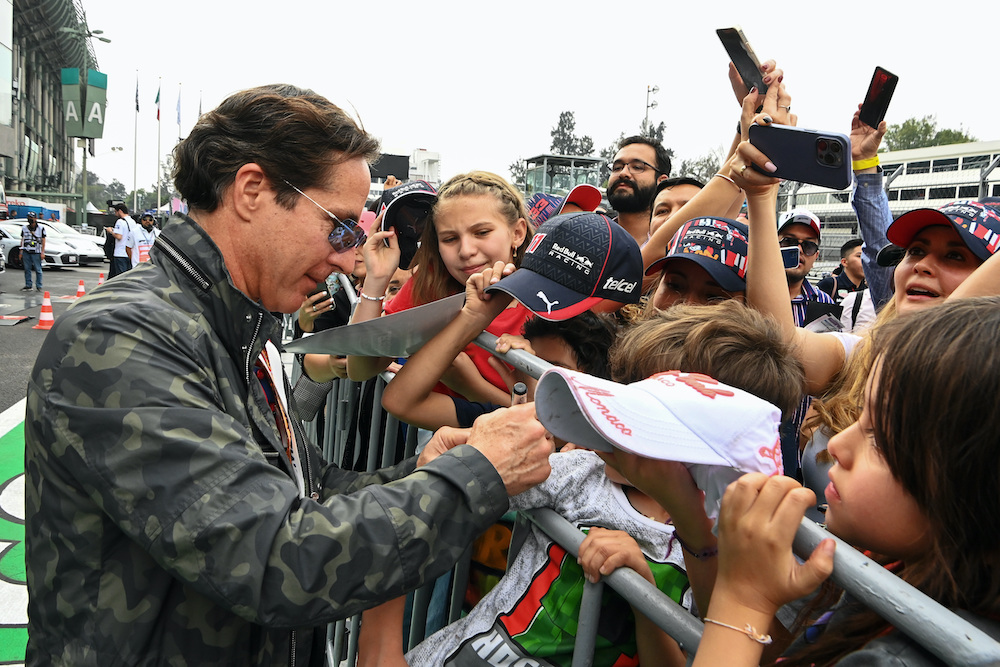
They may be F1 fans, but they know when they're in the presence of greatness. Mark Sutton/Motorsport Images
The point being is if you’re a newish F1 fan, be prepared for one team and at least one of its drivers -- if not both -- to dominate each season. Throw in the two wins by Sergio Perez, and Red Bull’s taken 80 percent of the victories in 2022. Since people don’t tune into races to see who places seventh, it’s the victories we monitor, and for all the noise made about this new formula, I guess I don’t see the difference at the checkered flag. And that’s nothing new. I still have the 16 VHS tapes I kept from ESPN’s broadcasts of the 1988 F1 season where McLaren went 15 of 16, and the only thing keeping it from being a clean sweep was Senna tripping over a backmarker while leading at Monza.
IndyCar has been the cool new thing on many occasions over the last century. F1 has also been super-loved in the past, and largely ignored by us in the past. Live long enough, and you see the boom-and-bust cycles for all the major racing series. Some, though, have booms and busts that last far longer than expected. If it weren’t for COVID and a ton of people stuck at home browsing through Netflix and happening upon "Drive To Survive" in 2020, we wouldn’t be witnessing F1’s big boom.
There’s nothing radically different in what F1 offered fans in 2019 than what it offered in 2020, so there’s zero reason for the drivers, cars, or on-track product to suddenly capture America’s interest. F1’s been here forever, but until DTS, it was stuck, like IndyCar, as a niche sport that had nothing but diehard fans. Now, it’s the cool new thing. And that will change. It always does -- doesn’t matter which series.
Q: With Hinch in the booth and Palou getting an FP1 appearance, I would say that COTA was a pretty good weekend for IndyCar in terms of exposure and credibility in the eyes of the F1 snobs. Your thoughts?
Ian
MP: I’m told F1TV might want to hold onto Hinch, which would be great for them and terrible for us.
Palou’s outright speed in FP1 was the best free advertisement IndyCar’s had in 20 years. IndyCar is where he went to develop the last few percent of his talent and he was rewarded with a hard-fought championship victory. He returned to defend his crown and was smacked around for most of the year, which only reinforced how tough IndyCar happens to be. And then he nearly matches McLaren’s Lando Norris, one of F1’s most celebrated next-generation stars, on the stopwatch on the same tires, which further showed where top IndyCar talent stands. Hopefully, that doesn’t lead to poaching of our best drivers, but that’s not a real concern.
Q: Just to add to the Super Formula discussion started by Tom Yang, they’ve mentioned that beyond the carbon neutral fuel and tires (very similar to stuff IndyCar has announced), they’re using hemp-based bodywork on part of the car, like DTM tried a few years back. But the borrowing of ideas from IndyCar (or at least, coming to the same conclusions) continues with a set of new bodywork for 2023 that drops downforce 15%, and massively reduces the wake turbulence to promote more passing. (The IR18 was so far out in front of everyone else on this, and still looks better than the rest).
Unfortunately, the other thing that they are borrowing from IndyCar is a refusal to introduce a new car any time soon. They say a new chassis will arrive in 2026 at the earliest.
While IndyCar and Super Formula obviously do have financial constraints, it’s worth noting that the lack of new cars is going to hurt. During the same timeframe, F1 has introduced the first intelligent set of rules it has ever had (the 2022 chassis rules), and will be introducing a big step forward in 2026, while Formula E is debuting a 2023 car that is 60kg lighter and with 29% more power (now 470hp), and will be looking at maybe going to 800hp in 2026 with the Gen4 car (with further weight loss on the table, too). That’s a lot of shiny new toys to compete for limited attention and budgets, and while F1 is its own beast, Formula E, with its budget cap, is very, very close to IndyCar or Super Formula costs, but maybe a much more appealing package for corporate backers with its upwards bound narrative and new things to show.
I think IndyCar might want to be a little braver, as things seem to be changing around it faster than the series seems to understand.
Duncan in Ottawa
MP: There have been many intelligent F1 regulation sets over the years, brother. I wouldn’t place what we have in 2022 anywhere near the top.
As for IndyCar, you’re spot-on. Let’s say we have a new fan who started following in 2019. Since then, they’ve seen an aeroscreen get bolted onto the cars, but that’s the start and end of keeping-things-fresh. In that same span, we’ve had NASCAR drop a new car, F1 drop a new car, seen flashy new events at the L.A. Coliseum, Miami, Chicago, and Las Vegas either happen or get announced, and if we go to IMSA, they’ve had an exciting new hybrid formula in GTP get announced that goes live in January.
We’ll get a new synthetic fuel next season and hybrids in 2024. The fuel part is the most interesting for me; that’s the one and only area of technology where IndyCar will be leading the major series it competes against.
First hemp bodywork I saw in action was at the 2009 ALMS race at Laguna Seca. Small team made the engine cover for its Radical LMP1 chassis out of the material.
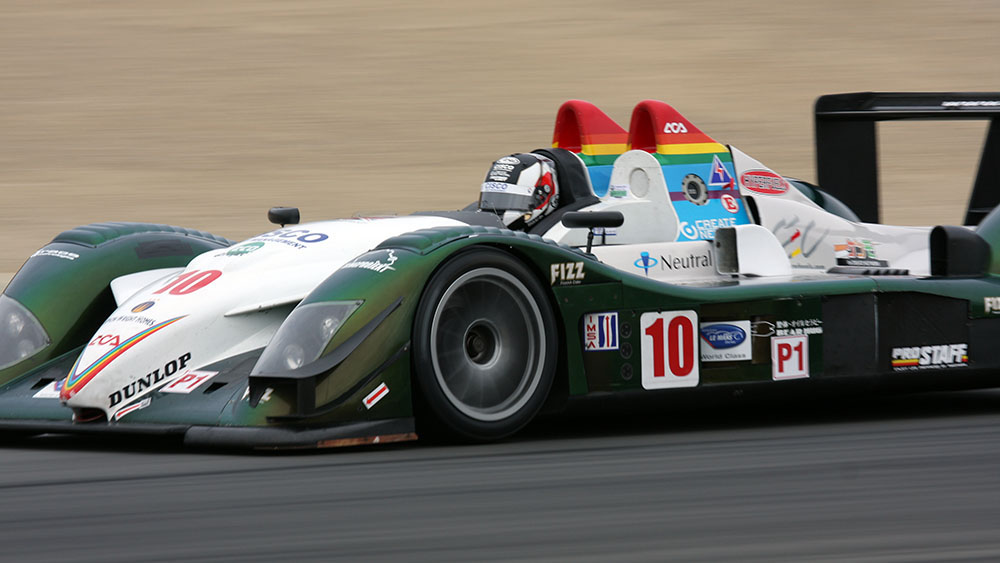
Was a product related to hemp to blame for the Radical's engine cover fitting so badly? Image by Marshall Pruett
Q: I saw the RACER article about IndyCar testing coming to the Thermal Motorsports Park next February. Have you heard of any steps that will be taken for next February in order to accommodate spectators?
I think it is interesting how IndyCar has chosen to rein in costs, prevent one team from dominating and control speeds by utilizing spec cars and bespoke engines that the teams can’t modify. It’s a very different thought process to what F1, IMSA and NASCAR have done. It’s not a better than/worse than kind of thing. It is thinking about what is best given the circumstances of a particular series.
That is also true for me across the other major sanctioning organizations, in spite of their apparent differences. Drivers, and cars, win for very particular reasons, but that isn’t explored very often. In my opinion, in order to make the sport accessible for new fans, and this is across the broadcasts of all four organizations, more sophisticated topics are rarely covered. That leaves us who are way beyond casual fans wanting more. I’m a retired mechanical engineer so the technical side of the cars and competition is always of great interest.
Don Hopings, Cathedral City, CA
MP: No spectators will be allowed at Thermal’s Spring Training. Last thing I heard is the series is working on offering live streaming so it doesn’t happen in total isolation, but there’s nothing confirmed so far.
I wouldn’t include NASCAR and IMSA alongside F1 in terms of different thought processes to IndyCar. NASCAR and IMSA are the two most highly controlled and restrictive series in the country; IndyCar is only a little bit more open, but it’s noticeable.
I’m a retired race car mechanic and engineer who is continually sad that we have a series where the cars and engines are old enough to attend junior high school old.
Q: Just finished reading "Survival of the Fastest" by Randy Lanier along with A.J.Baime. It’s a fascinating tale of Randy's escapades back in the ’80s. Damn good racer and risk-taker, as it turns out. You have a couple photos in the book to your credit of the No. 56 and No. 57 Blue Thunder March-Chevys from 1984.
I was at a lot of those Florida races and now realize that the burning rope smell was coming from his pit when I thought all along it was from my camp neighbor. Did you have any contact with him or the Whittingtons or Pauls? Any stories, anecdotes, gossip you can maybe share, and of course keeping in mind the Statute of Limitations? DO YOU KNOW WHERE THE GOLD BARS ARE BURIED?
Jeff, Florida
MP: Thanks, Jeff. Yes, those photos are a few from an archive I own. The International Marijuana Smuggling Association had returned to plain old IMSA by the time I arrived a few years later, so all of the stories I’ve been told have either been published in stories and podcasts, or shared in private. Keep in mind that for most of the crew who supported their efforts, the passage of time and disassociation with drug smugglers has been important; spinning big yarns about what they witnessed and the illegal trade that paid their salaries has, in my experience, not been something many have wanted to do.
That being said, one tale about the Whittingtons adding gunpowder to the fuel cell of a Porsche 935 and marveling at the long green flames shooting from the exhaust -- before the motor went kerblammo -- is something I hope to capture in audio form in the coming months at Daytona.
Q: I'm always carrying on in the comments about what I perceive as being wrong with the IndyCar hybrid program and thought I would bring this to racing gurus on high.
First, I'm all for hybrids, just not serial hybrids as are being proposed for IndyCar engine manufacturers. Serial hybrid technology has already been developed in many other racing series and virtually nothing will be gleaned from IndyCar. That ship has sailed -- IndyCar missed it by 5-10 years -- so leap past that, and lead instead of following a lap down. F1, from what I understand, is dropping hybrids in few years. Also, theirs are lot more complex and expensive as compared to just increasing displacement and/or boost.
So how could it be innovative and forward-looking? A parallel setup with the electric motors to drive the front wheels, which would offers a host of benefits:
1) The amount of regeneration under braking would be about 220% greater, allowing for more power with a lighter, smaller battery that is less expensive.
2) Having four driven wheels should significantly improve lap times.
3) Cars get under power without stalling, and in some cases, out of gravel traps without causing a yellow flag.
4) It would allow potential engine manufacturers to develop technology that is new and unique, since if IndyCar just went hybrid they would be beating down a door doesn't appear to be materializing.
5) Being decoupled from the engine would mean it could simply be removed for large ovals like the 500 in the event it just doesn't provide any real-world benefits, which seems likely. It could also be developed simultaneously while the current system is in use, or leased to other engine manufacturers for a duration while they get up to speed.
6) It would get some serious press that IndyCar lacks and needs. We have the best racing, the most diverse series and could also have the best platform where IndyCar has speed parity with F1 at a fraction of the cost and would eat their lunch in the wet.
IndyCar has been slowly gaining global respect and recognition but still needs a boost. This might be what the doctor ordered if Honda and Chevy would buy in.
JamBo, Brazil, IN
MP: I guess I never thought of IndyCar as the place where Chevy and Honda would have the ability to promote their all-wheel-drive trucks, but this concept would certainly make that technology and promotional transfer possible.
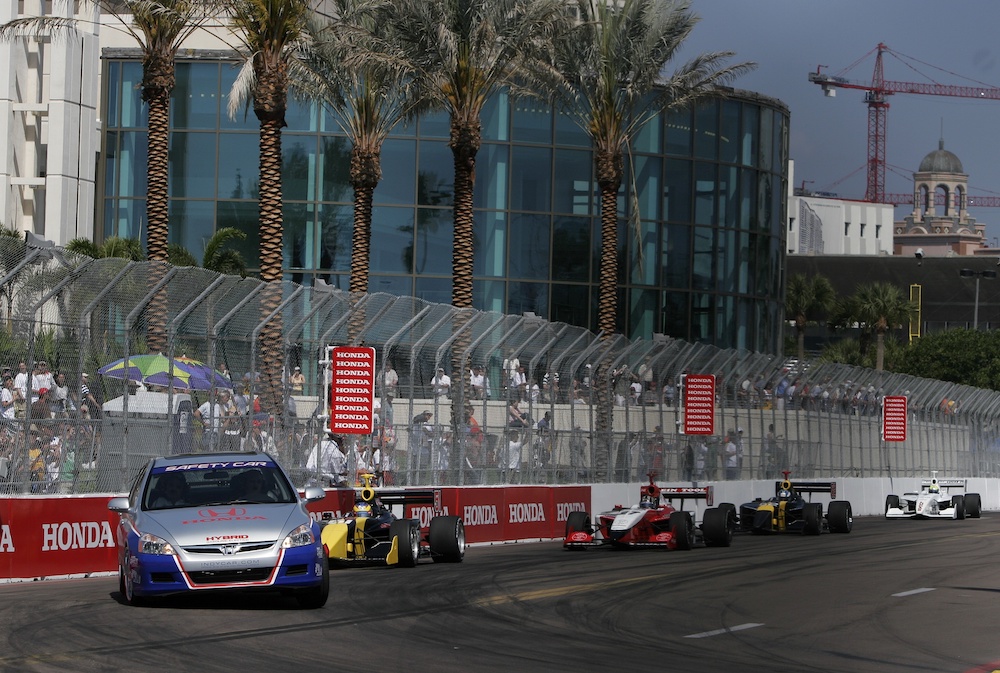
Hybrids are nothing new for IndyCar. We had a cutting-edge Accord pace car 16 years ago. Dan Streck/Motorsport Images
Q: I’m starting to agree with Roger Penske about developing a new IndyCar. Why bother? If there is a new car, we know it’ll come from Dallara, and it will be some incremental change that Dallara typically does. As a consequence, you can forget about a new engine supplier coming into the series. Car companies yawn at IndyCar’s new hybrid formula, which isn’t a true integrated hybrid formula at all. It’s just a piston engine with a push-button electric motor boost. That’s hardly a marketable idea.
The way to get the millions of dollars streaming into the IndyCar series is to follow Formula E’s example -- think big. Half the weight, half the drag, half the power, all of the speed. Sound familiar? If IndyCar adopted a DeltaWing-style car with a zero emission hydrogen motor, international automobile manufacturers would inundate the series, much the same way as they did in the fledgling days of Formula E.
Ben Bowlby was right! And the ICONIC Committee set back AOWR back 20 years. Rant complete.
Don Davis
MP: Why bother? Sweet Baby Jesus, Brother Don. Because IndyCar is becoming a vintage racing series with each passing season. NASCAR? New car/formula. F1? New car/formula. IMSA? New car/formula arriving in 2.5 months. IndyCar? Let’s see if we can use the same chassis for 15 years!
And sure, we have new hybrid engines coming in 2024, which is a first for IndyCar, but it’s old news. We had a hybrid LMP1 prototype here in the ALMS in 2008; F1 debuted its first hybrid halfway through 2009; IMSA’s going hybrid in 2023, and F1’s been 100-percent hybrid since 2014. Go back to the 1990s, and we had "Sparky," Don Panoz’s hybrid Le Mans racer…
IndyCar is your friend who just discovered "The Office" or "Game of Thrones" many years after it went off the air and long after it stopped being a cultural phenomenon, but wants to talk about it like it’s the hot new show because to them, it is new. Again, I’m genuinely happy that we’re going hybrid, but other than NASCAR, we’ll be the last to the party.
This is a big part of the problem. To date, Penske Entertainment has shown no imagination and no creativity when it comes to its future. Trust me, its competitors are thankful for IndyCar’s fear of change.
As for the DW12’s replacement, a spec car from Dallara doesn’t have to look like ass. Look at what Dallara did with its latest Super Formula design, which isn’t perfect from every angle, but from the side, it looks like something from the future. There are many fine digital artists who create futuristic 3D renderings of open-wheel cars; how about engaging with them to create some IndyCar 202X concepts?
I’ll never forget sitting in the auditorium for the ICONIC Committee’s "selection" of Dallara. Miller and I looked at each other and said, almost simultaneously, "You’ve got to be s****ing me," once the sham decision was presented. I usually save my prayers for real things, but maybe I need to include a prayer for IndyCar to learn from its lessons with the DW12 and aim higher with the next car. It’s spec. It can look and perform like anything they want.
Q: I am watching the NFL and just saw the Honda commercial which has played numerous times, thus I felt it needed your comment.
The commercial highlights Honda's worldwide involvement and success in motorsports and is a very well-done ad. What is striking to us who pay attention is the huge slight Honda made by omitting IndyCar! What great footage for an ad it would be of Ericsson driving the Honda-powered car down the main straight and taking the checkered flag at the Indy 500 this year.
I'm sure many in IndyCar (as well as IndyCar fans like me) are furious with Honda over such a blatant slap in the face.
The Colonel, Overland Park, KS
MP: This is what I get for watching NFL Red Zone on Sundays where the show’s producers cut all commercials out of the games. I’ll keep an eye out for it. Honestly, though, if I’m involved in two open-wheel series and one of them is F1, I’m using that all day long to promote whatever I’m selling because there’s a much bigger audience that knows about F1 than IndyCar, Indy Lights, F2, etc. It might also be a not-so-subtle message to IndyCar that it’s getting left behind in the awareness game.
Q: Hundreds if not thousands of people rely on IndyCar's success to put food on their table. Obviously everyone in the organization wants IndyCar to succeed, so why does IndyCar itself make it so difficult to advance?
The F1 race at COTA was mind-blowing, not for on-track action obviously, but the fanfare. Brad Pitt, Ed Sheeran, Marshmallow, Shaggy, the list goes on. We had Palou running FP1, Hinch on the broadcast, Conor, Marcus, Pato there hanging out... why was nothing said about Alex's FP1 outing? Marcus had his 500 ring on all weekend! I understand that we are "competing" series, but we really are not. We barely race on the same continent, and our season is over.
IndyCar is at a point where we can explode into stardom or shrink back to the sad sorry 2010 version of the series, so why won’t we do anything to help ourselves? To get to my actual question: Who is at fault and why? My friend was a marketing intern with IMS last summer... they had her stuffing ticket envelopes instead of filming TikToks. Jay Frye, Mark Miles, are they just sitting back collecting paychecks?
"Speedstreet" with Conor Daly and "Off Track with Hinch and Rossi" are both disgusted with IndyCar, per their most recent podcasts after the F1 race.
Little Possum, Indianapolis
MP: If you read last week’s mailbag, the answer was presented there: “I keep waiting for the big ‘Here’s how Penske Entertainment is taking IndyCar to the next level’ plan. It can’t be one thing like going to hybrid engines; I’m looking for a mission statement, a call to action, something that spells out where IndyCar is headed through the end of the decade and how those plans will return the series to the place of national prominence it once held.”
The problems the series are facing was only exacerbated by yet another huge F1 event on American soil this year. We know our racing is better and collectively, we’re damn proud of it, but where’s the investments on the marketing side to let new and younger generations of Americans and U.S. residents know that IndyCar exists? Where’s the money and the strategy to keep from being buried by F1 and NASCAR? There are good people in the series who can do big things if they’re empowered with a real budget and bigger staff to bring IndyCar out of the growing shadows. So far, they aren’t.
Another segment from last week: “And then we have the actions and decisions … that speak to heavy financial conservatism, cost cutting and a general lack of investment in a series that’s getting beaten up on a regular basis by its domestic and international rivals as they grow, expand into new places, introduce new technologies and welcome new fans.”
FWIW, Frye, Miles, and the rest of the employees inherited by Penske Entertainment are limited by what they’re allowed to do by the new owners. As I understand, a decision was made to not acknowledge any of the IndyCar-related happenings at COTA, which is why no mention was made of Palou or the others in Austin.
Prior to PE’s purchase of the series at the onset of 2020, remember how busy the series was in doing new things and trying to revitalize itself? Frye and company working to create the sexy new UAK 18 bodywork. We had the announcement of a new 2.4-liter twin-turbo V6 engine formula made in 2018. We had a follow-up announcement in 2019 that the new engine formula would become a hybrid package -- IndyCar’s first -- in its long history. We had the development of the aeroscreen in 2018 and 2019, which was finalized for introduction in 2020. And since? We’ve added Nashville and Iowa, which is awesome, but those aren’t the type of things that will transform the series on their own.
What’s coming for IndyCar in the near future was all set in motion before Penske’s purchase. A move to synthetic fuel was announced this year for 2023, so that’s great, but that’s another thing Frye was working on before IndyCar’s sale. So I’ll ask again: What’s next?
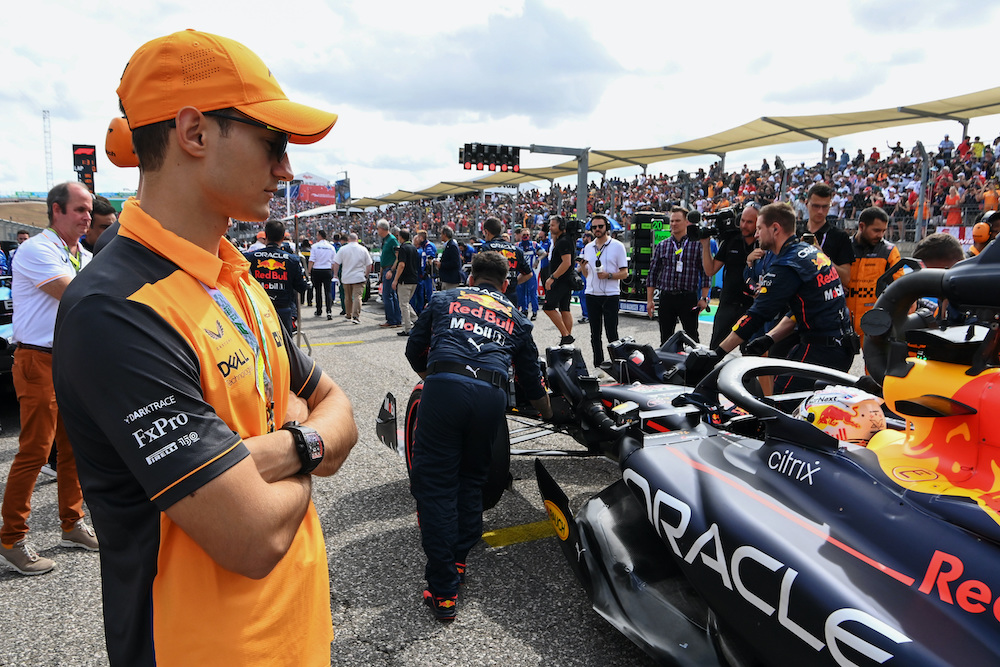
At risk of upsetting any racing series that would prefer not to highlight anything that happened in Austin recently, we're going to caption this "Fast-looking Spanish man admires bovine-aligned car." Mark Sutton/Motorsport Images
Q: When I finally saw a NASCAR race in person earlier this year I was struck by the fact that most of the sponsorship on the cars was from small brands that weren’t familiar. I suspect that’s part of what makes running a profitable team so much harder now. Most of the major brands are sponsoring the TV broadcast, not the teams. It doesn’t seem very healthy or sustainable to me.
Paul, Austin, TX
KELLY CRANDALL: What makes running a profitable team hard is that the cost of racing is always going up, and teams are always investing money somewhere to try and be the best. Dave Alpern, the president of Joe Gibbs Racing, said it best: if they don’t win, they don’t survive. That is why teams are so competitive and why they hire the best drivers, pit crews, etc. But there is the other side of the story that was reported a few weeks ago that the health of the teams is once again coming to the forefront and they are determined to get a better slice of the pie from the next media rights contract.
Q: At the finish of the Martinsville race, I was focusing on Christopher Bell, thinking everything is done, before being dumbfounded about where the heck Ross Chastain came from! I totally missed it the first time before having a long laugh at the audacious move -- credit to Chastain. I think it worked thanks to the combination of short distance to start-finish and the car being tougher than the old gens.
While I really applaud and amazed at the glorious move, I think this is the type of move where first few times will be amazing, after that it would look a bit silly, especially if, as some drivers said, what if everyone drives the wall on the last lap. Who knows, maybe a new Jeff Burton rule will come to light later, but for now it's celebrating time.
Oh and let's not forget Bell wins next stage's spot, twice!
Axel
KC: It was unbelievable to watch. Being in the media center, I can attest that many were in shock and forgot that we had to run outside for post-race interviews. It took time to process what we just saw because it didn’t seem real, and the more you watch the video in real time, the crazier it seems. It does make for interesting discussion about how much the sport should see of that in the future because it is cool and unique and special the first time it happens but after that, it’s unlikely to always play out with the right outcome.
As for Bell, how about that? I don’t think many people had him accomplishing walk-off wins twice in the playoffs, but he has risen to the occasion and certainly proven himself a contender. The No. 20 team has been fast and if they can go to Phoenix and run their race without any misfortune out of their control, they should have a shot for the big prize.
Q: Is it just U.S. viewers, or do British viewers also find Crofty and Brundle to be a bit out of touch with the generation of fans F1 is trying to connect with? There’s an article on RACER about ESPN considering adding Daniel Ricciardo to its F1 coverage. I’m not sure what there is to think about on ESPN’s part. That seems obvious. They would benefit from putting their own stamp on the broadcast, especially as the world feed continues to increasingly feel out of touch.
Ryan in West Michigan
CHRIS MEDLAND: It's hard for me to comment too much because I don't get to see the coverage, but I do hear some regular complaints from those who watch it in the UK. I think in some areas Sky does some great stuff but largely in the context of the UK market, and that's what it should be focusing on. If there's going to be a world feed, it should be provided by F1 itself, not a specific broadcaster. That would be a more middle-of-the-road option, but other broadcasters can then tailor firmly to their own market.
And I agree, I really think ESPN should be doing more of its own coverage and commentary. Ricciardo is a great name to target, although I'm hearing Daniel is unlikely to commit to a media role as he doesn't want to be seen as a former driver. Even so, it's good that they will be increasing their shoulder programming and leaning on their on-site journalists more at specific races next year, but without it being intended as a criticism of Sky, I personally feel like a U.S.-targeted show would be better for growth now than taking the British broadcaster's coverage (which made more sense at the start of the ESPN era).
Q: When the track in Austin opened, I seem to recall that the F1 community described it as something along the lines of a “Mickey Mouse” track. Now all the drivers and commentators are gushing with praise for the layout. I don’t recall any changes to the configuration, so what gives?
Carl Schmidt, San Miguel de Allende, Mexico
CM: I think I'm going to have to disagree with you on that, Carl -- I recall the drivers being very positive even before they drove it. At the time Fernando Alonso said, “The track seems spectacular, very, very nice," and Lewis Hamilton described it as "fantastic to drive." I think there was perhaps a little bit of criticism of part of the final sector, but as cars evolve that's become a good area to race in too. I'm happy to be proven wrong (well, not happy, more like willing) but I only ever remember everyone praising the first sector and overtaking opportunities.
Q: I’m watching practice for the Formula 1 race in Mexico. I've always wondered why the pit crew wears polo shirts during practices. Is IndyCar the same? It seems to me that the pit is just as dangerous during practice as it is during a race. So why isn't the pit crew wearing fire suits and crash helmets?
Peter
CM: I can't answer for IndyCar's protocols on this one but from an F1 point of view, mechanics are actually never required to wear the suits. You have to wear a helmet if you are carrying out work in the pit lane during qualifying, the Sprint or a race, but other than that teams are free to choose. They tend to go for it in races because it's an extra layer of protection when the pit lane is at its most hectic, but also because the commercial aspect becomes greater when teams want prime in-race television coverage -- looking coordinated and having certainty over logo placement matters most on a Sunday.
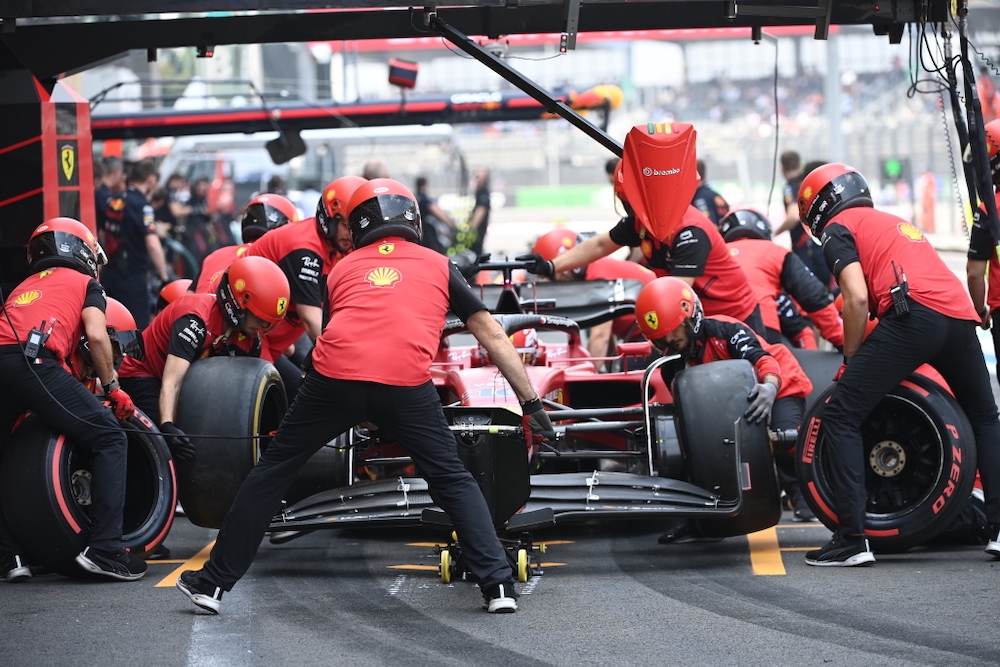
Friday is casual day in the F1 pitlane. Mark Sutton/Motorsport Images
Q: So here's my observation/question about the penalty the FIA handed down to Red Bull for its overspend. A week before the penalty was announced, Zak Brown said he believed the penalty should be double whatever overspend a team was found to have committed.
If you apply the unused tax credit to Red Bull's overspend, they were somewhere around $350k-$400k over the cost cap. For that overspend, they were fined $7 million, and given a 10-percent reduction in their wind tunnel time. I'm not a math expert, but that looks like roughly a 20-fold penalty to me. Zak Brown himself said the penalty should be double the overspend. So why is he now complaining about the penalty not being harsh enough, when in fact, it is tenfold larger than the penalty he proposed just a week earlier? Even if I'm totally misremembering Brown's comment about the penalty being double the overspend, am I crazy for thinking a 20-fold penalty like the one Red Bull received is sufficient? I'm honestly surprised that so many people think they got off with a mere slap on the wrist. They're paying $20 in fines for every $1 in overspend!
Clinton Thomas, St. Joseph, MO
CM: The main reason people are complaining is that the fine is actually irrelevant because it doesn't come out of the budget cap. When Red Bull pays the fine it's excluded, whereas Zak's letter was saying any fine should then be taken out of a team's future budget (I don't get why we have these discussions now though when all the teams signed off on the rules originally). As it stands, if you've got the money -- like the big teams have -- you overspend and pay the fine and it doesn't really hurt you financially when it comes to operating the team.
The aerodynamic testing time penalty is decent, though. The FIA has penalized Red Bull for the $2.2m original overspend before the tax they should have excluded, so even though they acknowledge the overspend was really much less, that's on Red Bull for making the error of including tax.
To be honest, I think Toto Wolff summed it up best, saying it's as much a reputation penalty that teams will want to avoid more than anything else, with Red Bull really unhappy at being called cheats for what have transpired to be legitimate misinterpretations of how they could allocate items in the accounts. But it was such a big undertaking that all of the other teams who had no issues with their accounts are probably feeling a little entitled to pat themselves on the back for making sure they got everything right, and want anyone who didn't to be punished as heavily as possible in order to gain as much of an advantage as they can. They're always looking out for themselves, it's the nature of the competition.
Q: Red Bull restricted Sky Sports’ access to its driver and team principal, and the broadcast on Sunday showed mostly the midfield and second-place battles while avoiding Verstappen's victory drive. There is a good argument that the midfield was more interesting, but it was obvious why Sky Sports focused there. Besides the TV guys and the engine manufacturers, are there other groups that the team and driver should never, ever criticize publicly? Do the teams hold a grudge when you call them out in print?
Mike White, Beverly Hills, MI
CM: I can't promise this 100% because Sky does put a huge amount of money into Formula 1's coffers, but there shouldn't be any correlation between Sky's issues and what you see on TV, because the world feed is the same images sent to every single broadcaster by F1 itself. Sky gets what every other broadcaster around the world gets, and F1 controls those pictures. I think it's just because Max was disappearing up the road, and I feel like we saw a fair bit of Checo.
After Christian Horner's comments about "begrudgingly" accepting the ABA, one team this weekend said they would never publicly criticize the FIA because they need to maintain a professional relationship, but I don't think that applies to everyone.
Teams or drivers will absolutely ban other media and journalists if they feel justified -- the BBC 5 Live reporter recently got blocked by Daniel Ricciardo for falsely claiming he creates a toxic culture within teams (he most certainly does not) -- and as another example, Lewis Hamilton has declined to take questions from one specific British newspaper journalist at times, too. I'd call it very rare that that happens, though. If you're always fair with teams/drivers/F1/FIA then they don't hold a grudge if you criticize them when it's deserved.
One such case recently involved Zak Brown being angry with the way a piece from another outlet was written over the summer, but instead of publicly responding or blocking anyone, he privately explained his unhappiness with the piece with the journalist in question and they have a better relationship for it.
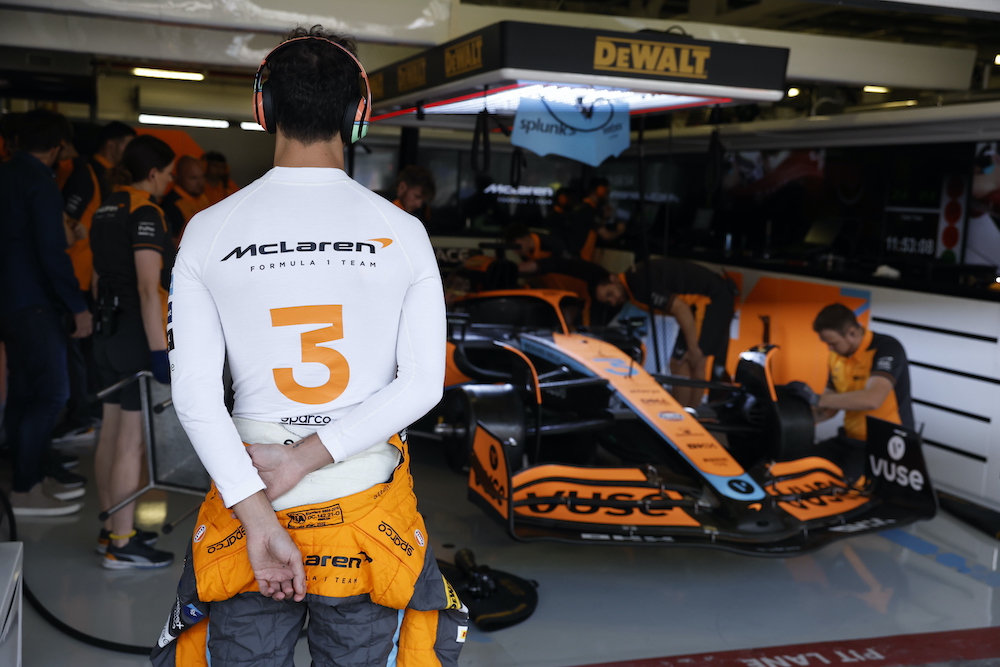
Apparently this is the only view a certain BBC Five Live journalist is getting of Daniel Ricciardo. Steven Tee/Motorsport Images
Q: Fernando Alonso knows how to press buttons, doesn’t he? His comments about Schumacher and Hamilton’s seven titles not meaning as much as Max Verstappen’s two because they fought teammates for most of them was amusing. His point is valid in that beating another team is "more meaningful." Obviously Schumacher had a teammate that was contractually obligated to be his lap dog. Lewis did not, so a little different there. They both had some challenges from other teams in a few seasons. I'll stop there.
Chris, maybe you can help me put together who Max had to fight this year, because I can’t. Leclerc? He started great but he was in Max and Honda’s rearview mirror well before halfway, and a tiny spec in it before the summer break -- 80 points back, to be exact. Barring something spectacularly unforeseen Max is set to easily win out the year and finish with 17 victories. That’s fighting another team? He had a great 2021 season but winning due to a mistake of historic proportions then steamrolling to another title amid an overspending breach isn’t exactly what I’d call "more meaningful" than someone winning seven titles. Is there some standard of measurement Alonso is using that I’m missing?
Eric Z, Lancaster, NY
CM: He's entertaining if nothing else, isn't he? Fernando tends to have these moments when he will belittle Hamilton's achievements, because he was obviously unhappy about how their season together at McLaren went, but it's fair to say he knows he could easily have many more championships himself if he'd been in the right place at the right time. Even now, he's definitely good enough to be winning the title in a car that's competitive. I just really wish he had one.
That said, it's slightly ironic that a driver who stood out as world class because he beat the great Michael Schumacher then looked to belittle Schumacher's achievements, but I feel like Alonso holds some frustration that he doesn't have the number of titles his talent deserves, and that his and Hamilton's career paths are more intertwined. Verstappen, on the other hand, is experiencing an era that Alonso never really had a chance of being part of (as in, the current Red Bull is not a team he would have been driving for nearing 40), so it's easier to praise Verstappen without any lingering regret.
He's right that whoever won last year's title (ignoring the circumstances of the final race) was going to view it differently to the way Max won this year -- Verstappen himself said as much in Japan -- but he did have a strong challenge from Ferrari initially, just like Lewis did in 2017 and 2018. I think it's fair to say some titles carry more weight than others, but beating a competitive teammate who has the same machinery is also hard-won.
I actually like that Alonso says what he believes -- whether I agree with him or not is another matter -- but I don't understand why he then pretends he hasn't said things or blames the media for creating headlines out of his comments. To me, it feels like while he waits for a competitive-enough car, all he can do is pass comment on those fighting for titles, which must be a really frustrating position for a multiple world champion to be in.
THE FINAL WORD
From Robin Miller's Mailbag, November 5, 2014
Q: It has been 15 years since the Indy Car world lost two humble members. Anytime we remember Fontana, we still hear the echos of the tragedy of Greg Moore. And looking back at his resume, he almost swept the Indy Lights series back in 1995 after finishing third the year before. By looking at his results before entering the IndyCar series, that would have been enough to become the "next Canadian F1 hopeful." It did not make sense why he was ignored. I could see him testing any F1 machinery back then.
But anyway -- Forsythe took the gamble and four years time, Roger decided to pounce on the chance to have Greg in his team. But fate took a wrong turn and Greg was gone. I could imagine what kind of a driver he would have been both in IndyCar and in F1.
Dale Coyne has been keeping busy trying to establish for the 2015 season. Back in 1997 when I was a delivery driver for a flooring company, I remember while driving the I-80 I realized that I passed his HQ in Plainfield. Before it was DCR, it was PCR – Payton-Coyne Racing. It was all about No. 34 -- Sweetness. Right after Walter Payton hung up his cleats, he decided to explore that new venture into motorsports. He got involved in racing and wanted to establish his IndyCar team. But soon after his death, Coyne became sole proprietor of the team. In these stories, what where their aftermaths?
JLS, Chicago
ROBIN MILLER: I don’t think it was much of a gamble, putting Greg in an IndyCar. His debut at Homestead was nothing short of breathtaking. I think R.P. had the wheels in motion to get Greg as soon as 1998 but contracts had to run out. As for Sweetness, there wasn’t a finer gentleman and he was so gung-ho about CART racing. I think Walter was as well liked as anyone in the paddock. Their aftermaths? They both got a lot out of life in a relatively short time.
Presented by:
Marshall Pruett
The 2026 season marks Marshall Pruett's 40th year working in the sport. In his role today for RACER, Pruett covers open-wheel and sports car racing as a writer, reporter, photographer, and filmmaker. In his previous career, he served as a mechanic, engineer, and team manager in a variety of series, including IndyCar, IMSA, and World Challenge.
Read Marshall Pruett's articles
Latest News

Comments
Comments are disabled until you accept Social Networking Cookies. Update cookie preferences
If the dialog doesn't appear, ad-blockers are often the cause; try disabling yours or see our Social Features Support.