IMS Photo
RETRO: The wild tale of 1982’s Eagle Aviation Flyer IndyCar, part 2
We pick up after part 1 as Ken Hamilton, the world’s bravest man, was preparing to drive the insane DW2-Chevy for the first time.
With the Rookie Orientation Program doubling as his first opportunity to lap the Indianapolis Motor Speedway with the DW2, Ken Hamilton was expected to drive in a manner that was capable and trustworthy. Instilling confidence in the highly critical veterans -- the ROP approval committee -- who were swift to deny any Indy 500 rookie who looked too slow or out of control was the only goal for Hamilton. The Dean Wilson 2 had other things in mind.
“I lost it the first time down in Turn 1,” he continued. “It was in the morning, rookie session, and I finally got the green flag. I gassed it up into Turn 1, it came around and I was able to gather it up. It had gotten onto the grass and it was wet, had dew on it -- I got on the brakes and it came back on track.”
Just like he was riding the cushion in a sprint car, Hamilton caught the mile-long DW2’s broad slide and somehow -- while defying the laws of physics -- managed to regain control of the car before it fully spun and crashed.
“So I just went by the short chute wall there between [Turns] 1 and 2 and started down the backstraight.” he said. “And here come the ambulance people and rescue people because they knew I'd already crashed, but I didn't. So I pulled in, and that’s when I took it [to the chassis alignment specialists in Gasoline Alley] and then Dean changed it.”
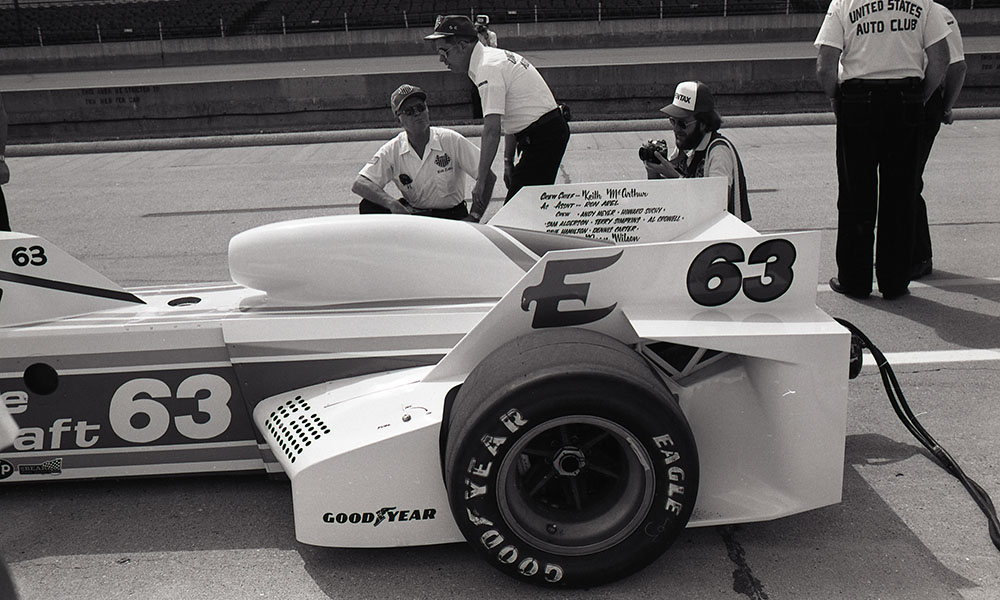
Scholars could study the rear of the DW2 for eons and fail to grasp all of the concepts at play. IMS Photo
We’ll get to that last comment in a moment. Frustrated by the DW2’s extreme lack of rear stability, Hamilton took matters into his own hands.
“I had a guy in Indianapolis build me a wing -- cost me $1,000 for a little wing that was like 42 inches wide and 11 inches deep,” he said. “And the wing was worth 10 miles an hour.”
With unstable aerodynamics and unstable handling, Hamilton was lucky to save the No. 63 DW2-Chevy from hammering the wall the first time. The car had one dominant trait: It wanted to spin when the steering wheel was turned. Daunting at a track where turning left would be required 800 times if Hamilton made it into the race, the DW2 was behaving like a four-wheeled widow maker.
Adding a rear wing made a bad situation slightly better, but there wasn’t much that could be done with the front and rear ground effects systems that refused to work together. The suspension, however, was wide open for all manner of improvements.
But rather than rely upon those with open-wheel chassis setup knowledge to try and find the fastest settings for the brand-new DW2, Hamilton says the first-time race car designer nominated himself to tune the car’s handling.
“One of the guys that I had taken there as crew chief got in one morning and he said, ‘Kenny, watch out -- Dean's been in here changing the suspension geometry on the car,’” he added. “I lost it coming off Turn 4. Fortunately, I spun it around a couple of times, grabbed a gear and drove it straight into the pits.”
After just a couple of brief outings on the 2.5-mile oval, Hamilton reached his limit. Twice lucky, he finally listened to the wiser version of himself.
“I thought, ‘You know, my feet are six inches from the wall, the way he designed that thing…I knew I should not even be in the car,” he said. “I got out, headed back to the garage, and told them I was getting on an airplane and going back to Idaho. He attempted to kill me twice. I wasn't gonna go fast enough to ever make the show anyway.”
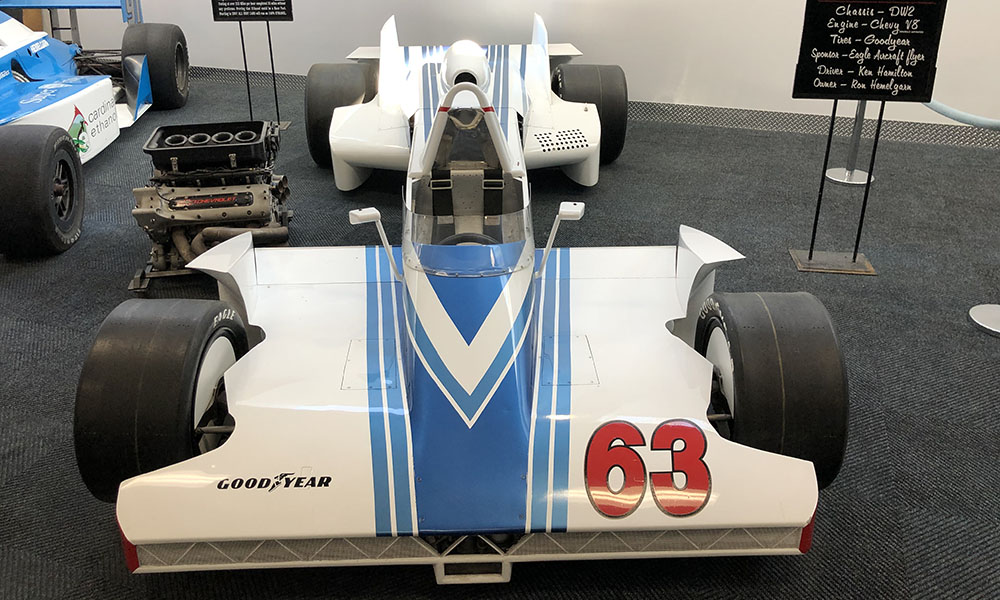
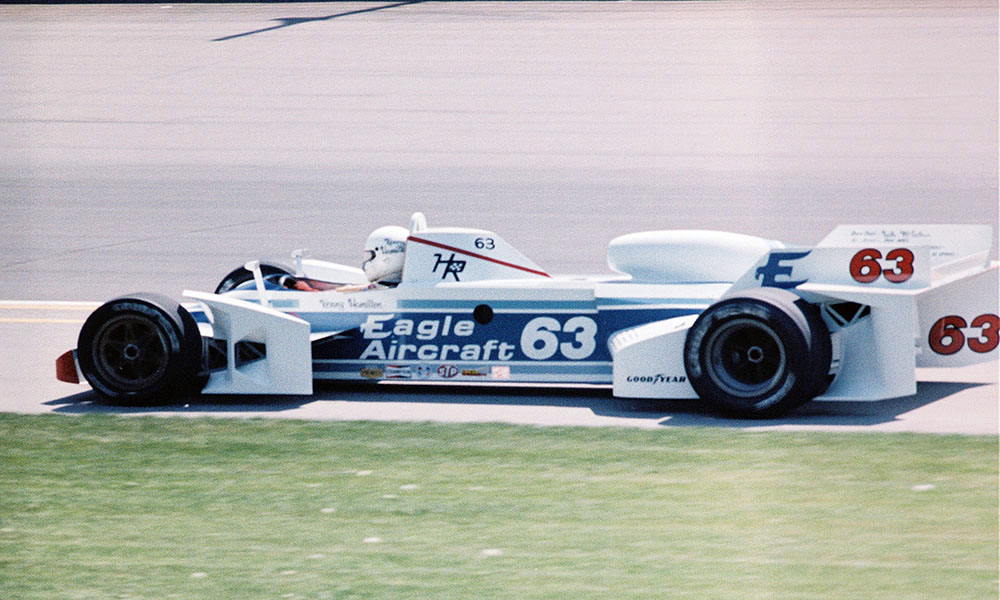
This ode to science fiction actually lapped the Indianapolis Motor Speedway. Photo by Amy Mauder
The car described by IMS as the "radically-different and longer No. 63 Eagle Aircraft Flyer" spun twice in three days, and in between the gyrations, Penske Racing’s Rick Mears set the event’s best practice lap at 205mph. Pole would eventually go to Mears at 207.0mph while the slowest qualifier, Josele Garza, squeaked in at 194.5. Let’s just say that Mears had a 25mph margin of comfort over Hamilton and the DW2’s best lap at IMS.
“It took [194] mph in 1982 to make the show,” he said. “And the car that I had was almost 12 miles an hour slow.”
Along with the 300-foot slide in Turn 1 and its dreadful absence of speed, Hamilton’s son has vivid memories of the DW2 treating his dad like he was flying the DW1 crop duster.
“Another thing I remember is that it just wanted to pull his head off,” Davey said of the extreme aerodynamic lift happening above the cockpit. “That was another problem they had to deal with using [helmet] wickers and a windshield. It took the first week just to try to get the thing able to go around the track, honestly. And then once they started feeling like they did the most they could do to keep his helmet on his head, it still was just uncontrollable.
“So then what happens? My dad tells the car owner [Turtling], ‘You know what, it’s just not going work. If you want somebody else to drive it, so be it, but I'm out. And the guy goes, ‘We’ll just load it up, we're done. I don't want anybody else in it.”
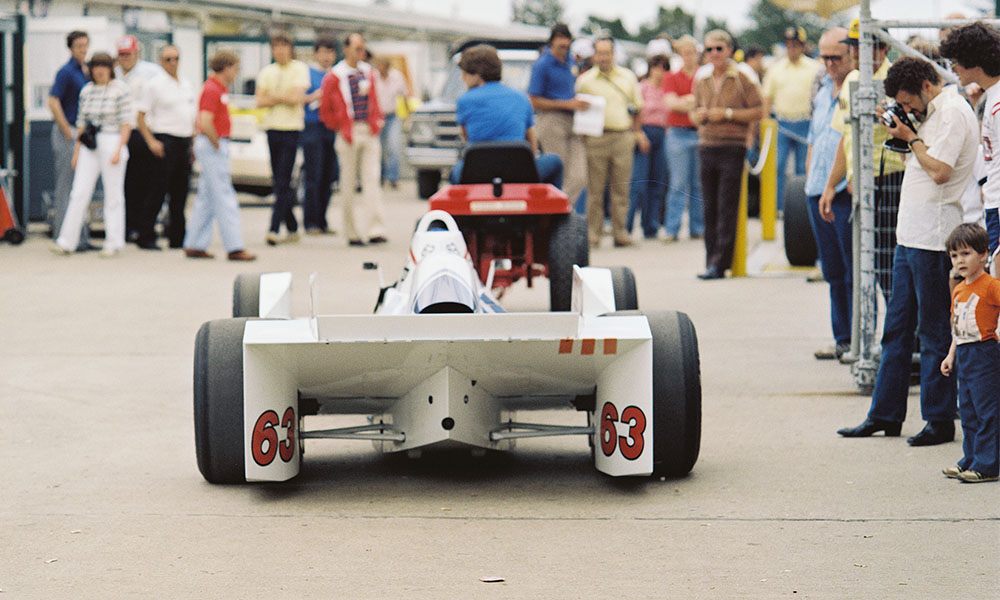
The DW2 drew a crowd whenever it emerged. IMS Photo
Just as the DW2 appeared to kill Ken Hamilton’s Indy 500 dreams, Turtling seemed opened to buying a proven car from one of the Speedway’s legendary mechanics and entrants, George Bignotti. Like everything involving the Eagle Aviation Flyer program, there’s another story.
“Turtling came back, and in fact, at that time, Tom Sneva came down and said, ‘Why don't you get your guy with the money to buy one of these Marches from Bignotti?’” Ken Hamilton said. “So I went and talked to George Bignotti and I took Joe Turtling down with me. And George says, ‘We'll take your crew and take the car back to the shop, sell you this car here and have your guys go through it. Then we'll have Tom shake it down and Tom guarantees you'll run at 200 miles an hour, Kenny, right out of the box.’
“Turtling says, ‘OK, I'll go back home and I'll wire you the money on Monday morning.’ And so I'm down at the bank waiting for the money…waiting for the money. Nothing happens. Finally, I get a hold of him, and he said, ‘Well, I just can't do that. My controllers lost me $11 million in the airplane factory.’ He had bought American Eagle. He said, ‘I just don't have the money that I feel that I can spend on that car. What are you going to do next?’ I said, ‘Well, all I can do is load that thing in the truck and bring it home.’”
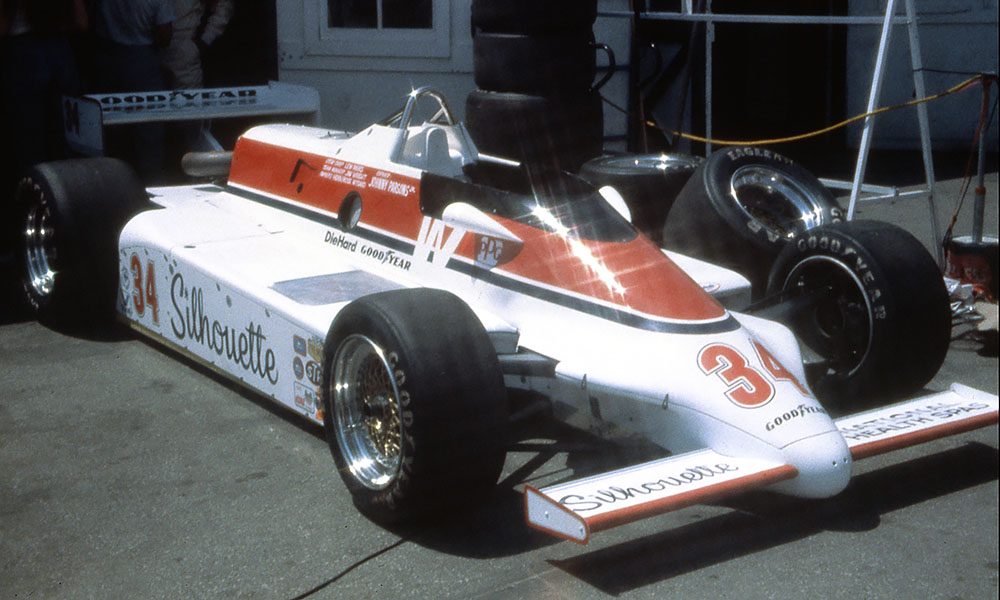
An off-the-shelf March chassis would have been a perfect solution for Hamilton. Marshall Pruett archive
“And it goes back to Idaho,” Davey adds. “Everybody's tail between their legs, my dad’s super dejected. This was his opportunity. When you have an opportunity, and you take it, it might have worked and it might not, but you’ll never know unless you try it, right?”
Stuck with the laughingstock of the Indy 500, Turtling gave Hamilton the task of deciding the DW2’s fate.
“I went down to talk to him, and he had a great big table about 20 feet long, and he said, ‘Well, now what are you going to do with the car?’” he said. “I told him, ‘There’s nothing I can do with it, I mean, it's not a race car. All I can do is take parts off of it and sell what I can to recoup some of my money.’ And he said, ‘OK, do whatever you want because it's no good to me, either.’ So it was just a big white albatross around my neck. Sure, I did sell the engine out of it, and then I had it stored out here at one of my paint shops.”
The DW2 would eventually migrate to a more fitting home.
“It sat out in a barn in this field owned by one of my dad’s partners for the next nine years,” Davey Hamilton said. “They had a nice little custom car cover made for everything. And I remember a guy was racing a rear-engine car out in Meridian and had the steering break, so my dad goes, ‘Hey, go over to the barn and take the steering rack out of the Indy car because it’s the same kind.’ That was the only parts we took off it the whole time. It was still all there.”
So what happened to the bizarre car with the wacky farmland aircraft concepts? Yes, there’s another story to be told.
“Davey called me and said, ‘Hey Dad, what are you going to do with that car?” Hamilton said. “And I said, ‘I don't know, I'd like to bury the son of a bitch somewhere, but I can’t find a hole deep enough!”
Like his father, Davey Hamilton felt the pull of the Indianapolis 500. Finding a way to get there was the problem. Enter veteran IndyCar entrant Ron Hemelgarn in 1991.
“I kept in touch with Ron and said, ‘Man, if there's any way I can ever get a rookie test at Indy with you…’’ Davey said. “I didn't know what to do because I didn't have any money. And he says, ‘You still have that that car? Your dad's Eagle Flyer?’ I said, ‘Yeah, we still have it.’ He goes, ‘Well, if you want to give me that car, I'll give you a rookie test. So I call my dad I go, ‘Hey, buddy, what are you ever gonna do with that car? ‘ He says, ‘Take it!’ So I put it on an open trailer behind my pickup truck and headed to Indy.’”
As hard as it might be to fathom, after watching Hamilton try in vain to pass ROP in 1982, Hemelgarn locked the DW2 into his memory as a vehicle to pursue if it became available for acquisition.
“A lot of those old cars, if you get your hands on them, in time, they are going to be a very collectible,” Hemelgarn said. “Back then, it was a different time period. Today’s cars are all the same. When you take that car, and the story that goes along with it, and it did run a little bit at the Indy 500, it's unique. And there's only one of them.”
After receiving the car and running Davey Hamilton through his Indy 500 ROP in 1991, Hemelgarn put the Eagle Aviation Flyer through a full restoration that brought the car back to its original form.
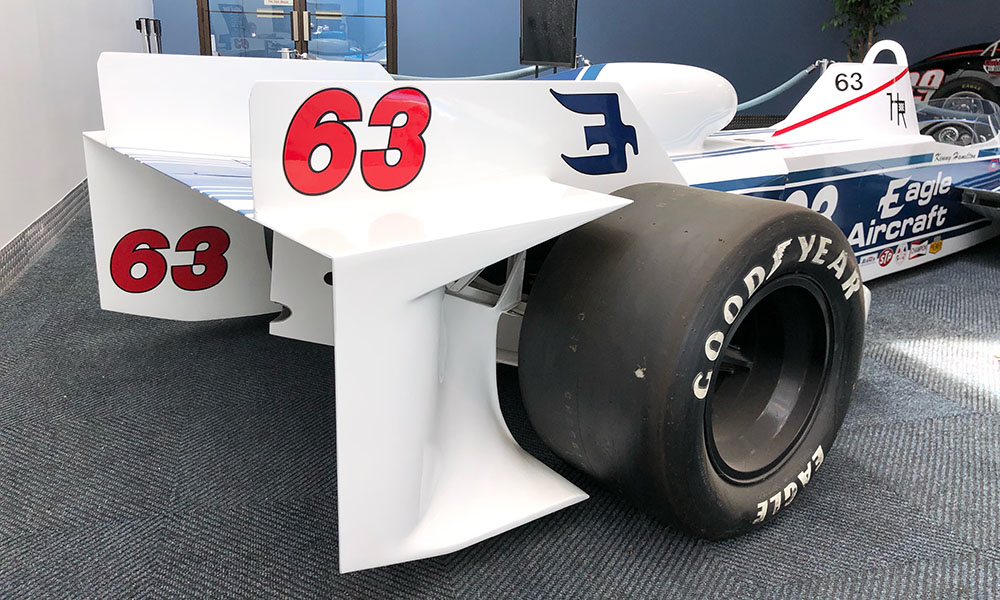
The DW2 in all its restored resplendence. Amy Mauder photo
Hamilton would try to qualify for his first Indy 500 that year with Hemelgarn, and in another family parallel, he didn’t make it into the field of 33. In fact, Ken’s son would fail to qualify for his first three Indy 500s before qualifying 10th and finishing 12th for A.J. Foyt in 1996.
Hamilton would go on to become one of the biggest stars in the new Indy Racing League, adding a sixth-place Indy 500 result for Foyt in 1997 and a career best of fourth at the Speedway the following year for Nienhouse Motorsports.
Thanks to Hemelgarn’s appreciation for weirder IndyCar designs, all of the risks taken by Ken Hamilton and all of the distance Joe Turtling wanted from the costly failure he funded was turned into a most unexpected pathway for Davey Hamilton, who launched an IndyCar career that spanned 21 years because of the DW2.
Looking back on the 40-year anniversary of his ill-fated attempt to compete at Indy in the DW2, Ken Hamilton still can’t believe all he went through in 1982.
“I took the risk and went ahead and tried it,” he said. “And at the time, I was really glad to get an opportunity to try it…until I really saw the car was complete. And then after dealing with this [Wilson] guy -- you know, the guy's a genius, but he's a dumb son of a bitch, also.”
And where can you find the mercurial Eagle Aviation Flyer DW2-Chevy today?
“The car is sitting in my lobby at one of my Super Fitness centers in Toledo, Ohio,” Hemelgarn said. “It’s quite the conversation piece.”
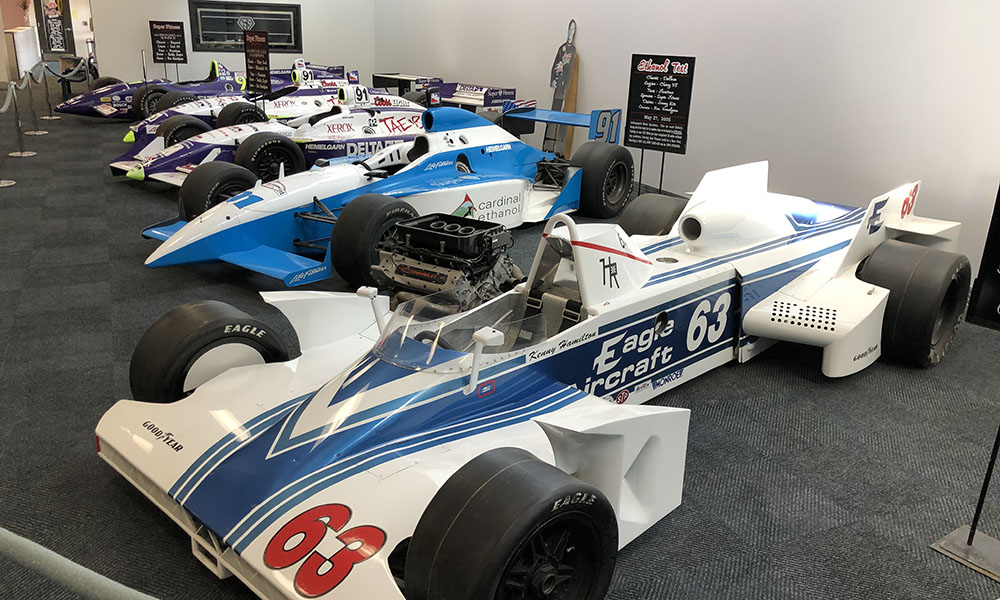
The DW2 alongside other additions to the Hemelgarn stable. Amy Mauder photo
Marshall Pruett
The 2026 season marks Marshall Pruett's 40th year working in the sport. In his role today for RACER, Pruett covers open-wheel and sports car racing as a writer, reporter, photographer, and filmmaker. In his previous career, he served as a mechanic, engineer, and team manager in a variety of series, including IndyCar, IMSA, and World Challenge.
Read Marshall Pruett's articles
Latest News
Comments
Comments are disabled until you accept Social Networking Cookies. Update cookie preferences
If the dialog doesn't appear, ad-blockers are often the cause; try disabling yours or see our Social Features Support.