Andy Hone/Motorsport Images
INSIGHT: Why Haas can afford to start dreaming again
Success for American Formula 1 teams has always been fleeting, with Dan Gurney’s All American Racers, Penske Racing and (although by this stage officially a British team) Shadow each winning one world championship race. But for the past four decades, it’s always been the ‘next’ American team that offered hope, which recently has meant the Andretti organization’s attempt to get on the grid in the future.
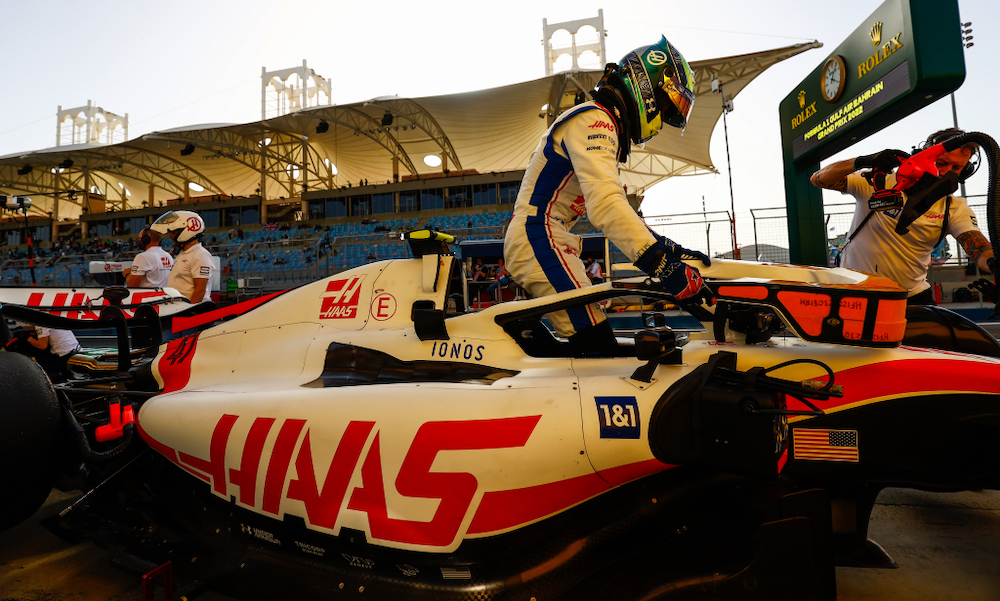
The first two races of the 2022 season have reminded us that there is an American team already on the grid, one that many had abandoned hope in after it spent most of the previous three seasons floundering at the back of the grid. But with fifth place in the Bahrain Grand Prix then ninth in Saudi Arabia, the latter despite under-prepared returnee Kevin Magnussen struggling with his neck as he rebuilds F1 fitness and not being at his best, Haas has recaptured the ‘little team that could’ luster that defined its early years in F1.
It wasn’t long ago that Haas’s future in F1 was uncertain. Owner Gene Haas was on record with concerns about F1’s financial model being unsustainable, the Rich Energy title sponsorship debacle in 2019 caused embarrassment and a cash shortfall, on-track results were poor and investment in the team was cut to the bone amid the COVID-19 pandemic. Michael Andretti has even admitted making overtures to buy the team, a logical attempt given the difficulty of getting a place on the F1 grid.
That everything has changed for Haas is down to a combination of factors, some external and some internal, with the return to form this year the reward for a logical strategy. But that shouldn’t be a surprise, because it has always been a pragmatic team.
Originally, Haas planned to enter F1 running Ferrari chassis at a point when customer cars seemed set to be permitted again. When that possibility vanished, it seemed Gene Haas’s hopes of creating an F1 team had been extinguished. But team principal Guenther Steiner hit upon an idea that made it possible not only to get on the grid, but also to achieve unprecedented success for a new F1 team in the 21st century.
A controversial technical partnership was established with Ferrari, whereby Haas was supplied with as many of what were then called non-listed parts (as distinct from the listed parts such as the monocoque and aero surfaces that are required for a team to qualify as a constructor) as possible. This included the engine, gearbox, suspension and myriad under-the-skin components that were deemed not to be key performance differentiators.
Sixth on the team’s debut in Australia 2016 for Romain Grosjean, followed by fifth in the second race in Bahrain, was a stunning start. Inevitably, this whipped up criticism of the Ferrari partnership among rivals to fever pitch, but despite some tweaks being made to the regulations, nothing happened that fundamentally changed the business model. Haas had a partnership with Italian chassis specialist Dallara to design the car, the Ferrari windtunnel at Maranello was also used and the team itself focused on operating the cars.
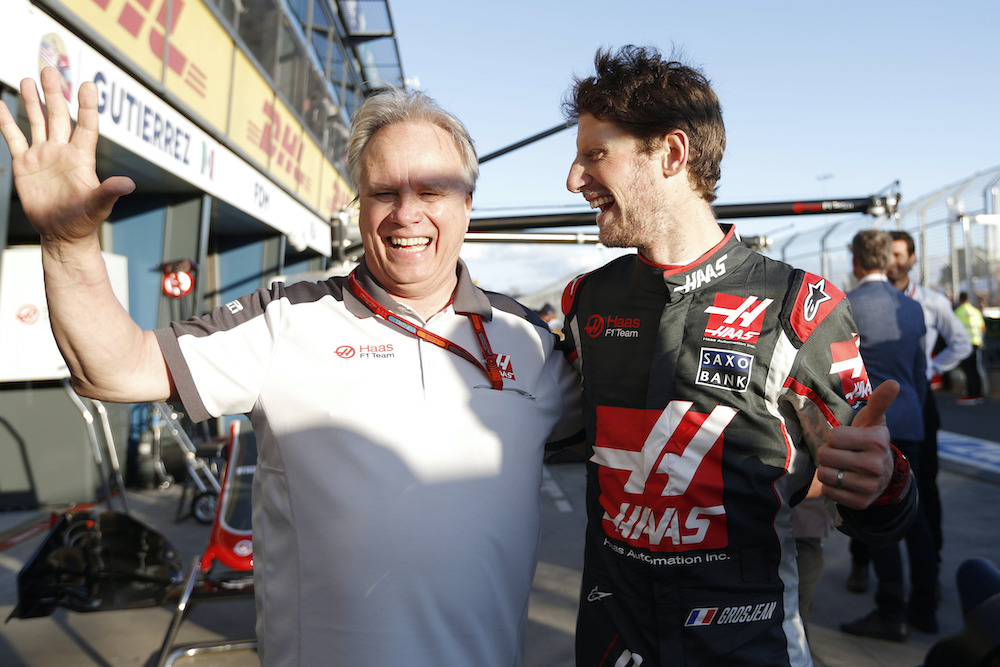
Haas made good use of an innovative technical partnership with Ferrari to be quick straight out of the gates in 2016, with Romain Grosjean finishing sixth on the team's debut in Australia. Sam Bloxham/Motorsport Images
This model allowed Haas to finish fifth in the 2018 constructors’ championship, although that arguably represented underachievement given it had the fourth-fastest car on average. But then everything changed in 2019. After a promising start with Magnussen’s sixth place in Australia, the team’s form slumped and it dropped to ninth in the championship. This was down to a fundamental aerodynamic problem the team took too long to diagnose.
In low and medium speed corners, the rear aero was stalling, in particular during the braking phase. This also overworked the tires, meaning that even on weekends when the car qualified well it often vanished in the races – with track temperatures in the low-70s proving problematic. It was only at the end of the season, with a short-lived tweaked diffuser, that things started to improve but it was too little, too late.
But 2019 can be considered a one-off. Plenty of teams have hit trouble with their aero concept in the past, and while the team did take too long to understand it, in doing so it improved its capabilities. The 2020 car had no such problem and made a promising start in pre-season testing, only for the COVID-19 pandemic to shut down its progress.
The money taps were turned off, and justifiably so given the fact that there was huge uncertainty about team income. This was at a time when F1 didn’t know when it would be able to go racing again and there were no assurances about what kind of income could be expected. As a result, development was frozen – even outside of F1’s mandated, extended emergency shutdown – and parts that were in the design phase expected to produce a performance boost were never completed.
While results were terrible during 2020, with Magnussen’s opportunistic 10th place in Hungary after a formation-lap pitstop for slicks and Grosjean’s ninth at a cold October Nurburgring the sole highlights, several important things did happen that year. The first was the cost cap was dropped to a baseline figure of $145million for ’21, dropping by $5m in each of the subsequent two years. The second was the finalizing of a new Concorde Agreement in August that ensured a more equitable share of the slice of F1’s income split among the teams that convinced Haas to recommit to F1. The third was the deferring of the new rules for 2021 to ’22, which allowed Steiner to implement the strategy that led directly to Haas’s recent revival.
Realizing that the need to carry over largely the same car for 2021 offered only a slender opportunity to improve while the ’22 rules were a fresh start, the decision was made to do the bare minimum of work on last year’s car and effectively abandon the season. Steiner himself prefers the term “transitional year” but it was long, tough and profoundly unsuccessful with no points scored and a near-permanent reservation on the back row. But this allowed the resources to be poured into the Haas VF-22 that has started the season so well.
“In 2020, I sat down with Gene and explained the situation and said next year it will be what it is,” said Steiner in Saudi Arabia “In ‘21 Gene told me ‘Guenther you didn’t lie to me, you told me it would be bad, but it’s really bad’. “I said ‘yeah but I knew that and hopefully we can get ‘22 to be better’ – and it looks like it’s worked.”
The development of the 2022 car was also aided by the sliding scale of aerodynamic testing rules F1 introduced in 2021. This restricted windtunnel runs and CFD items, but with those allocations increasing as constructors’ championship position went down. Therefore, during 2021, nobody had more than Haas, with it and Williams having the largest allocation. For the first six months of this year, Haas also has the most thanks to finishing last in 2021, although the allocations are reset based on championship position at the end of June.
But there’s more to it than that. Haas has not simply gone back to where it was in 2018 when it was also at the forefront of the midfield, it has also evolved as a team. The Dallara partnership remains, but this car is the product of Haas’s own bolstered design team. This has been partly facilitated by the cost cap, which left Ferrari and the other big teams needing to find ways to reallocate personnel to other projects. As a result, Haas now has a design hub at Maranello headed up by Simone Resta, who joined as technical director at the start of last year, that took on a significant amount of the design work of the 2022 car.
Inevitably, this has been the subject of questions from other teams. Tensions are high when it comes to ‘b-teams’ and Haas comes closest to filling that definition, although as Steiner has stressed the FIA regularly inspects its activities and has found no irregularities. Even so, there’s no lack of paddock whispers about any team suspected of being a little too close to a partner and Haas is not the only outfit subject to such suggestions.
But as far as the FIA is concerned, there’s nothing wrong with the Haas/Ferrari partnership and the regulations clearly allow for a set-up like this. It’s inevitable there will be some aero similarities given much of the packaging architecture of the car is common, but it hardly requires an expert eye to spot the differences between the Ferrari and Haas. As Steiner has often pointed out, the complaints tend to rise and fall in lockstep with Haas's fortunes improving and waning.
There have been two other key factors that have helped Haas, one entirely down to happenstance. After having taken Nikita Mazepin and Uralkali money, the Russian invasion of Ukraine led to these partnerships ending. This led to Magnussen returning to the team in Mazepin’s place, a significant upgrade and a reminder of the value of strong drivers to a team. So far, Mick Schumacher has struggled to keep pace, but he’s a driver with potential and it’s likely Magnussen’s presence will lead to him raising his game and emerging as a points regular provided the car remains competitive.
The other big gain is the Ferrari power unit package. This held Haas back significantly in 2020 and was a minor weakness last year, but it’s no coincidence that Ferrari and its customer teams have all had strong starts to the season.
The big question for the rest of 2022 is whether Haas can keep up with what is expected to be a rapid pace of development. It would be wrong to dismiss the Haas team’s ability to develop the car purely on the basis of what happened over the previous three seasons. Instead, a look at 2018 shows that the car was still competitive at the end of the year so it does have the ability to maintain development rate, especially with a bolstered design capacity.
Haas is also certain there’s more to come from the car in its existing form. Pre-season testing hardly went smoothly, the team completing only 160 laps in the first test in Barcelona, then starting late in Bahrain following freight problems and regaining some of that ground after being given dispensation for some extra running on the second and third day of the last test. But set-up understanding is still building, and with Magnussen still regaining F1 fitness, there’s more to come on all fronts. There will be upgrades, but Steiner has stressed the need for these to be strategically deployed and well-researched to prevent getting lost. It remains to be seen how well these work but, while Haas is still F1’s smallest team, there’s no reason why it can’t make good improvements – especially given its new design facility has proved itself so spectacularly with the start-of-season 2022 car.
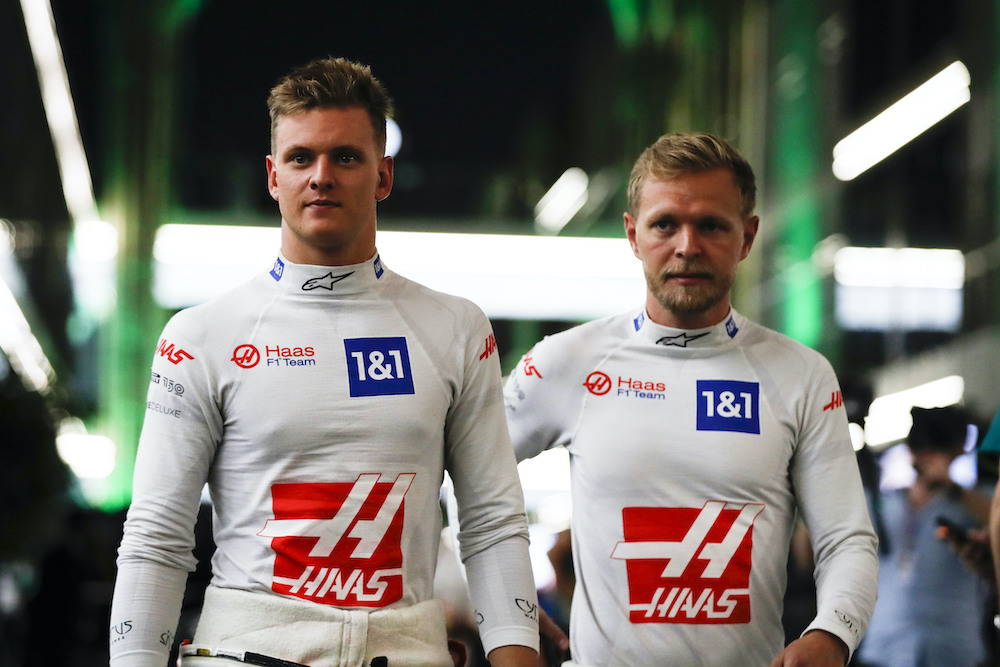
Haas has turned the Uralkali upheaval to its advantage, securing an immediate upgrade in driver quality in the shape of Kevin Magnussen, who in turn might also help bring more of Mick Schumacher's potential to the surface. Carl Bingham/Motorsport Images
The second big question about the team is one that is entirely speculative – how far can it go in F1? Being dependent on Ferrari inevitably limits its horizons in some ways as it must follow aspects of its design lead. However, fellow customer team Alfa Romeo has proved there are ways round this by using Ferrari gearbox internals but making its own casing. This allows it to run pushrod rear suspension rather than following Ferrari’s pullrod direction.
Of course, for Haas to do that it would need to make its own suspension parts (rather than simply producing the aero shrouds for them, as demanded under the 2022 regulations). But it is proof that there are ways of breaking away from a technical partner that could confer a performance advantage.
The existence of the cost cap, part of a regulations set that is conceived to keep the competitive spread close, should also mean that Haas can aspire to be stronger relative to its size than it could have been in the previous generation of F1. But how far that means it can go remains to be seen. So far, it has proved it can be a strong midfield force, but to win races if you’re not Ferrari, Red Bull or Mercedes right now (and even then Mercedes has work to do) is a big ask for any team.
McLaren and Aston Martin have invested heavily in major infrastructure projects such as state-of-the-art windtunnels and, in the case of the latter, a new factory. Alpine, too, has invested significantly in its factory over the past six years, while even AlphaTauri has been slowly expanding. And of Haas’s erstwhile backmarker rivals, Alfa Romeo has also been expanding over the years, while Williams has bolstered its facilities under its new ownership, with plans in the works for its own factory redevelopment.
F1 has certainly come to Haas over the years, and it has used that opportunity to re-establish itself as a team capable of upsetting the established order. For it to take further strides and be a race-winning force, it will most likely need to expand further.
But not only has the Haas ship been steadied, but it has also made its own progress to becoming a more complete team in its own right. With financial stability seemingly assured and results likely to make it easier to draw in sponsorship, Haas could now be on a path that might conceivably allow it to aspire to emerging as a genuine top team on a long enough timeline. But for now and the coming years, simply existing as a competitive midfield operation is a good position to be in, especially at a time when F1 team values have grown dramatically.
Such a positive prognosis would have been impossible in the ‘old’ F1, in which Haas’s very survival as an F1 team was in doubt. That’s an indication of how far Haas, and F1 as a whole, has come.
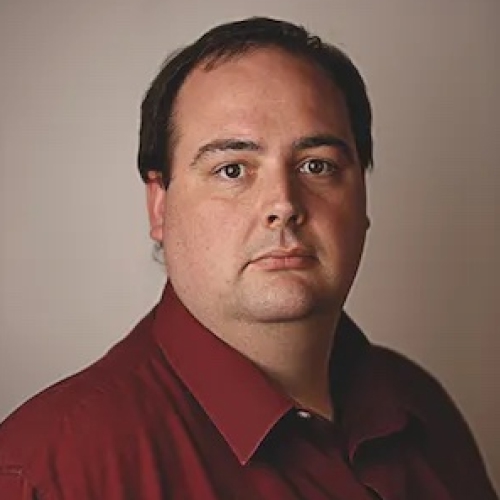
Edd Straw
Edd Straw is a Formula 1 journalist and broadcaster, and regular contributor to RACER magazine. He started his career in motorsport journalism at Autosport in 2002, reporting on a wide range of international motorsport before covering grand prix racing from 2008, as well as putting in stints as editor and editor-in-chief before moving on at the end of 2019. A familiar face both in the F1 paddock, and watching the cars trackside, his analytical approach has become his trademark, having had the privilege of watching all of the great grand prix drivers and teams of the 21st century in action - as well has having a keen interest in the history of motorsport. He was also once a keen amateur racing driver whose achievements are better measured in enjoyment than silverware.
Read Edd Straw's articles
Latest News
Comments
Comments are disabled until you accept Social Networking Cookies. Update cookie preferences
If the dialog doesn't appear, ad-blockers are often the cause; try disabling yours or see our Social Features Support.