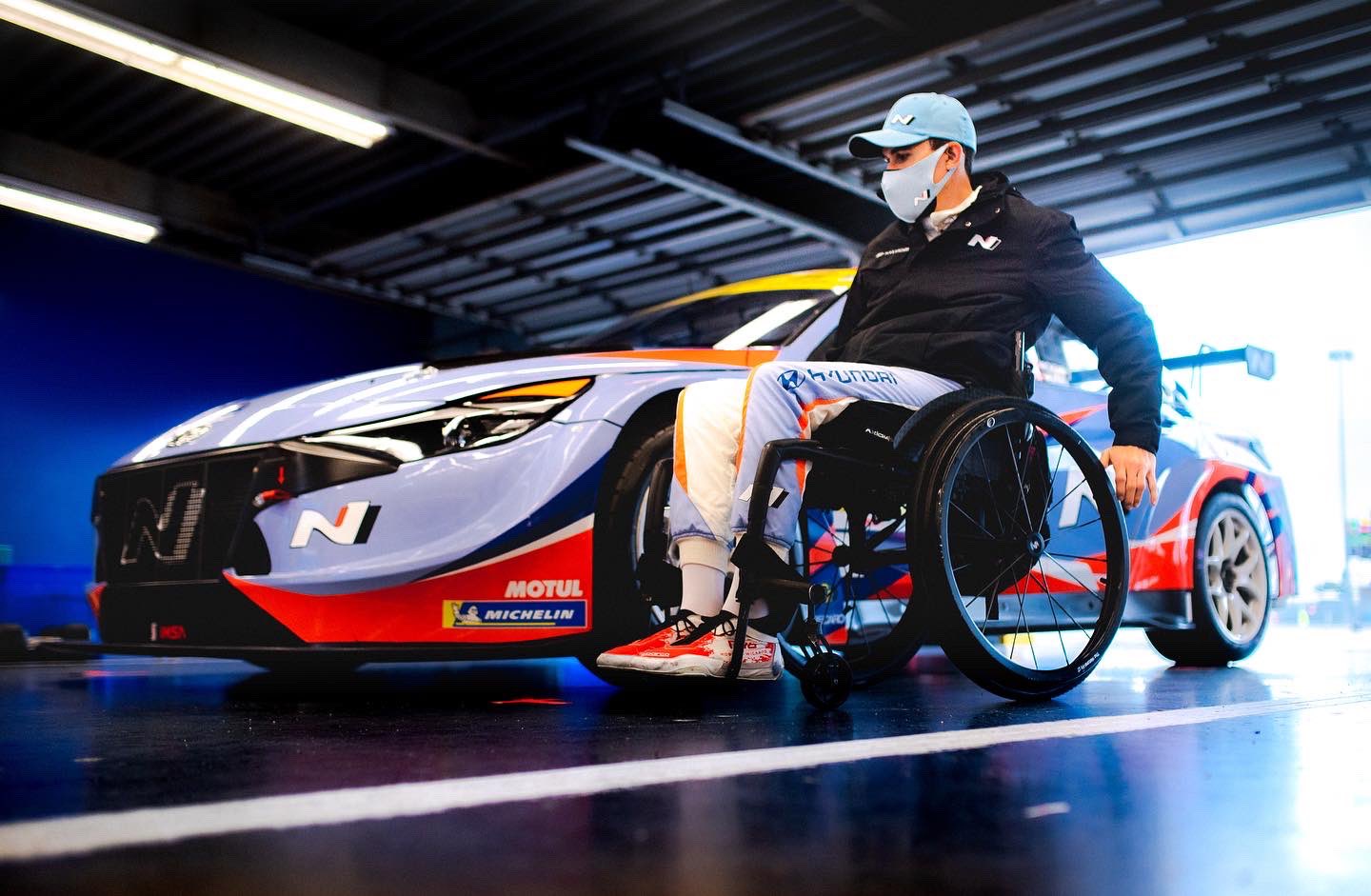
Image courtesy of Robert Wickens
PRUETT: Wickens staying hungry as racing comeback begins
Robert Wickens is happiest when he’s functioning as a hunter-killer.
He’s a member of an elite group of drivers whose on-track persona and performances have the look and feel of a big cat chasing down and devouring its prey in the wild. In his natural state, Wickens unleashes sustained aggression on those who are locked into his sights, and there’s nothing polite about Wickens’ advances. He doesn’t probe and hint at his intentions to see if a pass is possible. It’s a series of quick and decisive strikes that come instinctively to the former DTM and IndyCar star.
And that’s where all of the adversity he’s endured in recent years has thrown the Canadian out of his normal state. In the wake of his punishing crash at Pocono’s superspeedway in 2018, Wickens applied his innate hunter-killer tendencies to conquering rehabilitation.
The on-track hunt was replaced by a resolute determination to restore movement in his legs, to heal the myriad bones and discs that were broken or fractured, to force communications from his brain through the stoppage in his spinal cord and down to his legs and feet. Given time and more intensive rehab, he took his first steps, unsure steps.
His mental commands were delayed, incomplete, but Wickens’ vigilant mind pressed on. The rhythmic moves involved with walking were erased by the accident, so he practiced them in a slow and arduous syncopated process that mimics carefree walking, but requires immense focus to perform in short bursts that feel alien.
Wickens’ wheelchair remains a valuable tool, and after three years of unrelenting investment to reclaim as much mobility as was possible, he came to the realization that major breakthroughs were in the past. It’s here, where Wickens set forth on a journey -- a homecoming -- to his version of the Serengeti.
Bryan Herta Autosport and Hyundai would become his facilitators, opening the door to a full-season of IMSA sports car racing in the Michelin Pilot Challenge series. The hunting begins anew on Friday at Daytona International Speedway.
https://twitter.com/robertwickens/status/1486451329291759616?s=20
“It's amazing. First off, talking about routines, it started months ago when I decided I wanted to make sure I was fit and ready enough to race in case the opportunity came up,” Wickens tells RACER. “And, you know, with the help of PitFit, I was doing two sessions a day, five days a week, at the gym four hours a day, just making sure. So I feel like I'm in phenomenal shape. I feel like when I got into the car, I knew that there was there was no doubts that I was gonna be able to do it.
“And then being here, being in the paddock with a purpose, doing something that I am used to, getting ready to drive the car, is a routine I haven’t had for a long time. I think my work with the Arrow McLaren SP IndyCar team has kept my mind sharp -- analyzing the drivers, the attention to detail and the little things that can bring performance has been quite helpful. So when I got into the IMSA paddock for the first time, it was just game on. I could already start looking at telemetry and start seeing areas where I could prevent issues and to be better for myself. It’s been a ride, so far. I'm looking forward to getting into the first race.”
BHA has paired Wickens with countryman and sports car champion Mark Wilkins, whose body of work at all levels of endurance and sprint racing is peerless. Together, they share the No. 33 Hyundai Elantra N TCR as part of the team’s six-car stable. Through the first full weekend of testing at Daytona, Wilkins and Wickens -- "WilKens" -- were closely matched on the timing reports. In a type of car that’s new to Wickens and well-known to Wilkins, the gap was less than 0.4s as the TCR veteran continues to help the rookie to master his new weapon.
“Mark has just been incredible. I've known him for what feels like my whole life because when I when I first got into kart racing, we were both from the Toronto area and he was at the same kart tracks in classes that were a little ahead of me. Then he moved up to cars, similar time as James Hinchcliffe and I think they were teammates,” Wickens notes.
“Mark’s had such a decorated career in the sports car realm. I've never met a more patient, easygoing teammate in my life. I'm used to the inner teammate competition, that fight to be the best, and Mark's just so laid back and easygoing, he sees the bigger picture. He sees the team aspect of sharing a car, even from when we were doing our seat fits. I've never had to compromise a seat fit for someone else. It was always just exactly what I wanted my whole career. But Mark was so relaxed about it.
“I would ask him if he liked this, and he's like, ‘Yeah, that's good.’ Then I’d be like, ‘What about that?’ ‘Yeah, it's good.’ I couldn't ask for a better teammate, because I'm definitely a bit of a fighter. I like pushing people and I like making sure that no stone’s left unturned. So I think he brings me back down a little bit, and I think I might be lighting a little spark under his butt.”
Wickens has tested and raced the fastest of open-wheel cars and competed at the highest level in the silhouette DTM sports car series. Trading a rear-engine, rear-wheel-drive IndyCar, or a front-engine, rear-wheel-drive DTM machine for a front-engine, front-wheel-drive turbocharged Hyundai TCR car has called for a thorough recalibration of his sensory inputs.
Learning to deal with torque-steer and other FWD tendencies has been made more challenging as a result of his driving needs as Wickens is controlling the Elantra N’s throttle and brake through mechanisms attached to the steering wheel. Summoning immense strength, force, and control to brake and accelerate with his feet is not a realistic expectation during Michelin Pilot Challenge races that can last up to four hours, so on top of learning his car’s unique handling traits, Wickens is figuring out how to make a high-speed vehicle dance with his fingertips.
“There's only certain scenarios where you notice that it’s front-wheel drive, but it's so well balanced, that it really just handles like a nice race car,” he says. “It does what you want it to do. Obviously, things happen a little slower than what I remember when I was in IndyCar and some other categories, but it's still a race car and you have to treat it like one.
“You have to be very positive with all of your inputs. It’s not one of these lazy cars that people may expect a TCR car to be. I would say the biggest change for me is the hand controls -- tenfold over driving a car with front-wheel drive. If you get a little bit of wheelspin off of a corner, you find that you're getting understeer instead of oversteer. Apart from that, you wouldn't really know the difference.”
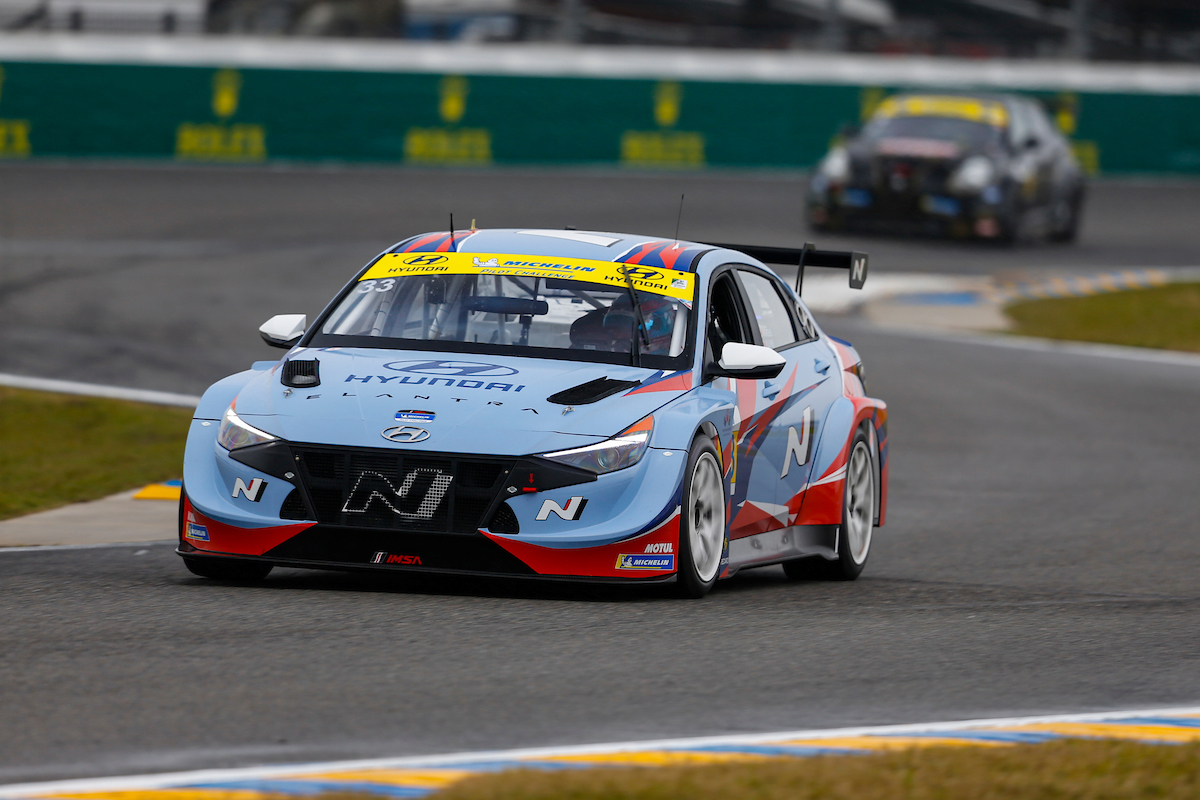
Along with hand control technique, Wickens has had to adapt his style to the dynamics of his new Hyundai Elantra N TCR, but says it "really just handles like a nice race car.” Jake Galstad/Motorsport Images
Wickens credits his wife Karli and a popular online racing platform for helping with shortening his experience gap with hand controls ahead of his TCE debut during Friday’s BMW M Endurance Challenge At Daytona event.
“In terms of using my hands to control the vehicle, I would say it’s about 99-percent second nature that I'm not thinking with my feet anymore,” he relates. “Honestly, the biggest tool for that was iRacing. The fact that I had a simulator in my house is what allowed me to really make hand controls second nature. The iRacing gave me not only the ability to compete again, which was an incredible experience at the beginning of 2020, but to keep honing my craft and to make to learn kind of the throttle sensitivity I needed through using my hand.
“And not only that, but to try some different hand control options to see what I liked what I didn't like. It was really an amazing tool for me. There’s that saying about it taking 10,000 hours of doing something and you'll become a professional at it, and yep, Karli can attest I probably spent twice that amount on iRacing figuring out how to race with hand controls.
“I’ve even changed something on our Hyundai last weekend; we moved the throttle from a ring to a lever -- like a hydraulic clutch lever -- so that I can use my fingers more on that while keeping more of my whole hand gripped onto the steering wheel. We’re still learning.”
A byproduct of training to race with nothing other than his upper body has come with newfound muscle strength attuned to manipulating the No. 33 Hyundai with the claws and pistons attached to his torso. Shake Wickens’ hand at your own peril.
https://twitter.com/robertwickens/status/1481686508998479872?s=20
“My training’s obviously changed quite a bit since the accident, since I was discharged from hospital, and in the last two to three months, we switched the focus from more of a lower extremity strengthening program to core and more grip strength,” he explains. “Thankfully, the grip strength comes naturally now with the wheelchair, just because of what I'm doing for transportation everywhere I need to go.
“But we’ve been making sure we spend quite a bit of time bulking up, just making sure I had the strength. Then the last three, four weeks, we were really focusing on conditioning to make sure that I will be able to last for hours, whatever the team requires from me in these races. If the team wants me to do a double stint, I wanted to make sure that I would be strong enough to do that. And time will tell, but I'm pretty confident and I'm definitely up for the challenge.”
At 1:35 p.m. ET on Friday, a full 1258 days since his last professional motor race, Wickens, the hunter-killer, will be unleashed. Don’t feel bad if it takes a few races for him to rediscover the form that made Wickens such a lethal opponent to face.
“I have never been shy to some good, aggressive racing, but it's been a minute since I've raced, I'm not gonna lie,” he says. “But then again, I'm racing on a nightly basis, virtually. I feel like the nature of racecraft, although it's been virtual, I haven't really lost that, and I've been able to keep that fairly sharp.
“If I have to go wheel to wheel with someone in my Hyundai, I will. But one thing that I do know from endurance racing is it's a long, long, old race, and there's a time and a place to be aggressive. I’m going to take it one step at a time. Pit stop sequences will be critical like they are in every category. Driver changes are something that we’ve been working on. I feel like I'm getting pretty good at it but it's something where I've been used to getting into the car 15 minutes prior, casually getting everything in line and taking 10 minutes to get strapped in. You know, that life's over in multi-driver racing, and I need to learn this quick expediency of getting in and getting out of there with driver changes.”
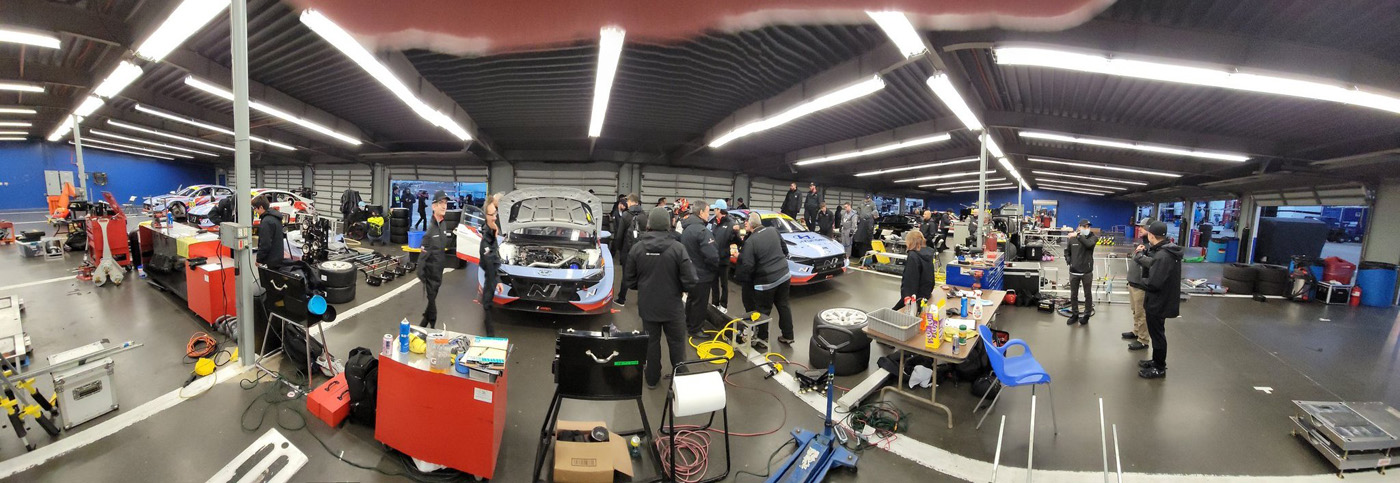
Wickens has a wealth of talent and experience to draw on with the mult-car BHA Hyundai team. Image courtesy of Bryan Herta Autosport
Wickens has BHA stablemate Michael Johnson -- a winner in TCR who is paralyzed below the waist and uses hand controls to drive his No. 54 Hyundai -- as someone to pattern the ingress and egress process after.
“Every driver has their own little tricks, even able-bodied people, and you watch someone getting into the car, they'll all do it slightly differently,” Wickens says. “You know, I'm quite a bit longer legged than Michael, so we tried doing exactly what he did, and my feet keep getting stuck on things, so we're trying new techniques. Every time I get into the car, even if it's practice, I'm trying to figure out how I can position my body to get in and out more efficiently and more consistently. It's just gonna take some time to figure out, but I know by the time we go racing, that's not going to be a problem.”
As if continuing to work with the AMSP IndyCar team and adding a full calendar of IMSA racing with BHA wasn’t enough of a commitment, Robert and Karli Wickens are close to welcoming their first child into the world. Considering all of the suffering he went through since 2018, the man deserves all the personal and professional joy he can handle.
"Well, the first thing is the pregnancy is the best news that I've had coming in 2022,” he admits. “It’s been incredible. We had to do IVF, and it takes some time to get all the pieces together in order to do that. We definitely didn't plan to put everything happening at the same time, but you know, some things in life just can't schedule. It's gonna be one heck of a year, but I think we're up for the challenge.”
Marshall Pruett
The 2026 season marks Marshall Pruett's 40th year working in the sport. In his role today for RACER, Pruett covers open-wheel and sports car racing as a writer, reporter, photographer, and filmmaker. In his previous career, he served as a mechanic, engineer, and team manager in a variety of series, including IndyCar, IMSA, and World Challenge.
Read Marshall Pruett's articles
Latest News
Comments
Comments are disabled until you accept Social Networking Cookies. Update cookie preferences
If the dialog doesn't appear, ad-blockers are often the cause; try disabling yours or see our Social Features Support.