Lesley Ann Miller/Motorsport Images
INTERVIEW: Toyota’s David Wilson on 23XI expansion
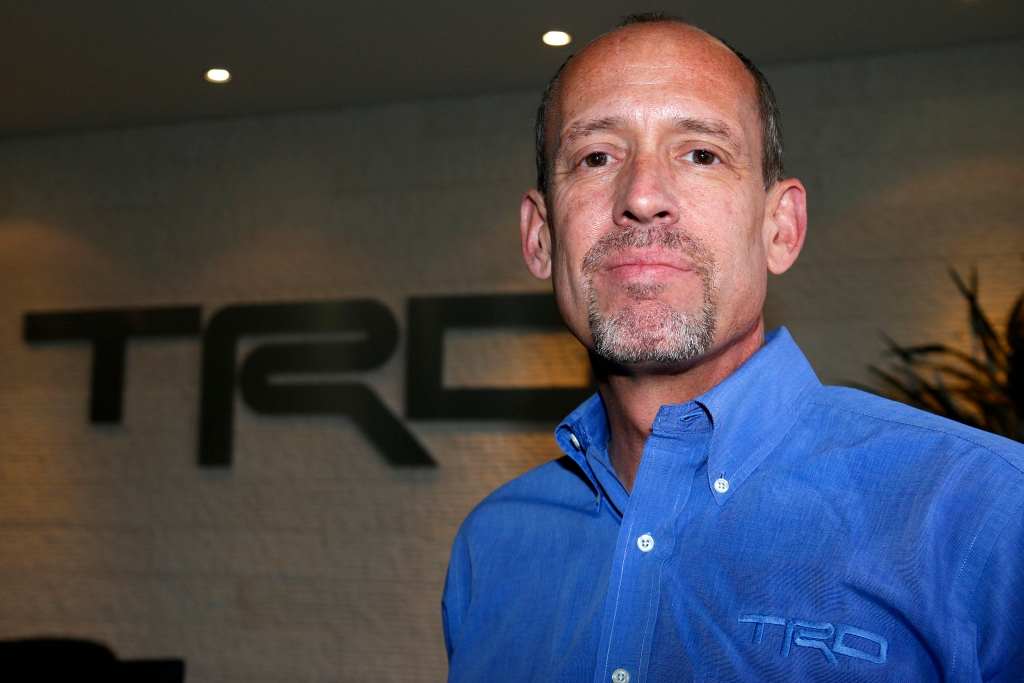
As Toyota Racing Development President David Wilson told Kelly Crandall in a recent interview for RACER Magazine, “Those who know our culture and how we operate, our intensity level is a 10 out of 10. That’s just part of our culture; it’s part of our commitment towards continuous improvement.”
As recent motor racing history has taught us, Wilson has been front and center in joining Michael Jordan, Denny Hamlin, Bubba Wallace, Toyota and Toyota Racing Development together in the creation of the 23XI Racing organization. And as part of the commitment towards improvement and high performance, the 23XI team recently revealed that Kurt Busch would drive for the team during the 2022 NASCAR Cup season. A 22-year veteran who won the Cup championship in 2004, Busch is the perfect wheelman for a team that is still busily defining itself. Heavily backed and fortified by Toyota and TRD, 23XI is moving fast, has big plans and has focused designs on competing at the absolute highest levels and Wilson spoke about it all on the eve of Sunday’s South Point 400 in Kurt Busch’s hometown of Las Vegas.
Q: David, Toyota, TRD, 23XI Racing, Kurt Busch, the NASCAR Next Gen car, you have a lot on your plate! How in the world have things been going?
DAVID WILSON: It’s been a crazy year, to perfectly be honest, Eric. Not one like I can remember in a long time. The unique challenges that we’ve faced this year were amazing. We’ve got our day job, which is to compete every weekend across all kinds of different racing series and that keeps us plenty busy. On top of that and in parallel, we’ve got to put this brand-new race car on the track next year. For the industry as a whole, this has just been monumental challenge. It has just been chaos. The fun stuff really has been working with Denny Hamlin and Michael Jordan and helping them continue to build this young organization and to be a party to what direction they are heading and I love that part.
Q: You’ve been very vocal about the importance of the NASCAR Next Gen car. It’s a project very close to the heart of not only Toyota and TRD, but to you, as well, isn’t it?
DW: Yeah, it really is. Our culture is somewhat unique relative to our competitors. We approach racing in a very hands-on manner. We have this dedicated focus group of some 200 to 250 engineers and technicians who are very closely partnered with all of our team organizations and I say that it can get really uncomfortable at times because we put ourselves in a position where we are part of what goes on track every single week and that’s what we love. We learn so much from that and we truly feel like we are a part of the team effort. The payoff is when we succeed. Whether it is race wins or championships, those become that much more special because we are in the trenches with our partners.
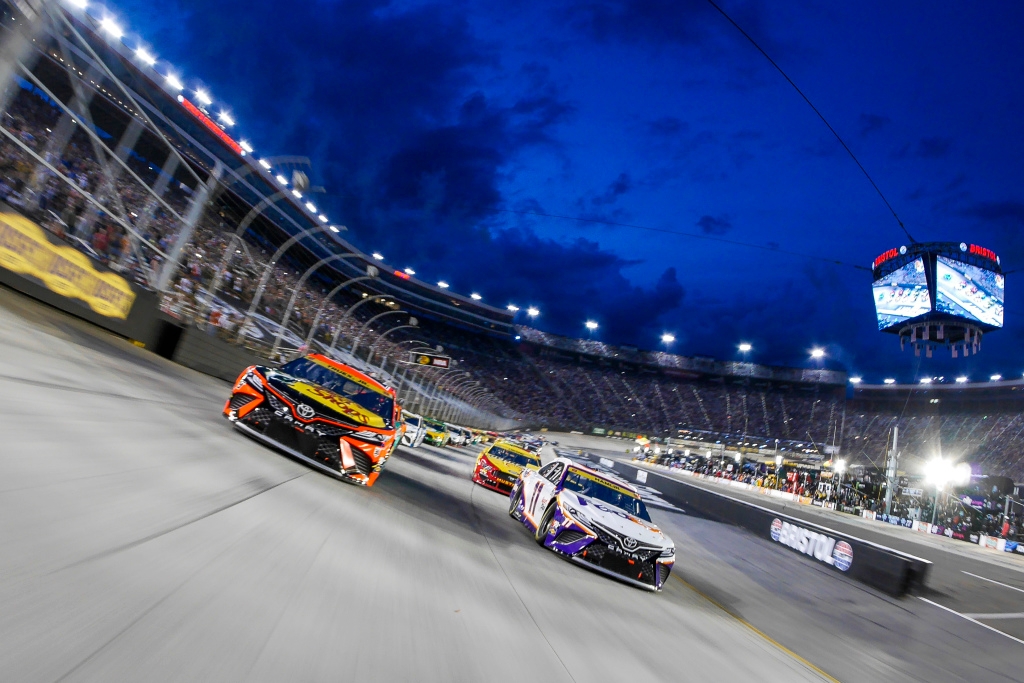
Denny Hamlin and JGR Toyota teammate Martin Truex Jr. are already winners in the Playoffs. Lesley Ann Miller/Motorsport Images
Q: Martin Truex, Denny Hamlin, Kyle Busch and Christopher Bell all made it into the 2021 NASCAR Cup Series Playoffs. It’s very evident Toyota and TRD are in it to win it. And with that comes a hell of a lot of time, effort and tenacity. No shortcuts, huh?
DW: Exactly. Our week starts with a lot going on. There is no, “Why don’t we just chill on Monday?” Our week starts on Monday at the shop. We are right in the competition meeting at Joe Gibbs Racing and we’re sitting at the table and what I love about it is that you go around the table and if you didn’t know better, you wouldn’t know who is TRD or who is Joe Gibbs Racing. We are imbedded. Well and truly. It’s a very organized process where our driver athletes have the opportunity to download. They literally fill out a report before the get to the meeting. They compose their thoughts and in a very open way. Sometimes it can be difficult, but in a very open and transparent manner we share where we are and what isn’t working well and what needs to be better and we talk about near term, mid term and long term plan. That’s a constant cycle, so here we are. We kind of just put the first round of the playoffs behind us. Our focus is on Las Vegas, Talladega and the Charlotte Road Course because that is the next chapter in our goal. Our goal is to get no less than three of our four teams to advance to the next round.
Q: It's so hard to win these Cup races. Strength in numbers is a big part of it now, isn’t it?
DW: It’s strength in numbers, but it’s also strength by focus. I talk about this a lot. We’ve never had the numbers as an OEM. Look at the entry list on Sunday on any given race weekend. Toyota is the least subscribed manufacturer and I used to think we needed a proportionate number of driver and cars in the field. What I came to understand -- and this is the principals of warfare -- is that fewer higher quality cars allows us to amass our resources in a more effective manner. And the fact that we’re the only OEM that transferred every one of their drivers into the next round isn’t an accident because we don’t have any fluff. Every one of those drivers were capable of winning on any given weekend, but to your point, it requires a tremendous focus at this level of competition. As you pointed out, it is so hard to win and you cannot make mistakes. You have to execute. Forget about the speed of your cars and your hardware, but the race craft has to be spot-on.
Q: I wanted to ask you about all of that. I’ve read in recent interviews that you have done that you’re a major proponent of investigating race strategy and even gaming science as NASCAR moves into this new era. Thoughts?
DW: Yeah, this is absolutely something that TRD is putting a lot of focus and a lot of resources towards globally. Whether it’s international soccer or stick and ball, strategy is a big deal right now and so is applying science and history and building a model that allows our teammates to make good decisions. You know, so much of the history of our sport involved crew chiefs and talking about their notebooks. Those notebooks are long gone, simply because we have so much data and we’re able to know collect it and process and put it in a manner that, again, gives those crew chiefs just better information to help make better decisions. Because where the sport is going is all about technology and innovation, but we also recognized as an industry that we have to protect ourselves from ourselves.
You know, engineers left to their own devices can be dangerous thing. I’m an engineer, so I can say that. So what we’ve done is that we’ve started to marginalize, or make the margins smaller, where can’t compete because of the costs and the potential costs is just kind of open ended development, so what we love to do is say, “OK, the box that we have to operate in is smaller. How can we innovate and in what areas can we focus on to get out and front and learn?”
And what that involves? Honestly, it involves a lot of failure. We fail a hell of a lot more than we succeed, but on occasion we find stuff. Obviously, we were the first OEM to bring vehicle simulation into the sport and now everyone has it. You have to have it. It’s part of this area where you still can compete and so yes, gaming and strategy are there. I feel like we are still just on the cusp of it all. We’ve got a lot of work to do, but I think that is something that we are going to put a lot of focus on.
Q: The creation of the 23XI team has been a topic of much conversation in the NASCAR community. In the way many of the variables fell into place to create the new team, you’ve made mention in the racing media that it’s all been almost serendipitous...
DW: Yeah, it really is. One of the things that we came to realize is that with this new car and with the changing model of competition, we needed another partner. I love telling the story of Denny calling me kind of out of the blue. He wanted to kind of philosophize about his career moving forward. This was during the pandemic and we were going to the racetrack and Denny realized that as much as he loved golf, he needed a challenge, right? And he didn’t know whether it was building up his father’s trailer hitch business or doing something in the sport of NASCAR. He has that conversation a few weeks later with Michael Jordan and the next thing you know he’s calling me and he’s like, “Dave, what do you think?”
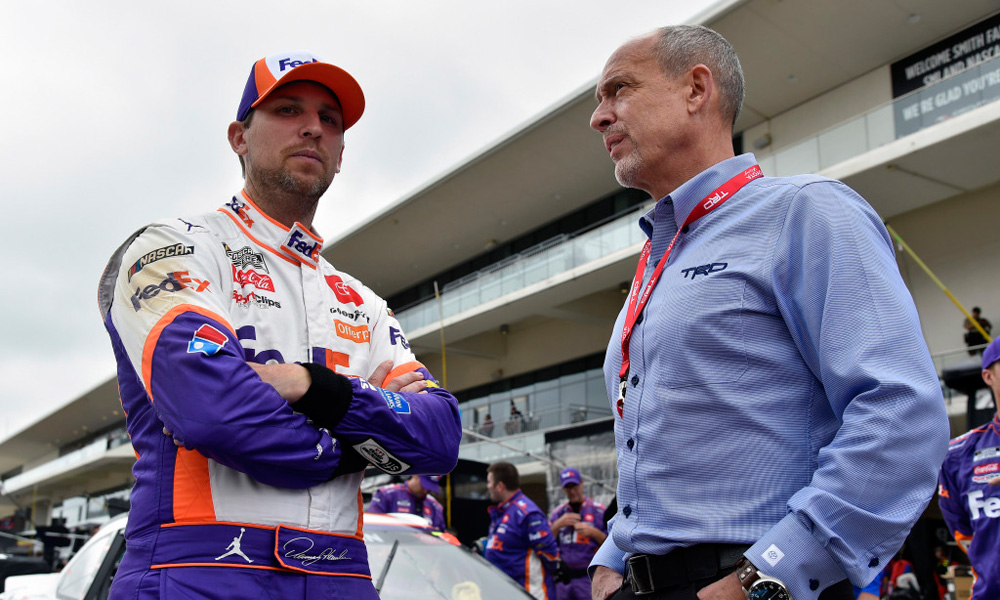
What’s been so cool about it is from the very first day, Denny has said, “Listen, I’m a driver. I don’t know what I’m doing. I need all the help I can get.” He’s been just wide-open. And actually, he doesn’t have the bad habits of a team owner yet because he hasn’t been one. It’s been really fun working with him shoulder to shoulder to build up this organization and to put the pieces in place. And we had calls where we would say, “OK, who is on your list of drivers?” And we’d compare notes and the guy at the top of both lists was Kurt Busch.
Q: Having Kurt Busch there and in on the shop ground floor has to be very confidence-inspiring for you and the entire program.
Yeah, it’s very cool. And as a fine point, Kurt actually has raced for Toyota. Back in 2012 Kurt ran a handful of Xfinity races for his brother and he actually won at Richmond in 2012. Certainly, though, on the Cup side this will be his first opportunity. In a simple, prideful manner, Kurt can become only the second driver in history to win at the Cup level with four different manufacturers. The only guy right now is Kasey Kahne. I think that’s cool.
The reason why Denny and I had Kurt at the top of our list, it was as much of what we believed what he could contribute outside of the race car. Inside that race car? That’s a no-brainer. You just look at the numbers. Kurt makes the playoffs every year. Kurt wins a race every year. Kurt is just like money. But it is outside of the race car and it is giving that young organization a real bench mark because while Bubba Wallace is talented, he’s still finding his way. What Kurt is doing is that he’s taking a chance on us by joining this very young organization. We’re going to know very quickly just how good the equipment is at 23XI because with Kurt, there is no guessing. It’s that index. It’s him helping Bubba. It’s him getting involved in TRD’s young driver development program, which he’s very excited about. All of those things add up to both of us smiling and looking forward to the next couple of years.
Q: Have you spoken much with Michael Jordan and Joe Gibbs?
DW: Yeah, so I’ve gotten to spend a little time with Michael and the very first impression that blew me away was that he’s a NASCAR fan and grew up with his dad taking him to the races. Oh my gosh, he is a NASCAR fan. He pauses his golf game to go in the clubhouse to make sure he’s tuned-in on everything in the sport. And this is well before 23XI came to be, so it was so cool and it is so cool to see how passionate he is abut all of it. He busts balls with the best of them and he has fun and you can tell and you love that.
Coach Gibbs has been terrific. Honestly, at the outset, there is perhaps a natural anxiety because Denny has a day job. He has responsibilities to Toyota and Joe Gibbs Racing and FedEx and what all of us have come to appreciate and respect is Denny’s ability to compartmentalize. And as counterintuitive as it sounds, I think he’s better in the driver’s seat right now, or as good as he’s ever been. That’s just an interesting point. That’s paying respect to him and his ability to focus depending on what the task is at hand. That also speaks to him acknowledging, “Hey, my name is on the sign out front as an owner.” He’s going to surround himself with the right people that can run that team. I respect the way he has handled this and certainly Joe has been very supportive, as well.
Q: I recently spoke with Bubba Wallace and he was very enthused about Kurt joining him in the team. Bubba spoke about how much both he and Denny can help him and his progression in the team and in the sport.
DW: Absolutely. That’s what you would want to see from a driver in his position. As opposed to, you could see somebody who maybe gets a little bit insecure or defensive. That’s not Bubba. He’s racing the pressure because this is going to put some pressure on him, without a doubt. He knows that with Kurt and with Denny he’ll well and truly be able to see and understand where the bar is and what he’s got to do to reach that bar.
Q: NASCAR is poised to enter a very brave new era. It’s easy to see that Toyota and TRD are all systems go with everything. Exciting times, eh?
DW: It’s so exciting. Sometimes it’s terrifying because I can say very confidently that year over year our sport is going to see more change than it has its entire 60-plus-year history and that takes a lot of courage by the sanctioning body, by Jim France sand the France family. It takes a lot of commitment by all those stakeholders -- the teams, the manufacturers, the networks, the track owners because we all stand to reap the fruits of this. Directionally, I have no doubt this is correct and we’re going to be more front and center in pop culture. The pressure is immense on all of us right now. It comes back to my first comment because to be perfectly candid, there is no Plan B. We have to get this car right and we cannot take for granted how big of a job that is. In reality, and I use the expression sometimes, we’re going to be working on the airplane as it’s flying. That’s what we’re signing up for, but it is the right direction and we’re proud and grateful to be in this great sport.
Eric Johnson
Born and raised in the rust belt to a dad who liked to race cars and build race engines, Eric Johnson grew up going to the races. After making it out of college, Johnson went into the Los Angeles advertising agency world before helping start the motocross magazine Racer X Illustrated in 1998. Some 20 years ago, Johnson met Paul Pfanner and, well, Paul put him to work on IndyCar, NASCAR, F1, NHRA, IMSA – all sorts of gasoline-burning things. He’s still here. We can’t get rid of him.
Read Eric Johnson's articles
Latest News
Comments
Comments are disabled until you accept Social Networking Cookies. Update cookie preferences
If the dialog doesn't appear, ad-blockers are often the cause; try disabling yours or see our Social Features Support.