Motorsport Images
SPECIAL: Dario’s dynasty
print or digital subscription
.A decade before Ted Horn swept his Maserati 8CTF to three consecutive AAA championships between 1946 and ’48, novelist Thomas Wolfe completed a work whose title eventually made its way into everyday conversation: “You Can’t Go Home Again.”
Dario Franchitti’s interest in mid-20th century American literature is open for debate, but the Scot clearly has little regard for Wolfe’s sentiment. At the end of 2007, the newly-crowned IndyCar champion quit open-wheelers in search of a new challenge. Less than a year later, after a soul-bruising foray into NASCAR, he’d agreed terms with Chip Ganassi Racing to return “home” to IndyCar, whereupon he immediately produced a period of dominance that may never be repeated.
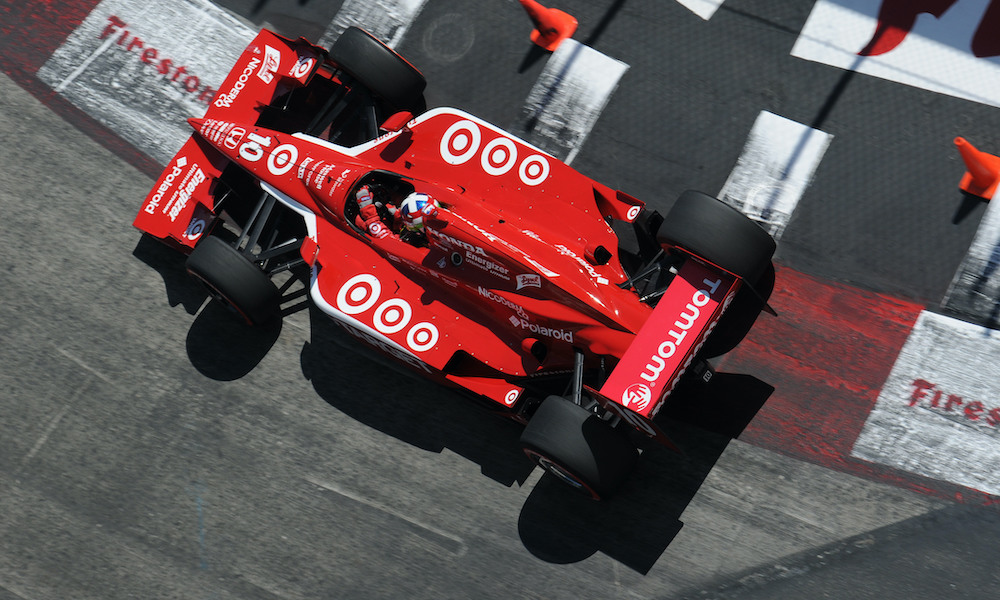
The three championships that Franchitti claimed between 2009 and ’11 echoed Horn’s achievements six decades earlier, but unlike Horn -- who was ludicrously unlucky at the Brickyard -- Franchitti added a second Indianapolis 500 victory to the one he’d already earned with Andretti Green in ’07, and then tacked on a third Indy win as an exclamation point to the whole thing in 2012.
Of all the many things that are remarkable about Franchitti’s streak, one of the most striking is how close it came to not happening. Never mind the thousands of things that need to fall into place to win a championship, and then another, and another after that. His mere presence on the starting grid of 2009’s season-opener at St. Petersburg in Ganassi’s No.10 was only possible due to a very precise sequence of events, the first of which was an about-face on his decision to quit IndyCar.
“I’d accomplished what I wanted to accomplish, which was winning a championship and winning an Indy 500,” says Franchitti of his initial desire to move on. “I’d actually made a decision after winning the 500 [in 2007] that it was almost mission accomplished, and I could feel that I was going to need new motivation. Winning the championship that year put the stamp on it, but I’d made the decision already by that point. So it was a long-term deal with Chip [Ganassi] to do NASCAR [in 2008]. But pretty quickly, the dominoes fell. The first time I drove the car, I realized I’d made a mistake.”
His ill-fated NASCAR foray has been well-documented. Poor results and a lack of funding were compounded by a broken ankle sustained in a crash at Talladega. After recovering, Franchitti returned for a handful of races before Ganassi was forced to shutter the self-funded No. 40 Cup Series team mid-season. Franchitti went on to make some starts in the second-tier Nationwide Series, picking up a fifth at the Watkins Glen road course, but less than a season into this new chapter of his career, he was heading toward another crossroads.
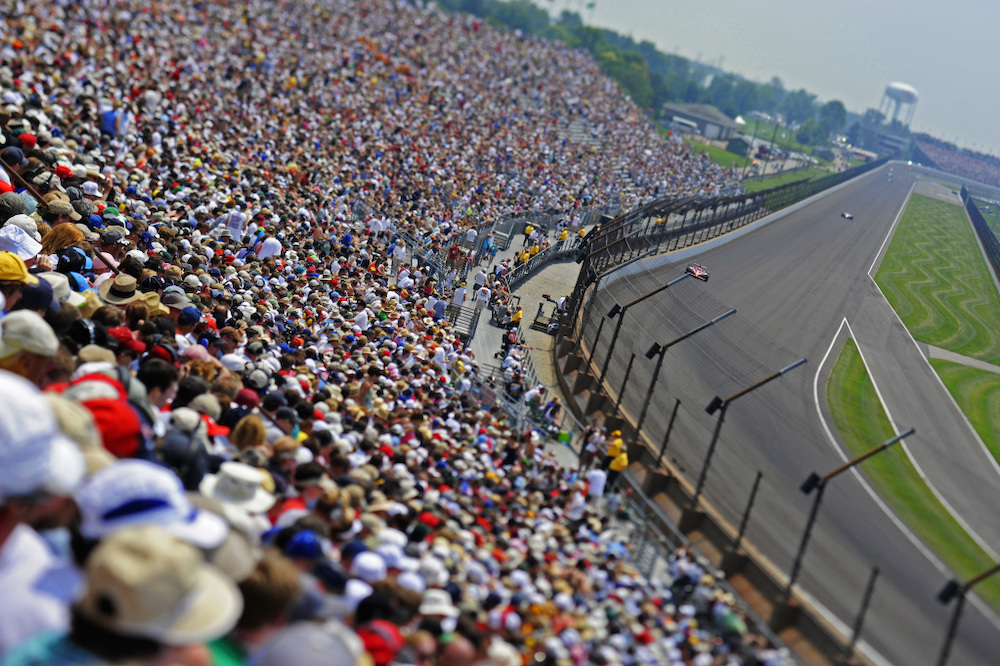
Franchitti started third, hit the front on lap one, and went on to lead 155 of 200 laps on his way to a second career Indy 500 victory in 2010. Williams/Motorsport Images
“By that point I was looking at a future in sports car racing,” he says. “I’m quite good at convincing myself of things – I think it’s part of being a good oval driver; there’s a lot of mind over matter! And I’d convinced myself I didn’t want to do the IndyCar Series again.”
That August, Franchitti made the trip out to the IndyCar/ALMS double-header in Detroit to watch his younger brother, Marino, wheeling Dyson Racing’s LMP2 Porsche RS Spyder. The sight of soon-to-be-champion Scott Dixon manhandling CGR’s No. 9 car between the barriers during Friday practice planted the first seed in Franchitti’s mind that he’d perhaps been too hasty in writing IndyCar off. That seed germinated rapidly later the same day when Franchitti got into a conversation with Ganassi managing director Mike Hull.
“He said, ‘I’m here to watch Marino and just checking things out,’” Hull recalls. “He said, ‘I’m not going to try to go back and do NASCAR again.’ And I said, ‘So what do you want to do?’ And he said, ‘Well, I’d love to drive Indy cars, but all the big teams are full, aren’t they?’”
Unknown to Franchitti and everyone else outside of the “need to know” circle, Ganassi had a 2009 IndyCar problem of its own. As Hull tells it, Dan Wheldon had surprised the team a few weeks earlier with the news that he would decline an option to continue on in the No. 10 after ’08 in favor of a move to Panther Racing. Until Franchitti showed up in the Detroit paddock, there were few obvious candidates available to fill what was clearly going to be one of the best cars in the field.
There’s an apparent yellow flag here. On one hand, Ganassi had a competitive IndyCar and nobody to drive it. On the other, it had the previous season’s IndyCar champion under a NASCAR contract and looking for something to do the following season. It seems inexplicable that nobody connected the dots, but both Hull and Franchitti insist that it wasn’t as straightforward as it seems in hindsight. Hull says that at the time, he was still of the belief that Franchitti wanted to continue in NASCAR. And when Franchitti joined Ganassi’s NASCAR team, he’d walled himself off from the IndyCar operation.
“I'd made it clear when I came over that I wasn't going to divulge anything I'd done at Andretti, because I'd made a promise to those guys that I wouldn't,” Franchitti says. “Not to the owners, but to the engineers and mechanics that had worked so hard. So we never talked about (IndyCar).”
Hull alerted Chip Ganassi to Franchitti’s availability, and terms were thrashed out over dinner in the team’s hospitality unit on the Saturday evening. By all accounts, the negotiations was quick, but the process stalled when Ganassi attempted to formalize Franchitti’s commitment by having him sign a paper napkin. When Franchitti held firm to his insistence on an actual contract, Ganassi set him a deadline of 7:00 a.m. the following morning to have the finalized paperwork in hand. Franchitti delivered it at 6:30 a.m.
“If you understand Dario time, 6:30 a.m. is not easy,” Hull says. “But that’s how much he wanted to drive for us in IndyCar again. The rest is history. But we never really wavered from what was on that dinner napkin.”
As firm as Franchitti’s intention had been to close the door on IndyCar after 2007, his dedication upon returning was equally unwavering. But that commitment was laced with a certain amount of trepidation.
“I definitely wanted to show that the NASCAR thing was a blip,” he says. “But I was also nervous that I wouldn’t have the level of commitment required, and I wouldn’t be sharp enough to go up against Scott. I rated Scott so highly, and I knew what he was capable of. I felt I was going into ‘his’ team, as it were. I didn’t want to embarrass myself, and I didn’t want to let my team down. And I wasn’t sure how I was going to fit in. That was the mindset going in.”
Franchitti’s impact was immediate. He and Dixon had already developed a friendship to match their rivalry on track – Franchitti’s 2007 championship came at Dixon’s expense – and the pair combined to win 10 of the 17 races on the 2009 calendar, split equally at five victories apiece. The title went down to a three-way battle between the two Ganassi drivers and Team Penske’s Ryan Briscoe, with Franchitti ultimately triumphing in a fuel-mileage contest at the Homestead finale.
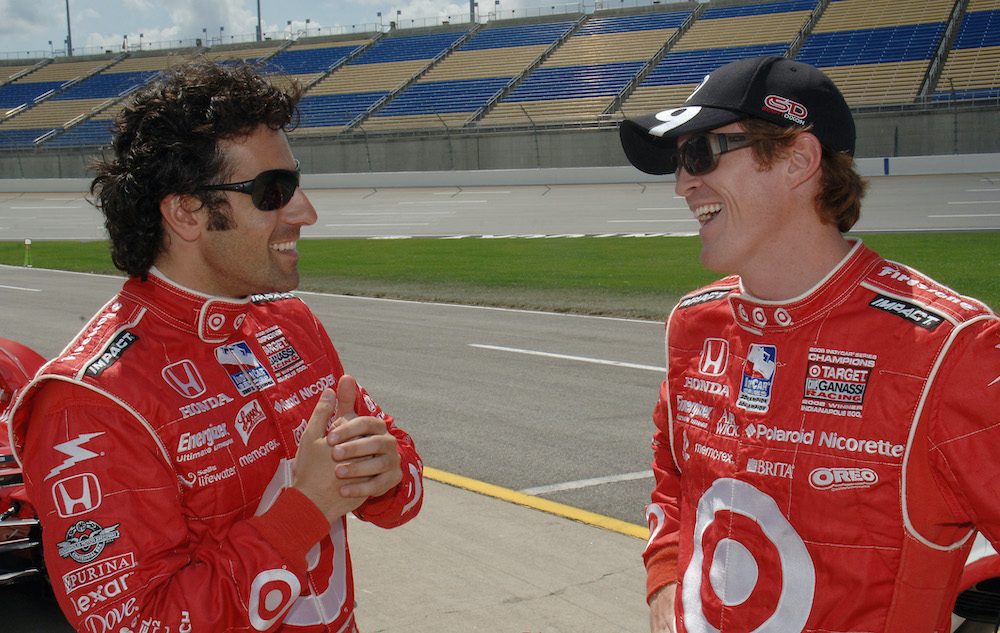
Franchitti admits to having had some concerns about going into "Dixon's team", but the two immediately established an on-track potency to go with their off-track friendship. Motorsport Images
Championships are inevitably – if disproportionally – characterized by the final round. The following year, Franchitti dominated the Indy 500, then triumphed over Penske’s Will Power in the Homestead season-closer when the Australian hit the barriers while attempting to clear traffic. The scheduled 2011 title decider at Las Vegas was abandoned in the wake of Dan Wheldon’s horrific accident, so we look back to the previous race at Kentucky Speedway, where Power came into the weekend with the points lead, only to be clobbered by Ana Beatriz’s car in pitlane, eliminating the main obstacle standing between Franchitti and another crown.
But the real story was the work done to build toward those defining moments, and the effort required to sustain that appetite for success, season after season.
“I felt [the momentum] as a confidence level,” Franchitti says. “It was a well-oiled machine. And I knew at the time that these things can’t go on forever. So I enjoyed every moment of it, because I knew at some point it would stop. And we had that discussion within the team, too.
“But by the third year, to keep that killer instinct...that’s where the people around me came in, because I don’t care who you are, you can tail off a bit with the success. And that’s where having Chip as a boss really helped; he’s so hungry for wins and championships. From the top down, you had that, ‘OK, we’ve won a couple of championships. It doesn’t matter. Let’s keep pushing.’ And in a period that was so difficult to win in, that’s something we’re very proud of.”
The end of Franchitti’s dominance coincided with the arrival of the new DW12 car for 2012.
“At first I really struggled because – and this is bizarre – IndyCar wouldn’t let us use a braking system where I could right-foot brake,” he says. “Everything had to be spec. I literally had to threaten to retire before they would modify the brake pedal so I could right-foot brake. It was absolutely ridiculous. I smashed up two cars in testing trying to learn to left-foot brake on a road course. That’s when Chip got involved!
“But even without that, right from the beginning, I struggled with the new car. Not with the one-lap pace, because I got a few poles, but the race balance and adapting to the car through a race wasn’t so good.”
He was spared those struggles at the 2012 Indy 500, where he was hit in the pit box, dropped to last, and then fought back to survive a last-lap lunge from Takuma Sato and out-drag Dixon to the finish line for a third drink of milk. It was the final win of his career, which was cut short by his medically-enforced retirement after a shocking crash at Houston in ’13.
Time has given Dario a new perspective on his golden Ganassi era, in part because of what Dixon – now a six-time champ – has done since.
“When I look at Scott’s record now, and what that boy’s achieved, I think, ‘That wasn’t a bad run,’” chuckles Franchitti. “I kept him honest.”
Mark Glendenning
Read Mark Glendenning's articles
Latest News
Comments
Comments are disabled until you accept Social Networking Cookies. Update cookie preferences
If the dialog doesn't appear, ad-blockers are often the cause; try disabling yours or see our Social Features Support.