Bryn Lennon/Getty Images
What exactly is a grand prix anyway?
The current grand prix distance of a minimum of 305km (189.5 miles) is set to change in 2027, with a reduction to 290km (180 miles) approved by the F1 Commission earlier this week.
Coming soon after the announcement that there will be 10 Sprint events next year, the format of the sport is rapidly evolving, and what appeared to be a firm line in the sand in terms of the parameters of a race distance has been shifted.
The reasoning is to accommodate a higher fuel flow rate as part of changes to increase the influence of the internal combustion engine (ICE) compared to this season. The simple solution would be to increase the fuel tank size to allow more fuel to be carried during a race, but a number of teams were aiming to carry over their current chassis for cost reasons. So the option that was selected was to simply reduce the grand prix distance to reduce the chances of cars running out of fuel.
For the most successful driver on the grid – who has seen multiple tweaks and more radical changes to regulations over the past 20 seasons – it’s a move in the wrong direction.
“I don’t really know anything about it or any of the reasons behind it,” Lewis Hamilton said. “I think the races should be longer, because the races are physically easier than ever before, so shortening them I don’t think makes much sense.
“This weekend we have the C3, C4 and C5 tires which can pretty much go the distance so we have a lot of races where there is only one pit-stop so it is not particularly challenging. It is challenging, but they are making tires that go longer. There have been many races where I wish we have had more laps, so I would be asking for the opposite, longer races, to be honest.
“This is supposed to be the sport which is the most physically and mentally demanding, and there are some that are so hot and you are on the edge – Singapore is incredibly hot and demanding, and Malaysia will be crazy this year, too. But that is where you want to see athletes, right on the edge of performance and pushing their bodies further because that is what this sport is all about, pushing the levels and pushing the boundaries. So shortening the races makes absolutely no sense to me.”
Hamilton’s viewpoint is one that felt like it would have strong support, given the drivers have grown up with the same race distance throughout, and fans have also watched races that fluctuate in time but are all – bar Monaco – over the same length. And yet, in perhaps a sign of how different generations of fans may view the change, there were a number of other established drivers who were less perturbed.
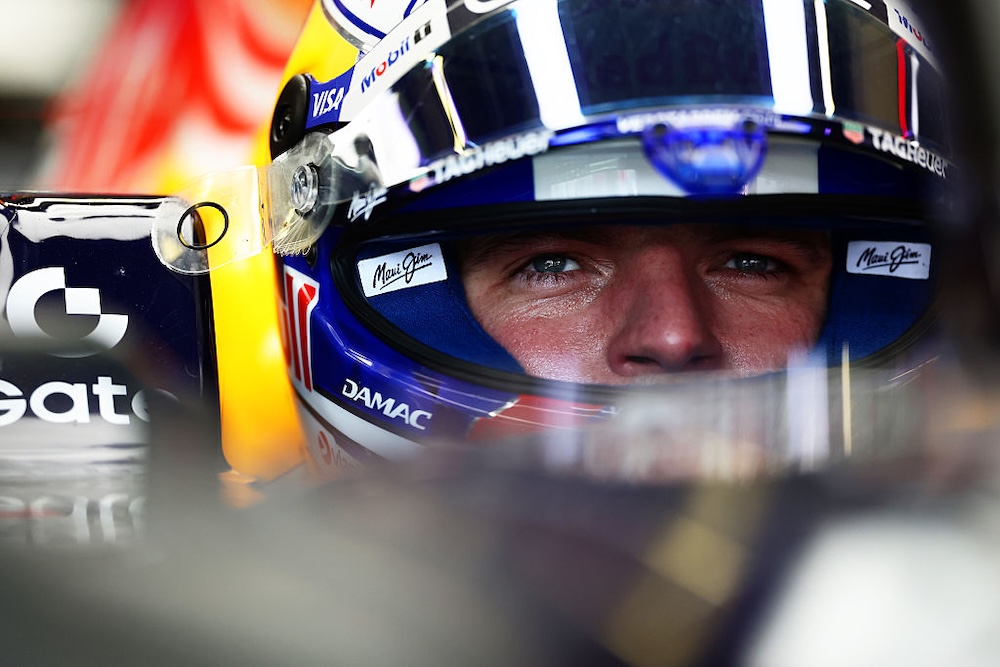
For Max Verstappen, distaste for the current engine formula overrides concerns about race distance. Mark Thompson/Getty Images
“Slightly earlier bath on Sunday afternoon, I guess!” George Russell said. “But it’s [on average] three laps… I think some races you’ll be thankful. Singapore, when it’s an hour and 50 to two hours long, it does feel too long. Then some races like Monza, that’s only an hour and 15 minutes, feel a little bit short. But it doesn’t change a lot.”
It’s true that the current F1 calendar is heading into a run of races that will test the drivers physically, but the majority of races have been deemed to be slightly less demanding than in the past under the current regulations.
Max Verstappen has not only been a vocal opponent of the current regulations, but he has also voiced his indifference to Sprint races on multiple occasions. Despite reiterating the fact that his priority is a grand prix on a Sunday, the four-time world champion says it’s about quality over quantity.
“I didn't design the rules in the first place,” Verstappen said. “If that means that we have to run three laps less, I would run 50% less if it would give me a nicer engine to drive! But I don't think it's a big problem.
“It's like I said before, sometimes you would wish that the race is three laps longer and sometimes you're happy that it's three laps shorter to keep someone behind. And if we have to shorten it a little bit for the fuel consumption, but for overall a better racing experience, then I think everyone will take it.”
The sentiments are similar for the current world champion, Lando Norris, who views the change as a necessary step to make the cars a better challenge to drive, and reward the talents he believes should be rewarded in a driver.
“It's not that you push harder,” Norris said. “You're just not having to think about the battery as often as you are this year, which is what we want as drivers.
“It's a good compromise that we need to make to make our sport better and rely more on driving rather than who can look after our battery the best. It's not what this sport is about. It's about which drivers can extract the most from the car, and that's not what we're seeing this year.
“That's the compromise we have to make. It's a short-term compromise, I think. In a few years' time, when all engine manufacturers are on board with having more fuel again and having bigger tanks and all of that, then it's something we can go back to the longer races and the races that we've always had in Formula 1, but it's a compromise we have to make to suit all teams.”
Historically, the distance of a Formula 1 race has changed under different regulations, but it has been more than 40 years since the standard distance dropped below 300km.
Perhaps it’s a small compromise that will have a wider impact on better racing. Perhaps it’s a large one that will improve the quality of racing overall. Whether it’s planned to be a short-term change or not, what’s certain is it has opened the door to something more permanent if it’s deemed to be more entertaining. The evolution of what an F1 race looks like is showing no signs of slowing down.
Chris Medland
While studying Sports Journalism at the University of Central Lancashire, Chris managed to talk his way into working at the British Grand Prix in 2008 and was retained for three years before joining ESPN F1 as Assistant Editor. After three further years at ESPN, a spell as F1 Editor at Crash Media Group was followed by the major task of launching F1i.com’s English-language website and running it as Editor. Present at every race since the start of 2014, he has continued building his freelance portfolio, working with international titles. As well as writing for RACER, his broadcast work includes television appearances on F1 TV and as a presenter and reporter on North America's live radio coverage on SiriusXM.
Read Chris Medland's articles
Latest News
Comments
Comments are disabled until you accept Social Networking Cookies. Update cookie preferences
If the dialog doesn't appear, ad-blockers are often the cause; try disabling yours or see our Social Features Support.