Sutton/Motorsport Images
RETRO: The first Magnussen IndyCar debut
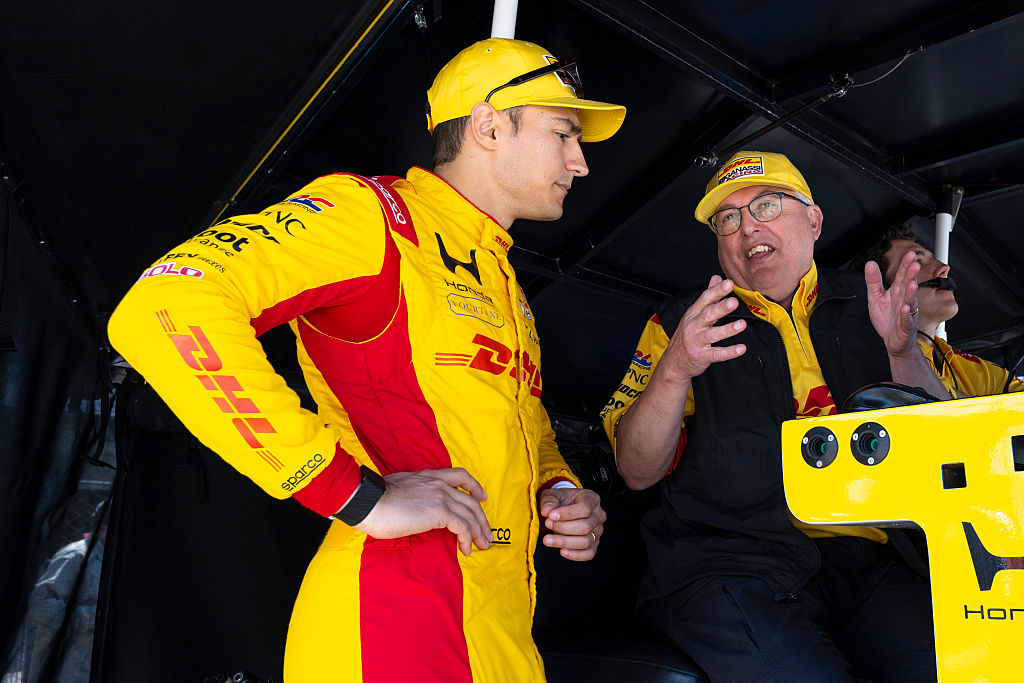
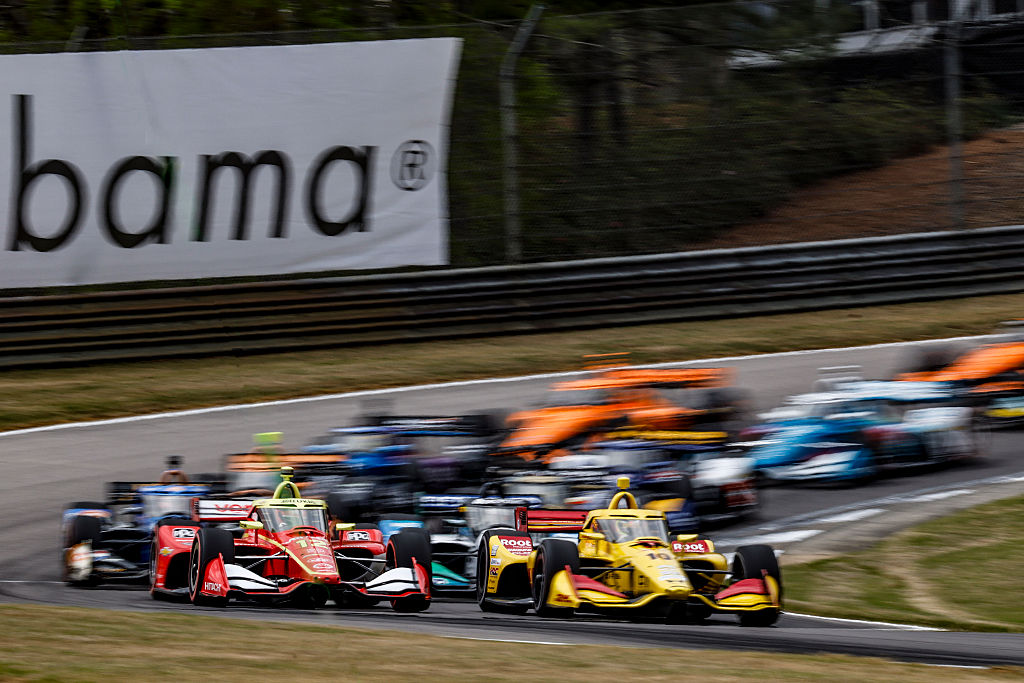
Jan Magnussen’s first drive in the CART IndyCar Series came in the summer of 1996 at Mid-Ohio (pictured above). He was drafted in to substitute for Team Penske’s Paul Tracy, who had been injured in a severe crash at Michigan International Speedway. Twenty-five years later, his son Kevin finds himself in the same scenario as he prepares to substitute for the injured Felix Rosenqvist with Arrow McLaren SP at Road America.
The elder Magnussen would go on to make his second CART IndyCar start in yet another super-sub opportunity at the next round. By coincidence, it took place at Road America where he filled in for the injured Emerson Fittipaldi in the Penske-affiliated Hogan Racing entry.
Altogether, Magnussen would make four starts in 1996, adding Vancouver and Laguna Seca to his plate with a best finish of eighth coming in Monterey.
The parallels between father and continue as Jan’s first Formula 1 start was with McLaren in 1995 while Kevin made his F1 debut with McLaren in 2014, and with his upcoming start in IndyCar, he’s back with McLaren through a direct outreach from the team.
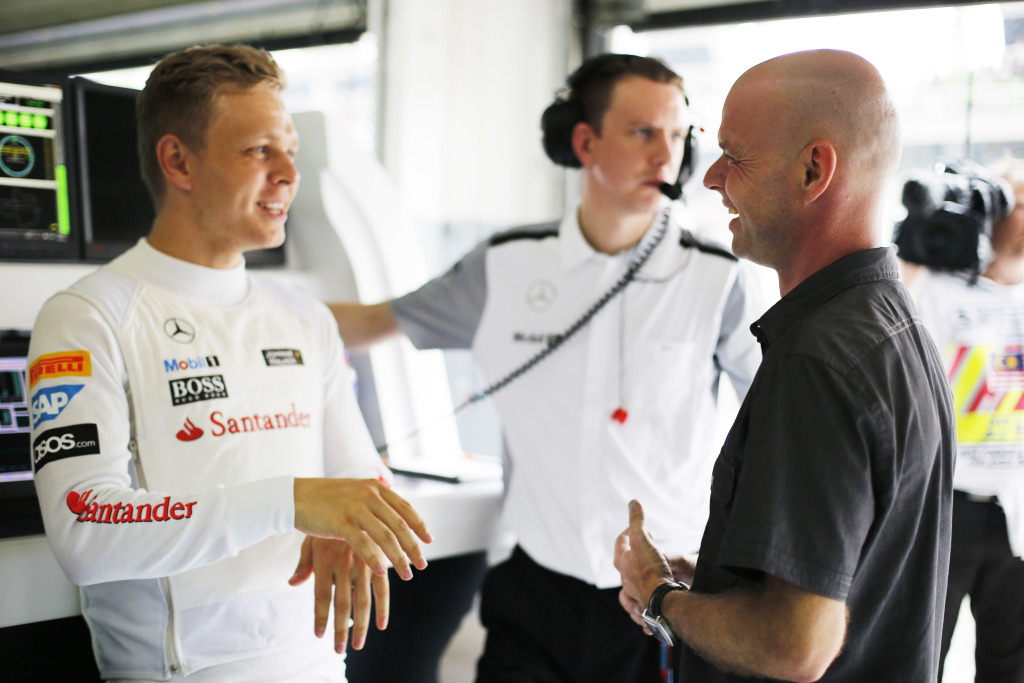
Both Magnussens made their F1 debuts with McLaren, but would experience more frustration than fun there. Steven Tee/Motorsports Images
Jan returned to CART in 1999 to make seven additional starts, this time for Patrick Racing after his F1 career met a frustrating and unrewarding end with the upstart Stewart Ford team. He’d soon return and become a legend of North American sports car racing with Corvette in the ALMS and IMSA. Kevin’s story is similar, leaving F1 after the newish Haas F1 team devolved on an annual basis. And what was his choice for a career reboot? North America, in IMSA, with a factory sports car team representing General Motors. and now, IndyCar.
“Our careers have had a few of these similarities,” the 47-year-old Magnussen told RACER. We both debuted in F1 for McLaren, and now all of this. Kevin and I were talking about this before he got on a plane to go to Road America this weekend. The same thing happened to me 25 years ago, and I hope he has better luck!”
Kevin’s journey from winning his first IMSA WeatherTech SportsCar Championship race last weekend in Detroit with the Cadillac Chip Ganassi Racing team to subbing for Rosenqvist days later at Road America is simple and straightforward compared to what his father went through a quarter-century ago.
“I was just coming back from an injury myself; I crashed my scooter in the paddock at a DTM race and broke my leg,” he related. “I was still going through rehab in Austria, getting back on my feet after that accident, and I get the call from [former McLaren boss] Ron Dennis who asked if it was something I wanted to do. I hadn't been following the American racing scene very much, but I said yes immediately.
“I was doing DTM with Mercedes and had my testing contract with McLaren, but I saw this IndyCar opportunity as a way try these cars and maybe to get back in Formula 1. My first test was at Sebring at the little short course, and those things were just monsters -- so much power, heavy cars compared to the Formula 1 car, but a lot of power. But I wasn’t really finished with my rehab at all.”
There’s no denying the fortitude of the racing Magnussens from Denmark.
“I really did come straight from rehab to Sebring,” he continued. “I still had the staples in my knee. They had inserted a big titanium rod, like a nail, that went down from my knee to my ankle to hold the broken bone together, and when Ron called, I was in the rehab hospital in Austria getting that removed. So when I arrived at Sebring and I walk into the tent, they knew I came straight from the hospital. The team said, ‘There might be a little bit of a problem. You're testing the car today, but the doctors here won't let you test with the staples in your knee.’
“I'm like, ‘Well, we can take them out!’ I was pretty sure you could just get rid of them and go testing; it was only a short day of testing anyway. I thought, ‘Screw this,’ so I went into one of the mechanic’s toolboxes, got a pair of pliers, and clipped them out myself! I really wanted to drive. I thought, ‘Well, better a little bit of pain now than to not drive at all.’”
Jan would step into the No. 3 Penske PC-25 chassis powered by a 2.65-liter V8 turbo Mercedes-Benz engine built by Ilmor Engineering -- the same company that builds the 2.2-liter twin-turbo V6 Kevin will use in the No. 7 Dallara DW12-Chevy. New to American racing, Magnussen fell in love with the CART IndyCar Series and the reception from Team Penske.
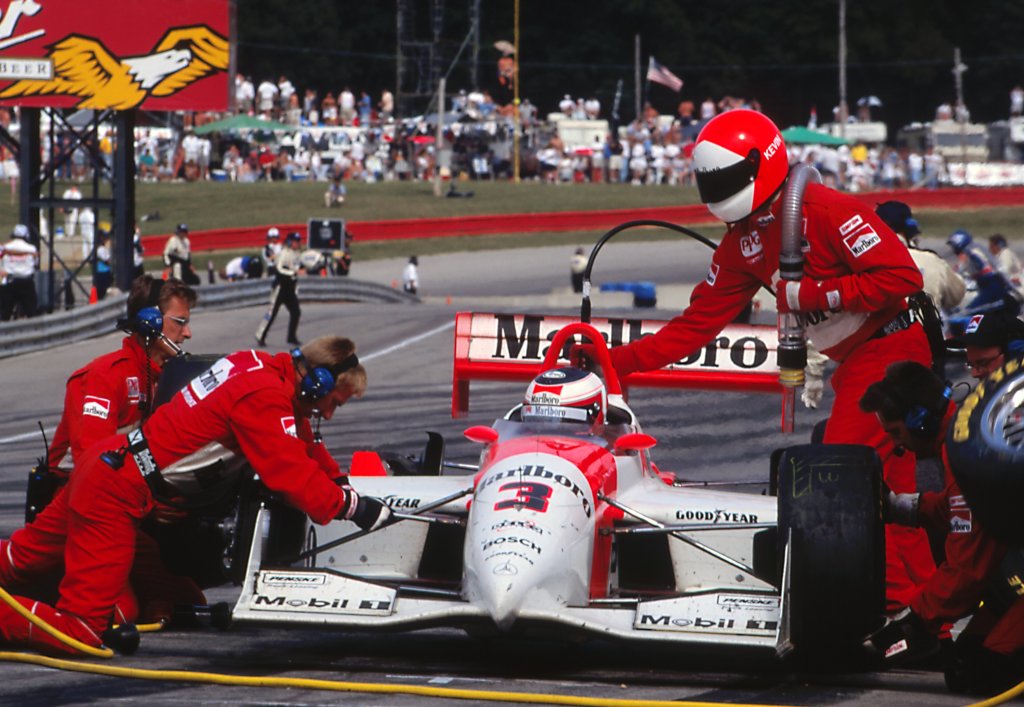
The PC-25 Mercedes was a handful even without a damaged leg, but Jan Magnussen still impressed with Team Penske at Mid-Ohio in 1996. Motorsport Images
“I'd only been out of Formula 1 for about a year, but those CART cars were fast,” he said. “I remember getting in this car and it had a sequential shifter -- a stick shift, which I hadn’t used in a little while. And just the way the power came in with the turbo and all the stuff that I wasn’t used to in Formula 1. And then at Sebring, super bumpy, but I felt I could get in and drive here; it was such a cool experience.
“The team was great with me, gave me all the room and the time I needed to settle in, just being really professional. I had the same feeling the feeling I had when I joined the Panoz [ALMS] team in ’99 after having a s••• time in Formula 1. This was team spirit like I had never felt before: We're doing this together. I found that again, with a great big team like Team Penske. And the only thing I knew about Penske was it was the equivalent of McLaren, but in America, and they were so much nicer than McLaren. Just took really good care of me.”
For years, Mid-Ohio has been among the most grueling stops on the IndyCar calendar. On top of being new to the car, team and series, Magnussen’s first laps at Mid-Ohio were done the old-fashioned way. Long before simulators and YouTube videos existed, the then-23-year-old got to grips with the rolling road course by flogging the 850hp Penske-Mercedes.
“You know, testing doesn't really prepare you for racing at Mid-Ohio, so I do remember how physical it was,” he said. “Especially Turns 7-8-9, and how the car compressed after that sequence; just a super, super physical ride. And no power steering, which is what I was used to.”
Magnussen qualified 18th for his IndyCar debut, and while the starting position might not stand out as remarkable, his veteran teammate and two-time series champion Al Unser Jr. qualified 15th.
“The coolest part is I was being told by Roger Penske, before the race -- because I was doing this one for him and then doing some for Hogan after -- he said, ‘Go out there and race, learn as much as possible, but don't take any crap from anybody!’ I was like, ‘Nice! Freedom with responsibility.’ He didn’t want me to let anybody push me around, which I thought was a cool note to give your new driver. But man, I got into the race and I really wanted power steering. I wasn’t physically prepared for all that because of the broken leg and not so much training.
“But it was just a great experience. I ended up in the race coming together with Mark Blundell into the Keyhole, and needed to get pulled out of there, so I lost a couple of laps and finished 14th. I wish at that time -- because in ’96, I was en route back to Formula 1 -- to be more open to the idea of IndyCar being an option instead of Formula 1. But you know, you live and learn. It’s much easier to predict the past. I loved it. In hindsight, I should have pushed to stay in IndyCar, but then I wouldn’t have gone for Formula 1 and gotten my ass kicked…”
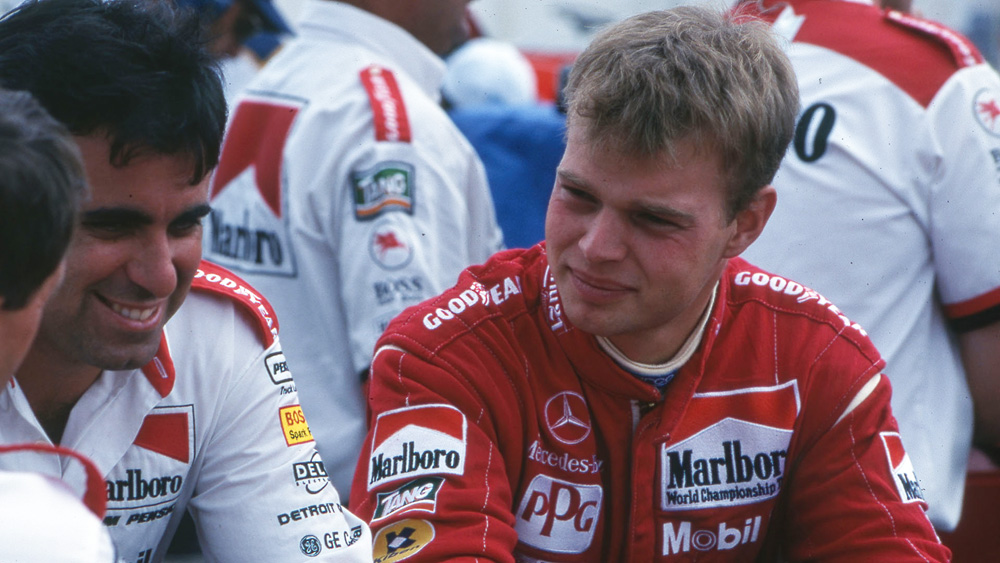
Magnussen found IndyCar a refreshing and challenging arena during stints with both the Penske and Hogan teams. Marshall Pruett archive
One week later, Magnussen would switch to Fittipaldi’s red No. 9 Penske PC-25-Mercedes at Road America, where he’d demonstrate the kind of performance that was on display in his European junior open-wheel days. Starting 10th, he outqualified Unser Jr. in 12th, and was primed for a fight with the season’s best in Jimmy Vasser, Alex Zanardi, Michael Andretti and so many others.
“Qualifying was good and then, actually, in the pre-race warm-up, I remember being right up towards the front of the time sheets, and I was like, ‘OK, now I know what I'm doing,’” he said. “Then at the start of the race coming down into Turn 3, there was a bunch of guys moving around, and in the end, I ended up driving into Bobby Rahal's rear wheel and breaking my front suspension. Race over already on Lap 1, which was a big shame because I think I could have done well in the race. But that's how these things go.”
As much as he’d like to be present for his son’s first IndyCar start on Sunday in Wisconsin, Jan will be in Sweden racing a Porsche, and will keep tabs from afar.
“Regardless of how it's gonna go with Kevin this weekend, I got lucky with that test at Sebring; he is really getting thrown in at the deep end, having never driven the car,” he said. “But the one good thing is he's been to the track. He tested with Chip Ganassi and the Cadillac DPi, so he knows the track, already loves the track, so he just needs to learn a car,
“But he's up against some super-talented drivers. So regardless, I know he's gonna love it. He loves to drive, and he loves to drive brutal cars, and IndyCar definitely is that, for sure.”
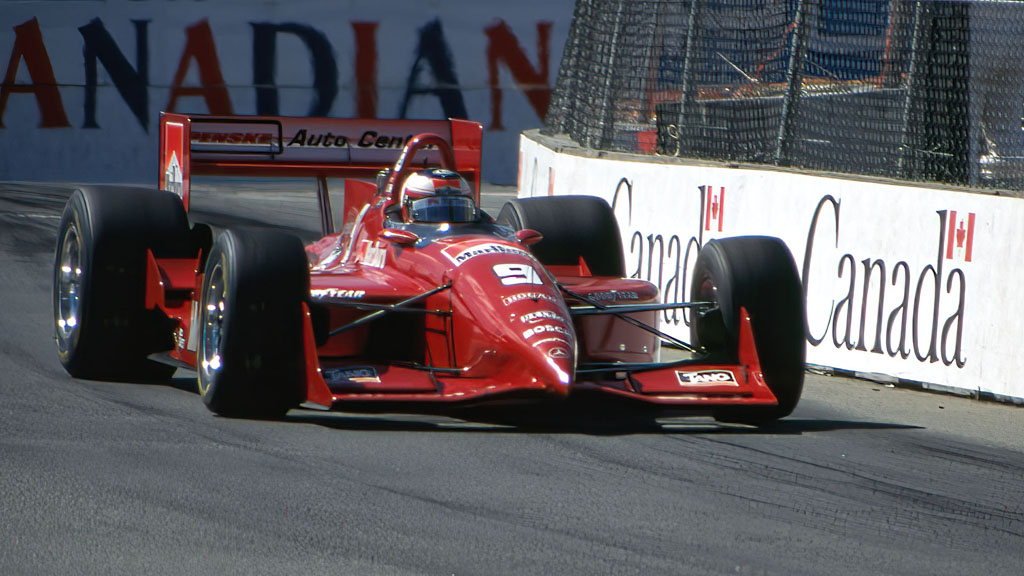
Magnussen’s Hogan Penske was literally flaming red on race day in Vancouver... Marshall Pruett archive
Returning to 1996, Magnussen would go on to do those two other races at Vancouver and Laguna Seca and focus on raising his four-year-old son Kevin as the Stewart F1 team beckoned. In typical fashion for the hilarious Dane, the conversation closed with a quick yarn about that Canadian CART race in the No. 9 Penske-Mercedes where he finished an unflattering 22nd.
“During the Vancouver race, I don't know what the hell happened,” he said. “I think I was running about midfield, and suddenly my shift-without-lift stopped working. You know, you just stay flat on the throttle and pull the gear lever and it would cut the ignition and let you shift without lifting. So that failed and I had to lift off to shift while I was fighting somebody for position, which wasn’t great on this street course.
“So I got a little pissed and call it in on the radio and said that no-lift-shift is not working. And no answer. Nobody answers a couple of times. Third time when I'm screaming over the radio, ‘The f•••ing no-lift-shift is broken,’ and just as I come off the radio button, I can hear my engineers just clicking off his button and I can hear the word ‘Fire.’
“And as I hear the word fire, there's yellows. I’m thinking, ‘All right, somebody crashed. It must be on fire.’ So I’m driving down the street, pissed with the knowledge of the car not working correctly, and I drive to the hairpin at the end of the straight, come around the hairpin and there's a big screen TV right there, so I can see what's going on…and there's me on fire. So that’s why the no-lift-shift wasn’t working…because it was on fire with the rest of the back of the car. I was calling my engineer complaining the same time he was calling me and I didn't hear about it until it was too late… Good times.”
Presented by:
Marshall Pruett
The 2026 season marks Marshall Pruett's 40th year working in the sport. In his role today for RACER, Pruett covers open-wheel and sports car racing as a writer, reporter, photographer, and filmmaker. In his previous career, he served as a mechanic, engineer, and team manager in a variety of series, including IndyCar, IMSA, and World Challenge.
Read Marshall Pruett's articles
Latest News
Comments
Comments are disabled until you accept Social Networking Cookies. Update cookie preferences
If the dialog doesn't appear, ad-blockers are often the cause; try disabling yours or see our Social Features Support.