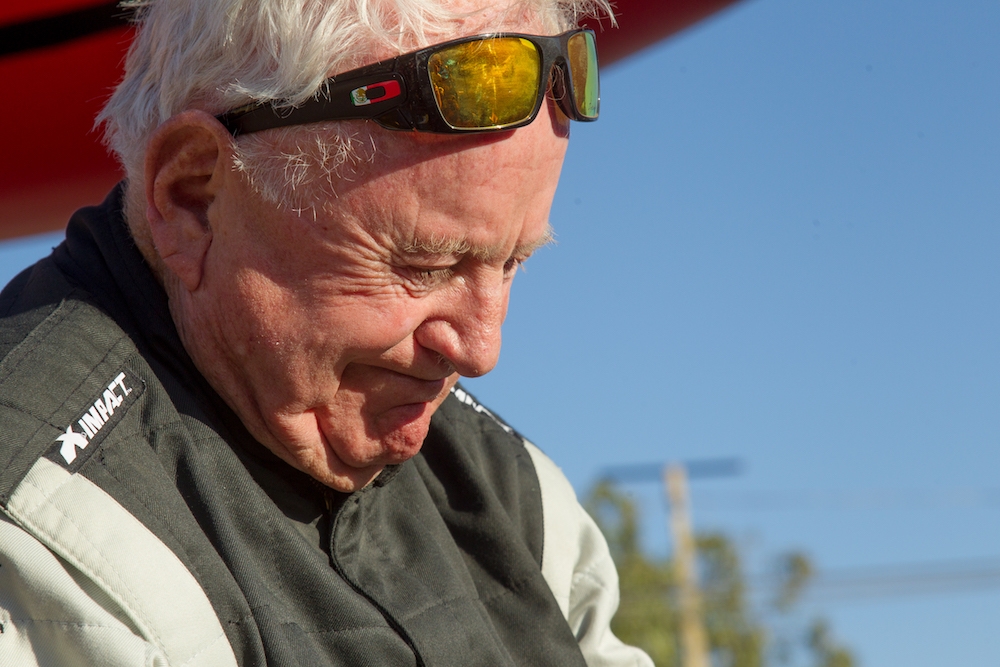
Image by Bink Designs
INSIGHT: Finding the finish line with Bruce Meyers
On Friday, February 19, the visionary whose fiberglass invention helped pioneer the sport of off-road racing while also creating millions of smiles across the world, passed away in the early morning hours. At 94 years young, Bruce Meyers was the embodiment of “you are only as old as you think you are.”
Time finally caught up with the walking poet lariat of the off-road culture, a guy whose youthful outlook and hope for the future were unmatched. Having carved an artistic swath through life, his tired body and ever youthful mind finally crossed the eternal finish line.
But that’s not the only finish line Bruce ever crossed. In 2014, I had the honor of helping him drive across another one after decades of failure.
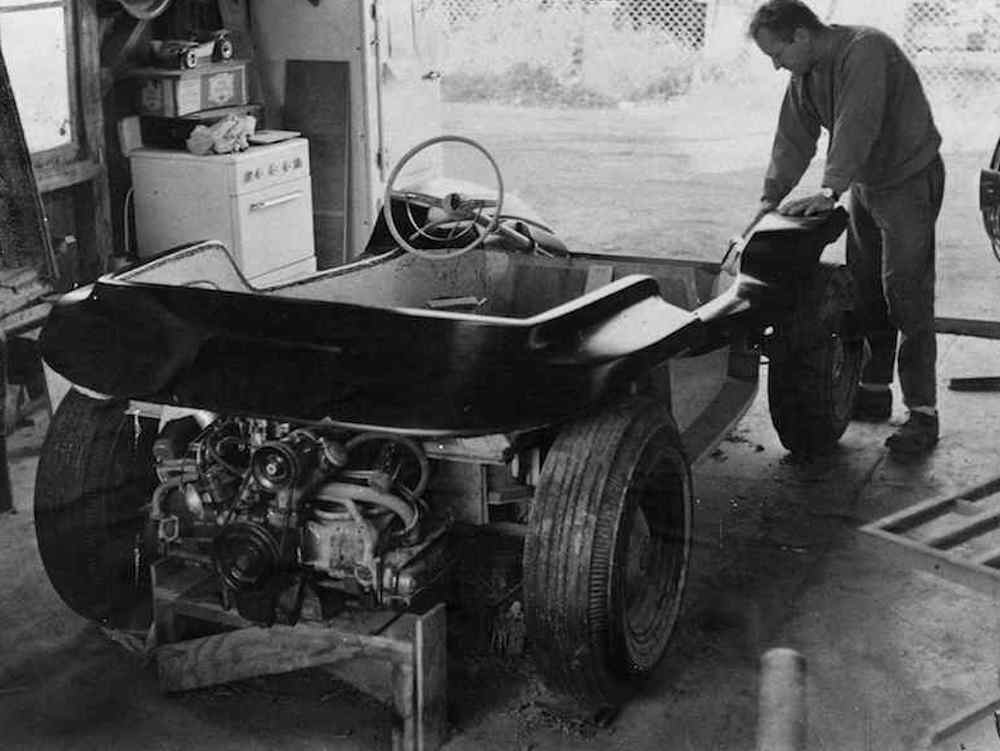
A young California artist, Bruce Meyers, crafts the original “Old Red” Meyers Manx, circa 1964.
The Bruce Meyers story is the stuff of legend, and fuel for countless articles and documentaries since he formed his first Meyer Manx dune buggy body in a tiny, one-car Newport Beach, California garage in 1964. Given his penchant for sand, surf and music, also having an interest in racing seemed to sit outside the well-known narrative. However, his ultimate influence on the sport of desert racing is yet another powerful chapter to his story.
Meyers built the Volkswagen Beetle-based car, affectionately entitled “Old Red,” to scratch an itch to explore the untapped vistas of the nearby Baja peninsula with his buddies. Bruce would share endless stories of free lobster, cold margaritas and beautiful local ladies; but the trips that he and his posse enjoyed were actually pre-runs towards the near future.
One particular alcohol-fueled dare turned into Meyers and friend Ted Mangels using Old Red to beat the fastest motorcycle times from the top of Baja in Tijuana to the near bottom in La Paz.
That singular act, and all the publicity about it that followed, really helped set in motion the very first professional desert race – the 1967 National Off-Road Racing Association (NORRA) Mexican 1000.
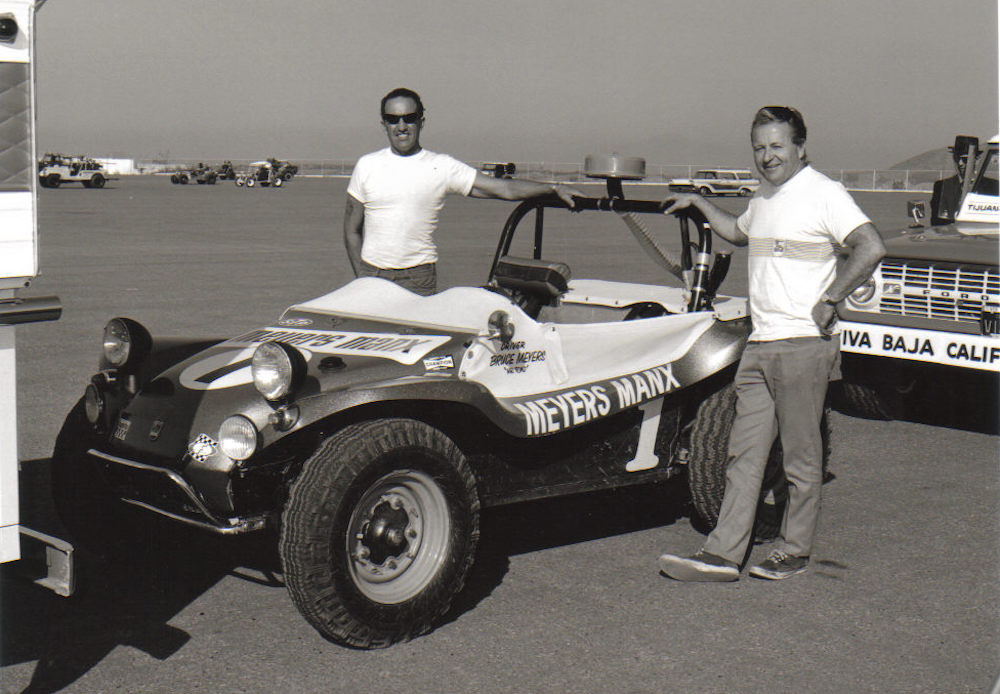
Meyers poses next to his factory Manx before the inaugural 1967 NORRA Mexican 1000.
Among the pioneering field of entries from that first race was Meyers, piloting a gold version of his creation that was part of a four-car factory Meyers Manx effort. Gifted the No. 1 entry and car number by NORRA, Meyers led the field for a large portion of the race before his primitive VW Beetle transmission gave up. Happily, however, the No. 10 Meyers Manx of off-road pioneer Vic Wilson and Mangels won the race and made motorsports history.
The following year, Meyers the racer returned for the 1968 Mexican 1000, this time with three of his new tube-framed Meyers Tow’ds powered by Ford industrial V-4s. Unlike the year before, he started in 66th position with co-driver Bill “Wheelo” Anderson. About 100 miles into the run, he was passed by Parnelli Jones and Bill Stroppe in a Ford Bronco on a stretch of pavement. Diving back onto the dirt, an adrenaline-inspired Meyers worked his way around Jones, only to crash heavily into the side of an infamous Baja arroyo. With the accident scene being serendipitously captured by the lone ABC Wide World of Sports helicopter, the two injured drivers got extracted from the stricken wreck, with the rudimentary Tow’d chassis nearly folded in half.
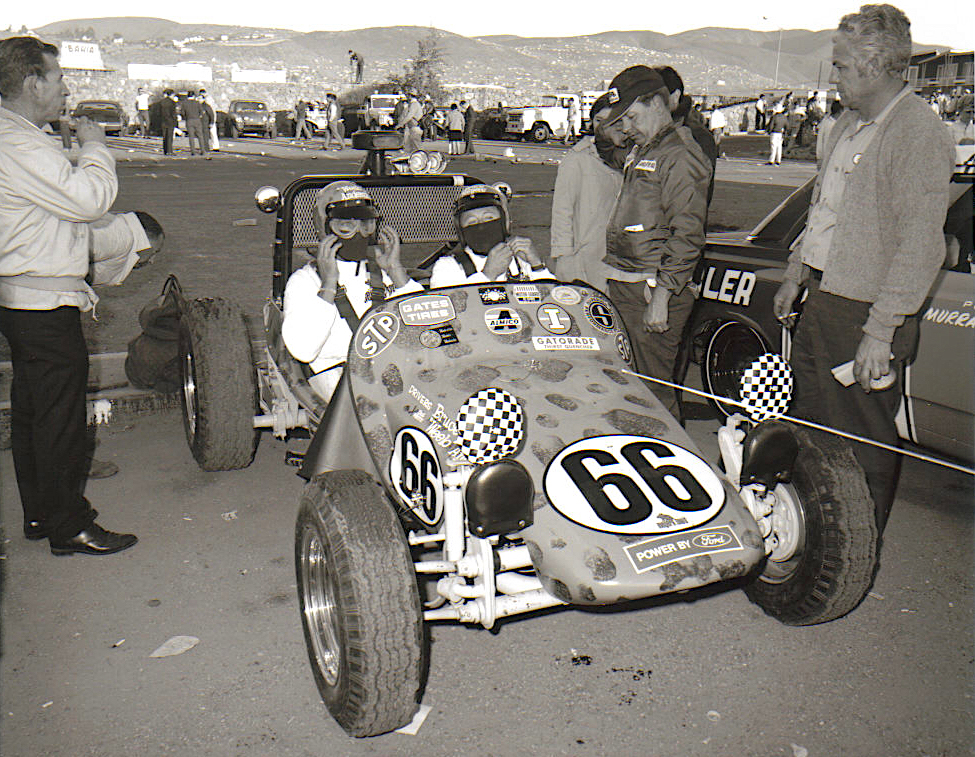
Strapped into their No. 66 Ford-powered Meyers Tow’d, Bill Anderson (left) and Meyers about to set off on a fateful '68 NORRA Mexican 1000.
While Anderson had a sprained wrist, Meyers lay on the hot desert floor with compound fractures of both legs and a mangled left ankle. His excruciating 23-hour ride to a San Diego hospital is the stuff of legends. The injured racer never fully recovered from the incident despite receiving a prosthetic ankle.
In a book that he wrote a few years ago, Bruce lamented the life that followed, explaining, “That limp was to follow me as a reminder of a ‘what the Hell -- let’s go for it’ youth, and that I was removed from the world of off-road racing. As the guy who possesses the very first trophy for the sport that followed, I knew very little about what took place after.”
He wasn’t removed forever.
Overcoming years of depression and survival after the loss of his original Meyers Manx business in the late 1990s, he and wife Winnie resurrected the company with the sale of new kits based on the original version of the Manx, as well as starting a worldwide club that is thriving today. That success spurred on his inspiration to build an all-new modern body, this one designed to fit a standard-length Volkswagen chassis (the original ones required a 14” cut to shorten them). He dubbed it the “Manxter.”
That new buggy not only inspired me to build my current version (an off-road/on-road machine known as a Meyers Manx Dual Sport), but it led me to help Bruce and a group of enthusiastic helpers to collaborate on a racing version of the Manxter designed to debut at the 35th anniversary SCORE Baja 1000 in 2002. Not only would Bruce race, but so too would original 1967 Mexican 1000 champion Vic Wilson along with others in his team. The effort was tied into the BFGoodrich/Toyota Class 1 team with Indy car drivers Mike and Robbie Groff, Jimmy Vasser and me. Together we managed to convince a bunch of generous industry people to join our retro efforts with all manner of needed parts and services.
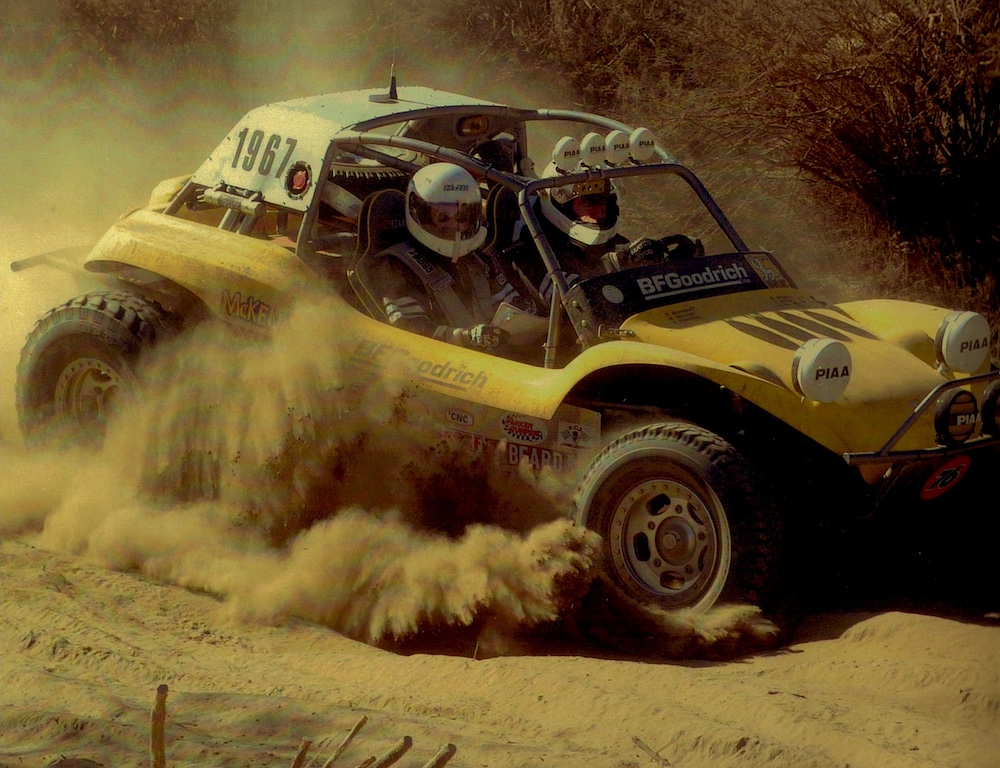
Making its debut at the 2002 SCORE Baja 1000, the newly constructed Manxter race car began what would be string of failure...
Wearing the No. 1967 in honor of the first year of the race itself, the well-intentioned effort made a valiant, but unsuccessful, quest to reach the finish line in La Paz. It would return the following year, a race which was documented in the theatrical film Dust to Glory for which I served as one of the producers. Sadly, there is a scene near the end where the race Manxter was unceremoniously being rescued back to civilization on a tow-strap.
The possessed car was campaigned with Bruce three more times. Three more times it failed to reach the end. Meyers had a Baja finishing record of 0 for 5.
After the Dust to Glory experience, I embarked on a second Baja racing film entitled Baja Social Club, thanks in large measure to the return of NORRA and the retro-themed Mexican 1000. Created to honor the original godfathers of the sport with NORRA as its backdrop, we filmed Meyers' return to his beloved peninsula with Old Red, this time with Vic Wilson driving a replica of the original 1967 race-winning No. 10 Meyers Manx.
It was sometime during that trip when I asked Bruce if the fact that he never finished one race bothered him like it would most racers. Ever the vibrant storyteller, he tried to spin off the obvious disappointment hidden deep inside with some type of cliche about life being a journey or something like that. That was Bruce.
The following year was the 50th anniversary of the Meyers Manx, and the idea of getting Bruce Meyers to the Baja finish line was compelling enough for me to unearth the 1967 race Manxter and get it prepared for the 2014 NORRA race. It had been purchased by a Manx enthusiast and arrived at my home shop as the overworked wreck that I kind of expected. It was a cobbled mess of arc-welded repair, suspect fabrication and junk parts.
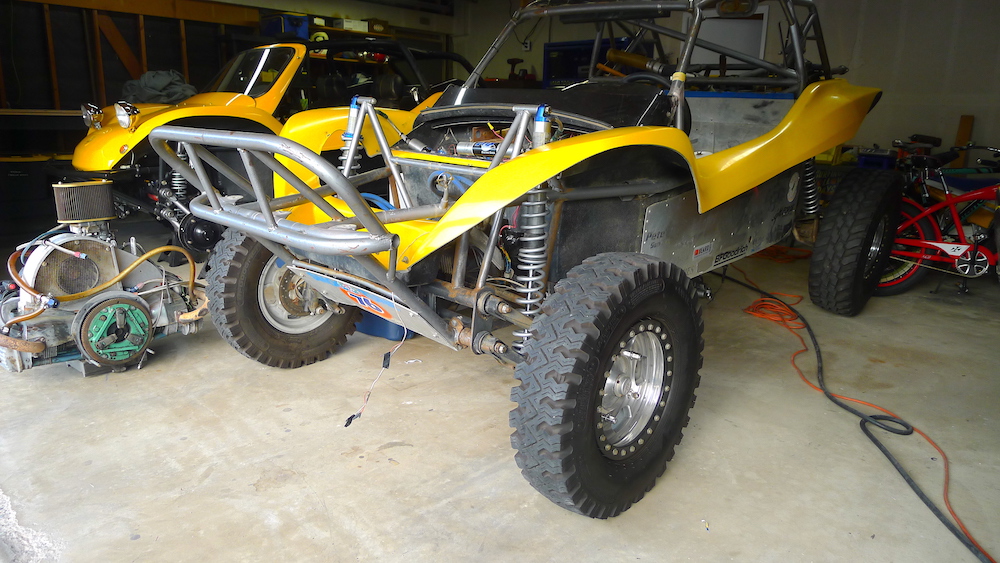
Once the oft-beaten race Manxter found its way back to Southern California, it was stripped down next to the author’s equally yellow Meyers Manx Dual Sport. Image by Marty Fiolka
Thankfully, the Bruce Meyers story of failure also became a battle cry. Every call we made was met with enthusiasm and, more importantly, parts and support. It was 2002 all over again. Even my late mentor and racing hero Bob Gordon provided a much-needed engine for the effort. Soon our humble home shop was being invaded with help, including original Meyers Manx builder Jim Chamberlin and our vital support team of motorcycle champion Andy Grider and his father Neil.
The beautifully reworked yellow Manxter, now wearing No. 1964 in recognition of its 50th anniversary, arrived in Newport Beach just in time for a special lunch and reunion of original Meyers Manx employees, VIP and media. From there, it was back to Baja.
Armed with as many spare parts as we could muster, the plan was for our team of Bruce, Andy Grider, Pirelli’s Rafael Navarro and myself to share driving duties, all dependent upon a then 86-year-old’s daily aspiration. Following the journey was a group of Manx Club members and their cars, my Dual Sport along with Bruce’s beloved wife Winnie.
We called the five day race the “Destiny in Dust Tour,” outfitted ourselves with special t-shirts and custom sunglasses gifted to us by Oakley. Bruce was even given a new driving suit and helmet from Impact Safety, but he especially liked rocking those new shades with special pride.
On race day, Bruce took the green flag out of Baja’s traditional Ensenada starting line for what turned out to be the final time. Handing the car off to Navarro, the group made it to the overnight stop in remote Bay of Los Angeles. The car arrived with a broken gearbox. No matter, we had a spare and our crew worked late into the night. As luck would have it, the hastily obtained transmission didn’t fit. Dejected, we crashed for the night with a looming sense of failure – again.
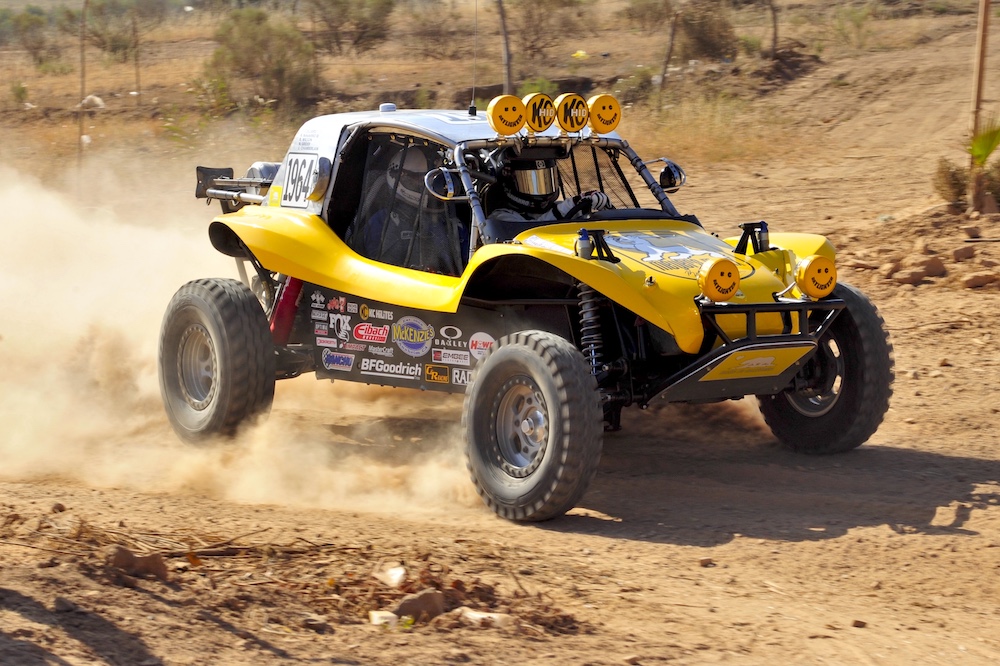
At speed leaving Bay of Los Angeles after an overnight transmission change, the No. 1964 Manxter would have many more challenges to overcome.
The next morning a friend looked at my pristine Dual Sport and realized it actually had the correct gearbox. We unceremoniously yanked the engine and transmission out of it and just made our 10:00 a.m. start time.
Looking back, the next four days was a blur of more broken parts, a weary crew and an unexpected engine change -- this time we had the right spare.
Leaving La Paz on the rally’s final run to Cabo San Lucas, the little yellow Manx did everything it could to keep its reputation as a diabolical loser alive and well. My job was to get the car to Bruce about 10 miles from the checkered flag, but when I got the car from Andy both the backup engine and transmission were almost done. Huffing and chugging, we made the 100 or so mile leg to meet a smiling Bruce.
What was the finish like? Per Meyers' book: “The intention was for me to finish a race before I die, so a few miles from the Cabo San Lucas line, I waited, helmet in hand, with my co-driver Neil Grider. The badly running car showed up after 1000 miles of torture. Yelled at over the noise of the engine, I was told it had only third gear and was running on three cylinders! Off we went, revving up to keep from killing a sick engine without first or second gears. My much-younger co-pilot, Neil, had better eyes than mine; he saved us, as I was troubled by the setting sun in my face as we approached the finish line.
“As I think back to that whole experience, the effort that was made by so many just to ensure that I actually finish a Baja race, I have to remember the pull, the drive that one feels in this accomplishment by so few lucky men.”
The Manx group was there at the finish and were able to see their hero finally meet a destiny that he never thought would be fulfilled. Amazingly, after five days and almost 1,300 miles, we managed to post an official race finish by just minutes.
So much heart had gone into it, but so much more was returned in the form of achievement and satisfaction. I swear there was a tear or two behind those Oakleys.
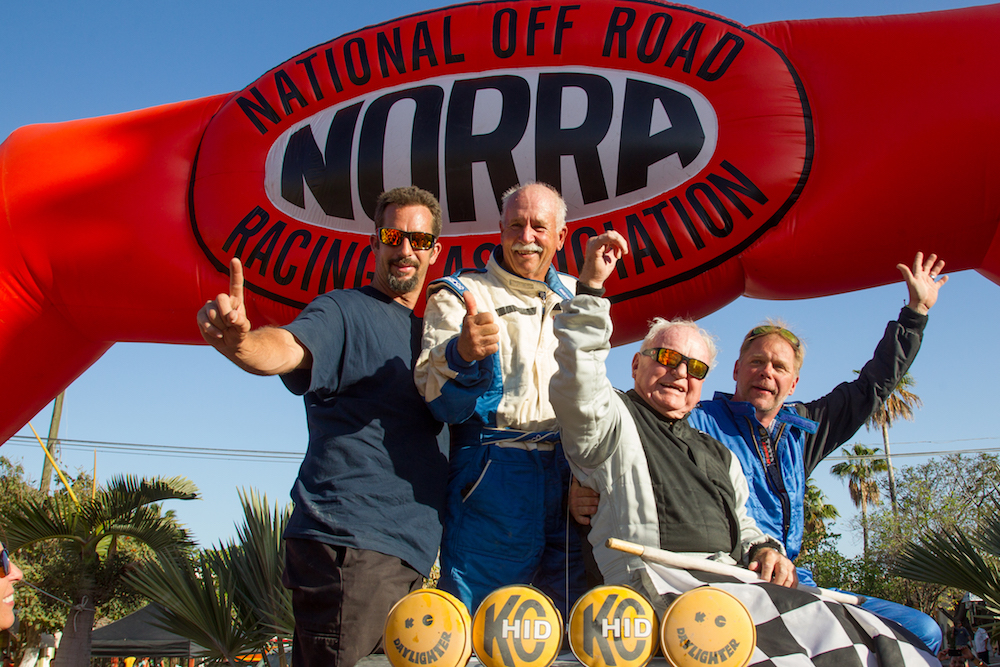
After years of trying, Meyers shares a triumphant moment finishing the 2014 NORRA Mexican 1000. (Left to right, Andy Grider, Neil Grider, Meyers and the author.)
Perhaps the memory of that moment will be the catalyst for finally finishing a Baja Social Club odyssey that has remained my perennial entry in the DNF club. We did film our Destiny in Dust project, just in case. Whatever happens, seeing one of the sport’s most influential personalities soaking in that NORRA moment may well be enough.
Rest in peace my dear friend. History shows your final record was 1 for 6.
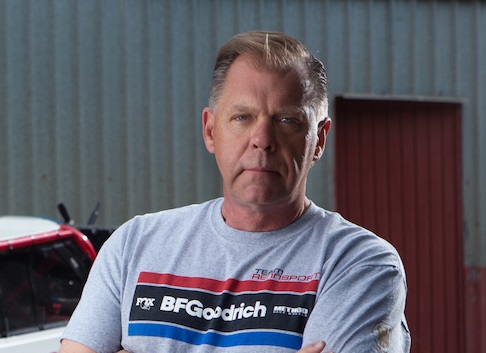
Marty Fiolka
A lifelong enthusiast of off road motorsports, Marty Fiolka raced his first Baja 1000 in 1992 and still enjoys getting behind the wheel via his annual BFG Team Rennsport NORRA Mexican 1000 effort. A graduate of University California at Long Beach, he founded The Rennsport Group in 1995 to execute motorsports public relations programs for Nissan, Infinity, Exxon, Mitsubishi, SCORE International and later became the editorial and marketing director for Dirtsports Magazine. Marty is a current contributor to RACER Magazine and RACER.com as well as operating the promotional agency for Crandon International Raceway and annual Red Bull Crandon World Cup. Fiolka was a 2014 Inductee to the Off Road Motorsports Hall of Fame (ORMHOF) and was instrumental in founding the Wide Open Baja adventure business and Ensenada's Horsepower Ranch. He also served as the associate producer of the original Dust to Glory documentary film and author of two books; 1000 Miles to Glory: The Baja 1000 Story and The Big Blue M: The History of McMillin Racing.
Read Marty Fiolka's articles
Latest News

Comments
Comments are disabled until you accept Social Networking Cookies. Update cookie preferences
If the dialog doesn't appear, ad-blockers are often the cause; try disabling yours or see our Social Features Support.