Images courtesy of Acura
ROLEX 24 RETRO: Acura’s wild breakthrough Daytona win
The scene in victory lane at Daytona International Speedway in 1991 was filled with wonderment for Acura and Comptech Racing.
Honda’s sub-brand, launched five years prior, was in its infancy in the marketplace, and like many auto companies, used auto racing as a vehicle to improve its positioning among buyers. Its efforts in IMSA’s International Sedan series -- a 1980s forerunner of today’s Michelin Pilot Challenge championship -- brought attention to Acura through Comptech’s considerable success with the Integra model, but racing in the lower rungs of the sport was never going to reach the masses.
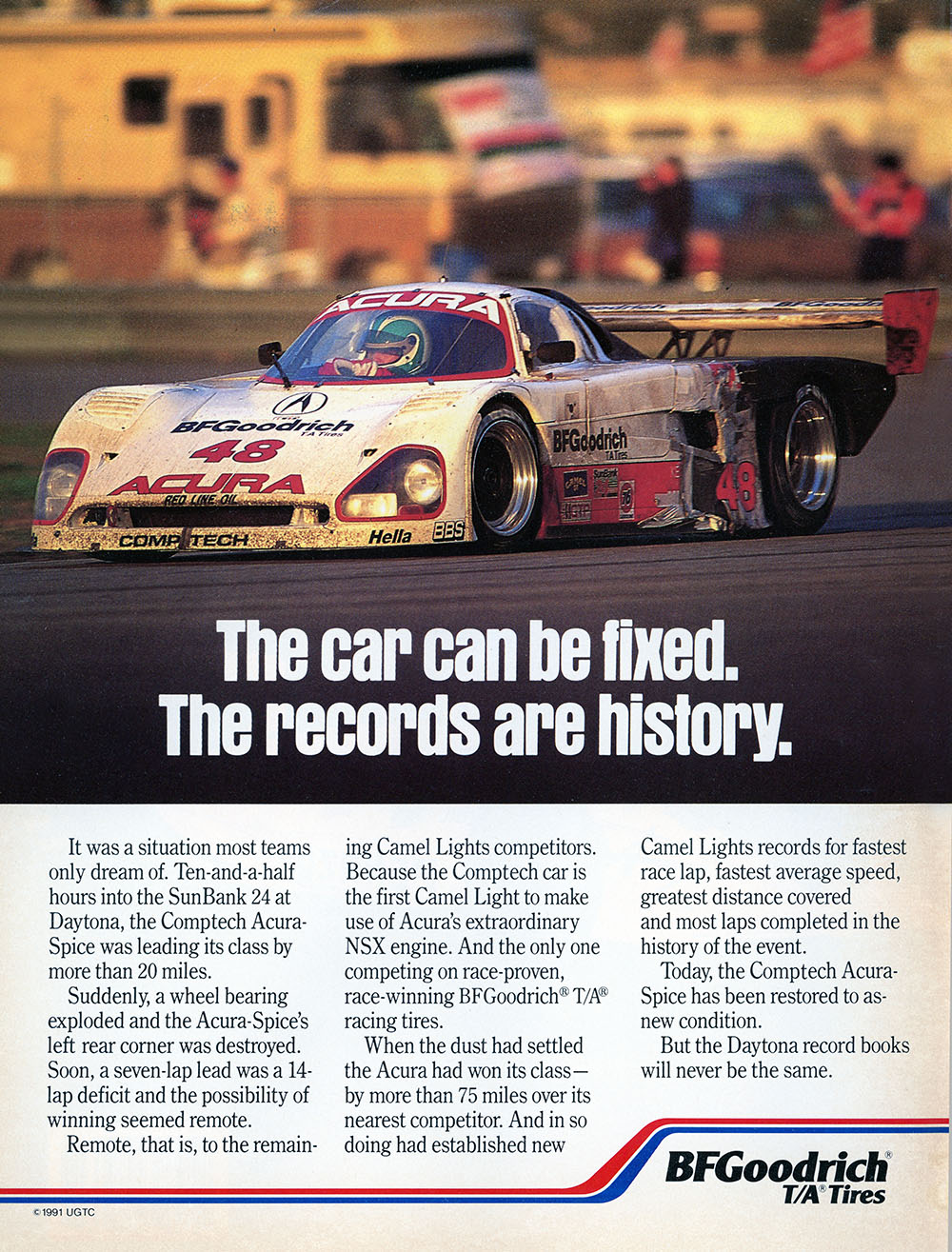
And that’s where the decision to step up to the big show in IMSA’s GTP Lights class, akin to modern LMP2, gifted Acura an amazing story to tell 30 years ago in the SunBank 24 At Daytona. Held over February 2-3, Comptech scrambled to prepare its Spice SE90CL chassis for the season opener from its shop on the other side of the country.
Located on the outskirts of Sacramento, Comptech founders Doug Peterson and Don Erb, and a small group of mechanics and engineers, waited patiently as December arrived and the Spice continued to have an engine-size absence in the back of their GTP Lights machine. Time was running out for Acura’s factory debut at Daytona.
“When the engine showed up on the 8th of December, three Japanese engineers from Honda showed up with it, and they spent the rest of the month of December there with us,” Peterson said of the stout 3.0-liter V6 NSX engine shipped from Japan. “Just observing until it became time to fire the engine up and helping us with little stuff. And then Christmas Eve, I drove it around the parking lot of our shop in Rancho Cordova, drove it up and down Mercantile Drive!”
From the Spice-Acura’s first motion in Northern California to the waving of the green flag at Daytona, 38 days were left for Comptech to figure out its new prototype and do its best to ably represent Acura at IMSA’s grandest race in front of an estimated 55,000 fans.
“And then we tried to get Sears Point open for testing on Christmas Day and they wouldn't,” said Peterson, who doubled as one of Comptech’s pro drivers alongside Parker Johnstone. “So, we went up the day after Christmas, beat the car around the track and then came back, looked it over, threw it in the trailer to head to the January test. We had no time and thankfully it all worked out. We did 900 miles of testing on that January three-day test with no major problems.”
Johnstone recalls being in hot water for venturing over to the Sonoma road course for the Spice-Acura’s maiden test.
“My daughter was born on the 24th, which was not very popular with my family to leave on Christmas Day to end up going testing at Sears!” he said. “But what I noticed immediately with the NSX engine was it had a very smooth, broad power band. It didn't have the torque of the Buicks. It was a bit more difficult to handle just because of the increase in size and weight and where it was placed. But we get to Daytona, and I was invincible and there's a synergy between me and my car.”
GTP Lights class founder Jim Downing and his Mazda rotary-powered cars were always the favorites when the race we know today as the Rolex 24 At Daytona arrived. General Motors and its massively powerful Buick V6 engines were popular choices for the category by 1991, and GM’s Pontiac brand was also represented with lightweight four-cylinder motors. In limited numbers, Ferrari V8s were heard in Lights, as chassis options from Spice, Tiga, and Kudzu populated most of the class. As newcomers, Acura’s positioning in Lights with Comptech wouldn’t be known until qualifying for the race took place in a severe downpour.
With Johnstone as the lead driver in a rotation that included Peterson, Steve Cameron, and Bob Lesnett, a notice of intent was sent by the end of the session. The No. 48 Spice-Acura, resplendent in its white and Dayglo orange paint that would become an iconic livery for the brand, took pole position by a ridiculous margin of 6.957s.
“For some reason in my brain at that moment, it's like, ‘Well, of course, because that's what you hired me to do. And this was what we're paid to do, which is to win poles and win races,’ Johnstone said. “It was absolutely right for me. And so Daytona and qualifying, it's just one of those things that I don't remember a moment of being out of deep focus and concentration of just being on it, trying to bring the absolute most out of the car and put together a couple of great laps, actually. But one in particular was significantly fast.”
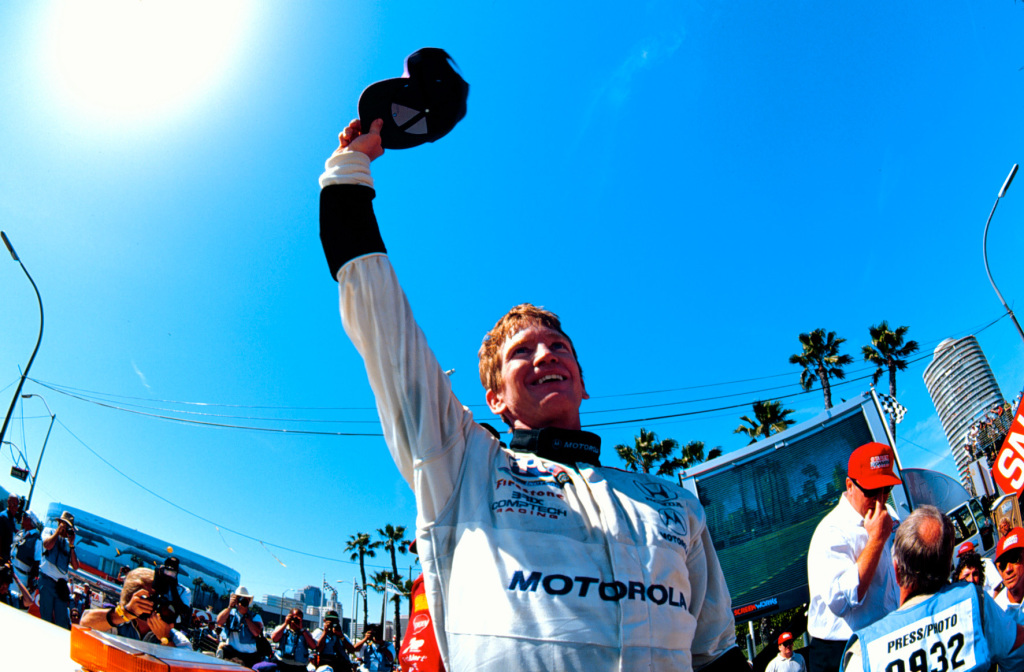
Johnstone’s IMSA successes in the Comptech Acura paved his way to CART with Honda in the 1990s. Michael Levitt/Motorsport Images
Johnstone, who would graduate to the CART IndyCar Series with Comptech and Acura/Honda a few years later, came to learn his driving style and chassis setup preferences -- complemented and amplified in the rain -- were perfect for solo runs, but not necessarily for those who shared the car in endurance races.
“Doug had always said, and now it had been confirmed by Steve Cameron and by Bob Lesnett, that the car was horribly loose and how do I drive it that way? Which was just the balance that I liked,” he said of the oversteer.
“[They said] ‘You're insane. How do you drive this thing?’ It's like, ‘What do you mean? It turns in very quickly and you better be on the throttle.’ And they went, ‘You're nuts.’ So, having never had a teammate in the same car until that point, I didn't know that that's how I set cars up. And so I got that dialed back for the race, but for qualifying, it was just wicked quick.”
Acura’s first 24-hour race at Daytona was filled with dramas, as Peterson, Johnstone, and Cameron recount in the podcast at the end of this story. From a suspension failure halfway through the race that blew one of the rear corners off the car, to the transmission losing second and fourth gear in the five-speed gearbox, to the electronics quitting and the Spice grinding to a halt five minutes shy of the checkered flag, the aforementioned road to victory lane was anything but smooth.
Despite the numerous obstacles, Comptech and Acura topped the first insane number it generated in qualifying by taking the GTP Lights win by an astounding 22 laps. Greater still, the achievement -- triumph in their first race, and at the 24 Hours of Daytona, no less -- stands as one of the brand’s finer results after decades of top-tier sports car participation.
“With hindsight, that Daytona win was a pivotal moment for the team -- setting a trajectory and establishing an expectation that we could succeed at the highest level each and every weekend,” Johnstone said. “The resulting momentum of that initial victory gave all of us the confidence to be on the attack for the next three seasons. Pole positions and race wins were the standard -- anything less was failure.”
On the 30th anniversary of Acura’s breakout and breakthrough performance in IMSA, a connection between the past and present remains with Cameron’s nephew Dane, who races for Acura as a factory driver with the No. 60 Meyer Shank Racing Acura ARX-05 program.
A DPi champion for Acura in 2019, the younger Cameron has been instrumental in helping the brand to win titles and many races, but one victory has eluded the brand and driver in the WeatherTech SportsCar Championship. Within the Cameron family, Steve’s Daytona win with Acura in 1991, and again in 1992, serve as motivation for his brother’s son.
"For sure winning the Rolex 24 in an Acura like Uncle Steve did is something that I would like to emulate,” Cameron said. “It's very cool that he was able to go back-to-back and do it in the Acura and for me in the last couple of years to be running a car with similar colors in the NSX GT3 and in the ARX-05 as well. It's really special to have that connection with my uncle.
“Now, with this being my 13th 24-hour race, I have even more appreciation for what he was able to accomplish as a part of that program. I was really proud to win the championship in 2019 and our cars were very similar colors. And I'm still chasing my first win here in Daytona and I think that would be an even better way to get my first win and do it on the 30th anniversary of what my Uncle Steve and Acura and Comptech did here. I couldn't imagine anything cooler than that."
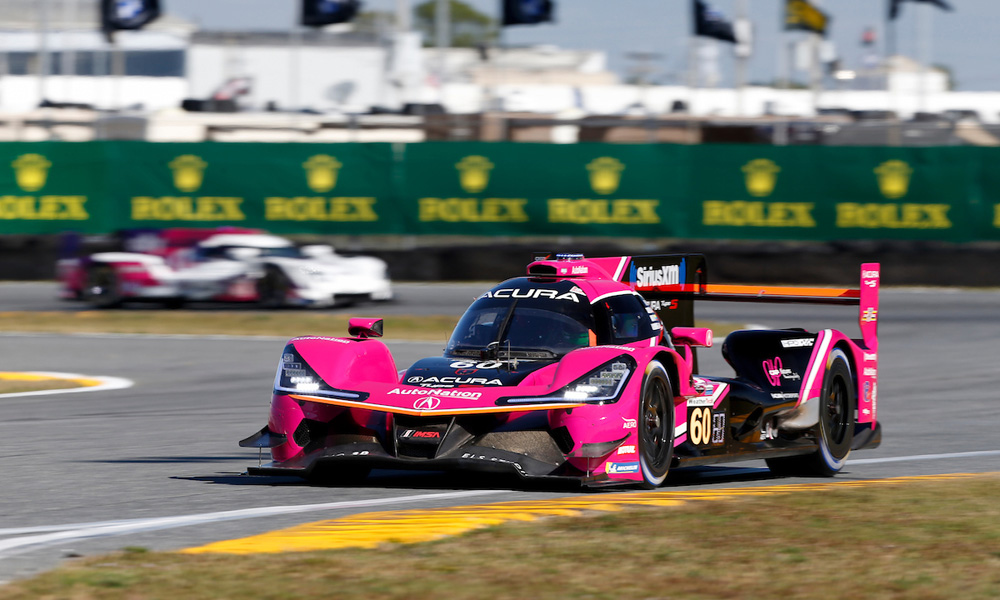
Winning the Rolex 24 At Daytona is the one significant achievement left for Acura’s factory DPi program. Jake Galstad/Motorsport Images
If Dane and the MSR Acura team are fortunate enough to win on Sunday, his father Ricky, a race engineer for the rival JDC-Miller Motorsports Cadillac DPi team, and Uncle Steve, who runs a Michelin Pilot Challenge team, will be there to celebrate.
“I'm super proud of Dane,” the elder Cameron said. “He's an awesome driver. He's a very humble person. He works extremely hard. I've got Ricky who engineers the JDC car and Dane in the Acura. Who do I root for this weekend? I think it's got to be Dane. I've got to hope that we get another Cameron there on the podium at Daytona.
“The last couple of years, we've had a few of photo ops where Dane and I've been able to get some photos next to the Penske. And, and obviously I think the thing that was most exciting about that, was that they had done the retro paint job on the Acura mimicking the Comptech car. So I think for me seeing him in that car, in those colors, it was just an amazing thing to see.”
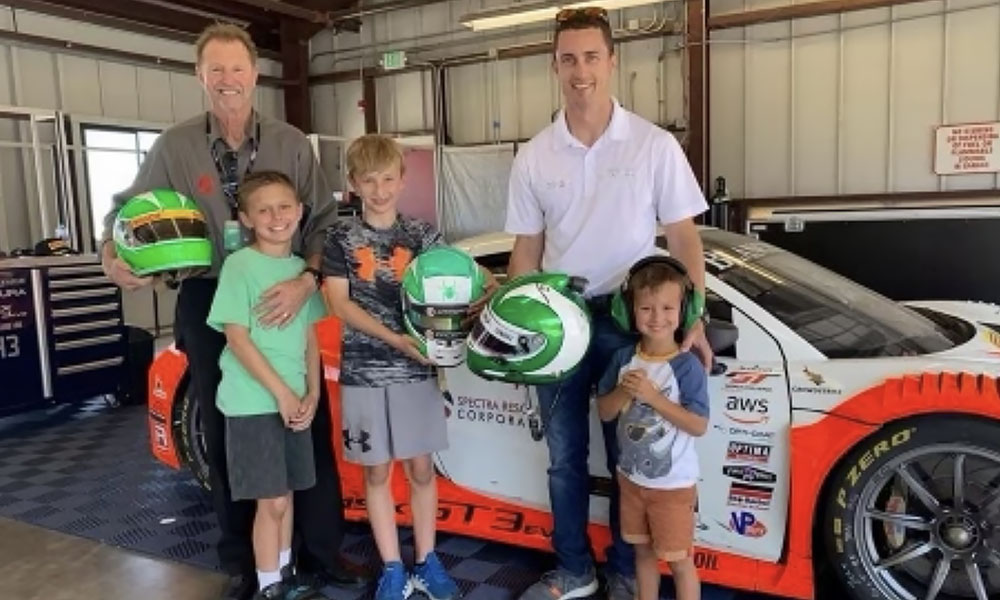
Steve and Dane Cameron, with their kids, and the tribute ‘Kiwi’ helmet the younger Cameron wore in honor of his uncle and their New Zealand ancestry. Photo courtesy of Dane Cameron
Provided Cameron’s Acura ARX-05 is victorious, he’ll receive a brand-new Rolex Daytona watch from the event’s sponsor. And if it happens, Dane will take the lead from Uncle Steve in one area.
“I think the only thing that really breaks my heart is in those days, in '91 and '92, if you won your class, you didn't get a Rolex,” he said. “So, I'm still waiting for my Rolex.”
The Rolex 24 At Daytona begins on Saturday at 3:40 p.m.
Catch the full story of developing, driving, and keeping the Spice-Acura alive 30 years ago in the audio feature below, or click here.
Marshall Pruett
The 2026 season marks Marshall Pruett's 40th year working in the sport. In his role today for RACER, Pruett covers open-wheel and sports car racing as a writer, reporter, photographer, and filmmaker. In his previous career, he served as a mechanic, engineer, and team manager in a variety of series, including IndyCar, IMSA, and World Challenge.
Read Marshall Pruett's articles
Latest News
Comments
Comments are disabled until you accept Social Networking Cookies. Update cookie preferences
If the dialog doesn't appear, ad-blockers are often the cause; try disabling yours or see our Social Features Support.