Robin Miller's Mailbag for January 6, presented by Honda Racing / HPD
hpd.honda.com
and on social media at@HondaRacing_HPD
and https://www.facebook.com/HondaRacingHPD.Questions for Robin can be sent to millersmailbag@racer.com. Due to the high volume of questions received, we can’t always guarantee that your letter will be printed, but Robin will get to as many as he can. Published questions have been edited for clarity. Views expressed do not necessarily reflect those of RACER or Honda/HPD.
Q: Excuse me if this subject has already been addressed and I missed it, but I am very concerned about access and egress of the drivers from the Indy cars. The opening above the aeroscreen seems way to small for a driver to be able to get out under normal conditions, but extremely difficult and dangerous at other times. For instance, Grosjean seemed to be able to get himself out fairly quickly and easily because, it seems to me, the opening on the F1 cars is larger than on the Indy cars. Is that true? Also, what if a driver has a serious back or neck injury? They would need to be pulled out through that narrow opening, probably exacerbating the injury. Why can't they make a quick disconnect to that the entire aeroscreen could be quickly be removed for better access to the driver?
Thomas C., Elizabethtown, NC
RM: Give IndyCar a little more credit. Don’t you think they’ve got a plan to extricate drivers? They spent a long time trying to find the best solution and it seems to be working for its desired affect – deflecting debris and keeping wheels and tires out of the cockpit. Thankfully there hasn’t been anyone upside down or any fire issues, but I know IndyCar has tools and a process in place to rescue the driver. IndyCar has the best safety team in motorsports so I’m fairly certain they’ll be prepared in the event of a situation like you brought up.
Q: A question really directed to Mike Hull, if you please. Regarding the height of the IndyCar aeroscreen, a couple of commenters at RACER, under Pruett's Insight article on the topic, got into a pissing contest regarding the height of the aeroscreen compared to F1’s halo. One stated that the IndyCar screen is higher than the F1 device (however "higher" is defined), while the other insists it's not and any appearance otherwise is an illusion. One states that the aeroscreen is "higher" due to sightline issues encountered on banked IndyCar ovals, the other states that sightline issues had nothing to do with the current design. How does the height of the aeroscreen compare to the F1 halo, and are either of these incessant blowhards correct?
Alfred N, Northern California
RM: Mike Hull was kind enough to answer your question. “Let’s talk about the reality of both the FIA-approved aeroscreen and halo. Either choice has already proved its competition worth at multiple levels of motorsports. That’s their core purpose, so let’s put driver’s wellbeing into perspective. In comparison with Chris Simmons, our Performance Director, who was directly involved in the development of the screen from the very first test at Phoenix Raceway, here’s our thoughts: The aeroscreen was redesigned to fit onto the DW12 with the support pylons added near the back of the cockpit for strength in a rollover or other vertical impact. That does give it the wider look and changes some of the sightlines, making it appear taller (and wider) than it is from some angles.
"Our team doesn’t have any direct measurements, but Scott Dixon was one of the drivers in the DiL Dallara simulator with the FIA halo fitted to the DW12. Visibility was not an issue at any of the ovals tried (Indy, Texas, Iowa and Pocono). He also did the same test with the prototype aeroscreen, first on the Phoenix oval. There were no visibility issues. Dallara would have CAD for both designs, so they could answer directly on the height difference. From having looked at them, and frankly based upon the question, took the time – it appears that any height difference would be small. The size and shape of the fairings that cover the titanium aeroscreen frame or halo would be the bigger difference, so it’s probably an optical illusion more than anything."
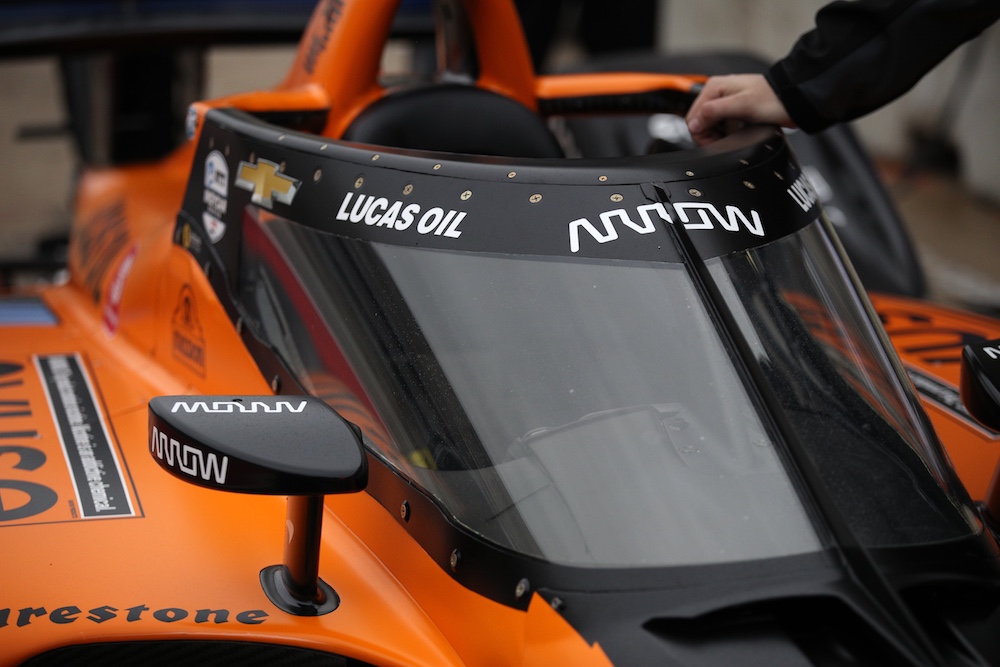
So having already argued about whether they work and what they look like, we're now arguing over whose is bigger. Image by IndyCar
Q: Do you still believe IndyCar will move the St. Petersburg March race to April of 2021? When will they make the announcement?
Richard K.
RM: A reader asked me to make a few predictions last week so I said I thought St. Pete might move back to the April date previously held by Long Beach because it made sense. It was a guess in case the pandemic is still limiting attendance, because Green Savoree and all the other IndyCar promoters need paying customers – they can’t survive another year like 2020. And now it sounds like the series is thinking the same way.
Q: I realize we’re all hoping for a full schedule with fans, but one of the best things about 2020 was the doubleheaders at Road America, Gateway, and Mid-Ohio. Can someone please beg Mr. Penske to do that again? The cars and drivers are already there, and two races at great tracks are always better than one.
Duncan Butcher
RM: It’s not that simple. Those doubleheaders were a necessity to make sure IndyCar had at least 14 races (don’t forget Iowa too) and while they were well-received by the fans, it’s tough on the teams and promoters. Tracks like the build-up with practice and qualifying towards race day, but not sure the paying customers wouldn’t prefer doubleheaders – it’s just financially challenging.
Q: Robin, any insight into what’s going on with Marco Andretti for this coming season? No confirmation of him in the No. 98, and it would appear U.S. Concrete is done as a sponsor. We know he missed out on the $1 million Leaders Circle money, so does that have anything to do with his plans being finalized for this season? I mean, we know he himself or Michael can pay out of pocket no problem if he doesn’t have a primary sponsor so what’s the hold up?
Paul Cray
RM: Here’s my insight: as long as he wants to drive it will be for his father, and he’ll be in No. 98 this season. Hinch hasn’t been formally announced yet either because I imagine Michael Andretti’s people are still scrambling to find as much sponsorship as possible. But what’s the hurry? We’re at least three months away from the season opener, and when everything is locked up, there will be announcements.
Q: Robin, would the teams rank top five races in order of importance to series? I realize it is highly subjective. Any race they might prefer to see expire? Love your stuff.
John Costello
RM: I don’t know about the teams, but here’s my top five (based on attendance, prestige, excitement and degree of difficulty). I think everyone wishes Texas and Toronto could get their old crowds back, but I don’t think anyone wants to get rid of them.
1. Indy 500
2. Long Beach
3. Road America
4. Mid-Ohio
5. Texas & Gateway
Q: If I were a betting man I would put $50 on Pato O’Ward to win Indy. I met that kid when he was driving Pro Mazda and watched him out at Lucas Oil. Somewhere in my Facebook there is a post that he will be the first Mexican Indy 500 winner! What say you? Agree?
Troay Strong, Kansas City
RM: I think it would be a good bet, because Pato should already have a couple of wins and he’s run good at IMS. Hell, he’s run good everywhere, and if Arrow McLaren SP continues to improve there could easily be a Mexican hat dance in Victory Lane next May.
Q: I was greatly saddened to read of the passing of Aldo Andretti on New Year's eve. A gentleman whose career suffered a lot setbacks, though it seems not to have affected his life's outlook. (Bad) luck, it seems, played as big a part in his life as skill. I had the treat of seeing both Andretti brothers compete in a USAC sprint car race in 1966. It was so early in their careers that both could stroll around the grandstands without being mobbed by fans. I saw one walking toward me and I assumed it was Mario until I got close enough to see the name stitched on the driving suit and discovered it was Aldo. Talk about identical twins! Did he have similar talent?
Steve C., Ithaca, NY
RM: They only ran together once in a sprint car race at Oswego, N.Y. to my knowledge, and that was probably the night you saw them (but it may have been 1967). Mario always said Aldo was just as good when they started, but after that first bad crash there was no comparison. I remember going to Bloomington with Danny Milburn (my former high school classmate and good sprint racer) in the late '60s (before his second accident) when he was stooging for Aldo, and he just didn’t have that touch needed to succeed in sprinters. But he was such a fine man, husband and father, and reveled in John’s success.
Q: It’s been a tough year or so for the Andretti family. Sympathies to the family. But it brings up a question: was it ever confirmed that Aldo ‘filled in’ for Mario after his 1969 victory? That it was Aldo who got his picture posted in the papers instead? Never heard the final story.
Terry Clevenger
RM: Aldo filled in during the front row photo at Indianapolis in ’69 because Mario was still recovering from his facial burns suffered in his Turn 4 practice crash.
Q: You can't write the article on the passing of Aldo Andretti with any more truth. Excellent writing about a very good person. You always saw Aldo in his son John.
Stephen Janny, Nazareth, PA
RM: Thanks. I remember when John was commuting from college in Pennsylvania to the Speedrome and I did a column about it for the Indianapolis Star. Aldo was so proud and so happy and he called me up and said he was buying 10 copies to pass out to everyone. John took his dad where he never got to go in racing.
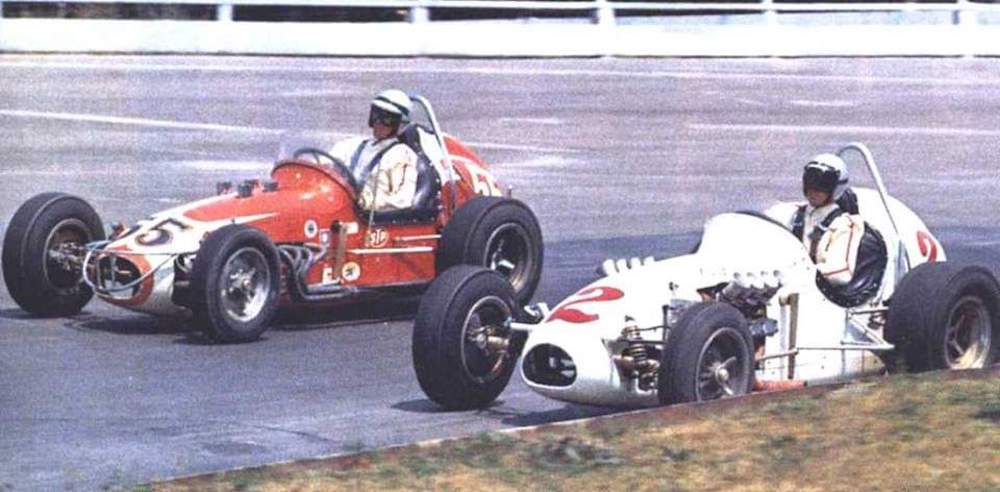
Andretti vs Andretti, Oswego 1967. Had fate been kinder to Aldo, we might have had the chance to see them do this at the Brickyard. Image by John Mahoney
Q: Very saddened by the passing of John Paul Jr. He was most successful in IMSA, but as you and Marshall pointed out, he won in IndyCar twice. If he had not run into legal trouble and had access to a good chassis, how far could he have gone? I watched his win at Michigan online the other night. That was a brave move, especially during a period of time that a crash on an oval almost guaranteed foot/leg injuries.
Jonathan and Cleide Morris, Ventura, CA
RM: My best answer is to read what I wrote on Monday. I have no doubt JPJ would have been a champion with a good team.
Q: Thanks for the tribute to John Paul Jr. I never knew what a great talent he was! I checked out the book you referenced – "50/50" by Sylvia Wilkinson – and it seems to be a quality book by a talented author. Do you know her, and what was her motivation for doing all this work? It seems like JPJ was a great person and pretty much the opposite of his father for whom he sacrificed so much. Any good JPJ stories? Thank you, Marshall and Ms. Wilkinson for bring out the greatness/goodness in JPJ instead of just repeating the old drug dealer stories.
Andy, Las Vegas
RM: Sylvia’s longtime companion, John Morton, was a helluva racer who teamed with JPJ is some sports car races and they became good friends. Sylvia’s original book, "The Stainless Steel Carrot," remains one of the best and she simply wrote JPJ’s story to try and raise money for him because she’s a great lady.
Q: Thank you for the kind article about the passing and life of John Paul Jr. He lived a complicated life, pulled in many directions and tried to do his best. He was always friendly with his fans, especially the young ones. He generally touched a lot of those on and off the track with his kindness. I always felt that you were fair to John in your articles, which was appreciated. Thank you again.
Jonathan Green
RM: If you knew JPJ you couldn’t help but like him, because he was such a genuine person and exceedingly humble and gracious. I always felt empathy for him because his evil father put him in such a terrible position, but he refused to ever play the pity card. I’ve read a lot of comments that people say he knew what he was doing when he was 15 and again when he was 25 and refused to testify against JP Senior. He was a kid and his dad was a violent person so of course he did what he was told, and 10 years later he had no idea where the old man was hiding, so how much help could he have been? He paid a severe price for his loyalty, but everyone that got to know him would testify that he wasn’t a doper or a criminal – just a good guy caught in bad circumstances. Thanks for your note.
Q: John Paul Jr.'s death got me thinking: what if the IRL had come about say, around 1984? An all-oval series with an American flavor. Who would have been the guys to venture there and who would have been the front-runners?
Ethan Donahue
RM: Well, you have to remember that IndyCar racing was all ovals until IRP made the schedule in 1965 and the USAC/CART split in 1979 made it necessary to go after road courses – which eventually turned out to be a good thing. The guys in the early ’80s that would have benefited from an IRL-type schedule and never got a shot would have been Ronnie Shuman, Chuck Gurney, Sleepy Tripp, Billy Casella, Doug Wolfgang, Shane Carson, Ricky Hood, Tony Elliott, Eric Gordon and Dave Darland off the top of my head. Obviously, Sammy Swindell and Steve Kinser would have been front and center, but likely wouldn’t have been able to take the pay cut.
Q: I saw a YouTube video by some unknown who claims NBC Sports channel is about to fold? Any truth to the story? Any idea what will happen to IndyCar racing coverage?
Thomas Grimes, Waco, TX
RM: I covered this last week. Yes there is a rumor that NBCSN may go away after 2021, and no, I don’t know what’s going to happen. But I imagine NBC, IMS Productions and R.P. will find an avenue if it does.
Q: What do you think of the push-to-pass option used in road course races? It seems like a video game gimmick. Do you like it or could do without it?
Paul, Pittsburgh, PA
RM: It was introduced to try and help overtaking on road and street circuits and it’s fine, I just wish teams couldn’t see each other’s remaining time. I was really hoping IndyCar would adopt the Caution Clock like NASCAR. Sure I was.
Q: With the current COVID-19 situation keeping me at home (I'm fine and intend to stay that way) I have a lot of spare time to pore over all the IndyCar websites. I'm currently reviewing the 1970s and the name Eldon Rasmussen shows up in the race results for several years and lists him as a Canadian. So I did some research on Eldon and found out that he is in the Canadian Motorsports Hall of Fame. I also found out that he was a highly regarded fabricator and car builder. What can you tell us about him?
Doug Mayer
RM: Eldon had a shop on the west side off Minnesota Street and employed George Morris, Joe Flynn, Mad Dog Luebbert and Tim Coffeen. They didn’t have much money but they had plenty of talent and moxie, and the RasCar made the show three times at Indy. It was the perfect example of the '70s shoestring team competing at the highest level. And the owner was a fabulous fabricator when he wasn’t talking on the telephone.
Q: I first started watching and following IndyCar (then known as USAC) in 1970. Like you Robin, I have many fond memories from the '70s. I have a few questions about a car that made its debut in 1976 – the Lightning-Offy designed by former AAR man Roman Slobodynsky. I thought the car looked sharp, and since it was penned by the creator of Dan Gurney’s blindingly fast Eagles of 1972-75, I expected it to be more successful than it was. First of all, where was it built? Secondly, what prompted Slobodynsky to leave what appeared to be a more capable operation at AAR for Lindsey Hopkins’ team? Thirdly, how good a car was it? I always suspected that it was a potent weapon but was used by teams (Hopkins, O’Connell, Fletcher, Alex Morales) that weren’t up to the level of McLaren, Patrick, Penske, VPJ, and Foyt. Finally, was it the last IndyCar of significance that was designed around the Offy?
Steven Meckna from Long Beach, CA
RM: Let’s begin with a quote from Roman in John Zimmermann’s excellent read: 'Dan Gurney’s Eagle Racing Cars.' “I was already gone by the time they won the Indy 500, I left early in the year. [Why?] I think that Dan thought I was difficult. That’s a facet of Dan’s and my relationship that I can’t figure out. The GM at that point just said, ‘Well, we’re not going to be building a new car so we don’t need you.’ Dan didn’t even come back and talk to me about it." The Lightnings were built at Don Edmunds’ Autoresearch shops and its best finish ever was second at Ontario in 1979 with Johnny Parsons while Bobby Unser qualified in the middle of Row 1 at Indy in 1977 in a Lightning. It was a good car and had big names like Mike Mosley, Pancho Carter, Roger McCluskey, Parsons and Unser, but never made it to victory lane.
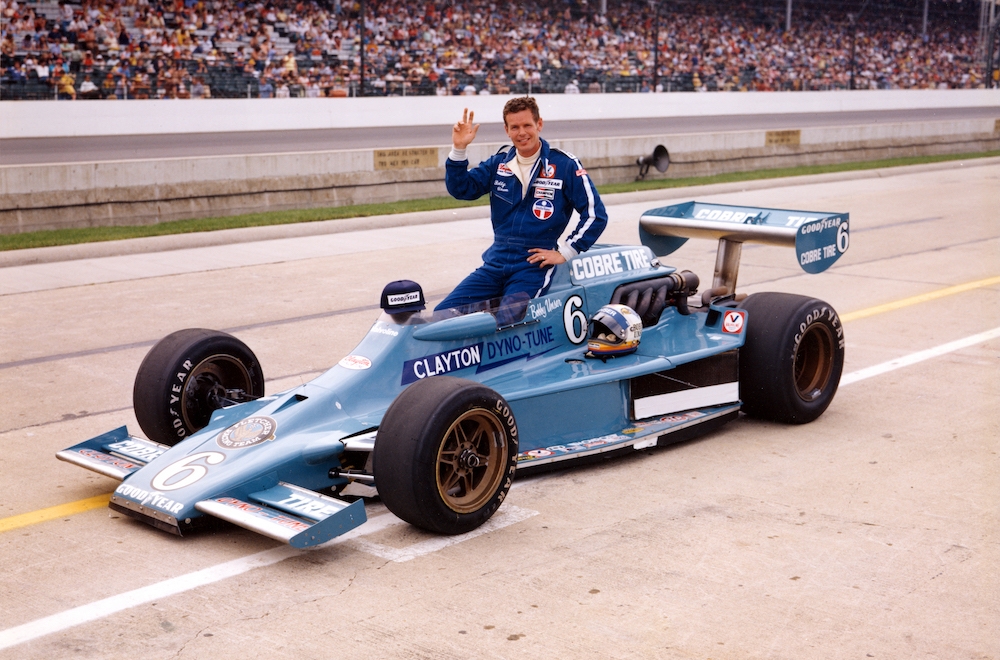
Bobby Unser proved the Lightning-Offy's potential in 1977, although the car never found its way into victory lane. Image by IMS
Q: When the IRL was formed they used USAC to officiate their races, but why was USAC so inept at officiating those races?
Ron, Portland, OR
RM: Oh Ron, don’t tease me like that. USAC has always had the best racing and worst management imaginable. Thank god it’s got Levi Jones running things today, because he’s a respected racer with a brain and common sense – two things lacking in previous USAC regimes.
Q: I think Spike Gehlhausen signed to drive for Bob Fletcher’s Cobre Tire Special and started inside Row 2 at Indy but crashed out early while running in the front pack. Probably not the best move that early in the race, and believe he was let go after Indy.
Dave Harder
RM: Good call but it was 1980, he didn’t get fired and it wasn’t yet the Cobre Tire Special. Spike ran five races for Fletcher with a best finish of fourth at Ontario and fifth at Milwaukee. Gordon Smiley ran twice that season for Fletcher as the team ran eight of the 12 CART races.
Q: What are the hottest and the coldest IndyCar Series races that you remember seeing?
Chris Fiegler, Latham, NY
RM: The first few California 500s were the hottest, and the 1992 Indy 500 was the coldest.
Q: Your response in last week’s Mailbag that “I ran my midget at Trenton to prove how stupid I really am” floored me. Did you ever run Winchester? I attended several USAC midget and sprint car races there during the ESPN “Thunder” heyday, including the fateful night in June 1991 when Don Schilling was effectively retired due to a bone-crushing crash, Ted Hines barrel-rolled down the backstretch, and Bob Cicconi’s horrific accident brought out the third red flag of the midget feature as the skies let loose with thunder, lightening, and torrential rain, prematurely but mercifully ending the evening of carnage. I remember hearing there were Indy 500 racers (who also regularly ran midgets, sprinters, and big cars, back in the day) who were unwilling to run Winchester due to the perceived danger. Any interesting insights?
Steve V., Fresno, CA
RM: I made the feature in my Winchester debut and started on the last row. I passed a couple guys in the first few laps and thought I was hauling ass until Rich Vogler and Johnny Parsons stormed past high and low to lap me and vanished. Hmmm, maybe I wasn’t going so fast. Anyway, ran Salem and Winchester a couple times and decided I had a lot better chance of running decent and not killing myself on the dirt. But there were great racers like Vuky, Rodger Ward and Bobby Grim who wanted no part of the high banks and Parnelli told me once it was the dumbest thing he’d ever done in a race car (and he won races!). Bottom, line Dayton, Salem and Winchester weren’t for everyone, but Pancho Carter was the best I ever saw on them and they say Troy Ruttman was tops in his era along with Duane Carter (Pancho’s dad).
Q: Not to be a nitpicker of your excellent column, but with regard to the answer given Jim Doyle in the December 30 column, gas turbine engines are indeed air cooled although not with fins on cylinders and heads like we think of in traditional piston engines. A substantial percentage of the air from the compressor that enters the combustor housing is used to cool the metal combustor surface to prevent it from burning up. Modern state of the art gas turbines also direct air through the turbine blades for cooling so that they can withstand extremely high turbine inlet temperatures. Overall, developing the cooling of these components is an important part of modern high performance gas turbine design.
Rich in Marion, NY
RM: Thanks Rich, I have no idea what any of that means but I appreciate your input and sharing it with us.
Robin Miller
Robin Miller flunked out of Ball State after two quarters, but got a job stooging for Jim Hurtubise at the 1968 Indianapolis 500 when Herk's was the last roadster to ever make the race. He got hired at The Indianapolis Star a month later and talked his way into the sports department, where he began covering USAC and IndyCar racing. He got fired at The Star for being anti-Tony George, but ESPN hired him to write and do RPM2Nite. Then he went to SPEED and worked on WIND TUNNEL and SPEED REPORT. He started at RACER when SPEED folded, and went on to write for RACER.com and RACER magazine while also working for NBCSN on IndyCar telecasts.
Read Robin Miller's articles
Latest News
Comments
Comments are disabled until you accept Social Networking Cookies. Update cookie preferences
If the dialog doesn't appear, ad-blockers are often the cause; try disabling yours or see our Social Features Support.