Michael Levitt photos
From the RACER archive: Shaking down IndyCar’s previous new car… in 2011
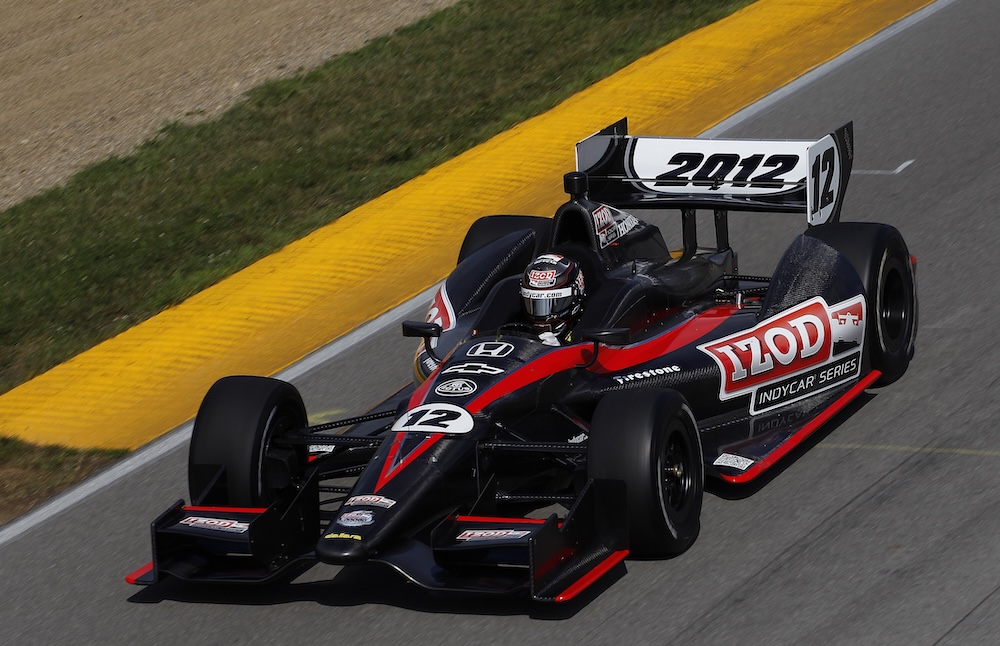
Amazing to think, but the last time an all-new NTT IndyCar Series race car made its track debut was almost 15 years ago. On Monday, Aug. 8, 2011, the late, great Dan Wheldon was at the wheel of Dallara’s new-for-2012 car for its shakedown laps at Mid-Ohio Sports Car Course (main image). RACER was there to hear his first impressions of a design which, through multiple iterations and updates, continues to serve the NTT IndyCar Series.
This story first appeared in RACER magazine No. 234, October 2011.
After more than a year of discussion, meetings, ICONIC committee decisions and preliminary prototypes being displayed, Dallara’s new-for-2012 IndyCar finally broke cover on track the Monday following the Honda Indy 200 at the Mid-Ohio Sports Car Course.
The test, led by Bryan Herta Autosport and driver Dan Wheldon in conjunction with IZOD [now NTT] IndyCar Series project officials, is merely the starting point in development of the first new chassis to hit the IndyCar grid since 2003.
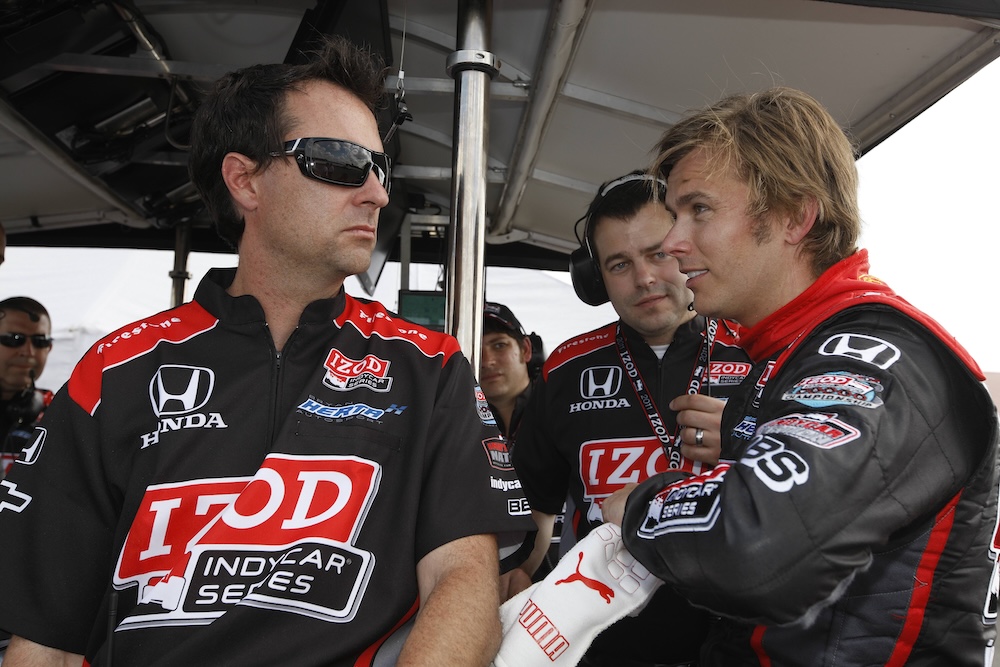
Bryan Herta and Dan Wheldon, with BHA’s chief engineer Todd Malloy, compare notes on IndyCar’s all-new racecar at its Mid-Ohio shakedown.
Following a near decade of stagnation, we left it to Wheldon, Herta, series vice president of technology Will Phillips and Honda Performance Development technical division manager Roger Griffiths to describe progress on the new car.
“The problem is some people really like it, some people don’t,” was Phillips’ response to initial opinions of the new car’s aesthetics. “If the car performs the way it has in all the simulations, the teams won’t complain.”
The airbox, or turbo inlet, is one of the main causes of annoyance from fans, if the comments section on RACER.com is anything to go by. However, contrary to some theorists, it doesn’t just exist to provide a vertical face for sponsor logos.
“It’s there so that whether an engine manufacturer chooses a single- or twin-turbo [engine configuration], the car has the same aero characteristics,” said Phillips. “A single scoop for one turbo might have had more drag than two side scoops for twin turbos and would therefore have interacted differently with the rear wing. Having the car this way meant the aero package was common to all installations. The top half of the airbox is a Dallara spec part, so a manufacturers’ aero kit cannot replace it with something else.”
While certain parts are spec, having the opportunity to develop the new car provides a challenge that Herta relishes.
“The mechanics love it because they’re having to figure things out,” he noted. “They are problem solvers again, not just parts changers. There are much more sophisticated electronics and a lot of suppliers involved, from brakes to clutches, to tires, to engines, to chassis, and basically they were all represented at initial testing.”
The new car is expected to offer more setup freedom across all kinds of circuits.
“The teams play with stuff like the differential already,” said Wheldon, “but on the current car a diff change is a huge job. With the new car, you’ll lose a bit of time, but you’ll be able to make that change during a session. It’s great for teams and drivers to have a lot to play with, and we’re going to have the ability to make those adjustments quickly now. There are a lot of things that you typically weren’t able to change during a session that you’ll now be able to.”
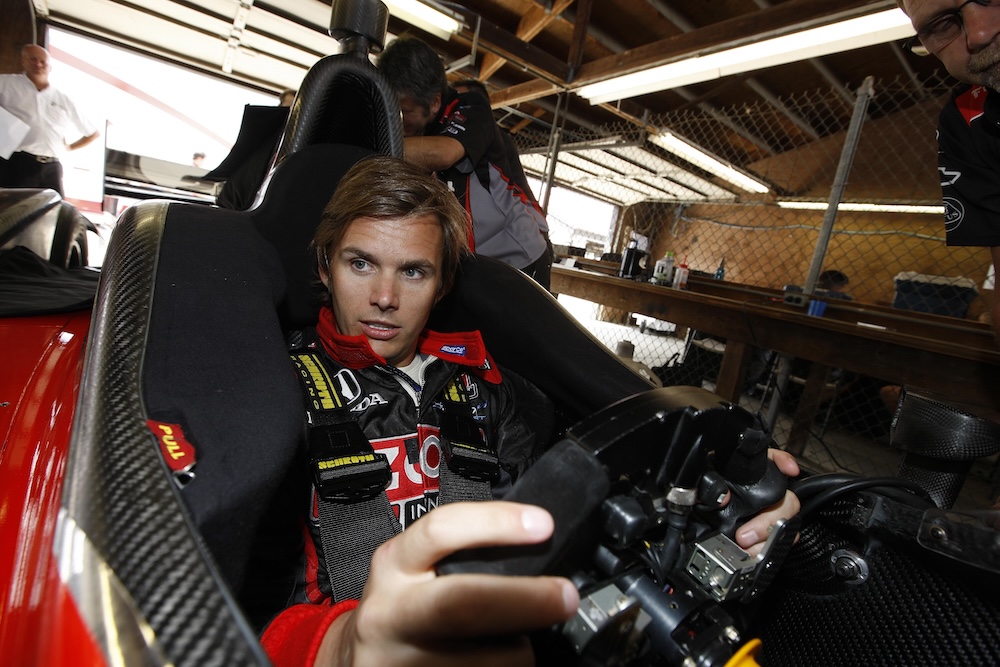
Dan Wheldon drove IndyCar’s new-for-2012 Dallara for its first laps in the summer of 2011. It would later be named the DW12 in a tribute to the two-time Indy 500 winner.
Herta and Wheldon’s initial stint was due to run for 15 test days. After that, manufacturers would be able to test with their partner teams. Honda’s new 2.2-liter, V6 turbo took an early jump on Chevrolet and Lotus by being ready in time to power the first prototype for IndyCar’s project team and Dallara.
Said Griffiths: “I know everybody says, ‘Honda is getting an advantage.’ Of course we are! But we were also the first ones to commit. If GM had committed ahead of us, then they probably would have been in the car ahead of us.
“The thing is, our responsibility here is to provide a reliable and stable platform for IndyCar and Dallara to sort through their new car. It’s not about us doing engine development at the race track.”
Phillips said the test team is working with the series in defining how much open testing the teams can have.
“We’re obviously expecting it to be more relaxed, so we give them more days than in the recent past,” he explained. “But we can’t just throw it open otherwise all the talk of controlling budgets will become irrelevant.
“We also have to make sure the manufacturers are ready to support everyone, that tires are available, etc. We expect to have those restrictions defined before too long.”
For Herta, the 2012 car represents a throwback to an era of technological innovation and, for his driver, it provides an outlet to determine the direction and feedback for the entire field.
“You remember the excitement of a first car showing up at the shop, and the first time you take it to the track,” said Herta. “We’re experiencing those things again for the first time in almost a decade.”
“I take this job personally,” added Wheldon. “It’s my responsibility, and the responsibility of everybody involved, to ensure that when the new cars are delivered, everybody says, ‘That is a vast improvement.’”
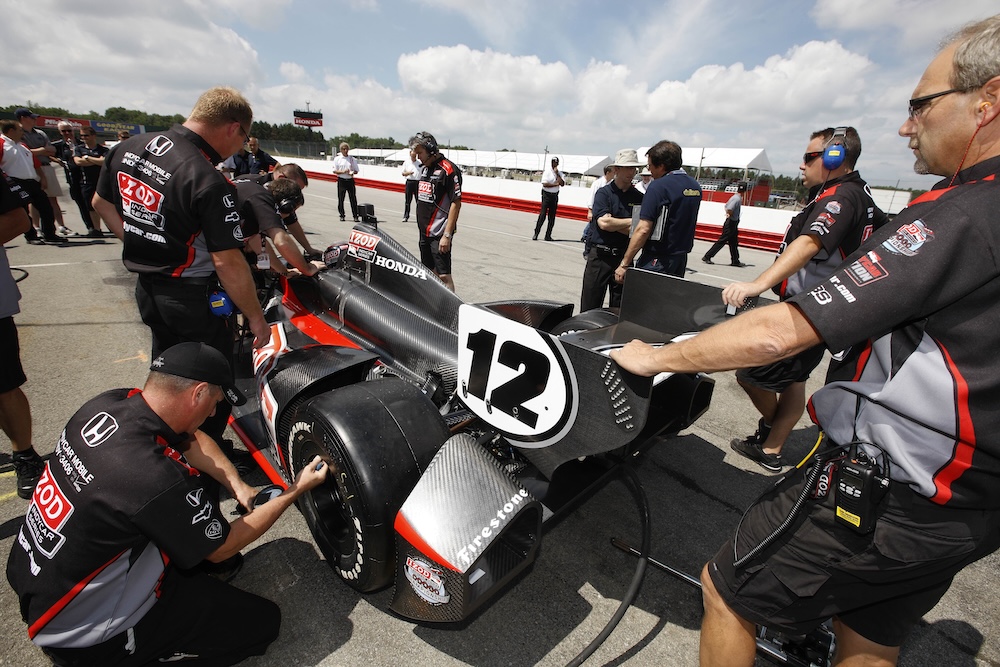
The Mid-Ohio shakedown was the start of an intensive, multi-venue testing program for IndyCar’s first all-new car since 2003.
Aero kits delayed…
While the new 2012 Dallara has made its initial laps, the aero kits have been delayed until 2013. In some respects, the decision to postpone validates team owner opinions that the cost was too prohibitive up front.
From Herta’s eyes, Dallara’s spec aero package takes some getting used to.
“I don’t love the look of the sidepods,” he said, “but it’s growing on me the more time I spend around it. There’s a lot to like about it, and if you don’t love the current Dallara bodywork, you only have to wait a year to see what the mad scientists come up with when body kits are introduced.”
Having gone through new car transitions in Formula 1 and Champ Car, HVM Racing team principal Keith Wiggins noted the innate desire to select the most attractive kit, plus spares and extras, and what it would do to the bottom line.
“Competition being what it is – and this is why 2012 was a concern – everyone has to find a way to have it if it’s better,” he said. “The problem was the timing of the kits. Not being ready or capable of being ready with the car and engine coming out so late would have potentially doubled the cost.”
Wiggins called the transition to the new Panoz DP01 in Champ Car in 2007 “fairly smooth,” and hoped this current one would produce similar results.
“I think it’s the right decision for sure,” he said, “but we have to be conscious of what the fans feel. We still want to have enough cars to go racing.”
Q&A: WILL PHILLIPS, INDYCAR VP OF TECHNOLOGY
How are the Chevrolet and Lotus engines progressing?
I expect to see Chevy run at the end of September, and Lotus will debut mid- to late-November.
Will a second car be made for testing the Chevy, or will it be installed in this prototype?
This prototype belongs to Dallara. Each of the engine manufacturers have a prototype in production. Both Chevy and Lotus will receive a chassis and start working with a mock-up engine to work out their routings of pipes and wires, etc. They’ll do that in Dallara Italy before shipping them over to Dallara USA.
So what’s the timeline for this prototype?
Within the next six weeks, we need to have visited all the types of circuits that we run on. We’d like to do one more road course test before going to an oval – potentially Barber, and then Texas Motor Speedway. We want to run the car at speed and know we’re happy with how it performs, and test it under load before we go to any oval.
Sebring is typically one of the best circuits for simulating a street course in terms of its bumps. But we also need to cover the short ovals, the 1.5-milers, and the road courses. And then Indy as well.
Will Bryan Herta and Dan Wheldon be running the first Chevy and Lotus tests, too?
No, Bryan Herta Autosport is contracted to run the prototype for IndyCar and Dallara, and it happened to be the Honda engine that was ready first. Once testing for us is completed at the end of September, their involvement in the prototype running will stop, and manufacturers can use any of their assigned teams to help them run their cars.
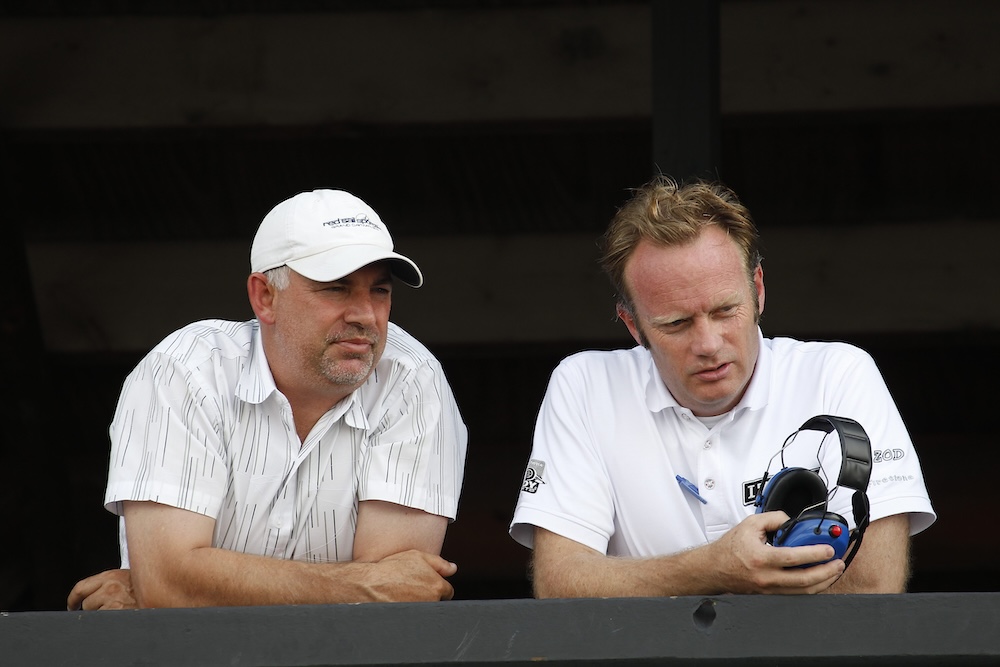
Project manager Tony Cotman and IndyCar VP of Technology Will Phillips watch the new Dallara being put through its paces at Mid-Ohio.
Q&A: ROGER GRIFFITHS, HONDA PERFORMANCE DEVELOPMENT, TECHNICAL DIVISION, MANAGER OF TECHNOLOGY
So is this a completely new engine?
Completely bespoke. Our V6 American Le Mans Series engine is based on an Odyssey minivan unit. This is an outright racing engine – direct injection, fly-by-wire, and so on. It’s not the first engine HPD has been credited with sole design on, but in terms of a clean sheet design, this is our first. Our 4-liter sports car engine was the first engine we could take credit for in terms of designing it from scratch, but obviously we had quite a bit of information on 3.4-, 3.5- and 3-liter naturally-aspirated V8 engines. This [2.2-liter, turbocharged V6 engine] is a very radical departure from that.
Your thoughts on the return to turbocharging?
Certainly it’s an additional level of complexity. When I look at all the stuff you add to the car – not just the turbocharger, but wastegates, actuators, pressurized plenums and all that kind of stuff – it is a lot more complex. It will probably require a little bit more hand holding than what we’ve been used to over the past five seasons. We have a lot more sophisticated strategies that we need to run, with boost control and things like that. But turbocharged engines are sort of the heart of IndyCar racing. It’s good to get back to that.
It sounds like you have a solid baseline to work from.
Yes. In terms of the packaging of the engine, in terms of the physical shape of the engine and the systems in and around the engine, I’m not saying it’s the final spec, but it’s going to be reasonably close. The part that will change will be the details of what’s inside it. That’s where the clever stuff comes from.
Marshall Pruett
The 2026 season marks Marshall Pruett's 40th year working in the sport. In his role today for RACER, Pruett covers open-wheel and sports car racing as a writer, reporter, photographer, and filmmaker. In his previous career, he served as a mechanic, engineer, and team manager in a variety of series, including IndyCar, IMSA, and World Challenge.
Read Marshall Pruett's articles
Latest News
Comments
Comments are disabled until you accept Social Networking Cookies. Update cookie preferences
If the dialog doesn't appear, ad-blockers are often the cause; try disabling yours or see our Social Features Support.