Image by Barry Cantrell/Motorsport Images
PRUETT: Notes from the Speedway
whose Twitter handle
is pure engineering comedy.In trying to understand how Dixon’s No. 9 Honda entry has gotten off to such a crushing start, there’s no need to rehash that angle, but it is worth acknowledging how an abstract subject like ‘feel’ can play such an important factor in how racing teams evolve.
CGR could have left Dixon’s team alone after the team scored two wins, earned an impressive 10 podium visits, and finished fourth in the 2019 standings. It could have been dismissed as Team Penske’s year, and with a solid off-season of work to bridge the gap, there’s every reason to believe Simmons and former assistant engineer Kate Gundlach could have helped Dixon to achieve the same wins at Texas and Indy in 2020.
But there was a general feeling inside the team that it was time to try something different, and despite having no proof it would work, that notion was acknowledged, respected, and acted upon. It was a courageous move in that regard; nothing whatsoever was wrong; the same engineering combo delivered the 2018 IndyCar title for Dixon and CGR, and nothing obvious leapt out during 2019 to necessitate a change. But there was that nagging feeling that a change was due.
Simmons was elevated to a bigger role where his experience could benefit the entire team, Gundlach left for Arrow McLaren SP in a new, more senior role as a performance engineer, and CGR acquired Cannon to fill Simmons’ seat on the timing stand. CGR veteran Ken Brooks – an old acquaintance of Cannon’s – was placed alongside him in Gundlach’s old seat after Ganassi’s Ford GT IMSA program was shuttered, and boom, you have two new faces positioned next to Mike Hull, Dixon’s race strategist.
Was it change for change’s sake? It was not. They had a feeling – something that couldn’t be quantified or proven through data analysis – went with it, and are reaping the early-season rewards.
With the main topic explored, here’s a bunch of random brain dumps from the event:
- IndyCar has an aeroscreen cooling problem that can no longer be ignored. I’ve read comments from a few veteran drivers on social media saying today’s drivers need to toughen up, and sure, extreme toughness never hurts, but that’s not the problem. Wrangling an 1800-pound car with 5000 pounds of downforce, with no power steering, while frying like an egg, will make even the strongest beg for mercy. Let’s go back to the most recent scenario of brutal cockpit heat and its negative effects. I happened to be covering the Grand-Am Rolex Series race at New Jersey Motorsports Park in 5000-degree weather about a decade ago, and with the closed-cockpit Daytona Prototypes which had front-mounted radiators, drivers of all ages, strength, fitness, and toughness levels were falling out with medical emergencies. With the crazy ambient heat flowing through water radiators that were well over 200 degrees, the cockpits became vomit-inducing kilns. EMTs toured pit lane with a stretcher during the race as drivers were dragged out of cars, taken to the care center, given IV fluids, and treated for heat exhaustion. It was pure stupidity on Grand-Am’s part. Now, of course, we didn’t have a situation like that on Saturday at Indy, but we were, according to a number of drivers, getting close to having serious problems with the side-mounted radiators and a lack of moving air in the cockpits turning the cars into microwaves on wheels. The Grand-Am recollection wasn’t just to paint a portrait of the worst-case scenario; it was also a tipping point for the series, which refused to introduce air conditioning, as paying drivers began to shy away from the DPs. Why fork out obscene amounts of money to enjoy driving a fast race car, only to spend your time behind the wheel in in heat-related agony? DPs got a deservedly bad reputation for baking their drivers, and it wasn’t long before it began hurting commerce. More than half of the IndyCar grid is populated by drivers who bring funding to their teams. Let’s hope IndyCar acts swiftly and avoids the same mistake that damaged the defunct Grand-Am series.
It was hot. Image by Cantrell/Motorsport Images
- The quality of Alexander Rossi’s early season fortune is found in the championship standings after two rounds. If currently holding 23 in points isn’t bad enough, the 2016 Indy 500 winner sits directly behind two drivers – Tony Kanaan and Takuma Sato – who’ve missed one race apiece.
- In a carryover from Round 1 at Texas, more problems took place on pit lane than on the race track. Dropped, lost, or loose wheel nuts (Santino Ferrucci, again, Spencer Pigot) continue to be the go-to problem, plus stalls, and we added dropping a car onto a wheel gun into the mix on Saturday. In a change from last year’s Indy GP, we had no refueling fires, so that was a positive. But overall, pit lane has not been the biggest friend to far too many drivers in 2020.
- Don’t look now, but Colton Herta is fourth in the championship and has yet to do anything spectacular.
- Can’t say if it’s a worthy concern, but when Will Power is doing exceeding well in a race, there’s a little voice in the back of my head asking when the transmission is going to break, or a mishap on pit lane, or some other road block will appear and derail his day. After two races, he’s 15 in points, which seems ill-fitting for the potential the No. 12 Chevy has shown.
- Dixon’s combined margin of victory from Texas and Indy is a ridiculous 24.3578 seconds.
- Rinus VeeKay took his lumps from Texas and turned in a mature performance on the run from 18 to fifth. His poise at the GMR GP is what was expected – but missed – in the opening round. Pitting on lap 31 for service proved to be fortuitous with Oliver Askew’s crash and yellow on lap 36; the Dutchman leapt to the top six and kept working his No. 21 Ed Carpenter Chevy to great effect while sustaining pressure from behind.
- Sure, VeeKay’s teammate Conor Daly had an unrewarding outcome of 12 at his home race, and the decision to stick with a two-stop race while all but two other entries switched to three conspired against a better outcome, but it was great to see both ECR cars with the raw pace to run towards the front. Before he went into ultra fuel conservation mode to make it to the finish, Daly and the No. 20 Chevy were quick like a bunny. Coupled with VeeKay, we could be on the cusp of a reinvigorated presence by ECR on road courses. The upcoming doubleheader in Wisconsin will answer that question.
- Simon Pagenaud was the master of mileage on Saturday, motoring 17 positions forward from start to finish. He stopped on the same lap as VeeKay – four spots ahead of the ECR driver on the road – and improved from a lowly start of 20 to third. It’s far too early to place stock in such things, but if Pagenaud ends up vying for the championship, we’ll need to look at what he and race engineer Ben Bretzman did on July 4 to turn a terrible qualifying into a podium visit as a meaningful contributor to their final place in the standings.
- Of the three who stuck to the two-stop plan, Graham Rahal was the only one to make it work. Starting fourth, he took the lead during the caution, was chased down by Dixon on fresh tires, stopped on lap 54, and cycled forward, racing home to second. On a three-stop strategy that mirrored Dixon’s, it would have been interesting to see the two try and settle things; with the different strategies, there was a point where Rahal had 40 seconds over Dixon, and in the end, Dixon held 20 over Rahal.
- It isn’t meant as a criticism when I say that Chevy has gone 0-for-2 this year. Unless I’m forgetting something, the Bowtie has also gone 0-for-2 in having engine issues at the two opening races while Honda has borne the brunt of motor problems. At Indy, Rossi’s team spent two days changing every fuel-related component in the No. 27 Honda, but to no avail. Rahal Letterman Lanigan Racing’s Spencer Pigot, who drove like a man possessed, was dealt a cruel blow after running as high as third late in the race, but retired after succumbing to a suspected broken exhaust header. Honda’s taken all the spoils on race day, which is what matters, but it can’t afford to have reliability issues so early in the season if it wants to vie for a third consecutive Manufacturers’ championship.
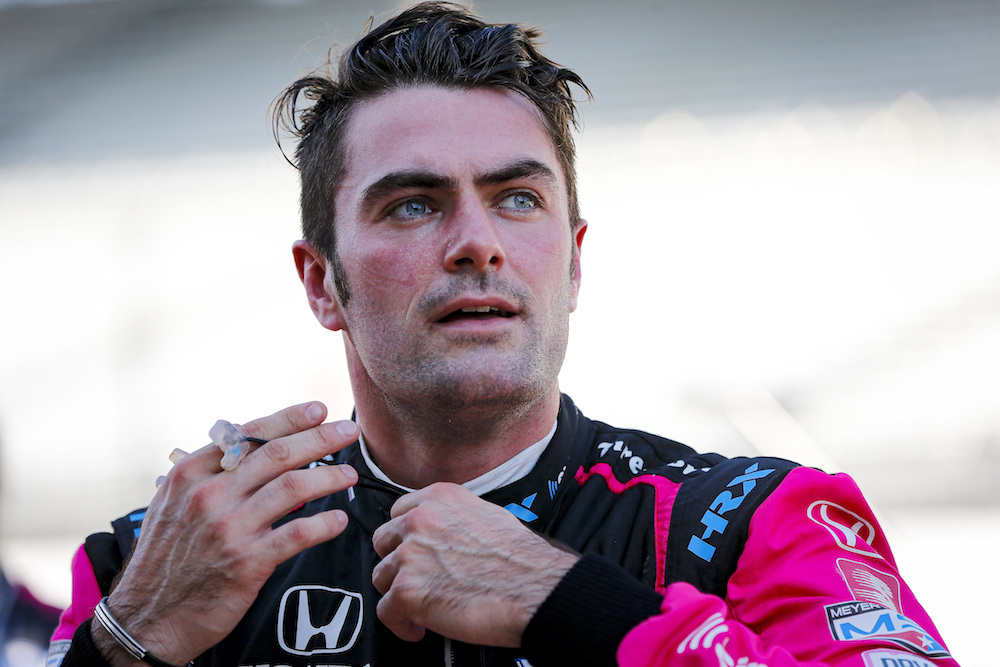
- Sticking with Pigot, how nice was it to see the 2015 Indy Lights champion having one of his most competitive IndyCar outings to date, all while coming in cold after exiting the Ed Carpenter Racing team last September, and missing the season-opener at Texas? More performances like this in the No. 45 Citrone/Buhl RLLR Honda could make it easy to envision a Graham-Spencer combo whenever the ageless Takuma Sato bids farewell to IndyCar.
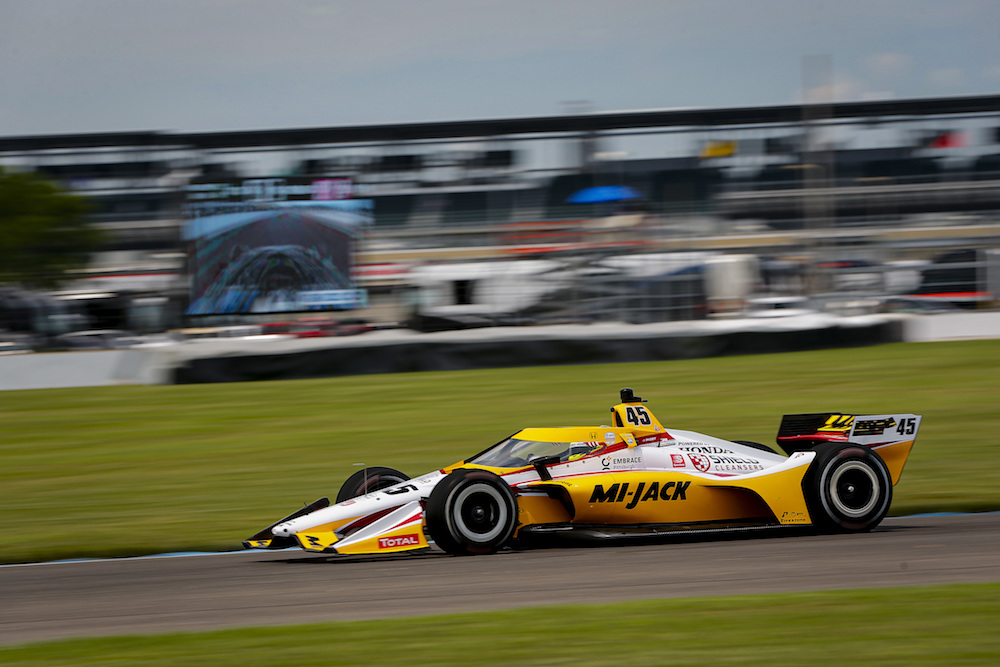
Has Pigot found his happy place? Image by Cantrell/Motorsport Images
- Hard not to feel for Meyer Shank Racing and second-place qualifier Jack Harvey. We already have my Golden Bowling Ball award for the driver who causes the most wreckage, and the ACME Cartoon Anvil for the driver befallen by the worst luck, so maybe we need to add a new Killed By Caution award. The first recipient is Harvey, whose third-place turned into 17 after his front-row start went massively awry.
- Team Penske has two poles, no wins, and Pagenaud and Josef Newgarden are drafting behind Dixon in the championship standings. The top three have yet to have a bad race, and that’s a rarity so far; Starting with Rahal in fifth, the rest of the field have at least one forgettable finish in just two events.
- In the ‘If I’d told you at the beginning of the year that ______ would happen’ chronicles, would you have believed that after two races, sixth through 10 in the championship would be Zach Veach, Conor Daly, Pato O’Ward, Ryan Hunter-Reay, and Marcus Ericsson?
- Man, Marco Andretti was really looking forward to improving upon his forgettable run to 14 in Texas. Indy had other ideas in mind as the cartoon anvil clipped his No. 98 Honda more than once (after it was finished with Rossi). Placing one lap down in 22nd wasn’t fun; if we’re looking for silver linings, he had the third-fastest race lap.
- Dixon said he got lucky with the timing of the yellow that benefited some and sank the fortunes of others. It might be a case of unnecessary modesty. Credit the decision to pit on lap 10, which set his next stop in motion somewhere in the ensuing 25 to 26 laps, at most. Also consider Dixon’s opening pace on Firestone’s primary black tires as another contributor to his win. The primaries didn’t appear to be the hot ticket in the race, and yet Dixon, the only front-running driver to open the contest on blacks, improved from seventh to sixth on the opening lap and held off the drivers behind him on reds until he pitted. Thanks to his pace on blacks, Dixon’s early stop for reds didn’t result in a huge drop down the running order. He emerged in 16, and as other drivers made their first stop in the ensuing laps, he climbed up to fifth. CGR could have tried to stretch Dixon’s first red-tire run to the limit, which would have meant pitting around lap 35 or 36, but they chose to go a few laps early and stop on lap 33. With Askew’s lap 36 crash, maybe that’s the lucky part he mentioned, but either way, that lap 10 trade of blacks for reds ended up playing a much bigger part in the GMR GP’s outcome than anyone could have predicted at the time.
- Askew’s fairytale start to the season ended in bizarre fashion. At the 2019 Indy GP, Arrow SPM rookie Marcus Ericsson was the first driver out of the event, crashing halfway through the final turn leading onto the front straight. His rookie replacement, Arrow McLaren SP’s Askew, was the first driver out of the 2020 event, crashing halfway through the final turn leading onto the front straight. After the incident, Askew told NBC he was dizzy and dehydrated, which is worrisome.
- Tip of the cap to AMSP’s O’Ward who backed up a decent 12-place result in Texas with a dogged effort to claim eighth in Indy. He was part of the happy-yellow brigade, stopping four laps before his teammate crashed.
- That might have been Marcus Ericsson’s best drive in an IndyCar. The Swede overcame a rough qualifying session to vault from 14 to sixth with the yellow, and was pressing hard to get by Rinus VeeKay in fifth in the closing laps. The No. 8 Honda was always on the move, and its driver appeared to be at one with the machine. If that’s the case, CGR might have another threat to pose to the field.
- Heading into Spring Training in February, there was a mild concern A.J. Foyt Racing’s Dalton Kellett might not have the pace to warrant a seat in the series. In his first IndyCar race, the Canadian was clean and unspectacular, and that’s a good thing. Running as high as sixth at one point during a pit stop exchange, Kellett finished 21, posted a fastest lap that only 0.165s off of teammate Charlie Kimball, and answered any lingering questions as to whether he belongs in IndyCar.
- CGR’s Felix Rosenqvist was largely invisible throughout the event. Qualifying ninth was solid, but he fell back to 15 at the start, was among those who suffered on pit lane, and finished 15, nearly one minute behind teammate Scott Dixon. If there was one positive to consider, it’s the Swede’s crazy approach to launching from his pit stall. On the couple of shots I saw, he must have kicked the No. 10 NTT Data Honda to a 45-degree angle while leaving the box. Nobody cranks the wheel more and points the nose at the race track harder than Felix. It’s highly entertaining.
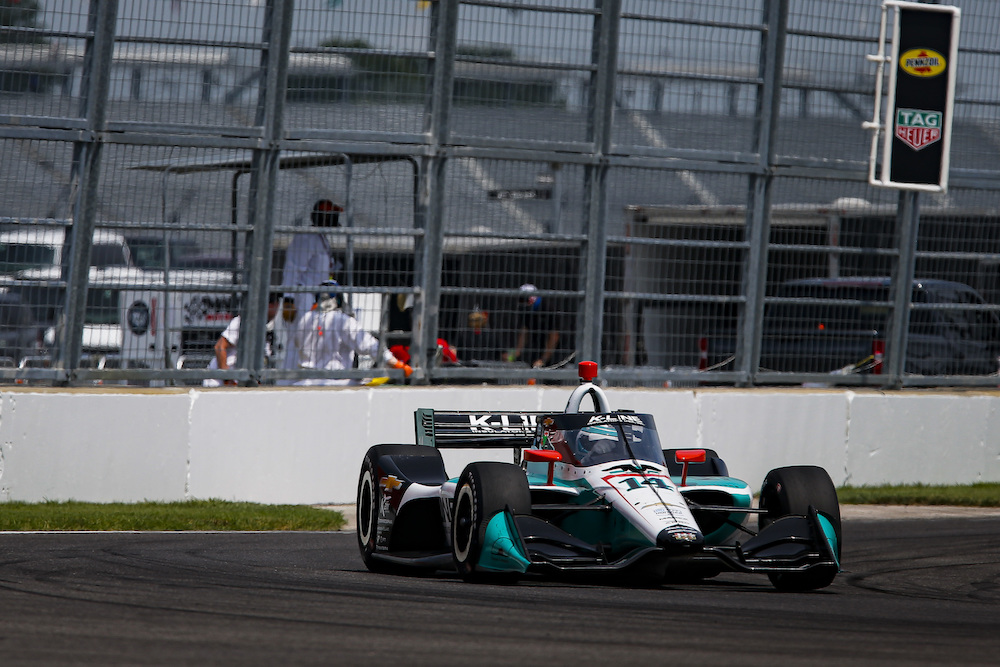
In showing some decent pace and keeping his nose clean, Kellett did everything that Foyt required of him. Image by Cantrell/Motorsport Images
- Interesting to see IndyCar drop its new ‘Race for Equality & Change’ initiative 30 minutes before the start of the GMR Grand Prix. I wouldn’t presume to know if team owners and drivers were briefed in advance, but it was hard to ignore the lack of response from teams and drivers for what could have been met with a wave of support. Granted, they were getting ready for the looming green flag, so there’s that to consider. What tends to happen with such things is a series of quotes are gathered beforehand and included in the release to show support for something new, different, and important. Even the basic announcement in April of 2019 about the new Advanced Frontal Protection device (remember that?) included a driver quote (thanks, Hinch!). A release about fundamentally changing how IndyCar and IMS do business, hire people, support charities, and who will one day race in its series? Nothing, which might not be a good message to send. Even Team Penske, whose owner is behind the formation of the RE&C program, had nothing to offer. Its first tweet, 30 minutes after the announcement was… to try and sell you merchandise.
https://twitter.com/Team_Penske/status/1279445363729072128
- Zach Veach was the author of the most amazing pass that was never going to stick. Entering Turn 7, he threaded the needle between Conor Daly and James Hinchcliffe before spearing off into the grass. His radio transmission to the Andretti Autosport team of “I am stupid” might be the most honest admission a driver has ever made following a mistake. And for the record, Veach is anything but stupid.
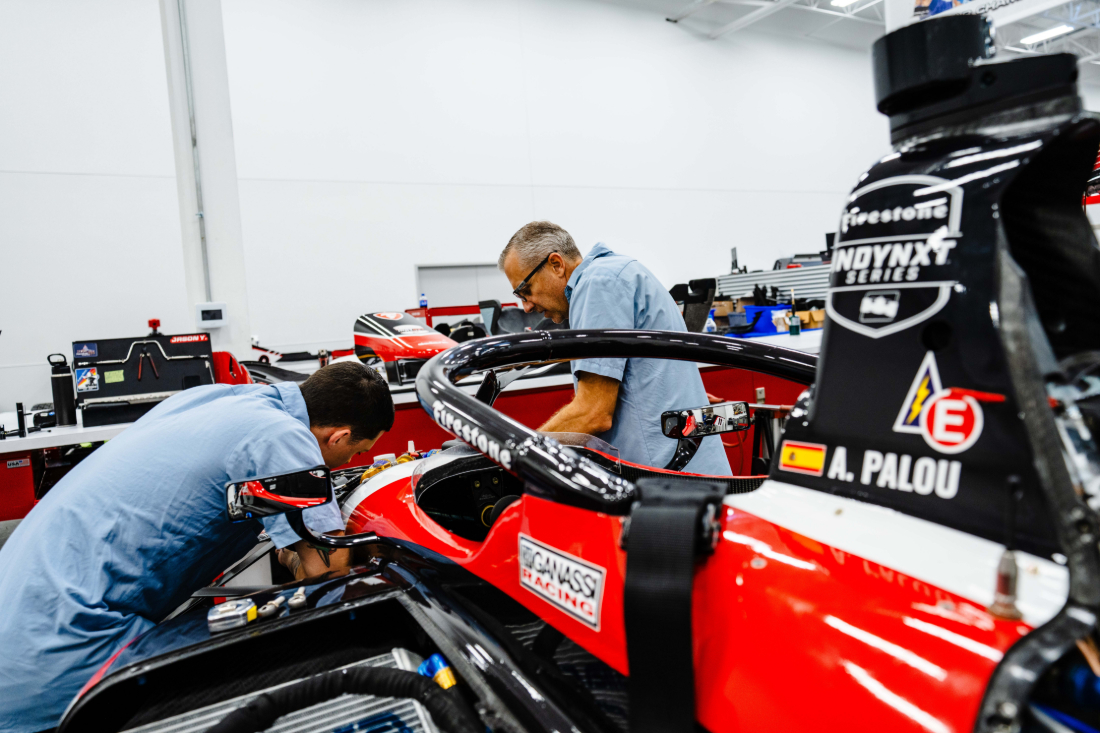
- Bit of a surprise to have Dale Coyne Racing rookie Alex Palou, a road racing phenom who I expected to shine on the Indy road course, spend the event mired in anonymity. He climbed from 21 to 11 at one point, got hosed by the caution, lost a lap, and took 19 at the finish line. If the Spaniard needs a pick-me-up, well, hey, he’s only two points behind Alex Rossi in the championship. Sadly, the Rossi-Palou train has a long ride ahead to improve from P23 and P24 in the standings.
- His teammate Santino Ferrucci didn’t let a slow pit stop prevent the No. 18 Honda from recording a stable ninth-place result. Remember how Dixon charged in his opening stint and only lost 9 positions in the pits? Ferrucci’s first stop cost him 17 spots! Fell from fourth to 21, and then dropped to 25 on his first lap out of the pits. Like others, he was aided by the caution, and made the two-stop plan work to his favor.
- Placing 16 wasn’t indicative of Max Chilton’s pace at Indy. His Carlin Racing squad, the only single-car effort on the grid, was stout in qualifying where the No. 59 Chevy captured 10 on the grid. The Briton was one of many to rue lost opportunities for a solid finish on Saturday.
Marshall Pruett
The 2026 season marks Marshall Pruett's 40th year working in the sport. In his role today for RACER, Pruett covers open-wheel and sports car racing as a writer, reporter, photographer, and filmmaker. In his previous career, he served as a mechanic, engineer, and team manager in a variety of series, including IndyCar, IMSA, and World Challenge.
Read Marshall Pruett's articles
Latest News
Comments
Comments are disabled until you accept Social Networking Cookies. Update cookie preferences
If the dialog doesn't appear, ad-blockers are often the cause; try disabling yours or see our Social Features Support.