Robin Miller's Mailbag for June 10, presented by Honda Racing / HPD
hpd.honda.com
and on social media at@HondaRacing_HPD
and https://www.facebook.com/HondaRacingHPD.Questions for Robin can be sent to millersmailbag@racer.com. Due to the high volume of questions received, we can’t always guarantee that your letter will be printed, but Robin will get to as many as he can. Published questions have been edited for clarity.
Q: After watching the race in Texas it was obvious the track was garbage, which is 100% NASCAR’s fault. I hope people know that. I think IndyCar will have to look into giving the teams more boost. I’m scared that the aero drag on the screen and the extra weight will make it hard – if not impossible – to pass, because when they pull out to pass they just stall out. More power would help this, I think. I know teams don’t want to spend more on motors and they have to last awhile, but Honda and Chevy both have said they can turn the motors up without any real changes other then mapping. Am I right about that? I think it’s worth the risk of blowing a motor here and there, because the last thing IndyCar needs is a super-boring season on top of all the bad things and hard times the teams tracks and NBC has had to deal with. Do you think IndyCar will be proactive on this?
Rick from PA
RM: The lack of passing had nothing to do with horsepower. Between that track compound used by NASCAR, the tires Firestone was forced to use because of the pandemic (there was no testing or development) and the high temps there was very little grip. The drivers I’ve spoken with said it was a combination of those three things, but not much could be done considering the circumstances.
Q: One-groove racing at Texas? They've ruined it!
Chris Fields
RM: On that particular night I agree, but there were some extenuating circumstances, as pointed out in the letter above yours. It was so slippery that if you got just a few feet off-line, like Felix Rosenqvist did, it was all over. Not conducive for side-by-side.
Q: So here’s my take on the aeroscreen: Couldn’t care either way. The internet told me there was passing. I wouldn’t know, it seemed like NBC only showed Dixon for 300 miles. Not sure if I was let down because I had high hopes for the first race in forever or it was just a ‘meh’ race. Am I wrong?
Shawn in MD
RM: There was some passing, just not what we’re accustomed to at Texas, and our producer always finds the best races on the track so I didn’t think NBC showed too much of Dixon. He made a bold one on the outside to take the lead from Newgarden, but it was a pretty forgettable race for all the reasons we’ve already discussed in earlier questions.
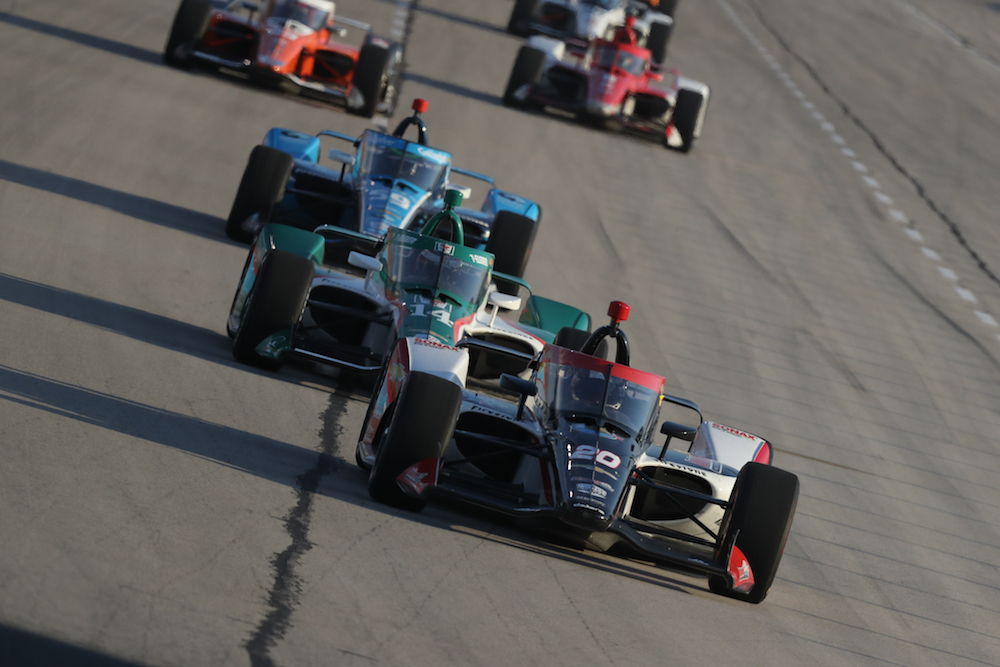
"The racing sucked! The aeroscreens sucked! The surface sucked! 35-lap stints sucked! The drive-through penalties sucked!" Welcome back, IndyCar. The Mailbag missed you. Image by IndyCar
Q: Assuming you were watching on TV like the rest of us, I was equal parts pleased for the series and yet still displeased at what could have been. Great to see the series back in action, on national television, and everyone goes home safe. Kudos to Gossage, Penske/Miles/Frye, the teams, manufacturers, safety team, drivers, and NBC. The aeroscreen seemed to ace its debut as well. I felt Firestone's pinch and the 35-lap stints were not an issue really at all. What was an issue was that pathetic excuse for a racing surface, courtesy of NASCAR. Now I'm not sure if the lack of a spring Cup race was at fault, but that crud they slapped on the track's outer groove totally ruined this race for IndyCar. Is that accurate?
Greg from NJ
RM: That’s accurate. Here’s a quote from one driver: “That NASCAR s%$# ruined the track and any chance we had to put on a decent show. We need to make sure that %$#@ is gone before we run there again. And the tires were awful but Firestone was worried about blistering so we get it – just made for a terrible show.”
Q: Can you please help us understand the rule/protocol for lapped cars on restarts? It seems inconsistent. Even Townsend (for what that is worth...) seemed confused when, as he put it, "...there isn't time for lapped cars to drive down pit lane." Been a fan since the early '90s, thanks for being you.
Luke Spencer, Seattle
RM: The standard operating procedure for superspeedways is that lapped cars are moved to the back of the field inside 15 laps to go, but Saturday night threw Race Director Kyle Novak a curveball and he responded with common sense. When Felix crashed there were nine laps to go and a few lapped cars between leader Dixon and second-place Pagenaud. The clock was ticking on NBC’s two-hour, primetime window so a red flag was out of the question, and had Novak moved the lap down cars to the back prior to the restart, it would have flirted with the white flag. Instead, they got four laps of green, the race ended at 9:51 p.m. ET and NBC was able to get a quick interview with Dixon. True, it wasn’t as thrilling as you wanted with Pagenaud offering no threat, but the 2019 Indy winner said afterwards it likely didn’t matter because Scott was pretty much untouchable.
Q: Who in the heck dreamed up that 35 laps of green tire rule? Same for all races, road and street? It really throws a monkey wrench into race strategies, penalizing a driver for being able to nurse tires home when not necessarily fastest. Can you tell me when an accident occurred from worn tires that also involved an innocent driver? It’s probably happened, but so rarely as to warrant another rule change?
Dan in CA
RM: Firestone requested it because it didn’t get to test or develop any tires during the past few months, and with the heat and speeds of Texas it was concerned about blistering. So it went with a hard compound and a mandatory tire window. The great thing about Firestone is that unlike NASCAR, there aren’t crashes every week in IndyCar from tires going down and sending the cars rocketing into the wall. So Firestone has earned the right to have some leeway.
Q: Unfortunately not the great race all we were all hoping for on national (broadcast) TV. The track made it tough to do much of anything. Why did Hunter-Reay and Rossi get double penalties at the start? They had to move to the back of the grid and had to do a drive-through. That doesn’t seem fair.
Paul Fitzgerald, Indianapolis
RM: “Hi Paul. Thank you for your question. This was an impound race, meaning that only limited, approved changes were permitted following qualifying and the cars are impounded under IndyCar supervision during this time. The No. 27 and No. 28 both made unapproved changes during the impound period and the penalty for unapproved changes is to start from the back of the grid and serve a drive-through penalty.” Kyle Novak, IndyCar Race Director.
Q: I was super-excited to watch IndyCar again. It’s great to have real racing back, but what the hell happened to Texas? The leaders couldn’t even get around a lapped car. Is it the NASCAR traction compound? The aeroscreen? I was really looking forward to the finish between the two CGR cars, but then Marco pulled the stupidest move I’ve seen in decades. He’s a lap down, Hinch is three laps down so it’s not even for position. He makes a bonehead move, takes the air off James’ wing and that pushes Felix into the dirt. He robbed all of us from a great finish. Hopefully he gets a tune-up for that. How about Veach and Daly?
Jeff from Canada
RM: As we said earlier it was that compound, hard tires and temps, and other than the extreme heat I didn’t hear any drivers complain that the aeroscreen was to blame, although I’m sure adding 60 pounds of weight does affects the center of gravity. It looked like Rosenqvist got on the “black ice” and lost it, but it's certainly possible that Marco's move was a factor. Great results for Veach and Daly, who has to have Trevor Carlin’s attention and affection by now.
Q: So post-Texas, what's the initial feedback on the aeroscreen in regard to cutting through the air and its effect on trailing cars? While there was passing, it also looked like a lot of drivers were having trouble getting around slower cars. Understand it could have been from other factors. Just curious to know if anyone attributed difficulty in passing to the aeroscreen?
Jim, Indy
RM: The complaints about the aeroscreen were universal, but focused on the heat – not the way it made the car perform. Tony Kanaan said it was the most difficult race of his 23 years: “I never sat in a race car that hot. I drank seven bottles of fluids during the race and lost four pounds. We’re use to cracking open our visor and getting a little air in our face, but this was like a sauna. I feel bad for the drivers racing on street and road courses, because you lose energy. But it worked, and it’s just a new thing we’ve got to get used to.”
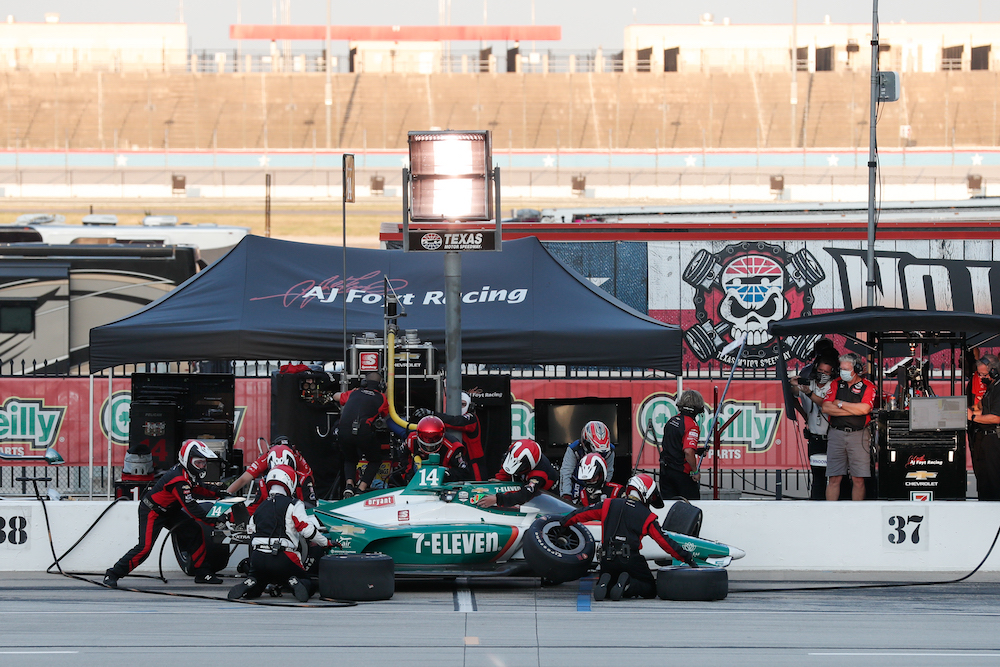
TK stops for fuel, tires and about nine Slurpees. Image by IndyCar
Q: After watching one of the replays of an IndyCar race on NBC earlier this year I was reminded of how awful the cars looked with the rear bumper pods. I then tuned into Saturday night’s race. In spite of previously seeing pictures of the aeroscreen, I was stunned by how bad it looks. This may be the worst thing to happen to IndyCar racing since The Split. Please explain to me again how the halo, which is used by F1 and multiple junior formulas, was going to be impossible to use on an IndyCar. I remember some discussion about how it would visually impair the driver’s vision on ovals, but I can’t see how this screen is any less obtrusive. If anything, it seems it would interfere with the driver’s vision even more than the halo.
I’m all for protecting the drivers and didn’t really have an issue when F1 started using the halo, but the aeroscreens have ruined the look of IndyCar, and every time they show a highlight from 2019 and then go back to live racing it’s going to be a reminder on how bad they look. It’s a shame that the rear bumpers finally went away, but these screens are never going away.
Dave, Vineland, NJ
RM: At a high-banked oval like Texas, where the drivers have to look up and down the track, my understanding is that the halo wasn’t acceptable. Now maybe after a year IndyCar will take a look and makes some modifications to the aeroscreen (it may have to in terms of getting the drivers some air), but there is no denying it’s butt-ugly compared to a standard IndyCar. I didn’t think it looked too bad from the side but head-on it’s not pretty. Of course if the racing stays good like it’s been, we’ll adapt. I hope.
Q: I’m devastated by the defacing of the best-looking cars in IndyCar for decades. They are ridiculous. They make the cars look like those hideous closed WEC LMP2 cars. Is anyone else as disappointed as I? They make the F1 halo look subtle.
Tim Kromholtz
RM: In a word: yes. I’ve got a dozen emails already this week and it’s 12-0 in favor of chopping off the aeroscreen, but it’s not going to happen.
Q: Given the condensed schedules, wouldn't it make sense for IndyCar to loosen the rule about back-up cars? Yes, there are financial costs to the teams, but I would argue not being able to take part in an event (Sato) is a far worse potential financial impact than having a car assembled in the transporter. I'm not saying we need to go back to having both cars set with identical settings, complete with engine and gearbox and being warmed up and taken out on track, but a rolling chassis in need of the proper setup applied to it doesn't seem that out of line.
Paul in Ellenton, FL
RM: Cost is one factor (for both the manufacturer and the team), but another is keeping track of engine use/mileage, especially now that Honda and Chevy are down to three engines for the shortened 2020 season. It’s simply easier for IndyCar to keep track of engine usage if there is only one engine assigned to a particular entry at a time.
Q: I'm definitely in favor of one-day shows as we saw in Texas this weekend. It means the teams and drivers have to work together, or they end up wasting what little track time they have. I think IndyCar should look at doing more in the future. However, with the tight time constraints for a single-day event, there is a real risk of missing the show. Sato showed us all how real that risk is when he looped the car into the wall during qualifying. I'm sure the entire RLL organization was thrashing to get the car repaired in time to start the race, but it wasn't to be.
I know there are very specific rules regarding for engines, back-up cars, etc. Those rules were written for multi-day shows. It's clear the rules need to be revisited for single events. Can you make a few calls and see if IndyCar is going to make the appropriate changes to the rules for single-day events? It's good to see the Foyt team looking racy.
John Balestrieri
RM: I bug Kyle Novak and Jay Frye every week with Mailbag questions, but I’m not going to bother them about something that may or may not become a staple of IndyCar. Oval-track owners don’t like one-day shows; they say they need at least two days to properly promote, and everything else on the schedule is two or three days, so it’s never been an issue.
Q: I enjoyed the Texas race. The lack of a crowd had no effect. Did I notice that the stands were empty? Sure, but the larger the venue (Road America?), the less that will be the case. Maybe the networks could do what the Esports folks do and use digital fans. One day for practice, qualifying and race. You know very well that is what they do at every local track in the U.S. It seems that the higher up the ladder we go, the more the practice sessions grow. Every year there is a call to lessen the cost of racing. How about at least one less day at the track? There are a lot of moving parts to the puzzle, but I did not see any difference between this year's and last year's race.
Chuck Genrich
RM: When I started going to USAC races in the '60s every event was one-day, but street and road courses changed that dynamic and made it a weekend festival. Richmond is going to want two days to bring IndyCar back in 2021, Gateway has two days worth of non-stop action every year so I doubt if it wants to change, and Iowa has added a doubleheader this year so not sure there’s going to be a trend to change. I know it’s cheaper for the teams and I always thought it ramped up the energy, but it’s not real popular.
Q: So they not allowing fans at three races where social distancing probably would never have been a big problem, but say they may have fans at the Indy 500 with social distancing. I would like to know how they expect to accomplish that?
You have people who buy tickets every year and sit right next to each other up in the grandstands year after year. How are you going to get them six feet apart? Are you going to disallow certain person’s tickets? No infield parking, no concerts, no Snake Pit? Personally I think they just need to have people sign some kind of additional liability issue that if they’re going, they’re not going blame the speedway if they get a cough or a cold or COVID-19. You’re not going to be able to do social distancing and have the Indy 500.
I looked up October’s weather from last year, and the average temperature for the month was in the low 50s. We all know what happened in 1992 when we had a race under those circumstances, so I do not think that’s an option. Personally I think it’s way overblown -- we have had more dangerous diseases than this in our lifetime and never went to these crazy measures.
Tim B.
RM: Roger Penske said he wasn’t going to run Indy without fans, but he never mentioned social distancing in our conversation last Saturday because he’s not sure what the rules will be by the end of August, and neither is anyone else. So my suggestion is to relax and let’s see what happens, because this is all new territory. And October is merely a back-up date in case August isn’t ready to accept fans at sporting events.
Q: NASCAR has been practicing social distancing in the grandstands for years! I was hoping that would run the Brickyard 400 with their fans as a trial run. You know, use the fans as guinea pigs. I know that is mean – but so much fun!
Jim M.
RM: It did seem like the Brickyard would have been perfect for spreading 30,000 people over 200,000 seats, but R.P. said he didn’t want to do anything to jeopardize the Indy 500.
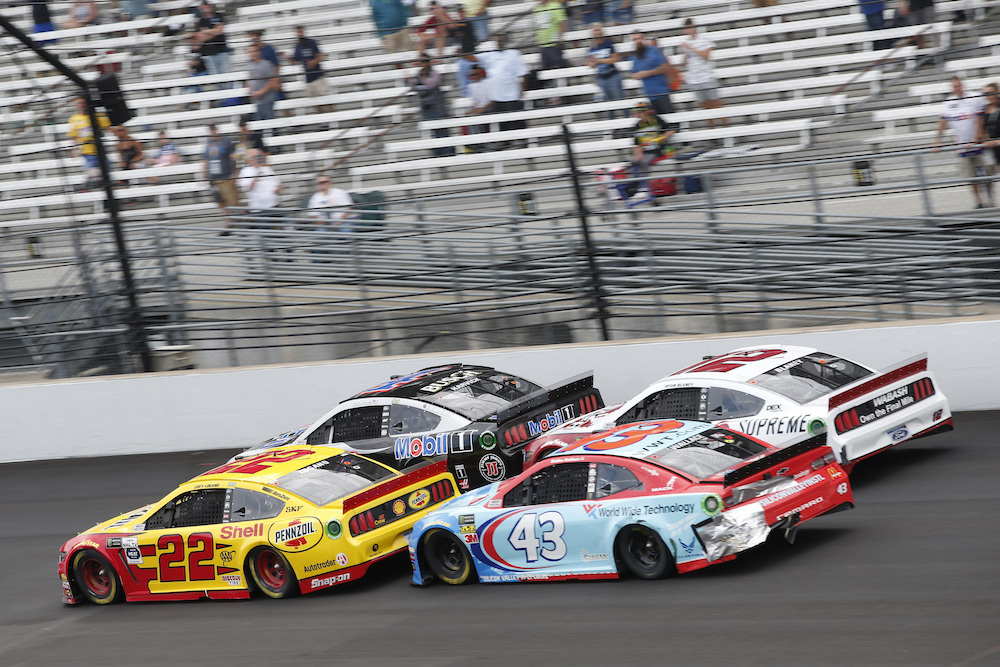
That might actually be what a socially-distanced IMS crowd could look like. Image by Matthew Thacker/Motorsport Images
Q: It was amazing that the season started, good race. My question is, and I know it’s hard to predict the ‘if’, but what you think if RP hasn’t bought the series, do you think the Hulman/George family would have been able to keep the series going because of the COVID 19?
Guillermo Calvillo, Winter Haven, FL
RM: Tony George spend a lot of money keeping the Indy Racing League up and running and was the impetus behind the Leaders Circle so, yes, I think IMS meant so much to his family that they would have done whatever necessary to survive.
Q: Supposing Indy 500 activities go off without a hitch, is IMS planning on dropping the price of a Carb Day ticket? With no Freedom 100 or concerts, it’s hard to justify spending $30 for a 90-minute practice session.
Kris, Kokomo, IN
RM: Haven’t received any news about whether there are other plans for Carb Day, but I wouldn’t count on the price being dropped.
Q: Good ratings for the Texas race. Why not do another race before the doubleheader? Roger said he would spend money to make money. Have it at Indy. IndyCar is a hot topic right now, and with the announcement of talks with Ferrari, I think it’s a wasted opportunity to go a month without a race.
Chris Cincinnati
RM: Nobody is going to throw a race together in a couple weeks, even if no spectators were allowed. And you have to have a television platform, and NBC and NBCSN have already got June and July planned.
Q: Are the position display LEDs dead? If IMSA can do it, why can't IndyCar? So the NASCAR traction compound actually reduces the coefficient of friction? Next time, save money by spreading used gear oil. I guess the look of the windscreen is just going to have to grow on me. We missed seeing/hearing you on the broadcast. Noticed the condo dwellers shoulder to shoulder with nary a mask among them. Oh, wait, it's Texas. It's time to get rid of the six-shooter in victory lane.
Rick in Lisle, IL
RM: IndyCar’s LEDs were haunted and likely not coming back – ever. Gear oil might have been a better option. Don’t think Eddie Gossage will ever quit firing guns and shooting fire – that’s the Texas trademark.
Q: Did the Texas governor bar you from entering Texas? I missed your to-the-point comments and questions.
Dave Thurston
RM: No, not yet, but thanks for missing me. NBC was limited in personnel and Marty and Kelli are two of the full-time pit reporters and they did a good job under boiling conditions in what had to be a very long day.
Q: While watching the Genesys 300 IndyCar race at Texas I noticed on an onboard shot of Pato O'Ward on Lap 117 where the hose connected to his helmet was flailing in the wind. This was not the first time that the air hose has been somewhere where it should not have been. (Hoses blowing above the cockpit pointed out a few times by Leigh, Townsend and Paul during qualifying) but this was the first time that I noticed one completely unattached from the helmet. First, as we all know it was hotter than h*** in Ft. Worth. How did Pato deal with this, as I never saw it addressed, how did it affect his performance, and will IndyCar deal with these issues?
Matt Payette, Westlake Village, CA
RM: Not sure, haven’t talked to him, but one driver I did speak with said that hose was useless and just collected dirt, so maybe Pato unhooked it.
Q: The Mailbag has been a true godsend during the racing shutdown. I’m glad you never went postal over all of the sim racing questions! In last week’s edition you mentioned that COTA will probably not be back on the schedule. Why is that? I would hate to see it go. I attended the inaugural IndyCar race and was looking forward to this year’s running. The track really suits IndyCars well and produces some good racing.
Rod, Houston
RM: I was told COTA has big financial troubles, and I’ve tried to call and email their people but never got so much as one response. But F1 is their bread and butter so IndyCar (which reportedly lost money in 2019) would seem to be very expendable.
Q: Not a question, but more of a heads-up. I think you, I and everybody else thought it was game over for the Nashville Superspeedway. Apparently not. They’re re-opening with a Cup race in 2021. Would be nice to see Indy return to middle Tennessee.
Rob, Spring Hill, TN
RM: I think if IndyCar ever returns to Nashville it will be in the form of a street race, and that was a hot topic not long ago but it seems to have cooled.
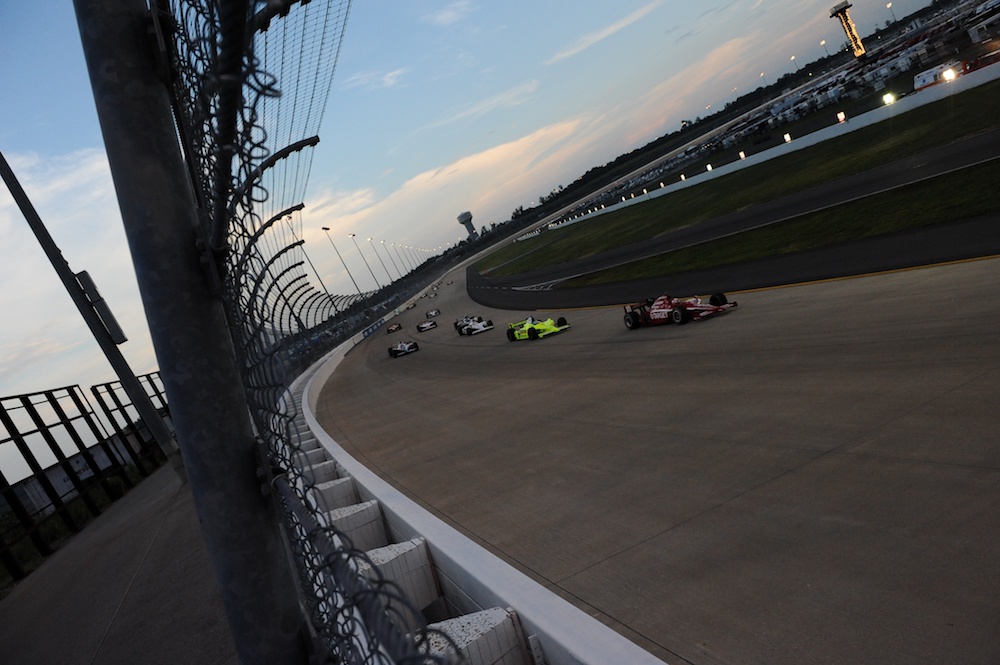
Nashville won't be an IndyCar playground again anytime soon. Image by Motorsport Images
Indy Lights getting rested for 2020
. Even with small grids, I do enjoy the racing, and the talent outscores the field size. I was enjoying how Kyle Kirkwood managed to get up the ladder, and eager to watch his progress alongside rivals like Lindh and Frost, along with returnees Norman and Uruttia.I can only wish good luck for them in 2020 while waiting for Indy Lights to get sorted for 2021, which led to my next question. Which element of the Indy Lights is so expensive? Also, why they are racing far less on ovals these days? I also think the Freedom 100, as fun as it’s been for two years, might be a bit better by using just a bit less downforce -- the draft power looks scary sometimes.
Axel, Indonesia
RM: Texas doesn’t want nine cars on a track its size, but Iowa and Gateway have embraced Lights, along with IMS. Richmond wanted to start again with only Indy cars. The crash damage is always higher for ovals, and the promoter has to spend more money to have them. One of the things I failed to point out in a Lights question last week was that the champion always gets $1 million towards three IndyCar races (including the Indy 500) the next year and that makes it very appetizing to a lot of young drivers. It’s also closer to $1 million than $2 million to run the whole season according to Dan Andersen’s group, and the overall 2020 purse was set at $1,553,195. It’s still pricey, but a bargain compared to Europe and that’s why so many foreigners come over here.
Q: I was very disappointed to hear about the cancellation of the Indy Lights season. It’s understandable, but nonetheless disappointing. Where do you think the Road to Indy fits among Roger Penske’s priorities? I know he has many, and not everything can be an immediate priority, but I believe the Road to Indy is a key step to growing the sport. I don’t pretend to know how it stacks up with other issues.
Wally, Eden Prairie, MN
RM: I asked The Captain last week about the future of Lights and all he said was “stay tuned,” so I think he’s got a plan.
Q: I see the values in simulators for learning circuits and racing lines, but am confused about how a simulator can be used to test various adjustable car setups? Assume they have “variable inputs” into simulator such as tire pressure, gearing, wing angle, toe, camber, brake bias, air temp, etc. That would then be run thru the simulator computer to give outputs: speed, drag, tire scrub, degree of push or loose and lap times. But the software algorithms already exist in the computer, so it’s just kicking out what is already written in code for certain combinations of inputs. To me, changing inputs will just result in a predetermined output. So I’m guessing the driver isn’t needed to actually sit in the sim and run laps of these scenarios on the screen, just engineers inputting the variables and seeing the computer output of the result they are trying to optimize?
Also, so much of racing is seat of the pants feelings of when car is pushing or in a great four-wheel drift or on knife edge and ready to spin. How does a simulator with a fixed seat and no true motion give this tactical feedback? I’m new to viewing RACER.com – what a great site for IndyCar fans!!
Jim Cox, Rock Island, IL
RM: I have no concept of how sims operate except that when Tim Considine’s son brought his unit to Long Beach a decade ago it was advanced beyond belief. You could change anything and everything and Lewis Hamilton flew over to test it because he’d heard it was so good. Does it help drivers learn tracks? Of course. Does it make them better? I don’t know, but I like A.J.’s quote: “When I raced your butt was your simulator and when you crashed you didn’t hit some button to start over – you hit concrete.”
Q: Some people I work with complain about some recent long hours (10-12). During the race season, what does an average week entail for the average IndyCar crew member? How many hours worked, and average pay? Do they have paid medical insurance? 401K? Holiday pay? Time and a half for over 40 hours? Some people think that racing is all fun and glory.
Dave O'Brien, Greenwood, IN
RM: Race weekends are a bitch for mechanics. A minimum of 12-hour days and usually longer, and that also includes working the pit stops and then helping load and tear down hospitality. I don’t think there’s such a thing as overtime in racing season, but they do have insurance and some have 401Ks. Somewhere between $50,000-$75,000 would seem to be the pay range, but they no longer get percentages of wins or year-end point funds and that hurts. And some had to take pay cuts during the pandemic but I don’t think anyone was laid off, so that was impressive. It was fun in the '60s, '70s and early '80s because everybody quit working around 5 p.m. and either had a beer or went and played softball – or both. But when engineers took over, all that ended.
Q: In a recent Mailbag, reader Evert Wolfe asked about a Ferrari entered for the 1956 Indy 500 and wondered where it is now. I think I saw that car at the Simeone Foundation Automotive Museum in Philadelphia, PA in 2018. Thanks for the great work. I enjoy RACER and Vintage Motorsport magazines as well the coverage from your team on RACER.com.
Eric Dahlstrom, Huntingtown, MD
RM: Thanks for sharing Eric. It looks faster than it ran, doesn’t it?
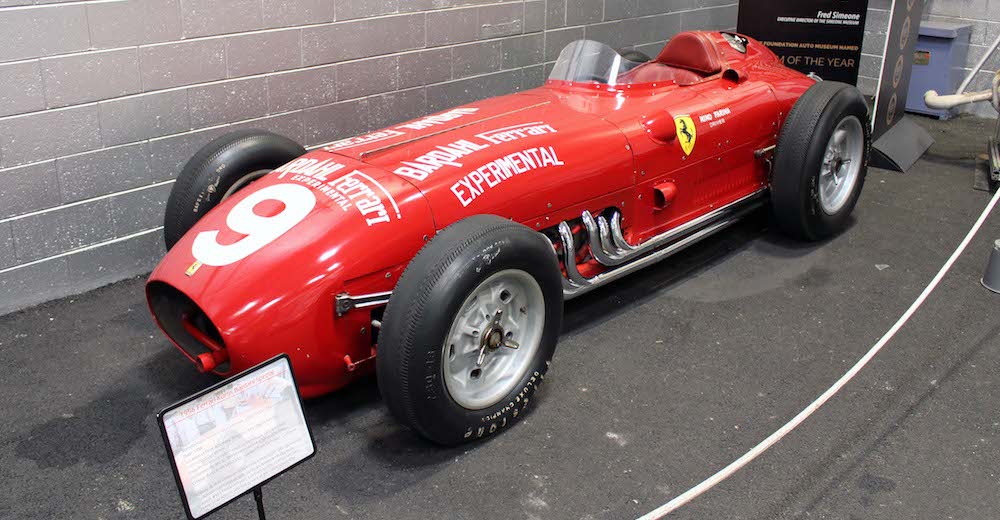
Image by Eric Dahlstrom
Q: If the IndyCar Series scheduled races either on Wednesday, Thursday or Friday night rather than Saturday nights, do you think that the ratings would go up?
Chris Fiegler, Latham, NY
RM: No, because they would most likely be on NBCSN instead of NBC and the cable number is always lower.
Q: I wanted to get your opinion of Scott Pruett during his CART years. I became a big fan after he came back from his testing accident with Truesports, and the fact that he led the Detroit Grand Prix with a Judd engine. He did a lot of development work for Firestone tires, and with the Truesports 91C chassis, but I get the feeling his competitors were not very fond of him. Paul Tracy continues to use the derogatory term "Pruett fade" when alluding to blocking, and I know he had an incident with Montoya in stock cars. Back in the '90s, I met both him and Richie Hearn at Fontana, and thought both were very nice guys that seemed to have some rough luck in open-wheel racing. Any thoughts or recollections?
Napalm Nick, Locust Grove, VA
RM: Always admired Scott because he used his savings to fund his IndyCar debut at Long Beach and made an impression that kick-started his career. His last-lap victory over Little Al at MIS in 1995 still ranks as one of the most exciting finishes ever, and getting back-to-back white flags in his win at Australia ranks as one of the funniest. He was a helluva sports car racer and just an all-around good shoe. P.T. just uses the “Pruett fade” as more of a term of endearment than ridicule – kinda like the Chrome Horn.
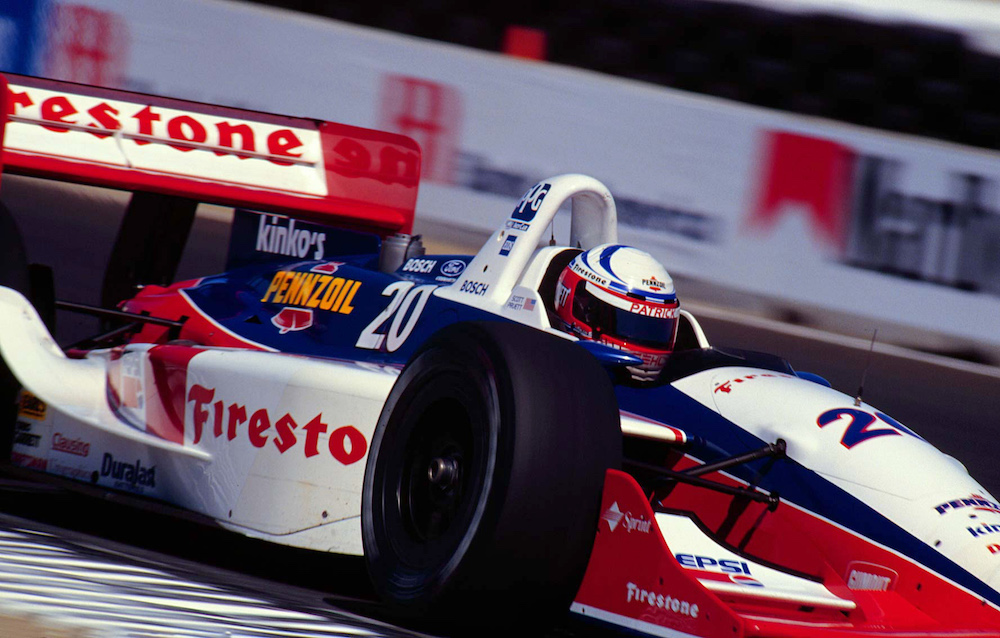
In the case of Scott Pruett, open-wheel racing's loss was the sports car world's gain. Image by Michael Levitt/Motorsport Images
Q: I have really enjoyed RACER’s Retro series. Your article featuring Lee Kunzman took my breath away. Lee and I were both from Iowa, and we were in the same Army at about the same time. You added a lot of detail to my knowledge of Lee and Dr. Dunseth. Before a tour in Vietnam I was stationed in Ft. Monmouth NJ in 1968-69, and the USAC sprinters were at Reading, PA. Of course I had to get there, and to Langhorne on Sunday. I was seated next to a nice gentlemen who I thought must have some connection with the event, as he dashed down to the pits between action on the dirt track. After a while I asked him what that connection was. He quietly replied " I own that No. 1 car." That pleasant gentleman was Dr. Ward Dunseth! Thanks for featuring Lee Kunzman, who served his country and is not to be forgotten.
Phil Jung
RM: My pleasure, glad you enjoyed it and thanks for sharing your memory of Zoom and Doc. Kunzman will always be my hero, and the dignity and courage in which he conducts his life is truly inspiring.
Q: I always enjoy Indy 500 history and was reviewing results when I came across some amazing stats on Ted Horn's race finishes. He finished in the top five from 1936 thru 1941. The Speedway was closed from 1942 thru 1945 for WWII. He then picked up where he left off, and finished in the top five from 1946 through 1948. That is a stunning nine consecutive finishes in the top five, during an era of very dangerous racing and poor equipment reliability. The streak ended with Horn's death at a race at DuQuoin on October 10, 1948. Can you contribute any additional facts or stories about Horn's career? What a wheelman! Too bad he never tasted the milk at the Speedway.
Jerry, Reading, PA
RM: No, he was a little before my time, and when we talk about the best to never win Indy we always say Michael Andretti, Lloyd Ruby, Tony & Gary Bettenhausen, Eddie Sachs and Rex Mays. Horn doesn’t get much love. He should – what a record.
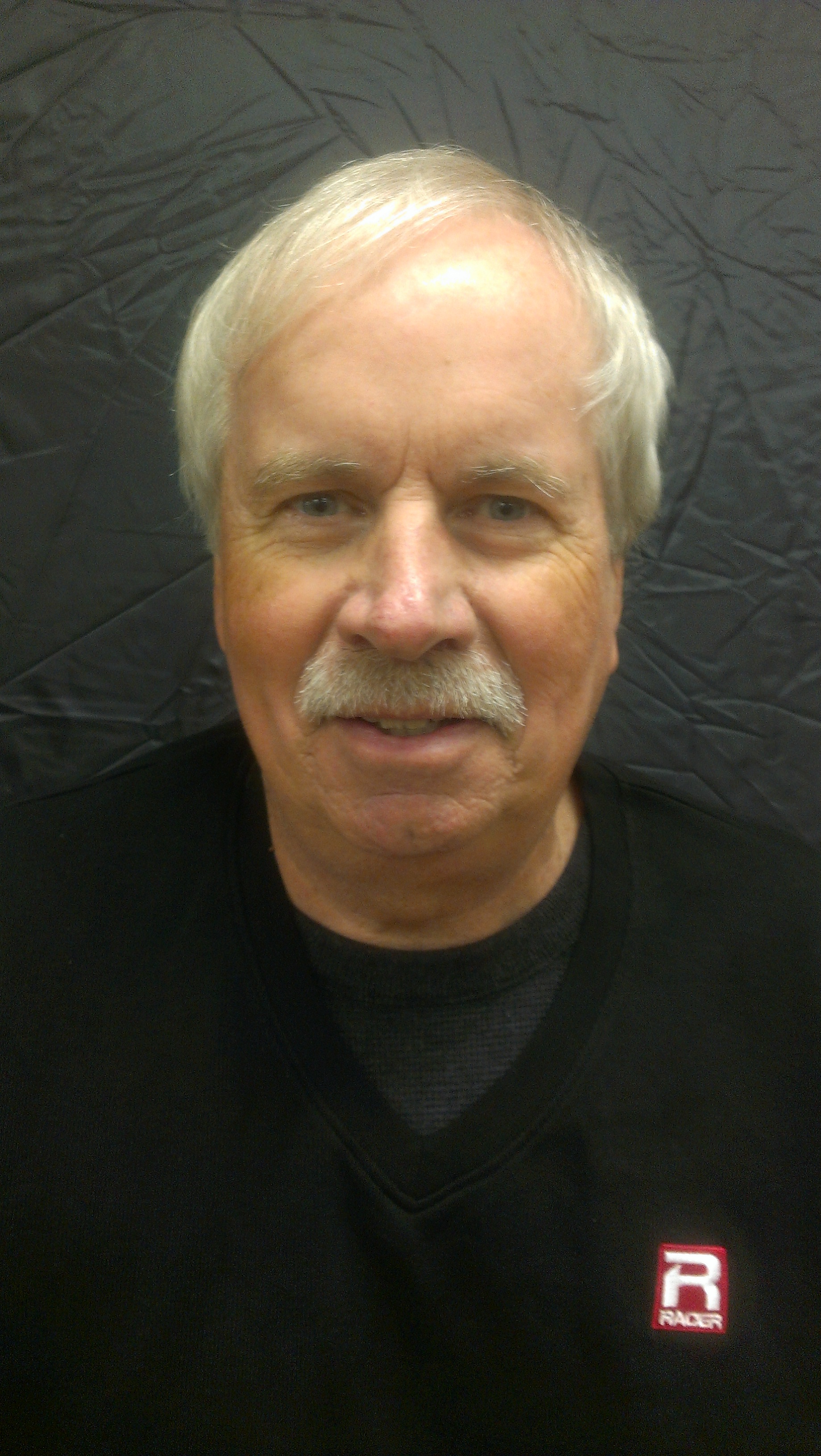
Robin Miller
Robin Miller flunked out of Ball State after two quarters, but got a job stooging for Jim Hurtubise at the 1968 Indianapolis 500 when Herk's was the last roadster to ever make the race. He got hired at The Indianapolis Star a month later and talked his way into the sports department, where he began covering USAC and IndyCar racing. He got fired at The Star for being anti-Tony George, but ESPN hired him to write and do RPM2Nite. Then he went to SPEED and worked on WIND TUNNEL and SPEED REPORT. He started at RACER when SPEED folded, and went on to write for RACER.com and RACER magazine while also working for NBCSN on IndyCar telecasts.
Read Robin Miller's articles
Latest News
Comments
Comments are disabled until you accept Social Networking Cookies. Update cookie preferences
If the dialog doesn't appear, ad-blockers are often the cause; try disabling yours or see our Social Features Support.