Image by Miller/Lumen
PRUETT: Lessons from the IndyCar iRacing Challenge
What did we learn after six weeks of the IndyCar iRacing Challenge events? A surprising amount, actually.
It was equal parts boring, thrilling, monotonous, and amusing. Very close to the real thing. But just different enough – like those Impossible Burgers made from plants – to leave us craving a return to the real thing.
We learned that while the racing might have been virtual, the real-world sense of fair play carried over in every lap turned at Watkins Glen, Barber Motorsports Park, Michigan International Speedway, Twin Ring Motegi, Circuit of The Americas, and the Indianapolis Motor Speedway. Especially the Indianapolis Motor Speedway, where the brazen actions by Simon Pagenaud and Santino Ferrucci transcended iRacing.
“Everything was going to be heavily debated and over-analyzed, because people have the time to do it right now, so you had to watch your moral conduct the whole time,” says Sebastien Bourdais. “I’m glad I didn’t say or do anything stupid! Unfortunately, we've seen things that nobody wanted to see. And yeah, it is virtual, but in the meantime, when you start to put the race suit on and the team polos or whatever, and you're on live TV, you're taking the effort to represent people.
“There are real consequences to what you can do, say, or what side of yourself you show. And it's one thing when it happens when we're practicing and insults start flying and people start driving crazy, but obviously when it's in front of a few hundred thousand people on TV, I'm not sure it's the right thing to display.”
Considering how big and prosperous the Esports world has become in the last decade, dismissing its fans with throwaway lines like "it's just a video game" struck a blow to legions of potential IndyCar fans as being out of touch and disrespectful. After five weeks of validating sim racing and embracing a new audience, two idiotic decisions seemingly unwound all of the positive gains made by the series within a coveted demographic.
“We've already seen a couple things,” Bourdais continued. “You look at Kyle Larson, and Bubba Wallace in a smaller way, and the stuff that's winding down with Simon and Santino, and the heat they're going to have to deal with that, following those guys. And there were some pretty ugly things said, and done, and there were some consequences. That's the world we live in. And I’m not being judgmental on any of the above, but I think some guys probably wish they could wind the clock back and have a redo.”
We learned new ways to love our favorite drummer and hip-hop enthusiast for stripping away all filters over the drivers’ group chat.
“Look, I know that I'm not going to be alive forever, so, it just doesn't matter man,” Will Power says. “I'm almost 40; it's gone by so fast. Am I lucky enough to live another 40 years? That would be amazing, but you just don't know. You just can’t care what people think. Say the truth. Say what you think and that's it.
“I just call it as it is at the time, and I don't dislike anyone; I just say what I think at the time, even if I'm a bit mad. So, it's not what I truly believe. I don't think whoever I call w*****s at the time are really w*****s, but they were at that time.”
We learned that unlike real races where everyone takes the sport seriously, the same level of commitment was not always present from start to finish. It might have left a sour taste for some with IndyCar’s iRacing product.
“For me, the lesson learned is that there are two ways to go about sim racing: Very seriously and very competitively with something on the line and in a well-structured system, or loosey-goosey, have some fun with it, and let's entertain some fans,” James Hinchcliffe says.
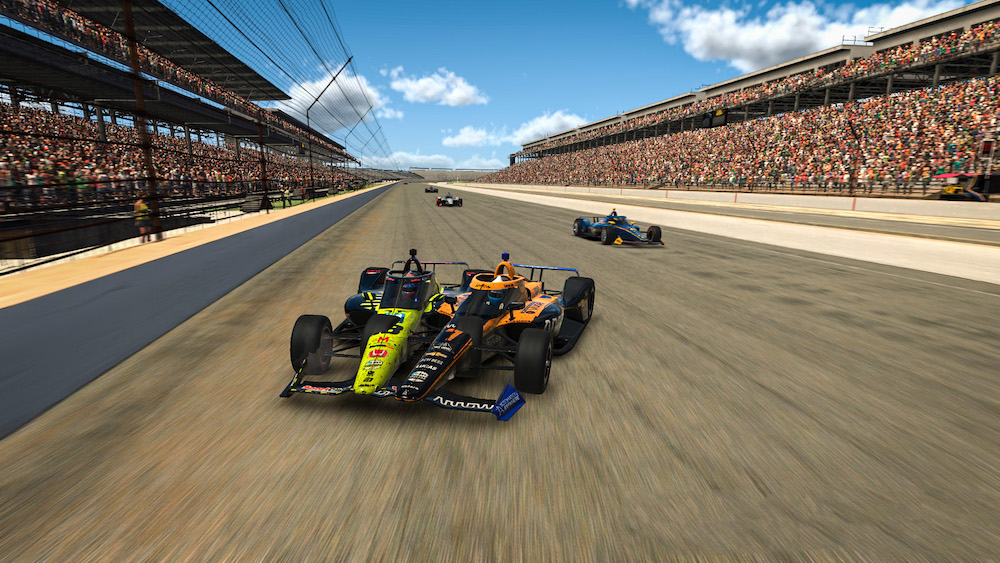
Drivers can choose to take iRacing seriously. Or, they can choose not to. But when drivers who taking opposite views of virtual racing start going side-by-side, well... Image by Miller/Lumen
“And I think what we realize now is that we landed way too much in the middle, because you had half the field that were kind of taking it seriously, half the field feeling that we're taking it extremely seriously, and you just can't do it that way. Everyone has to be out there for a good time or everyone has to be out there to win, and then the show, and the product we’re offering, and the point of it all, makes more sense. But we were stuck in no-man's land. We were in the neutral zone, and it wasn't the best place to be.”
We learned Bourdais has a cat. His name is Oscar. The clip of Oscar, riding shotgun on the bed behind Bourdais during the first race, generated an insane number of views. More, funnily enough, than any of the videos he and I have churned out…
We learned that with the various shelter-in-place orders in most states, the IndyCar iRacing Challenge became an all-consuming affair for many drivers who invested an unbelievable amount of time preparing for each round. A prime example comes from Lando Norris, who admitted to spending a combined 24 hours learning the art of oval racing for the finale at IMS. And in many cases, the time spent by a driver was compounded by the support received from the team. For Norris, three Arrow McLaren SP engineers were attached to those 24 hours of practice, meaning almost 100 hours of collective effort was sunk into prepping for a single 70-lap virtual race. The colossal time investment in this case was a significant contributor to the Briton’s frustration in the race’s outcome, and the lingering sense of loss.
We learned that teams viewed televised iRacing events on NBCSN as a lifeline to generate value for sponsors. It worked, in some cases, and IndyCar went to great lengths to produce internal reports for its teams to quantify the value and share the info with their sponsors and partners. There weren’t a ton of viewers, but credit NBC Sports and iRacing for rising to the production challenge during the coronavirus shutdown.
We also learned that some sponsors were either pushing to have money returned, or to skip making upcoming payments during the shutdown, which meant the furor raised last week at the Indy finale wasn’t helpful. As only four spots were made available during pre-qualifying to make the field of 33 – with no explanation why – the subsequent loss of popular drivers Kyle Busch, James Hinchcliffe, Robert Wickens, and more who failed to qualify for the race brought confusion that wasn’t needed. Add in the late-race stupidity and negativity produced by Ferrucci and Pagenaud, and real-world problems were caused for some teams clutching to the televised iRacing events as a way to appease and retain their sponsors.
We learned to enjoy some drivers in new and different ways as their personalities shined through during practice sessions, and even in a few races. And especially on Twitch, where tuning into Conor Daly’s stream was always entertaining, as was Scott McLaughlin’s.
“I really liked getting to know some of the drivers more than I did before,” Daly says. “I think because there was so little else going on in the world, you could almost look at every single sim session a driver did and learn something, because it's an open mic. Everything was public about what we were doing. Everything on the driver chat, everything on the streams. So, I certainly learned more about some people, and if they watched me, they got the real me.”
When he wasn’t laughing or torching his fellow competitors over the group chat, Power enjoyed the communal aspect of iRacing.
“I thought it was pretty fun,” he says. “Everyone got to see each other's true in-car personality a little bit. And everyone got to talk and you'd be angry at someone one minute, then you're fine with them the next. I thought it was kind of a bonding experience for everyone.”
We also learned that in some of the public and private sessions, heated conversations took place. And with the boorish behavior spilling out in the finale, some insights into which drivers are respected and those who are held in poor standing were revealed.
“Among the driver fraternity and among the racing crowd, there are some things that are known about some of the drivers, but we don't really want to say it,” Daly says. “We know how people are, but the public might not really know. And I think honestly, for me, I'm always me no matter what, in any setting. Whether it's an official interview, whether it's on the stream, whether it's anything, I'm always the same. But I think there's some people that can put on a good face for interviews or can put on a good a good picture for whatever it might be.
“I think there are some people that, when it comes down to it, and if we're sitting in pit lane at Texas, and we're ready to go out, whatever has happened on iRacing is not going to affect how I look at people at all. But some of the drivers that I would already be not that confident in are pretty much the same drivers that we weren't confident in on iRacing. So it's actually not too dissimilar. I think all it did was give the public more of an idea of like why we might feel that way about certain drivers.”
Bourdais wants Daly’s assessment to be correct.
“I hope everybody's going to have a big amnesia over it because otherwise there's going to be some serious hard feelings carrying into the season, which wouldn't be a good thing,” he says. “There’s going to be a lot of precedent between some guys. And I hope that it doesn't happen, especially the first race (Texas) being an oval. I don't think anybody wants to see any miscalculated aggression towards someone.”
Power understands the heated reactions, within reason.
“I'm not surprised,” he says. “You're in there competing, you put a lot of time into it, and some w***** takes you out?” he says. “It's really upsetting. And then about an hour later you should be just perfectly fine because you realize in your heart, it just isn’t real, and it doesn't matter. You don't get hurt in iRacing, and it doesn't cost anything. Unless you do something really bad, then it might cost you your career.”
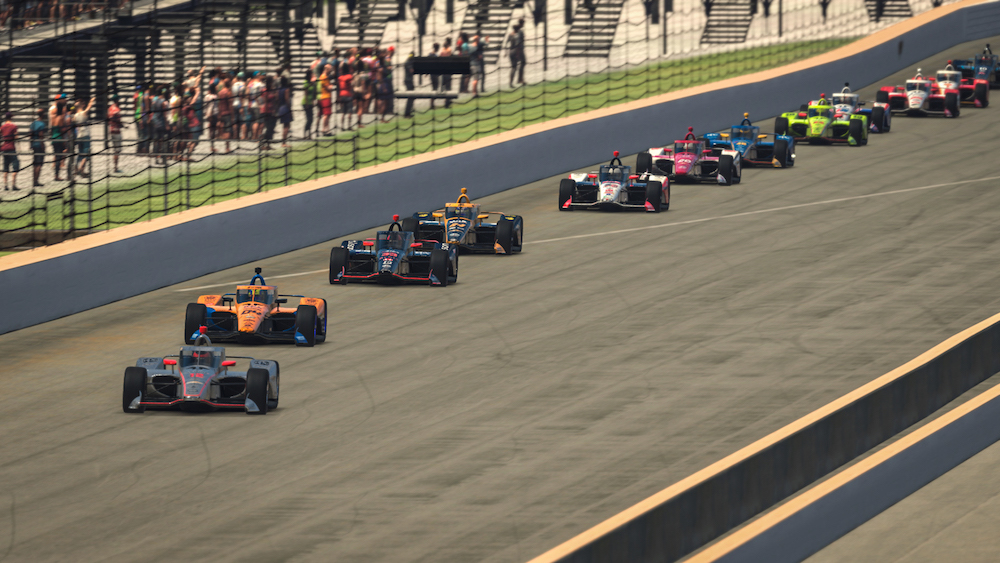
Power believes that the iRacing experiment helped drivers build real-world bonds. Image by Miller/Lumen
Counter to the first three opinions, Hinchcliffe isn’t sure the IndyCar iRacing scraps will be so easily forgotten.
"Real-life rivalries will be born out of sim racing, out of fake life driving,” he says. “Because they 100 percent believe that. And it's so funny, because it doesn't matter. I think that for sure it'll hang in the back of your head for... Not to me, because I just didn't get invested enough to get angry enough at anybody. But for sure there are going to be people that carry some of the grudges from this over to over the real world. Well, I mean, I don't think it's a 2011 rain-day planking exhibition at the Speedway... That lived exactly in the time that it should have and went no further. This, no, I don't think this disappears at all.”
We learned the cartoon anvil exists in the virtual world as Hinchcliffe, Tony Kanaan, Felipe Nasr, and more were knocked out of races, or unable to start races, due to a variety of glitches.
We learned that some drivers are excellent in virtual and real racing scenarios as Sage Karam, Scott McLaughlin, Simon Pagenaud, Lando Norris, and more distinguished themselves in the IndyCar iRacing Challenge.
We also learned that some IndyCar veterans were fast learners, with Scott Dixon, Alexander Rossi, and Sebastien Bourdais among the iRacing novices who marched forward at different rates of progress.
“For me, for sure with a single screen, it was particularly difficult to just get the spatial awareness,” Bourdais says. “Who's where, how close are you really and who's coming at you? And the depth perception and the speed. It was very challenging. And so, obviously, that led to a lot of incidents. As soon as you started to treat it a little seriously, then it would get very frustrating. But on the flip side of that, because it got so serious on the road courses, I won't deny, I tried, I mean I really tried to be very decent and I didn't succeed…
“But I did spend a huge amount of time trying to get better at it, and the fact that you could get crashed by something out of your control, which in real life would have been very easy to avoid, was tough. In the game, not so much, it led to massive frustration, overreaction, and so forth. But the goal was from the beginning to try and stay connected with the fans and give them something to watch on TV in those terribly boring times, which I think it kind of succeeded, even if some of us weren’t always very competitive…”
And we learned that despite the unsavory end to the IndyCar iRacing Challenge, our panel of drivers agree some form of permanent Esports IndyCar league is needed going forward.
“I think this brought a tremendous amount of attention to a very interesting prospective way to spend time between seasons,” Hinchcliffe says. “If we don't have a winter Esports series moving forward, I would be absolutely floored. We talk so much about how long our off-season is and how our sponsors are only getting value for half the year. All of our sponsors had time on NBC Sports Network the same way that they would have in a real race.
“And so if we can go back and take the lessons learned from this experiment, and apply it in an intelligent way, I think we can create an off-season E-championship that keeps the drivers in a competitive mindset for the off-season, keeps the sponsors in the sport a little more prominently positioned, and I think it's got a lot of value.”
Daly would like to see the initiative run deeper, similar to the Road To Indy, where IndyCar teams have an Esports step to offer on the open-wheel ladder system.
“Without a doubt, every IndyCar team also needs an Esports team,” he says. “I think that's huge just for the racing community, just for kids who like to go racing. Not every kid who loves racing is going to get a chance to be a race car driver. I love what NASCAR has done. I think a lot of those guys, even some of the drivers themselves have their own teams. I think that would be great.
“Should we as IndyCar drivers do more of it? I don't really know, because we're never going to beat the professional sim racers. But I do think we should be supporting that, and I do think that there were a lot of positives to come from this, without a doubt. Definitely more positives than negatives, for sure. Because if we weren't doing it, we would just be dead in the water, and there would be nothing to talk about at all, nothing to say.
“There was so many good things that happened. I still think it outweighs whatever kind of controversy came up. It will make for some really interesting interviews when we get back to the real racetracks. iRacing is so burned into our brain right now that I can't wait to hear what people say when we get back to real life.”
Marshall Pruett
The 2026 season marks Marshall Pruett's 40th year working in the sport. In his role today for RACER, Pruett covers open-wheel and sports car racing as a writer, reporter, photographer, and filmmaker. In his previous career, he served as a mechanic, engineer, and team manager in a variety of series, including IndyCar, IMSA, and World Challenge.
Read Marshall Pruett's articles
Latest News
Comments
Comments are disabled until you accept Social Networking Cookies. Update cookie preferences
If the dialog doesn't appear, ad-blockers are often the cause; try disabling yours or see our Social Features Support.