Image courtesy Daytona International Speedway
IMSA 1990 retrospective: Jags punish the Sunbank 24 field
If today’s flat-out style of Rolex 24 At Daytona racing has an author, it was surely the Tom Walkinshaw Racing USA team and its gorgeous Jaguar XJR-12Ds as they turned in a crushing performance over the Feb. 3-4 weekend 30 years ago.
Baked in heat, drenched in Florida’s notorious humidity, the 1990 Sunbank 24 Hours of Daytona saw the first use of torrid, unflinching pace to win the contest. In what’s become standard practice today, where the entire field pushes to the limit for all 24 hours, the '90 event featured a break from tradition where conserving the car for the first 20 hours was the standard plan in every pit stall.
Led by TWR team manager Tony Dowe, and chief engineer Ian Reed, the V12-powered Jags drew upon the considerable reliability advantage its naturally-aspirated Grand Touring Prototypes enjoyed over their turbocharged rivals.
By 1990, the twin-turbo V6 factory Nissan GTP-ZX Ts had won back-to-back championships, but a Daytona win was proving elusive. All American Racers was in the early stages of its GTP program with the four-cylinder turbo Toyota HF89, and even the bulletproof Porsche 962s, nearing the end of their competitive lifespan, were fast but on edge as teams wrung every drop of performance from the turbocharged flat-six motors.
“We were in the process of trying to build and develop the current V6 turbo [XJR-10],” Dowe said in a call from his adopted home in Australia. “And, so, the budgets were going turbo, rather than the V12. Having said that, one of the things we always made a big effort at Daytona, it's fairly obvious, right from the beginning, that while we were racing a car that fitted the rules, we weren't racing a car that was built to win in any. A lot of people within my world might take exception to that, but when you looked at what Nissan were able to do with turbos and downforce, and the tires they were running, it made it very hard.”
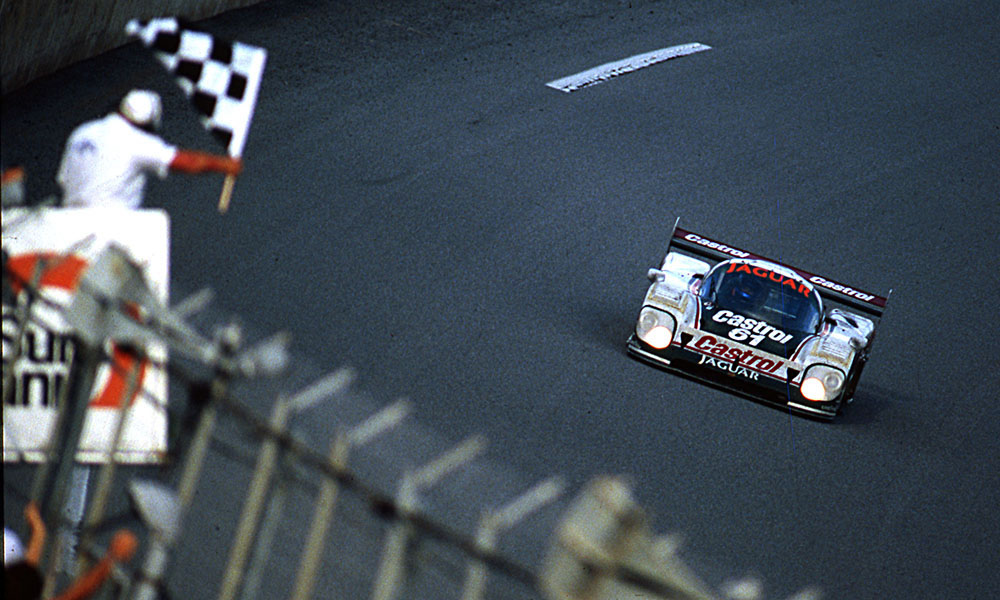
The punishing tempo set by the No. 61 piloted by Davy Jones, Jan Lammers, and Andy Wallace, and the sister No. 60 XJR-12D driven by Martin Brundle, Price Cobb, and John Nielsen would prove to be the winning formula.
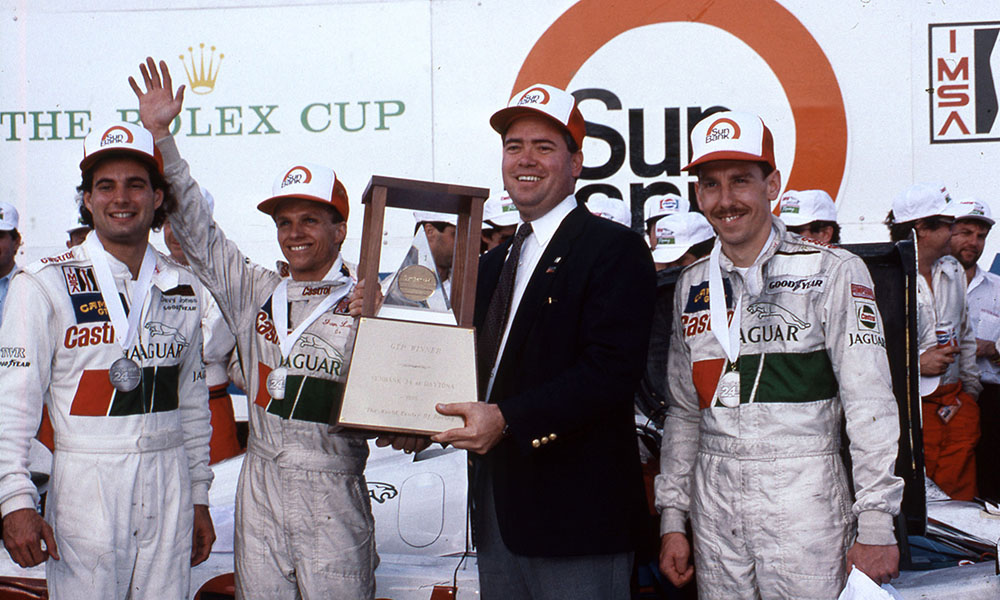
Davy Jones, Jan Lammers and Andy Wallace celebrate after 24 grueling hours. Image courtesy Daytona International Speedwat
“Well, you go to Daytona just knowing that you have the best team in every way,” Jones said of the crack TWR team that was based out of Valparaiso, Indiana. “You've got all the support to win that race. And it was ours to lose. The 962 Porsches had been so dominant for so many years. We knew that with the XJR-12 that that was our mule, that was our workhorse. We opted to go with the V12 just because it was bulletproof. They were reliable, and when you go into a race weekend knowing that you have the best of the best, it sets that mindset straight out.”
Coming into the weekend, 61 cars were ready to take part in practice and qualifying. Around the 3.56-mile road course and oval, which had none of the overhead lighting that makes life easy for modern drivers, clashes and attrition would await the deep field of GTPs, GTP Lights, GTOs, and GTUs.
In qualifying, the Nissans were met with a surprise as a highly developed No. 86 Bayside Porsche 962, with trick new aerodynamics dressed in the black colors of Texaco, snatched pole position with a lap of 1m37.8s. Nissan was close with the No. 84 GTP ZX-T turning a 1m37.9s lap to start second, and the No. 83 wasn’t far away in fourth. The best of the TWR Jags would line up ninth, with the No. 60 a full 2.5 seconds slower than the pole-winning Porsche. The No. 61 would post the 10th-fastest lap, 2.8 seconds off the Bayside 962, in the GTP class that sent 15 cars to take the start.
“Yeah, that time was our race time,” Dowe said. “That qualifying time was what we could race at. That was pretty much where we were going to be, so we weren't sweating.”
Without turbos to boost the Jag’s 6.0-liter V12s, Jones was unfazed by losing the qualifying battle.
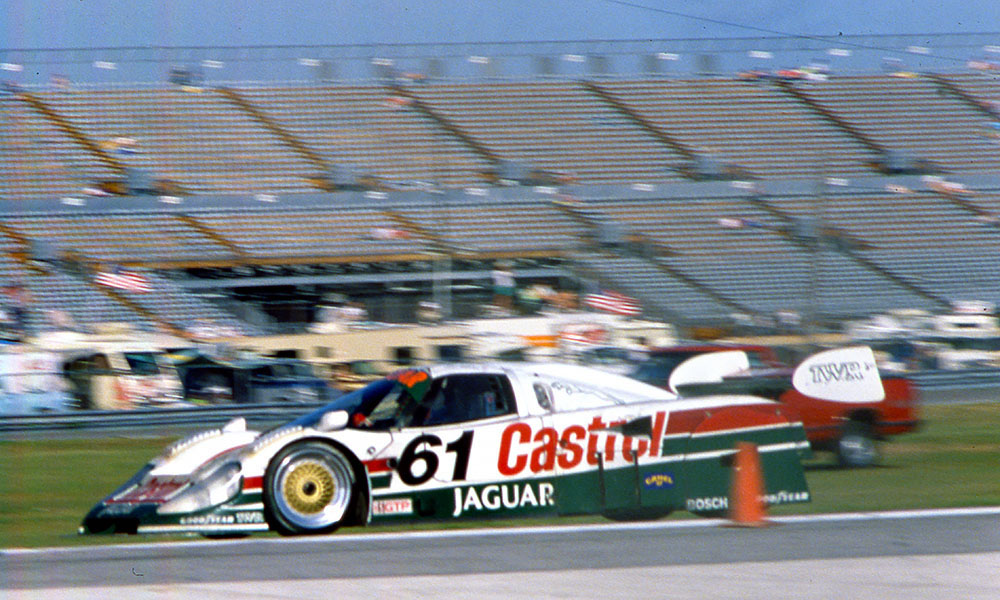
The Jaguars were well off the pole-winning pace, but could run for 24 hours at their qualifying speed. Image by Marshall Pruett.
“We didn't have the opportunity to turn up the boost and go for an all-out qualifying run just to be on the front row,” he said. “We had what we had. All you can do for qualifying is put new rubber on and lighter fuel tanks and maybe trim it out a little bit and piece together your best lap. You're going to go there and you're going to qualify up front, or you're going to qualify somewhere in the top 10 is where you want to be.
“And then after the race settles out after the first hour or two, generally you're setting the race pace that you want. (The others) went out and set qualifying times and put those laps together. We just continued our same pace from when we arrived, first practice all the way through to the race end. And we just focused on that.”
Jaguar’s winning debut at the 1988 Daytona 24 Hours and strong run at the 1989 race came with Dunlop rubber mounted to the cars. A popular solution in Europe and Japan, the Dunlops were losing ground to Goodyear as the 1989 season wore on, and, with its closest competitors using the American tires, TWR joined them in 1990. At Daytona, the XJR-12Ds were reborn under braking, in the corners, and while accelerating with the added grip and consistency the Goodyears offered.
“It settled the whole car down,” Jones confirmed. “The Dunlop tires, we had good tires, we had mediocre tires. We knew the tires that we received from Japan were okay tires. The tires that we received from the U.K. were better tires. But they had really super stiff sidewalls. When we put the Goodyears on, straight away it settled the whole car down. The car wasn't as nervous. It allowed the whole tire, the sidewall, the absorption, the grip, everything to work better and last longer for us.”
Once the green flag waved, sports car legend Bob Wollek disappeared from the head of the field in the Bayside 962. A broken fitting that fed oil one of the turbos on the 3.0-liter Porsche motor in the second hour would cost the team nine laps as repairs were made. Lapping at or near the low 1m40s times they turned in qualifying, the Nos. 60 and 61 Jags began marching forward as many of their closest threats dialed down the boost with hopes of making it to the finish.
“From our point of view, once Bob was out (of contention) with his car, we were racing ourselves the whole way,” Dowe said. “There is some awesome film of Brundle and Lammers swapping positions on the banking coming out of NASCAR 1 and 2, and I had to get on the phone and say, "Look, guys, we're only five hours into this race; we need to keep our heads on."
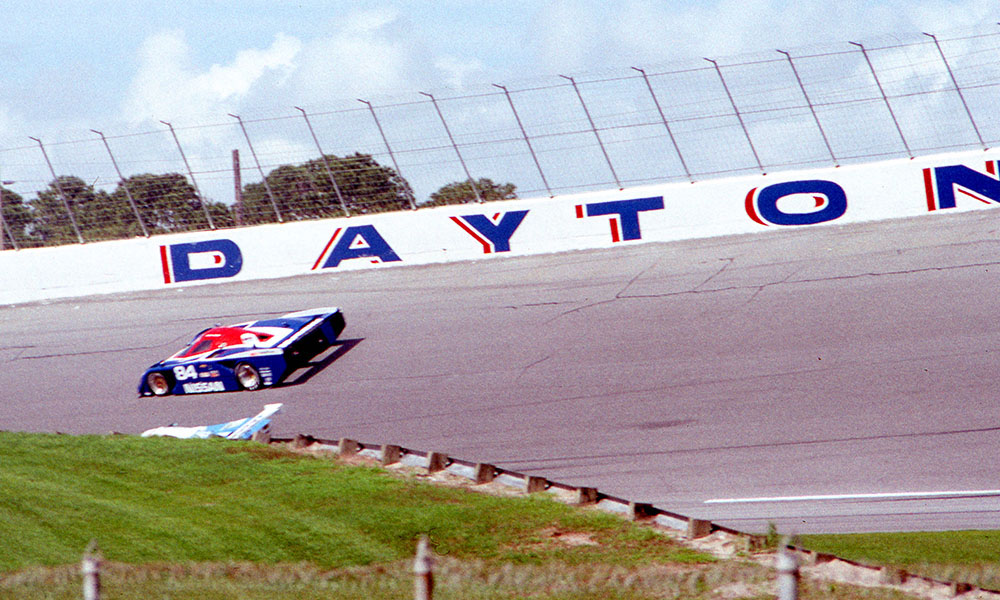
By the halfway point, both Nissan turbos were out. Image by Marshall Pruett
Following the Bayside Porsche mechanical drama, the race exposed reliability issues in other GTP models as midnight arrived. By the halfway point of the 24-hour race, both Nissans were done, the AAR Toyota was out, and even a few Porsche 962s were retired with blown engines or accidents conspiring against success.
The lone privateer Nissan, entered by Busby Racing, was also struck by misfortune when its engine exploded, leaving the XJR-12Ds to hammer away without interruption.
“When you have an endurance race, we were, as a team, able to have really good drivers, and really good teamwork,” Dowe said. “That's not putting any other team down, but we did put a big effort into that. We always felt the Nissan V6 was going to be fragile over 10, 12 hours, which proved to be the case. I mean, they only managed to win when they used the Group C car. They could do 12 hours at Sebring, but after that they became fairly marginal.”
Although they didn’t know it at the time, the TWR Jags were making history with their speed. Ignoring what the turbo GTP cars could do over a single lap in qualifying, their race pace either proved to be reckless while attempting to keep tabs on the XJR-12D drivers, or were simply insufficient to stay in touch with the big cats.
“When you take Jan Lammers and Andy Wallace and myself, you know all three of us, we could do the exact same lap time, lap, after lap, after lap,” Jones said. “We all three of us pretty much sat in the same seating position, so it didn't take long to do a driver change; and we all looked after the car. We always said to ourselves, any time one of us gets into that car, we want that car to think it's the same driver. Making the same moves. The three of us -- I think it was just a stellar team.”
Jones also took pride in eliminating big swings in speed throughout the race.
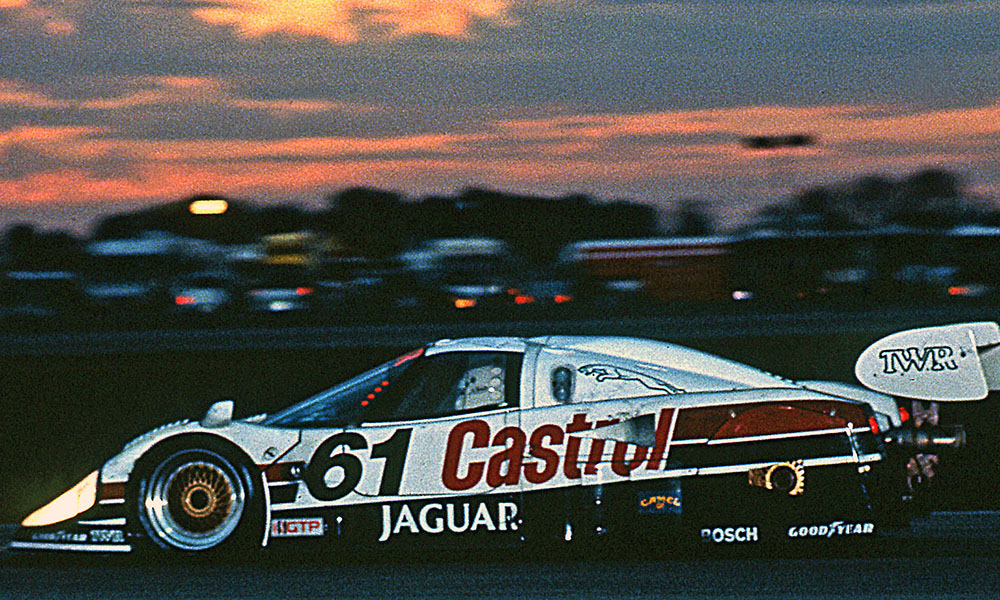
Well out in the lead and on route to a spectacular victory ... Image courtesy Daytona International Speedway
“I always look at these long endurance races ... You get a car that's super-fast in the beginning and it's setting its own pace, and everybody's trying to catch up with it. And you think the first couple hours (that) nobody's going to beat this car; they're way out front,” he continued. “And then you get through the middle of the night, get the next morning, and they're nowhere to be seen. All of a sudden the car that started the race at mid-pack is up front and setting the pace, and everybody's trying to hang with them.
Being part of the trend-setting team that turned the Daytona 24 Hours into a non-stop sprint race is another area where Jones finds immense gratification.
“Back in 1990, that's when it was starting to make the turn from ‘let's just cruise around and get into the morning Sunday, then we can start setting our pace,’” he said. “Well, 1990 it started to come together where each hour was almost like a sprint race, which it is today. I mean, the 24 Hours of Daytona and Le Mans today, it's just every lap is like a qualifying lap, and the cars are reliable now, they're finishing within seconds of each other after 24 hours of running.”
It’s a good thing the TWR cars were so fast. By amassing such a large lead over the depleted GTP field, the leading No. 60 Jag and the No. 61 running in lockstep were able to weather mechanical and engine hiccups of their own. The No. 60 was the first to blink after 20 of the 24 hours were recorded when braking issues forced the car to pit lane for a lengthy brake system fix.
Handed the lead, the No. 61 was soon hit with overheating woes as the V12 motor consumed its coolant, handing the lead back to the No. 60.
“They knew that if we had any overheating issues, that they had a system that they could depressurize and add water to the hot engine within just seconds, which we had ended up using towards the end of the race,” Jones said. “It was well thought out, well planned. Tony Dowe, he's a mastermind at that. And Ian Reed, I think the two of them just gave us a really, really capable team that just did what they had to do.”
The No. 60 also dealt with rising temperatures in the engine bay that put Jaguar’s anticipated win at risk.
“The truth is, we were racing each other,” Martin Brundle said of his No. 60. “I do remember when they came in for their water issues, I'm thinking we got this one covered, (but then) the car appeared to be running hot, hot, hot ... and a little bit hotter. But then it came back, the temperature gauge came back. It was an analog gauge and at that point you think, ‘Okay yes, we're going to be okay.’
“Well, that was (actually) the signal that there was no water passing the (temperature) sensor at that point! Basically, you'd run out of water. You're getting a bit from this crazy little gauge, thinking, ‘Yeah, yeah, we got this under control.’ And that was actually the beginning of your problems...”
With the Jags topped up with water, and the No. 61 leading the No. 60 in the final charge to the checkered flag, Dowe had to implement team orders to keep his chief engineer from turning the contest into a XJR-12D drag race. Down a couple of laps, there was more to lose than gain by having Brundle’s car take the fight to Jones’ entry.
“We actually had to cool it for the last two and a half hours because the cars were out of water, both of them,” he explained. “I had to really get uppity with Ian Reed. (His car) was in second place and he was trying to win it, and he was totally dehydrated and trying to gain time in pit stops and stuff like that. And I had to step in and say, ‘Well, that's the finishing order. That's the way we're going to be.’ Because if there had been a Porsche there to push us, we would've been in trouble.”
At the finish line, Jones completed the 761st lap, which was a new distance record of 2709.16 miles for the 23 editions of the Daytona 24 Hours. The average speed of 112.857mph set by Jones, Lammers, and Wallace over 24 hours was another record.
Considering all of the time and technology that has gone into the latest IMSA DPi prototypes, it’s rather impressive to know the current distance record, set in 2018, only moved the lap count up to 808 and the distance record to 2876.48 miles.
Another legacy from the 1990 race was the destruction that took place behind the Jags. GTP teams attempting to match their stride paid for the costly effort as the 15 GTP cars that started the race were reduced to four at the top of the results. After the TWR 1-2, the Bayside Porsche held on the capture third, another 962 was fourth (albeit 57 laps behind the winning No. 61 XJR-12D), and in fifth, the IMSA GTO class-winning Lincoln Mercury XR7 from Jack Roush Racing chased home the quartet of GTP finishers.
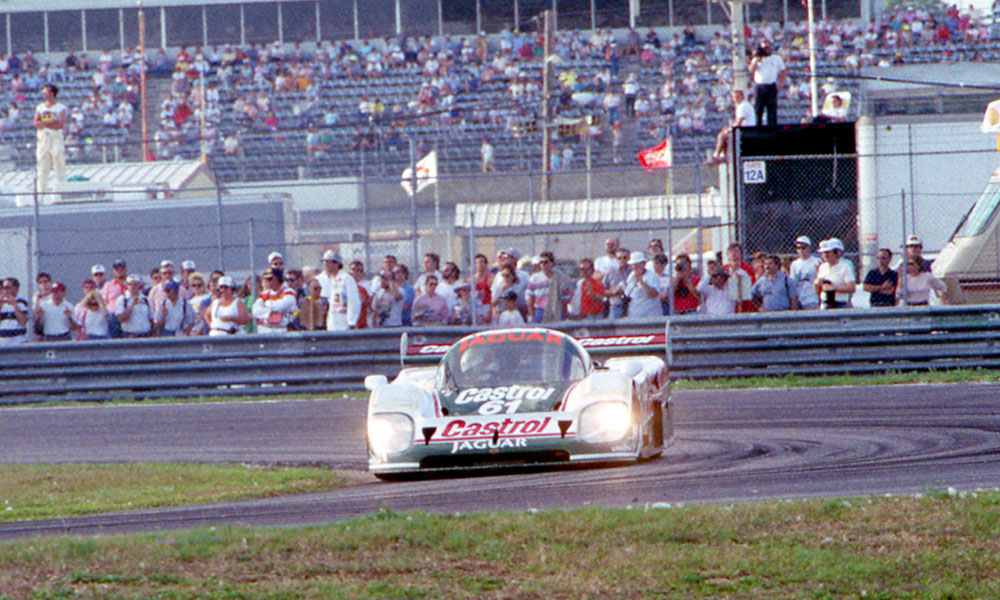
Image by Marshall Pruett
For Jones, the 1990 overall Daytona victory would stand as his greatest achievement in North American racing. In 1996, the Chicago native would add another 24-hour win at Le Mans. Decades later, Jones stands as the last American to visit the top step of the podium at the world’s most famous endurance race.
“You tell people about the 24 Hours of Daytona and their eyes light up,” he says. “It's because it is quite an achievement to win this race, and I think most important is to win the Rolex watch. That's a trophy that's with you all the time; that's not something that you just put on a shelf somewhere. It is a very special race, as well as Le Mans. Le Mans, it was gratifying to win that. I didn't really realize, it doesn't set in that you won a race like Daytona or Le Mans until weeks after, to tell you the truth. Because you are so focused and you're just there to do a job, and when you do your job and you do it the best you can and you win it's like you've achieved it.
"But when you look back, you say, 'Man that was a big deal. That was quite something.'”
Dowe took a workmanlike approach to TWR’s best day at Daytona.
“I might sound arrogant, but I would've been disappointed if we hadn't got 1-2, because we'd done the hard yards the previous year and we had really good people, and we had good planning, and we executed,” he said. “So from that point of view, it wasn't a surprise that we achieved.”
Owing to the high heat and humidity, and the ragged, unrelenting attack on time and speed over 24 hours, Jones and his co-drivers rewarded themselves after the podium ceremonies were complete.
“We had one of these strict diets where you can only consume water and electrolytes, and back then, we're eating pasta and buckwheat rolls and stuff like that, fig bars,” Jones said. “And after you win a race like that you just want to just have a beer and a pizza and cheeseburger with onions -- just make up for being healthy for a few weeks.”
The pint-size Dutchman Lammers also wanted something sweet to close the event. We’ll let Jones finish the story of TWR Jaguar’s amazing Daytona win on its 30th anniversary.
“One of the stories that's funny is Lammers -- he always seeked out the ice cream shops wherever we were racing,” he said. “And I wasn't sure if it was because he liked the scoops of ice cream, or because he liked the girls that were scooping it up...”
Marshall Pruett
The 2026 season marks Marshall Pruett's 40th year working in the sport. In his role today for RACER, Pruett covers open-wheel and sports car racing as a writer, reporter, photographer, and filmmaker. In his previous career, he served as a mechanic, engineer, and team manager in a variety of series, including IndyCar, IMSA, and World Challenge.
Read Marshall Pruett's articles
Latest News
Comments
Comments are disabled until you accept Social Networking Cookies. Update cookie preferences
If the dialog doesn't appear, ad-blockers are often the cause; try disabling yours or see our Social Features Support.