Image by IndyCar
DALY: Arrow McLaren SP's missing ingredient
The newly-branded Arrow McLaren SP team’s aggressive young driver approach will be fascinating to watch. Based on years of study and real life experience, I’m not so sure that Pato O’Ward and Oliver Askew can be successful for the same reason that Tony Kanaan and Matheus Leist failed at AJ Foyt Racing. They are both super-talented drivers, but may struggle to support each other and carry the team to the heights of IndyCar’s big three teams, Penske, Ganassi and Andretti.
I’ve watched O’Ward since his early junior years and have been highly impressed with his raw speed and bravery. Askew, likewise, has built an impressive junior success resume at every level of the Road to Indy development series. However, pairing them together at this stage of their careers just might be a big mistake.
In 1996, Derek Daly Academy did a driver development program on behalf of Team Kool Green, and over the course of two years we ran 44 young American drivers through a series of on and off track exercises to try to determine who might be a future star. Perhaps the biggest epiphany during the program was understanding that racing drivers, just like other athletes, are born with one of two types of talent: instant/reflex or feel sensitive talent. This realization was so powerful that it led me to write my first book on driver development, Race to Win.
Instinct/reflex talent is flat-out all the time, getting maximum performance, with little time to think about what the car is doing (think Montoya or Kanaan). The feel sensitive driver is forever working to engineer maximum grip and performance from the car, and provides good feedback to the engineers (think Scott Dixon or Dario Franchitti). One or the other is not right or wrong, but each type of talent needs a very different support system to extract its maximum potential. Twenty-three years later, I’m still amazed that so few team managers actually understand this, despite the fact that it makes such a huge difference to the structure of a team and its potential for success.
Instinct/reflex talent is the gunslinger; feel sensitive is the technician. Think Brett Favre and Peyton Manning. Both super-successful NFL quarterbacks, but very different in their approach and execution of their game. What made both of their styles work is that they had teams built around them that allowed their styles to flourish. Manning’s receivers knew precisely where they had to be to catch the ball, whereas Favre’s core group knew they just had to be ready for anything – just get open because the ball could arrive from any angle. Favre could not play a Manning style of football, nor could Manning dare to emulate Favre’s approach. Manning was the clear-thinking set-up technician; Favre was a flat-out, on-the-rev-limiter-every-play type of player. Two very different talents who achieved similar success.
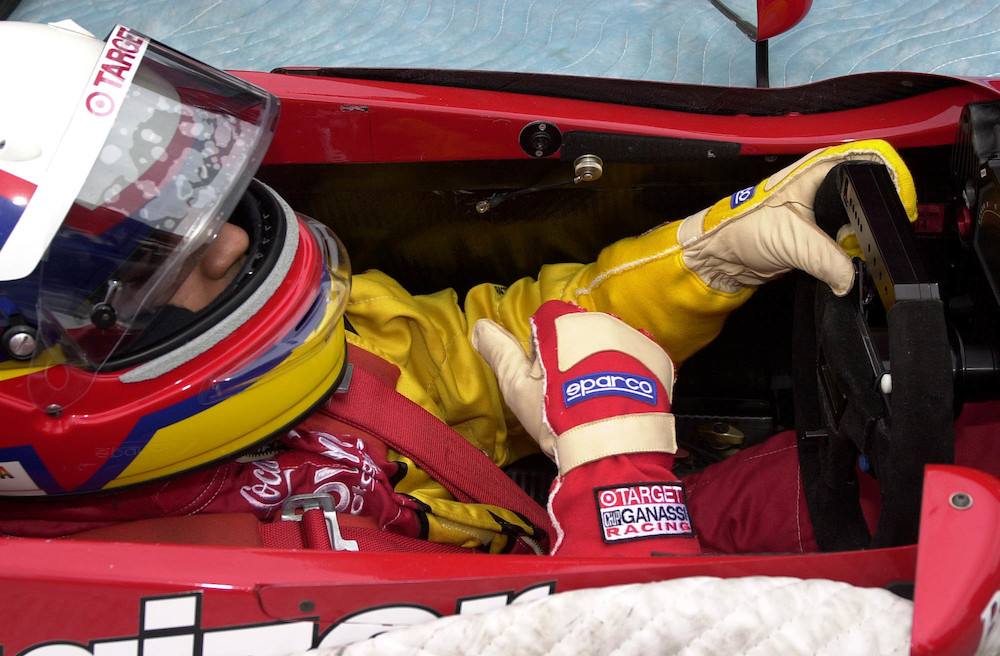
Under Daly's system, Montoya was a classic example of a driver who was guided by instinct and feel. Image by Levitt/LAT
Now think about the optimization side of IndyCar. There are almost no development areas available that can make a car faster, so optimized set-ups are king. No driver in the world can drive a bad car fast. So with set-up being king, the most important asset to a successful team is a good feedback driver. Don’t think for a minute that a good engineer can overcome poor feedback – it just doesn’t happen in a spec series. Formula 1 comes closest to being able to control car set-up without a constant input of strong feedback because of the number of sensors and data captured when the car is on track, and the amount invested in wind tunnels, CFD and simulation. However, even Red Bull design genius Adrian Newey says that no matter how many sensors are on a car, the ultimate development of the race car during a season is driven by accurate driver feedback.
So for O’Ward to flourish, he will need to be stepping into a well set-up car. How will he get that? There is no way that a rookie teammate can be expected to provide that type of support and team guidance. Colton Herta flourished as a rookie by plugging into the strength of Andretti’s deep and rich engineering notebook. Make no mistake about it, he looks like a superstar in the making, but he also had the vital set-up information and could compare notes with experienced drivers every day at every race. O’Ward won’t have that opportunity. This is exactly the situation that Kanaan found himself in at A.J. Foyt Racing. T.K. has always been an instinct/reflex driver who needs a good feel sensitive support driver for set up feedback. Leist was a fast rookie who was almost certainly another instinct/reflex driver, and therefore the downward spiral started as soon as the contracts were signed.
Understanding a drivers talent is not an exact science because there are so many other aspects that come into play, but I’ve seen enough drivers, both young and old, to know that understanding the talent type of your driver was born with is a key anchor to building a successful team structure. And yet, so few team managers understand it. The magical team set-up would be having one of each type. The feel sensitive driver keeps the team within a good development and set-up window, providing the instinct/reflex driver the perfect platform to perform. This structure also pushes each driver to his/her limits through trying to keep up with each other. A perfect example of this was Nico Rosberg/Lewis Hamilton at Mercedes in F1. Frank Williams said Nico Rosberg debriefed like an engineer, whereas Hamilton is more of an instinct/reflex driver. Think back to what happened last year without Rosberg. Valteri Bottas (who appears to be an instinct/reflex driver) took his seat, but did not have the Rosberg engineering savvy. Hence, and despite having a team of more than 400 development engineers, the car proved so difficult to sort and develop that it was called a ‘diva’.
Red Bull had the perfect driver combination with Max Verstappen/Daniel Riccardo. The team could lean on the feedback skills of Riccardo to develop the car and keep them within a set-up window, allowing Verstappen to perform at his gunslinger best. I don’t believe Red Bull fully understood or fully appreciated Riccardo’s true value. He felt the same way, and left for Renault. Verstappen recently voiced that he thought his pairing with Riccardo was the strongest the team had been. Since then Verstappen has been paired with rookies, and it’s probably fair to say that the team’s rate of development is not what it needs to be to win consistently, despite Verstappen’s exceptional talent.
Lay the driver talent model over other IndyCar teams and you can see structures of success, inconsistency or failure. I believe that Rahal Latterman Lanigan has two instinct/reflex drivers with Graham Rahal and Takumo Sato. This is a well-funded team with a strong engineering group, yet for years they have been inconsistent. They dominate some weekends, and struggle on others. Inconsistency is a hallmark of instinct/reflex drivers. It’s easy to know why a car is slow, but it invaluable to know why a car is fast, because if you truly understand it, you can reproduce the speed. Rahal and Sato have not been able to do that every weekend. When RRL added the instinct/reflex talent of Sato they got a fast, brave driver with a history of crashing. He has won races, but the team has not really developed.
Team Penske’s feel sensitive set-up driver is Simon Pagenaud. He’s known to be meticulous in his preparation and a deep thinker – all hallmarks of a feel sensitive, reliable feedback driver. Josef Newgarden is more than likely an instinct/reflex driver. I say this because he style is loose and on the limit, but when he’s armed with a good car (with help from Pagenaud) and in a good track position, he’s as good as anyone.
Chip Ganassi Racing has had the luxury of having one of the fastest feel sensitive drivers in IndyCar history: Dixon. No matter what the chassis or engine or engineer, the most consistent element to Ganassi’s success has been Dixon’s accurate feedback. It’s highly possible that Felix Rosenqvist is more of an instinct/reflex driver (I say that because of his on-the-limit style) and if this is correct, together they will push each other to the outer limits of what might be possible. This is a powerful combination for the future.
Andretti Autosport, in its early guise of Andretti Green, went through some interesting eras with drivers. One of its most stable times was the early 2000s when Franchitti and Bryan Herta were there. They are both regarded as strong feedback drivers who kept teams on the right set-up track. When both either left the team or retired, and seats were filled by Danica Patrick, Marco Andretti and Hideki Mutoh, the consistency of performance waned. They went from dominating in 2005 to not winning a race in 2009. It’s doubtful that either of these new drivers contributed to the set-up development of the cars.
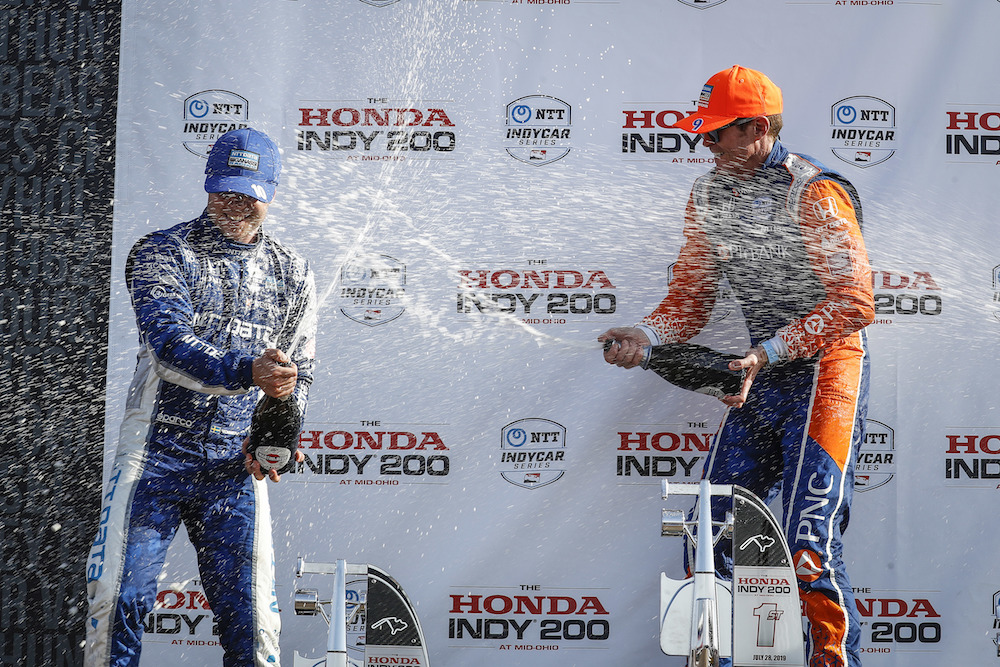
The complementary strengths of Dixon and Roseqvist could prove to be the foundation for a formidable partnership. Image by Levitt/LAT
My guess is that Ryan Hunter-Reay sides more on the feel sensitive set-up side of the equation, and when he joined in 2010, the team started winning again. With the addition of Rossi (feel sensitive), Andretti now appears to have a stable feedback platform with strong engineers and strong off-track mechanical development programs.
The most complete driver I’ve ever seen was Michael Schumacher. People said his success was because he always had the fastest car. I concur with those beliefs and ask, how do you think he got the fastest car? Without a doubt it was because of accurate driver feedback fed into the strong design and engineering group Ferrari had at that particular time.
Most young drivers today are instinct/reflex because becoming a good feedback driver is a learned trait. Young drivers have to become aware of the need to develop a feedback discipline, but with today’s access to data and sensors on every junior car across the world, drivers and teams have gravitated to lap tops and graphs to assist with set up decisions. This is a flawed way to develop sustained champions but it is what it is. One thing I’m sure of is that a strong feedback driver in an invaluable asset.
Understanding this aspect of a drivers make up will not guarantee success, but when a team gets it right (mostly by accident) it will definitely anchor the possibility of future success. The driver choice at Arrow McLaren SP was probably made by their sporting director, Gil De Ferran. Ironically, De Ferran was one of the best feel sensitive drivers in his day – yet he didn’t recognize that what Arrow McLaren SP needed in one of their seats was a clone of himself.
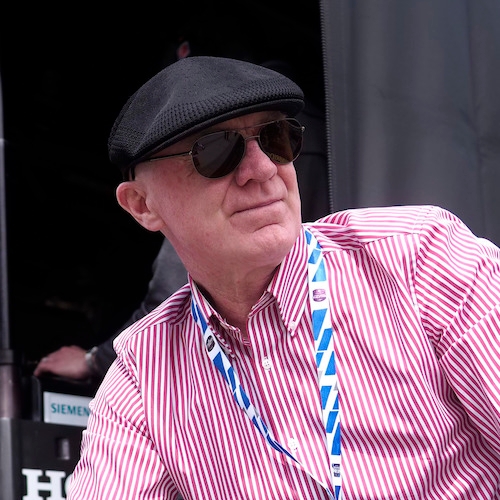
Derek Daly
Derek Daly's vast racing resume includes 49 F1 starts with Hesketh, Ensign, Tyrrell, March, Theodore and Williams, a podium in CART, and a fourth at Le Mans in the iconic Silk Cut Jaguar XKR-9LM. Since his retirement from driving he has juggled roles as a TV commentator, author and public speaker.
Read Derek Daly's articles
Latest News
Comments
Comments are disabled until you accept Social Networking Cookies. Update cookie preferences
If the dialog doesn't appear, ad-blockers are often the cause; try disabling yours or see our Social Features Support.