Images by Richard S. James
The Optimizer: SCCA GT-3 Runoffs champ is in a class of his own
In the 56-year history of the SCCA National Championship Runoffs, only eight drivers have entered the championship event more than once and gone undefeated. Scott Lagasse, Lewis Kerr, Earl T. Jones, Paul Jett, and John Greenwood are all two-for-two; Dave Vegher and Skip Barber set their records at three-for-three. Collin Jackson, meanwhile, is the sole person in the SCCA’s history to go five-for-five. Want to know his secret? I did, so I asked. And, you know, I think he told me.
“Do everything within your power to understand the variables, and optimize,” Collin explains to me. “If you don’t do your homework and your maintenance, you’re really there as a spectator for the guys who do.”
That said, Collin also lets loose another little secret, one that has been hiding in plain sight for anyone willing to do the research.
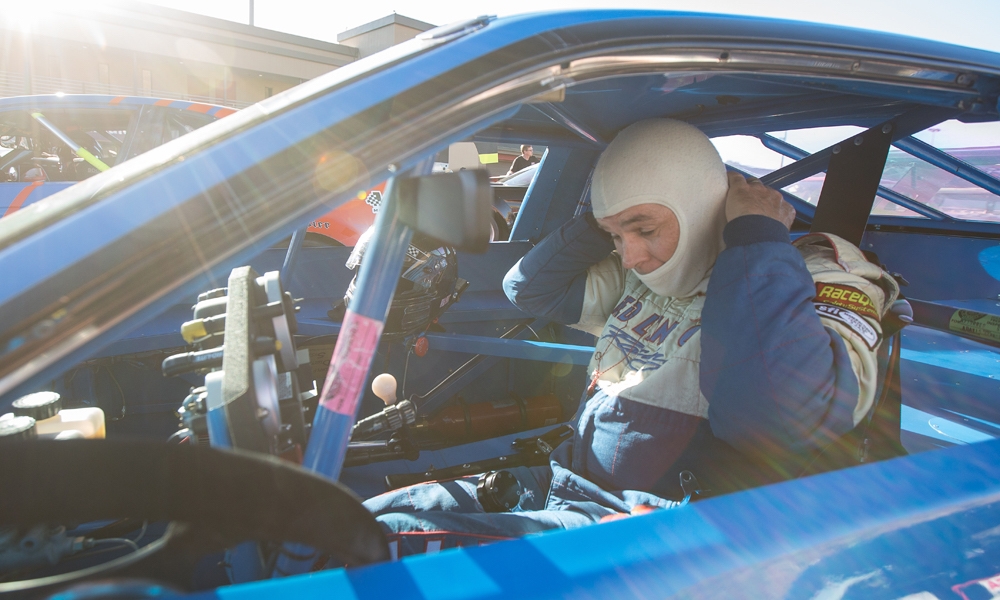
“People are making a rather big deal of [my Runoffs record], but I didn’t go to the Runoffs as a rookie,” he reveals. In fact, by the time Collin entered his first Runoffs in 2003, he was actually a nine-time racing champion. But his racing story starts long before that.
“I’ve been into racing my whole life,” Collin tells me of his early days. “My aunt and step-uncle raced cars when I was a kid and I was absolutely mesmerized by it. At 8 or 9 years old, there was nothing better than racing cars. My uncle had a sports racing car that I loved. I learned enough by being obsessive about it and going to as many races as I could.”
As Collin turned 14, a family friend by the name of Ron Householder was attempting to campaign a Formula Atlantic car on the West Coast, and Collin quickly signed up for the ride. “It was a 1973 Brabham BT40,” Collin says fondly of the car, “and I thought this was even cooler than the sports racer since it had wings.”
So, in 1975, Collin started working with this Formula Atlantic team. “Ron went about teaching me what we needed to accomplish during a race weekend in order to be successful. I quickly was able to do those things, and I wanted more. By the time I was 16, I was pretty much telling him what to do. We were very successful together.”
His family was fairly poor, Collin explains to me, so Householder assisted in putting him through college, where he became a mechanical engineer. When Householder passed away, he willed the Brabham to Collin.
“We were very close,” Collin says of the friendship that altered his life in so many ways.
Solidly in the workforce, Collin stepped into the driver’s seat, this time racing a Datsun 510. “Regionally I was quite successful,” he says. “And then an SCCA semi-pro series came along called NASPORT. I really liked that formula, so I started running NASPORT exclusively from 1987 through 2003 and I won nine NASPORT championships.”
But contrary to what you might think, I don’t believe Collin was attracted to the series due to his ability to win; conversely, it was how hard it was to do so.
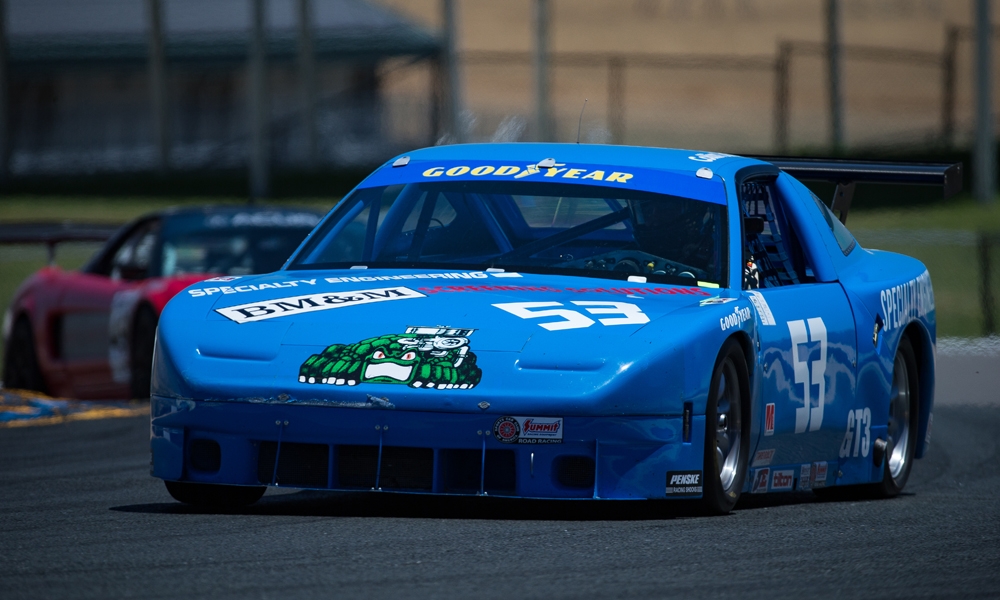
“The level of competition in that series was absolutely spectacular,” he points out. “Mike Lewis won several GT-3 Runoffs titles while he was running NASPORT, and Ken Murillo won the Runoffs when he was running NASPORT. The people I was racing in NASPORT were top-flight drivers, and that competition makes you better.”
When NASPORT began to dwindle, Collin shifted focus to club racing and SCCA’s GT-3 class where his NASPORT racecar fit, and that’s when he made his “rookie” debut at the Runoffs.
“I went to the Runoffs in GT-3 in 2003 as a nobody,” he laughs. “Nobody had heard of me because I guess people weren’t paying close attention to NASPORT. We were very successful; in 2003, I won and my teammate Dave Humphrey was second. In 2006, I went back to the Runoffs in Topeka and I finished first and Dave finished third. In 2014, I went to Laguna Seca and finished first and Dave finished fourth. Then at Indy, in 2017, I went by myself and I won that one, too.”
Then in 2018, he returned to the SCCA Runoffs once more, at what is essentially his home track of Sonoma Raceway. There, he won again, although not easily.
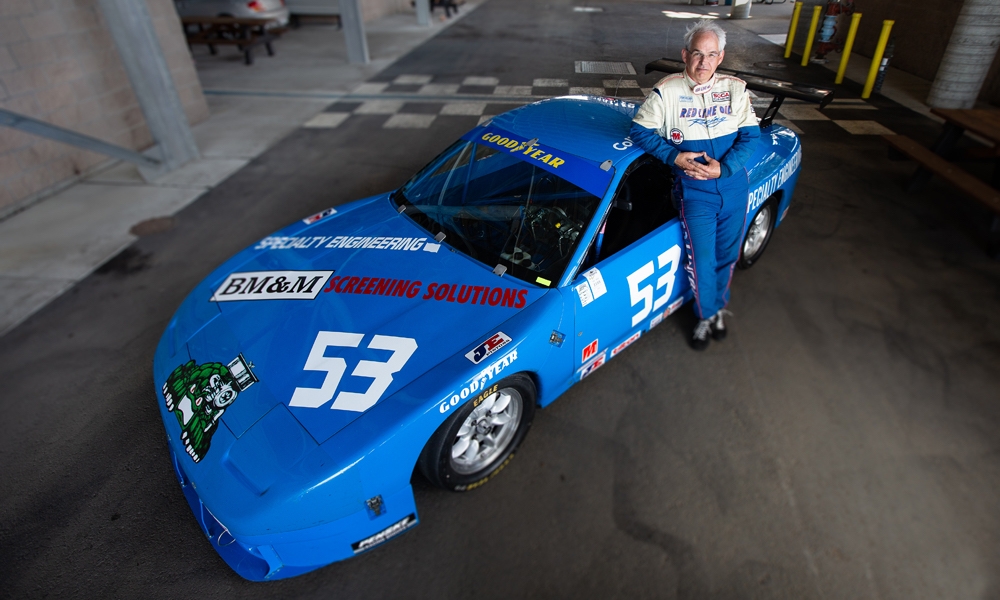
Now add to this impressive feat the fact that he’s accomplished his success with a small, tight-knit crew. “My team is my wife, Glenda; a longstanding friend of mine who is 85 years old now and is really my car chief, retired Air Force mechanic Jack Back; and Andy Pearson, who owns Specialty Engineering in Delta, B.C., Canada.” With Andy busy with work, the Jackson paddock space is populated simply by Collin, Glenda, and Jack.
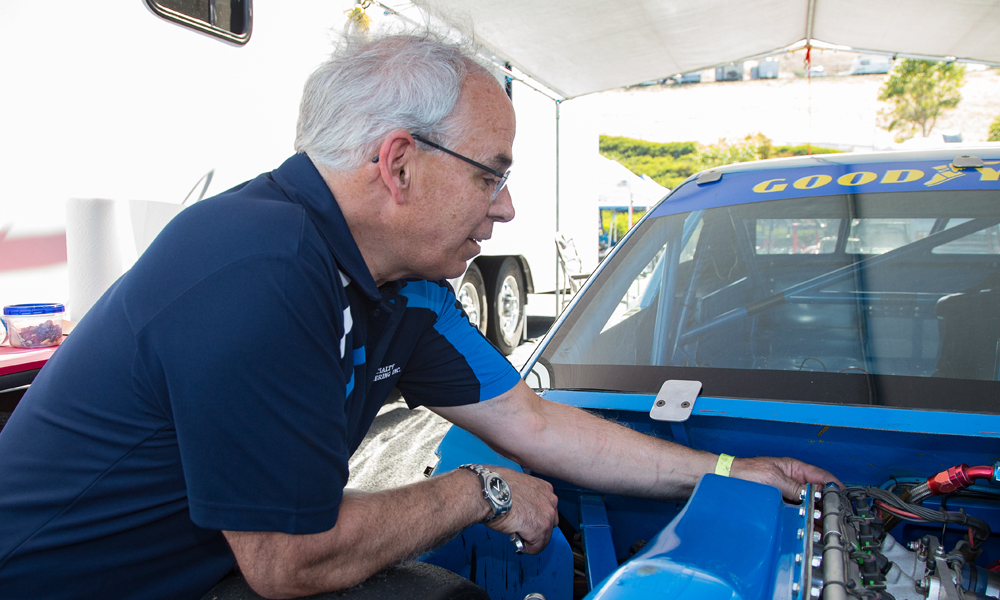
Collin Jackson at the SCCA US Majors Tour at Sonoma Raceway; June 29-July 1, 2018.
All of this begs the question: Who is Collin Jackson?
“I’m a technical guy,” he tells me, but would you expect anything less from a mechanical engineer? “My hobby is building and optimizing racecars – not racing my car. My sport is racing my car. Without my sport, I don’t have a hobby.
“I have a lot of stress in my job as president of a manufacturing company, so I go home and work on my racecar, or a design for my racecar,” he says. “I do something where I can totally forget about work. My hobby is a very internal thing. My passion is proving to myself that I have the ability to optimize something at a very high level.”
To that end, Collin is quick to quip that he’s not a fabricator. “I’m a fabricator’s assistant,” he chuckles. “I work with Andy Pearson – he owns Specialty Engineering which built the car. He’s a consummate designer. He’s just spectacular. Why would I weld on my racecar when I have an artist who can do it?”
Essentially, Collin explains to me, Specialty Engineering is the execution of his projects, but, he says, “I maintain my own cars; I strip them down. Do I rebuild the engines and put them on a dyno? No, Specialty Engineering does that. But 100 percent, I maintain my own cars.”
The word “optimize” comes up a lot in conversation with Collin. “I’m an optimizer,” he explains to me. “My results are based on Andy’s and my ability to build something that does what I want it to do. It’s not based on my ability to drive around a chassis that doesn’t work.”
OK, I say, tell me about optimizing for the SCCA Runoffs. Tell me how to win. “It isn’t all about me,” he says quickly, “it’s about my team and their ability to execute the plan. When I go to the racetrack I have a plan and a setup, and we execute those at the racetrack. I don’t do things on the fly – I’ll come to the Runoffs with a plan that’s prewritten.”
Collin develops a plan for each individual day at the Runoffs, down to the session.
“We’ll go [to the track] and prove what we know is applicable, then we’ll set a bracket of what I need to do if the track is slick, or whatever,” he says. “And then, every day, we try to execute an improvement to the previous day. It’s very much an iterative engineering process of optimizing the setup that we came to the track with, using the data that we’ve learned during each session.”
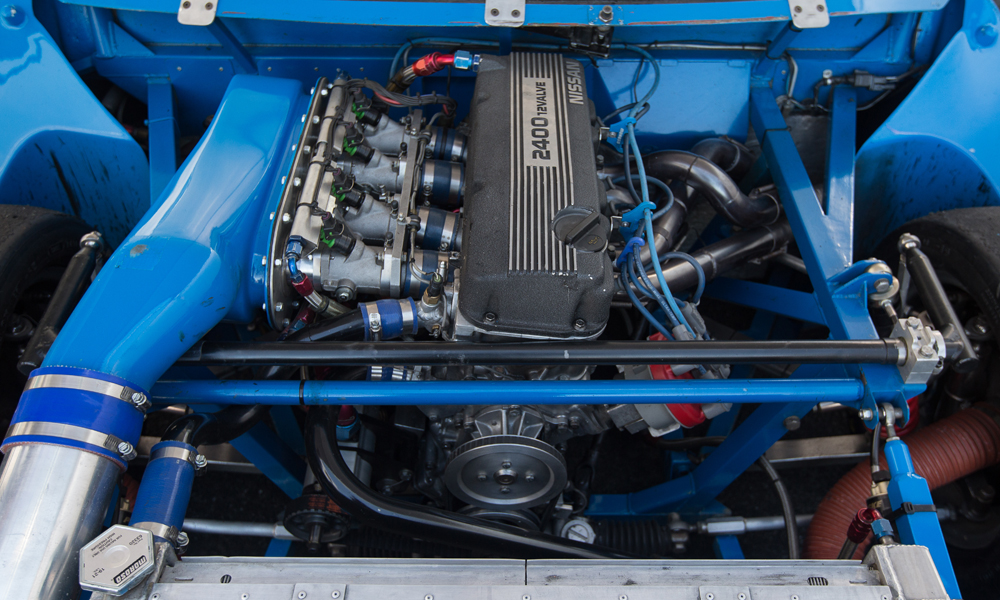
At this point, my weakness as an interviewer was showing. Posed with general questions, Collin returns general answers. Digging for details, I then struggled to tell whether the answers were specific or vague. But I dug nonetheless for Collin’s list of items to optimize.
“I like to put variables in a spreadsheet and start checking them off,” he says. “Shock absorbers, aero, brakes, suspension tuning, engine tuning, friction loss, tire construction – there’s a massive list. There’s no detail too small to optimize, and then re-optimize.”
Then, pay dirt. “It isn’t about lap time, it’s about race time,” he says as I feverishly jot down notes for my personal racing advantage. “I look for what’s the fastest over the race duration. I’m always about winning the race, not the lap. Nobody knows who led the first lap of the Indy 500, but everyone knows who won.”
There’s more. “If you’re tuning, you want to optimize one thing at a time. If the car is under steering, then you don’t want to do two things to get rid of understeer; but if the car’s doing one thing at slow speeds and another at high speeds, you can do two different things that affect them differently.” But done incorrectly, he points out, you can quickly turn one test day into two more.
“Racing isn’t just engineering your car, it’s also learning the difference between your car and your competitor’s car,” Collin tells me as I silently realize I’ve been doing it wrong for years. “If your competitor is 2mph faster than you down the straight and you take all of the downforce out of your car so now he’s only 1mph faster down the straight, you’re still going to get beat down the straight and now you’re going to get beat in the corners, too. You do the opposite of that.”
Then came a shocker to me: Collin isn’t a big user of data acquisition (“I find it to be very valuable but very obsessive, and therefore very unproductive,” he says); instead, he sings the praises of race simulators. In fact, he credits simulators with much of his success at the 2017 Indy SCCA Runoffs, although it wasn’t easy.
“I spent probably two months developing a car in a simulator that I thought handled like my Nissan so that I could do testing at Indy,” he explains. “It took me forever to find a car in the program. I ended up running a German touring car that had been de-rated to 300hp, I put super hard tires on it, and made a whole bunch of suspension changes.” He dialed the virtual car in using tracks like Sonoma and Laguna Seca, and then once the car was sorted, he loaded the Indy road course. “It turned out to be quite applicable,” he says.
Want to watch Jackson in action? Check out coverage from the 2018 SCCA Runoffs where Jackson and Lewis battled non-stop for 20 incredible laps at Sonoma Raceway this past October.
You already know how it ends: Jackson wins. But seeing it happen is something else.

Philip Royle
Read Philip Royle's articles
Latest News
Comments
Comments are disabled until you accept Social Networking Cookies. Update cookie preferences
If the dialog doesn't appear, ad-blockers are often the cause; try disabling yours or see our Social Features Support.