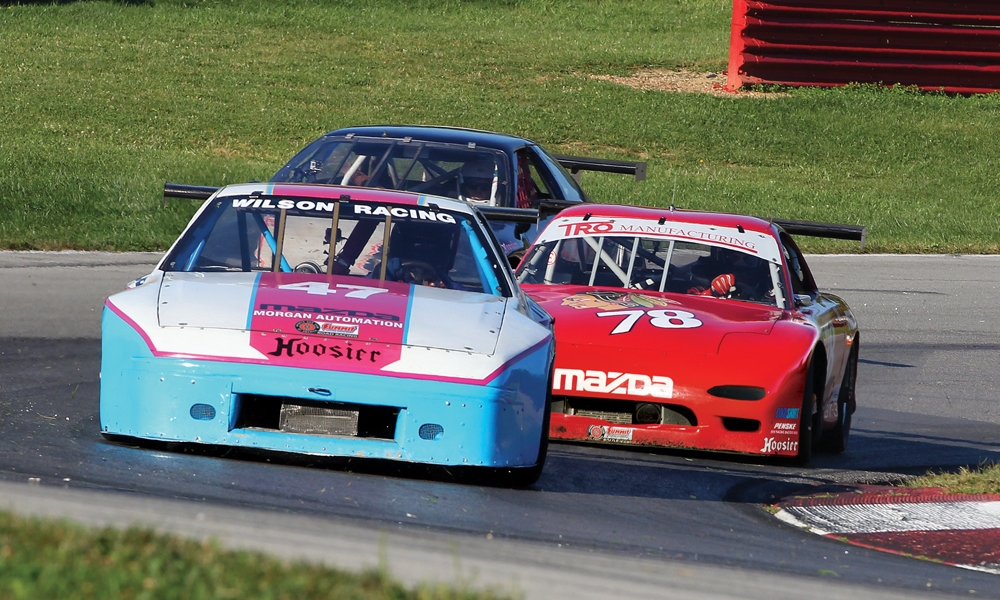
Image by Dennis Wood
GT3 Challenge set to boost SCCA class competition
It’s hard not to look at a GT-category race car in SCCA Road Racing competition and not be a little gobsmacked. From tubeframes to technologically developed engines to unique suspension and driveline solutions, these are race cars through and through. Unfortunately, not all of SCCA’s most exciting racing classes are highly subscribed to, and GT3 is no exception. But there’s hope, and with help from some friends – namely GT3 racers and enthusiastic manufacturers and suppliers – GT3 could soon return to its glory.
GT3 competitor Rob Warkocki tells a tale of the Runoffs from the early 1990s. One year, participation was down, as was the level of competition.
“It was an embarrassment and everybody felt that E Production was gone,” Warkocki recalls. “But what happened was they classed all of the ITA cars, which was a huge class regionally, and suddenly there were a bunch of RX-7s in there and then the Miata came in, and that was it, the class took off again.
"Now E Production looks like a bunch of heroes because participation is incredible, but that class was on death’s doorstep. It’s amazing what can happen with inspiration and when the right set of minds come together.”
Warkocki has been around and he knows that racing, both personally and as a class, has its highs and lows. Warkocki has attended the Runoffs more than 20 times, claiming a pair of National Championships along the way, all in GT3. He’s helped others, been helped, and done it all while racing a Mazda RX-7.
“I’ve been running GT3 since 1986, so I have a full history of the class, the previous drivers, the current drivers, where the cars are, plus the whole history of where the class has been and where it is now,” Warkocki explains.
Consequently, when Mazda Motorsports was looking to develop an idea that was born at the 2018 Hoosier Super Tour at VIRginia International Raceway, Warkocki received one of the first calls.
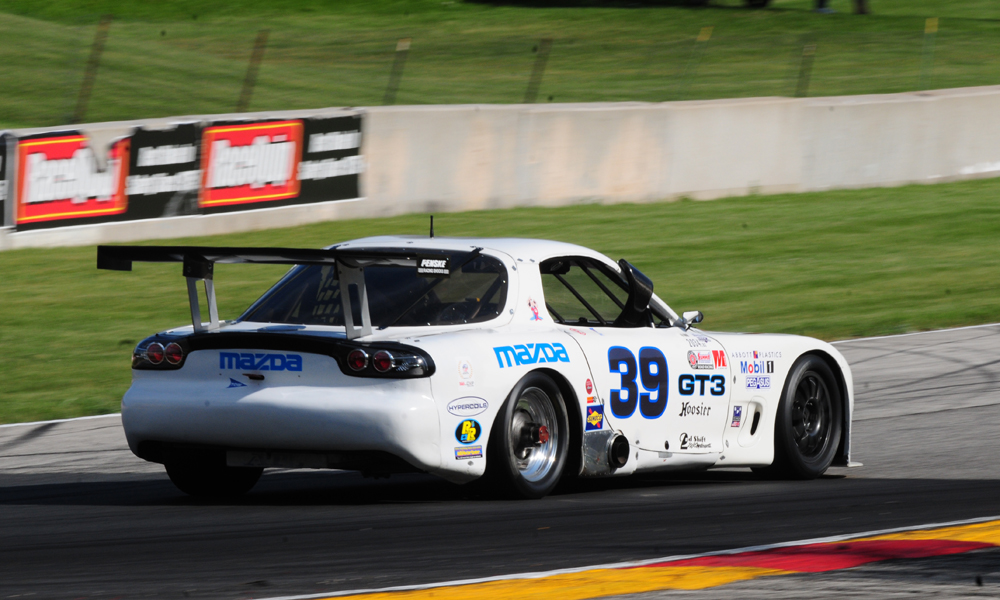
Image by Mark Weber
An idea is born
“I was contacted by [Business Development Manager for Mazda Motorsports] David Cook in the early spring about GT3 participation,” Warkocki says. “We ended up putting together a team to come up with ideas about the GT3 class, the cars, the drivers, the engine manufacturers, and chassis builders to try to get an idea of where the class is heading and why, and if there was anything we could do to make an effective change.”
The immediate goal was to boost GT3 class participation, but not necessarily for the reasons you might think. “It’s not about the class or the cars specifically, it’s about the racers,” Cook explains about Mazda’s involvement. “The racers in GT3 have made a significant investment over the years – sometimes over 20 years – and we see the class size shrinking, reducing the experience and the value for those long-term Mazda racers. We realized the only way we could stay true to ensuring our racers have the experience they deserve with Mazda was to substantially invest in them and the class.”
The initial concept of the GT3 Challenge was born during the 2018 VIR race weekend, and 2016 Runoffs GT3 National Champion Stacy Wilson was there when it happened. Wilson was competing in GT3 that weekend and got pulled into a brainstorming meeting with Cook, Steve Strickland, and several GT3 racers. The idea they came up with was simple: Encourage GT3 racers to participate in four key SCCA events before the 2019 Runoffs, splitting them up regionally, and crowning an overall GT3 Challenge winner at that Runoffs. Also, the special events should be appealing for all GT3 racers, not just those piloting Mazdas.
“I love the class,” says Wilson of GT3, a class he’s raced in since 1990. “Speed-wise, it’s probably as fast as anybody would want to go. The speed is tremendous, the cars handle great, and they’re one of a kind. It’s a very intriguing class. For me, one of the selling factors of GT3 is the engineering aspect – I try to be as good as I can be.”
But one major hurdle for GT3 class participation, Wilson pointed out at the meeting, is budgetary.
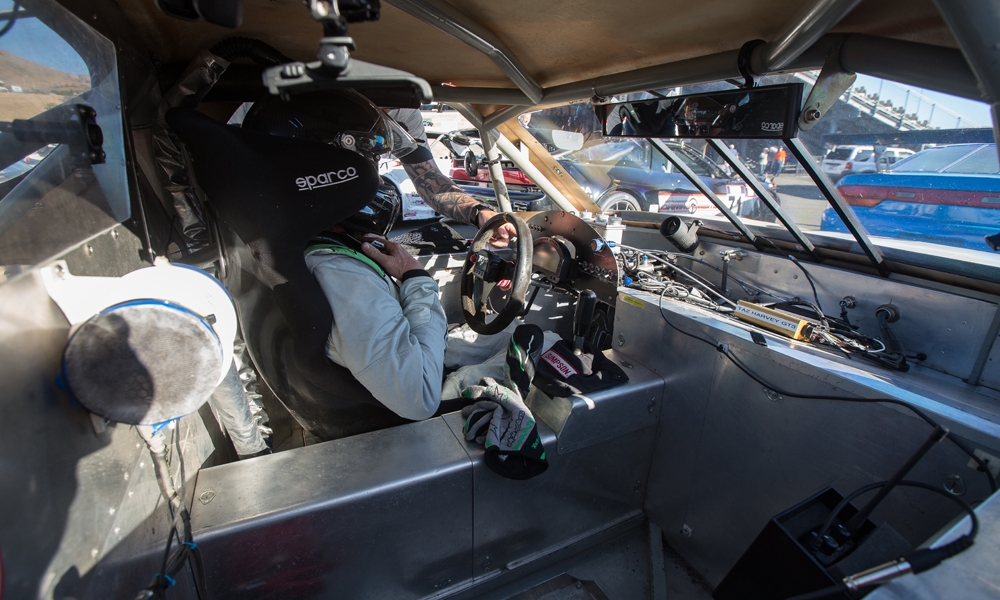
Image by Richard James
“I think the biggest obstacle for anyone going to a race is finances,” he says. “Sometimes there are things you can do about your budget and sometimes there aren’t. I know that if I don’t have the money, I just can’t go racing.
“Years ago, I would go through the scrap pile at the tire trailer and pick out the best used tires I could find in order to race,” Wilson says. “For me, I have to think about every tank of fuel I put in my tow vehicle.” Consequently, for Wilson, financial support for the GT3 Challenge was a necessity.
Tackling that, Mazda decided it would offer GT3 Challenge racers competing in Mazdas contingency payouts through (and perhaps beyond) 10th, increasing not only the number of racers normally offered contingency payouts but also the amount paid to each position. But while that was a good start, the group acknowledged more was needed.
“There will be significantly enhanced prizing across the board at GT3 Challenge events, not just for Mazda racers,” Cook explains. “In addition to the contingency awards for Mazda racers being bolstered, the GT3 Challenge is going to have a social event each weekend for all in the GT3 Challenge. We’ll have T-shirts and trophies, plus subsidies for GT3 Challenge entries will be applied to everyone, not just Mazda drivers. Also, Hoosier is increasing its contingency payout, and MPI [Max Papis Innovations] is going to be the title sponsor for the GT3 Challenge events.”
“I think Mazda has hit on a number of things, like putting contingency offerings further down the field,” says Wilson. “There are some people who might consider coming [to a GT3 Challenge race weekend] but they know they really don’t have a chance of winning, so if contingency is only offered for the winners, they might not come. Things like this can help make sure we have good fields, and that’s a win for everybody.”
Parts keep racers racing
Supporting racers in the GT classes is nothing new for Mazda. Over the years, Mazda Motorsports has supplied access to racing parts and is currently working with engine suppliers for hard-to-find rotary pieces. Also, Mazda recently partnered with EMCO Gears to develop replacement parts for the PBS dog-ring transmission that’s popular with Mazda racers in GT and Production classes, as well as the creation of a brand-new transmission, the EGMT.
“The process of developing a new dog-ring transmission probably started a dozen years ago when I would cry on [Director of Mazda Motorsports] John Doonan’s shoulder,” says Warkocki. “He said that if he ever got to the point where he was in charge of the motorsports program at Mazda, that would be one of the things he would work on. So, when he became the guy in charge, he called me and said let’s work on this.
“We called a couple of transmission manufacturers, and ultimately John dropped by my house one afternoon and we put my spare PBS transmission in the back of his Mazda and we drove up to Elk Grove Village, Illinois, which is the headquarters of EMCO Gears,” Warkocki explains of the trip he took nearly three years ago. “I set the transmission on their boardroom table, we pulled the transmission apart, and we discussed the whole idea of whether EMCO could make replacement parts, with the eventual production of a modern transmission. The market wants it.”
The thought is that offering parts support for grassroots racers can make the difference between someone making a race weekend and sitting that one out. “You’d be surprised how many people just need a hand,” says Warkocki. “If they could find that, they’d come out and race again.”
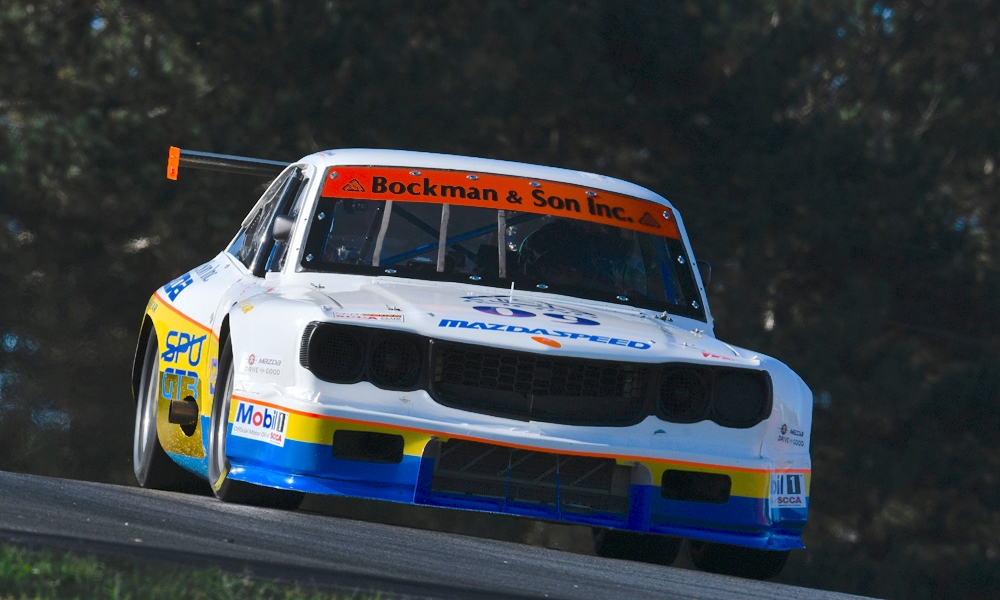
Image by Rupert Berrington
Support through racers
“We’re not investing in the cars, we’re investing in the racer,” Cook says, noting that in order to invest in racers, Mazda has to invest in the cars. This is why Mazda has helped fund the development of engine parts, a new race transmission intended for use in Miatas and RX-7s, and now a race series aimed at all GT3 competitors.
Yet none of this is done in a vacuum. For example, while the GT3 Challenge has initial dates set for the 2018 ARRC at Road Atlanta as the Southeast GT3 Challenge Region event, then weekends in 2019 including the U.S. Majors Tours at VIR (Mid-Atlantic Regional), the June Sprints at Road America (Midwest Regional), and Portland International Raceway (West Regional), Mazda wants to hear from racers to see which tracks they would like to see the GT3 Challenge head to next.
It’s also notable that the GT3 Challenge was born from racers and developed largely by racers. “Probably after two months of bi-weekly meetings, we had tons of really good ideas and we started networking and talking to other competitors and putting feelers out there to get a better picture of what’s going on in the class,” says Warkocki. “Once we decided it would be viable for Mazda to step in and create some kind of series that would generate excitement, Mazda then worked with competitors and suppliers like Hoosier and MPI [Max Papis Innovations] to launch the series. I’m really happy Max Papis is involved the way he is; he’s kind of paying it back to his grassroots motorsports roots.”
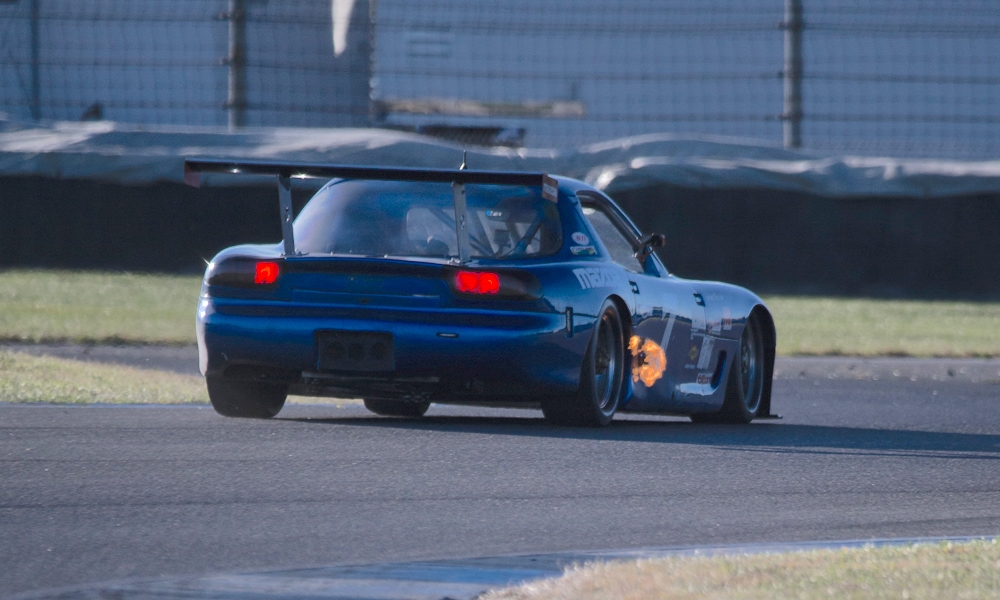
Image by Richard James
Boosting participation
“I’m a tinkerer,” says Warkocki of what originally drew him to GT3 and why he’s still there decades later. “I like the aspect of not being constricted with rules of production-based cars. In the GT class, you can just put on parts that are made for this and go race.”
So, does the veteran of the class think the GT3 Challenge will boost class participation in the long run?
“It sure has a wonderful shot,” Warkocki says. “It can build excitement, get some amazing race fields, and allow other people to witness what a full field of quality GT3 cars are like when they race, and that would expose people to it and make them interested in racing in the class.”
“If there are only one or two cars in a race field, who wants to throw their hat into that ring?” Warkocki asks. “But if there’s a field of 10 or 15 cars and they’re all having wonderful battles on track, people look at that and wonder how they can get involved.”
And that is what the GT3 Challenge is all about.
www.mazdamotorsports.com
.GT3 Challenge tentative schedule
November 2018: Road Atlanta, Georgia; SCCA American Road Race of Champions
April or May 2019: Virginia International Raceway, Virginia; SCCA U.S. Majors Tour
June 2019: Road America, Wisconsin; SCCA June Sprints U.S. Majors Tour
Summer 2019: Portland International Raceway, Oregon; SCCA U.S. Majors Tour
October 2019: VIRginia International Raceway, Virginia; National Championship Runoffs

Philip Royle
Read Philip Royle's articles
Latest News
Comments
Comments are disabled until you accept Social Networking Cookies. Update cookie preferences
If the dialog doesn't appear, ad-blockers are often the cause; try disabling yours or see our Social Features Support.