IndyCar dampers to remain open for development
IndyCar competition president Jay Frye and his team have tabled a plan that would have changed the series' stance on dampers development starting in 2018.
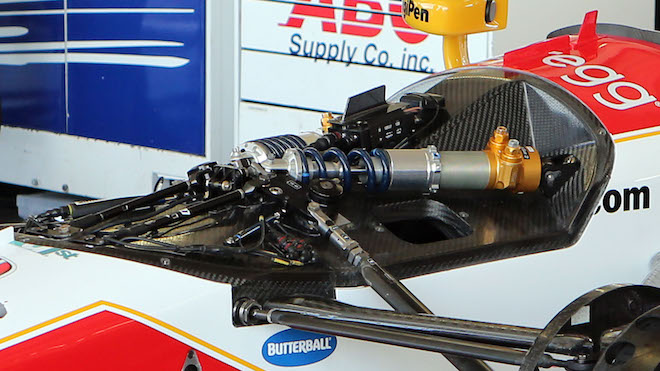
As one of the only components on the Dallara DW12 chassis that is not spec, teams continue to invest extraordinary sums in evolving damper technology through lightweight materials and trick internal components that have a surprisingly large influence in lap time. And with the continual reduction in track testing permitted by IndyCar, damper R&D and off-track tuning has become an area of significant expenditure, which led some teams to ask the series to consider introducing a spec solution next season.
"We had a year-end team manager meeting a few weeks ago, gave them some pre-meeting homework to complete and compiled it all for the meeting, and in it, we went through 50 topics," Frye told RACER. "We asked for their input, and from that homework, we looked at a lot of things coming out of the current season and next season, and one of the items was that there will be no changes to the dampers in 2018."
The meeting did, however, produce a timeline for when IndyCar's open-damper policy could change.
"There's nothing concrete, but we did discuss dampers staying as they are in 2018, again probably in 2019, and then possibly the first time we would make changes would be in '20," he added.
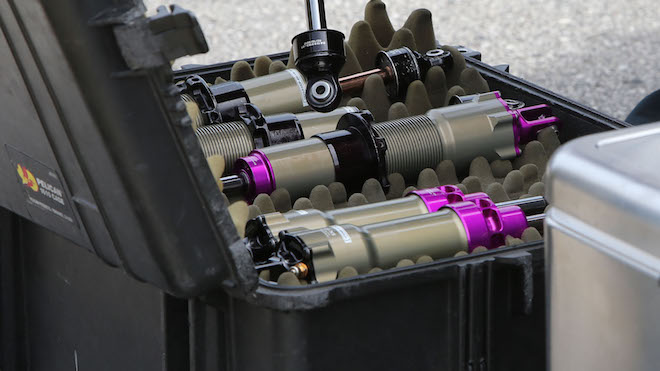
With the sets in hand, putting a price on R&D is impossible due to each team's respective budget and willingness to commit funding toward the project. Some teams will go as far as designing and machining their own dampers, which requires the hiring or contracting of a design engineer and the material costs to produce however many sets prior to an extensive R&D program. Damper engineers command low six-figure salaries, and then there's the cost of seven-post shaker rig testing – wealthier teams have purchased their own while others pay $5000-$7000 per day to use one at a facility that rents time on their unit.
The use of damper simulation software has also become standard fare, with a single license costing approximately $50,000 per year.
Where IndyCar will face a challenge if it wants to reduce costs in the area of dampers and the associated R&D is separating the price of the physical components and the sums being spent on off-track testing. As history has shown, as tighter regulations are implemented by the series, teams spend more money to overcome those restrictions through computer simulation tools, wind tunnel testing, shaker rig time, and any other method that can provide performance improvements away from the racetrack.
Forcing teams to use spec dampers would save money for some teams, but it won't address the unregulated off-track development costs that will only increase in reaction to the possible rule change in 2020.


Latest News
Comments
Comments are disabled until you accept Social Networking Cookies. Update cookie preferences
If the dialog doesn't appear, ad-blockers are often the cause; try disabling yours or see our Social Features Support.