Tuesday SCCA Runoffs notebook
News and notes from the SCCA National Championship Runoffs, set for Sept. 25-Oct. 1 at the Indianapolis Motor Speedway where nearly 1,000 drivers will compete for 28 national championships.
First round of qualifying times posted
The first day of qualifying turned out mixed results. With no drivers having the benefit of prior experience at the Indianapolis road course, the learning curve was steep, and favored those drivers able to attend the four test days available just prior to the start of the event.
SCCA National Champioship Runoffs viewing guide
Notable qualifying performances today included GT-1, where David Pintaric of Canfield, Ohio is currently first on grid in his Cadillac CTS-V. Pintaric drove to a time of 1:37.961, almost three full seconds faster than the second-place Ford Mustang of Zachary Monette of Milton, Georgia. In GT-3, three-time national champion Collin Jackson of Langley, B.C. put his Nissan 240SX into first position by nearly a 3.5-second margin over the second-place Acura RSX of Joe Kristenson from London, Ontario.
Elliott Finlayson of Yorkville, Ill. brought in the fastest lap in Formula Enterprises at 1:40.209, besting the second-place qualifier Justin Gordon of Lake Worth, Fla. by more than a second. Sedat Yelkin of Austintown, Ohio turned the fastest lap in Formula Atlantic at a 1:30.783 in his Mazda-powered Swift 016a.
Defending SRF champion Todd Harris of Portland, Oregon posted a fast time of 1:54.382, almost a quarter-second faster than second-place qualifier Denny Stripling of McKinney, Texas. This is the last SRF national championship, so several drivers are hoping to put their names on the list this year. In SRF3, it was Tray Ayres of Gainesville, Georgia with the fast lap at 1:50.533. Bobby Sak of Mattawan, Michigan was second and Harris third, leading past champions John Black, Mike Miserendino and Cliff White in fourth, fifth and sixth places. In all, 101 SRF3 drivers laid down times, making it the largest class ever in SCCA Runoffs history.
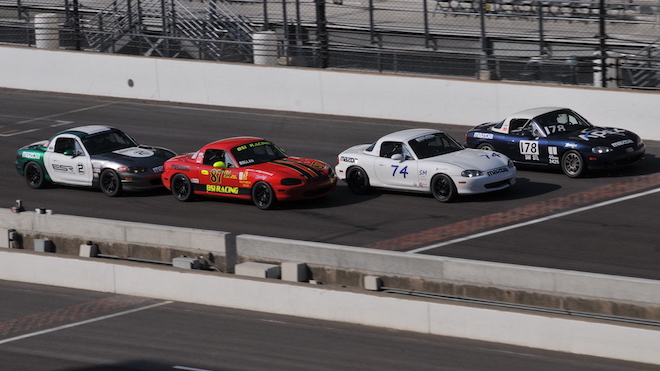
In Spec Miata, Chris Haldeman of McKinney, Texas delivered the fastest qualifying lap of 1:59.608, but he cannot rest on his laurels. In order to find a driver who qualified more than a second slower than Haldeman, you have to go down to 17th place. In all, 86 Spec Miata drivers turned a qualifying lap on Monday, but only 72 will make the race at 11:45 a.m. on Friday.
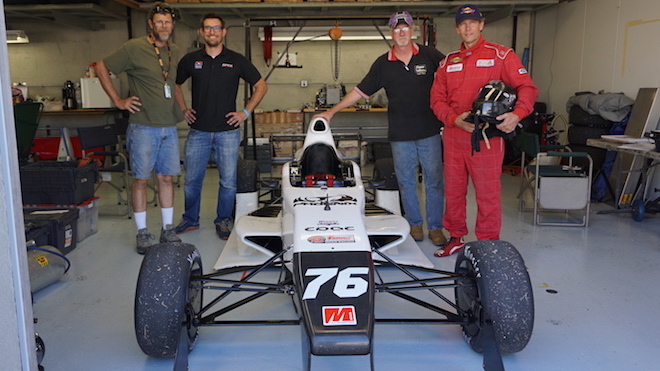
One of the great things about SCCA Club Racing and the Runoffs is that upstart racecar builders can come and compete with the best in North America. One of those upstarts is Phoenix Race Works. Based in Phoenix, Arizona, this company is building cars for the popular Formula 1000 (aka Formula B) class.
"We design the car, and we construct, manufacture and sell the car in a collaborative effort with Gary Hickman and Tony Moore at Edge Engineering," says Phoenix owner Dustin Wright. "My role is the chief technical guy. But it's truly a team effort to design and manufacture the cars. We have some help at the track from Chris Harrison at Harrison Auto Dynamics. He works with our whole team on setup, tuning, and refining the car."
There are two Phoenix cars competing at the Runoffs this year, competing against three apiece from Ralph Firman Racing and JDR Motorsports, four from Stohr, and a selection of others including notable builders such as Citation, Van Diemen and Philly Motorsports.
"We're a small company compared to our competitors," Wright says. "The four of us come out and race together as a team. But we've got over 100 years of combined racing experience."
Formula 1000 is among the newest classes in SCCA Club Racing, and its open rules encourage innovation and experimentation. The class uses a one-liter motorcycle engine in a winged formula car chassis for a low-cost, high-speed racing experience.
"We sat down with the rules sheet and balanced a whole bunch of requirements before we even started to draw things in CAD," Wright explains. "That allowed us to package the car efficiently, get the weight where we wanted it, and set up highly functional targets. After three or four years of sharpening the edge, we're very competitive in our class."
Wright has high hopes for future growth in F1000.
"We want competition," he insists. "We want people to come out and challenge us. We want people to buy our cars, and we want people to build their own cars, or buy them from another manufacturer and come out and race. We'd like to see 10 to 20 cars in this class at every race weekend."
The Phoenix team driver, Gary Hickman of Santee, California, is convinced they've got the right solution for a championship this year. Hickman won the Western Conference Majors title in F1000, and is the presumptive winner of the Hoosier Super Tour Points Championship. If he wins his race this weekend, it will count as a Super Sweep.
"The car is amazing to drive," Hickman states. "It really makes me look good. It's the most neutral-handling car I've ever driven, and it's confidence-inspiring. I routinely pull two and a half Gs, plus, in cornering, and close to that under braking. For the money and the performance, you can't beat it. It's fun to drive, it's easy to drive, and it's safe.
Monday's qualifying session saw Hickman in first position with a fast lap of 1:35.369, almost two full seconds ahead of the second position car of Kevin Roggenbuck of Woodinville, Washington. Formula 1000 races at 4:45 p.m. EDT on Saturday, September 30. You can watch the race live on SCCA.com.
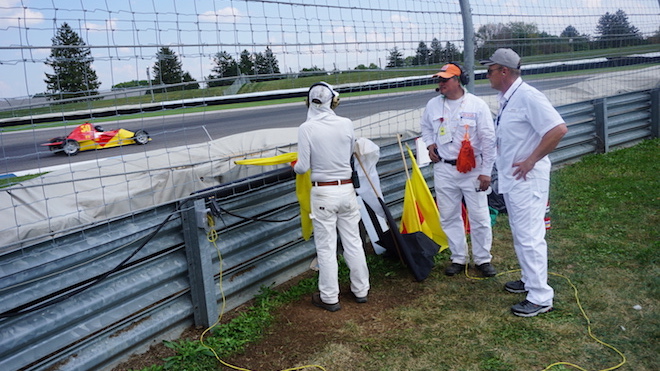
Much has been said about the nearly 1,000 racers coming to the Runoffs, but the event would not be possible if not for the volunteer efforts of hundreds more race workers from SCCA regions all over North America.
The Runoffs race official and specialty worker team includes 119 people working flagging and communications, 20 starters and two start judges, 87 technical inspectors, 42 people in timing and scoring, 23 people working pre-grid, 20 paddock marshals, 16 pit marshals, 26 race administrators, 16 registrars, 11 sound judges, 8 pace car drivers and many more stewards, driver services and emergency fire and rescue workers.
All told, 538 individual volunteers have come to Indianapolis to help make the SCCA Runoffs a reality this year. SCCA simply could not manage an event of this magnitude without their expertise and professionalism.

Latest News
Comments
Comments are disabled until you accept Social Networking Cookies. Update cookie preferences
If the dialog doesn't appear, ad-blockers are often the cause; try disabling yours or see our Social Features Support.