PWC racers grapple with GT3's aero dilemma
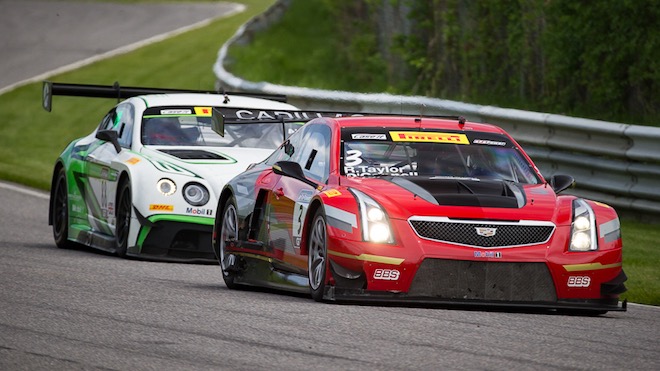
ABOVE: While the aero effect on passing might not be much of an issue in slower corners, it gets more significant as speeds rise.
Each generation of GT3 car seems to get faster and a little wilder looking, following the natural progression of racing in the Pirelli World Challenge. The wings get a little bigger, the ground effects a little more effective, and the cornering speeds increase. But as the lap times drop, often so do the passing opportunities.
As aerodynamics come more into play with GT3 machinery, it gets harder for one car to follow another closely through a fast turn. The air disturbed by the car in front leaves the following car with less downforce on the nose, and that leads to push. The only alternative is for the following car to go offline, which is far from ideal, or back off a bit.
"At Road America, going into the Kink, if there were a few cars in line, the first car would gain four or five car lengths through the Kink because the other cars had to lift so much earlier to slow down enough to get the front to bite," explains Alec Udell, driver of the No. 17 GMG/Euroworld Motorsports Porsche 911 GT3 R (and No. 77 GT3 R with Preston Calvert in SprintX). "Taking the aero off the front of the car is huge. Same thing in the Carousel. You watch someone trying to follow through the Carousel, and they just can't because they don't have the front grip they would if they were driving on their own."
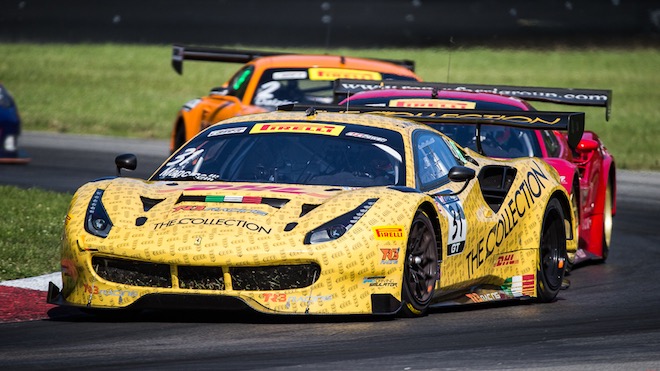
"It's the evolution of racing," says Bryan Sellers, driver of the No. 6 K-PAX McLaren 650S GT3. "The faster you want the cars to be and the more performance you need out of them, the more aero-dependent they become. The more aero-dependent they become, the worse they are in traffic and the harder it is to race."
Of course, everything is relative. For Jordan Taylor, who bounces back and forth between the Cadillac ATS-V.R GT3 that he shares with Michael Cooper and the Konica Minolta Cadillac DPi-V.R that he races with brother Ricky in the IMSA WeatherTech SportsCar Challenge, the aero sensitivity in the GT3 cars is minor.
"The aero disturbance in the prototype is a lot higher, especially depending on which car you're following. If it's a Cadillac prototype, it's not terrible; but if you're following an ORECA or a Ligier, it disturbs the air a lot more. At VIR and at Canadian Tire Motorsports Park [in Pirelli World Challenge] high-speed corners, I didn't think it was too bad. But it is definitely more sensitive than it used to be."
The regular driver of the No. 8 Cadillac, Cooper, comes at it from a different perspective. This is his sophomore season in GT, having previously won championships in GTS and Touring Car. The aerodynamics in a GT3 car are a huge step up from what he was used to.
"I felt [the aero push] pretty much right away last year when we got on a permanent circuit. The bigger the car in front of you, typically the bigger the wash is," he explains. "It makes it difficult to stay close to someone and put a move on someone. I think it hurts a little bit the spectacle of GT3 racing right now, because you end up with a bit of a parade."
The problem is that there's no easy fix. GT3 cars are homologated by the FIA, so Pirelli World Challenge can't dictate changes to reduce downforce. However, the FIA is already taking a look at it.
"They already have guidelines for the manufacturers on reduced downforce and reduced efficiencies, making the cars not so aero sensitive," says Marcus Haselgrove, World Challenge's vice president of Competition and Operations. "I think, although there was initially pushback – the manufacturers want to put out the best car – they realized that within the customer class it's been a blessing and a curse. You can make some amazing racecars, but it also created some situations. They need to find a balance between what the factory wants and producing the right cars that they're selling to the customer."
Haselgrove says that any solutions being discussed in the technical working groups are a ways out, with nothing likely implemented before the 2019 season. Then the trick becomes, he notes, making the reduced-downforce new cars competitive with the current machinery. Would the FIA require that manufacturers produce an evolution of the current cars? That would make a large stock of spares housed by manufacturers and teams suddenly obsolete, another problem altogether.
In the meantime, the drivers and teams in Pirelli World Challenge will just have to make the best of it, drive around the issue and perhaps even make use it in some cases.
"You can drive a little differently to try to stay out of the car's wake, but there are certain corners you can't do that," says Cooper. "You can also use it to your advantage if you're the car in front and you see someone running a different line behind you. You start running the line they're running to take away their front grip. I had to do that to Alvaro [Parente] in Turns 2 and 3 at Barber last year to be able to keep him behind me to win that second race – he was getting pretty close out of that corner before I started doing that. So it's something that can disadvantage you at times, but you can also use to your advantage."

Latest News
Comments
Comments are disabled until you accept Social Networking Cookies. Update cookie preferences
If the dialog doesn't appear, ad-blockers are often the cause; try disabling yours or see our Social Features Support.