Honda, Chevy on same 2018 test plan
IndyCar is conducting its first test of the 2018 universal bodywork. Here's what's happening at Indianapolis Motor Speedway.
***
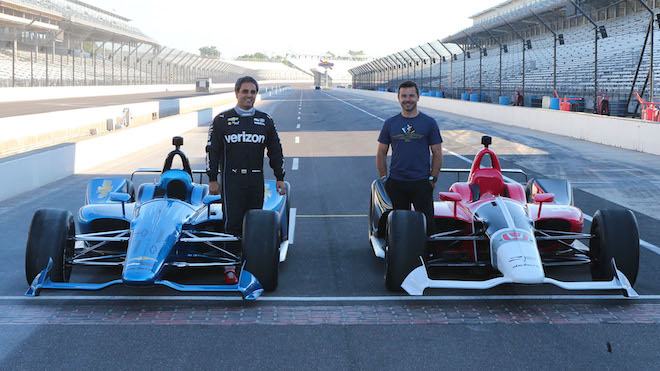
5 p.m. ET: The test day has ended, with IndyCar saying the test plan accomplished all goals and a second day wouldn't be needed. Oriol Servia ran just over 100 laps, and Juan Pablo Montoya closed out the day a bit later after electrical delays in the morning.
***
2:45 p.m. ET: Oriol Servia moved the fast lap to an unofficial 219.0mph just after 2 p.m. and returned to the track to make the first long run of the day. The Spaniard ran approximately a dozen laps while fellow veteran Juan Pablo Montoya sat on pit lane waiting for his next outing. Other than a big lift approaching the apex of Turn 1 toward the end of his stint, Servia looked settled during his run.
1:39 p.m. ET: Beset by electrical issues that kept his Chevy in the garage most of the morning, Juan Pablo Montoya rolled out shortly after the lunch break concluded at 1 p.m. and turned an unofficial top lap of 218.5mph. Oriol Servia followed suit about 30 minutes later with an unofficial 218.9mph lap in his Honda.
***
12:00 p.m. ET: Oriol Servia turned two additional laps at speed in the 216mph range before stopping at the lunch break. The Chevrolet test car has been silent for most of the test, barring a couple of installation laps just after 9 a.m.
***
11:22 a.m. ET: The first hot laps of the day have been turned after a quiet morning filled with installation checks and long periods of down time due to electronic problems. Oriol Servia turned an unofficial best lap of 217.9mph and completed two more laps at speed before pitting.
***
11:15 a.m. ET: IndyCar's plan to evaluate its new 2018 universal speedway bodywork is rather concise. Tino Belli and Bill Pappas, key leaders within IndyCar's competition department that led the 2018 aero project, will oversee the cars run by Schmidt Petersen Motorsports (Honda) and Team Penske (Chevy), and if all goes well, testing will conclude at the end of the day.
Related Stories
"Bill's on the Chevy, I'm on the Honda, and we're essentially on the same plan," Belli told RACER. "We'll start by doing a shakedown, then a Center of Pressure (CoP) check, and once we're confident we've got the CoP right, we'll go out, do a run, and make an adjustment, do another run, and once we're content, we'll fill the cars up with fuel, and do more runs for reliability. We have a set of tires to test for Firestone, we'll do coast-down checks, and if there's no surprises, that's it."
SPM and Team Penske will return to run the cars on Wednesday if IndyCar's test plan is incomplete. With only one flying lap completed during the first two hours of testing Tuesday morning due to electrical gremlins, the odds of a return are becoming more likely.
"You never know with a new kit and new electronics locations, so the second day is a backup," he confirmed. "In a normal environment, this test would be done in three-quarters of a day."
And the@HondaRacing_HPDis off!#INDYCARpic.twitter.com/VMLIubbuPA— IndyCar Series (@IndyCar)July 25, 2017
//platform.twitter.com/widgets.js
Looking at the 2018 superspeedway kit, race engineers at SPM and Team Penske will have few aero items at their disposal to tune the cars.
"Today it's just wing angles," Belli said. "We believe this will be the configuration for Indy next year. We might have a front wicker available for Indy next year. We don't envisage a rear wing wicker for Indy; we envisage one for Pocono. And an alternate front wing wicker for Pocono. So, two front wing wickers for Pocono, and a wicker for the (rear stability) flap at Pocono for higher downforce. The diffuser sidewalls are optional."
As drivers found with the original Dallara DW12 superspeedway kit and again with custom aero kits from Chevy and Honda, removing sidewalls sheds a lot of downforce and a lesser amount of drag in qualifying trim. Belli says the same degree of confidence and talent will be required once time trials begin next May.
"It's brave. It's the same. When we get to qualifying, you're going to need to remove one or more. I think the drivers will earn their money in qualifying," he added.
Having spent time in Honda's simulator lapping IMS with the 2018 bodywork, Oriol Servia came away feeling impressed with the advancements that were made – at least in the virtual testing environment.
"On the sim, the car felt very similar," he told RACER. "In race trim, it was about 1.5mph faster. In qualifying trim, it was slower, but that's what they're targeting. They don't want us to go faster than we're already going in qualifying, but in race trim, at the same downforce number [from the 2017 race], it was faster. I think the big difference will be in traffic.
"With the low engine cover making less drag and the bigger floor making more of the downforce, we should be more stable following cars and that should help passing that we expected. Aside from looks, that part is really impressive."
Servia will get his first taste of the 2018 road course package in testing next Tuesday at Mid-Ohio, and that's where the removal of the rear wheel guards and other hefty items at the back of the DW12 should make drivers much happier.
"They've moved the weight distribution 1.7 percent forward," he said. "It's huge. This year, when you were changing weight distribution [at Indy] to see how it would affect the handling, it was 0.2 percent you'd try. So 1.7 is a huge difference. On the oval, you already set up the car to be that way [with a lot of forward weight bias], so you won't feel it a lot here, but it's going to make a huge difference on road and street courses. That's where it will help immensely. The old car had way too much rear weight. This will be like every other car before it."
Presented by:

Latest News
Comments
Comments are disabled until you accept Social Networking Cookies. Update cookie preferences
If the dialog doesn't appear, ad-blockers are often the cause; try disabling yours or see our Social Features Support.