Excerpt 2: The Living History of VIR, Volume 1
Founding RACER.com Editor and old VIR hand Bill King has written the first volume of the official history of Virginia International Raceway.
Click here
to purchase "The Living History of Virginia International Raceway, Volume 1: The 20th Century" at The RACER Store.Virginia International Raceway was among the early group of American road courses that sprang up in the mid-1950s to fill a growing need for proper circuits for the burgeoning, post-WWII U.S. sports car market. Each venture was driven by a dream, the most common thread being the desire for a convenient venue to test themselves and their "exotic" cars
.
In describing VIR, Sylvia Wilkinson distilled the essence of all of these new racetracks: 'It's your favorite country road in captivity."
A group of enthusiasts in Greensboro, North Carolina, led the effort to create a road circuit in the mid-Atlantic. They found leaseable land in a rolling setting just into Virginia north of Milton, North Carolina. South Bend Farm was soon to be better known as Virginia International Raceway.
The chronicle of VIR's first 18 years forms a microcosm of road racing for the period, not only on the East Coast but across the country, mirroring the evolution of the sport. Many of the players who populated the early road racing ranks took the sport into the professional sphere.
In his foreword, Sam Posey says, "Here is a book that's authentic, rich in detail, and fun to read."
Excerpt 2: From the 1962 Goblin's Go Regional:
Sidebar: Graham Shaw was a genial gentleman from Columbia, S.C., who emerged on the road racing scene the summer of 1962 with a newly purchased Lister-Corvette. Shaw also came with a nickname – "Tombstone" – which he'd acquired during a brief foray into hill climbing the previous fall.
Looking to get in an extra practice run up Chimney Rock right after sun-up, Shaw was unaware that the "CLOSED" sign meant there was a chain across the road which in the early morning light was not sharply defined. A wee late, Shaw applied the brakes on his little Ferrari which he stopped mostly with his head, the chain stretched taut across the bridge of the nose before snapping. Luckily his vision was not affected, but the broken eyebrow and cheek bones left his eyes pointing in unnatural directions, a constant reminder of his near-death encounter. Shaw accepted his new moniker with good humor, although few called him Tombstone to his face.
[fast forward to October 1962]
The Goblin's Go would add to the legacy of interesting racing that marked VIR's early years and particularly 1962. The main players were as unlikely protagonists as you could find – Shaw in his new-to-him metallic blue C Modified Lister-Corvette and Art Tweedale in the quick little G Modified Lola Mk 1 he'd acquired after April's President's Cup weekend.
It wasn't long after the green flag waved that Shaw and Tweedale began rapidly distancing themselves from the rest of the field. Buck Fulp's Ferrari did not threaten. The big Lister would pull the Lola 15 to 20 car lengths down the 7/8th mile backstraight and still have much of that advantage going into the first corner at the end of the pit straight.
Tweedale, the '59 G Mod national champion, used his unquestioned skill and nimble racecar to gobble up the gap by Oak Tree. This scenario played out lap after lap.
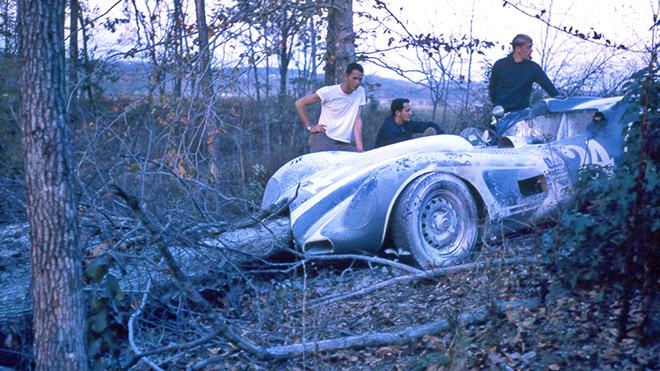
With barely five minutes remaining in the one-hour feature, the Lister's abused brakes faded enough at the end of the backstraight to put Shaw wheels off in the downhill chicane. The maddeningly consistent Tweedale slipped through to the lead which he held all the way to the backstraight. Shaw re-passed the Lola approaching the downhills but left off his braking until very late. That and the already fading binders sent him sailing straight off into the woods where the Lister ate a felled pine tree, rupturing the radiator and filling the immediate vicinity with clouds of steam. Responding quickly, the corner workers doused the Lister with dry chemical thinking it was seriously burning up.
Fortunately, Shaw was uninjured except in the pocketbook, but the race still was not over despite the pair of frontrunners having lapped the field. Tweedale ran out of gas on the ensuing lap, barely making it to the downhill chicane from which he could roll slowly to the pits.
Tweedale's alert crew managed to dump a gallon or so of fuel into the Lola as it crept onto pit road where Art managed to restart it and beat a fast closing Guy Marvin's Lotus XI to the finish line to claim the victory. Shaw's lap count earned him fourth place.

Latest News
Comments
Comments are disabled until you accept Social Networking Cookies. Update cookie preferences
If the dialog doesn't appear, ad-blockers are often the cause; try disabling yours or see our Social Features Support.