SCCA Project Spec Miata, Part 4 – More power
one
,two
andthree
. But in a nutshell, multi-time SCCA autocross national champion Jennifer Isley has her sights on competing at the 2017 SCCA National Championship Runoffs at Indianapolis Motor Speedway – this is the fourth installment of the Spec Miata she's building to make that happen. With that out of the way, lets begin...With much of the required suspension kit installed on her Spec Miata, it was time to find more power. To balance the various years that compete in Spec Miata, and to help control cost, the rules allowances under the hood are kept to a strict minimum – and items like the required SCCA Enterprises restrictor plate for the 1999 variant Isley is building helps keep everything in check.
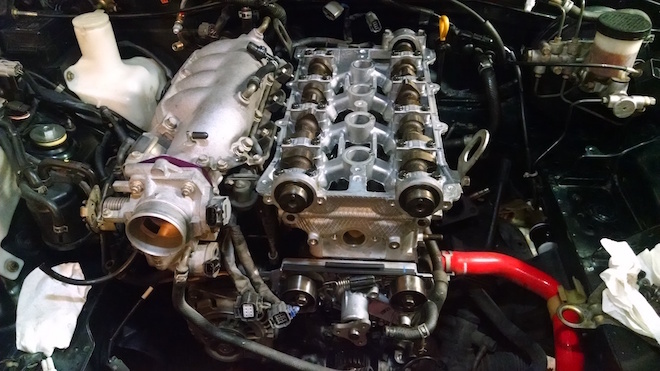
The SCCA General Competition Rules (GCR) includes detailed passages covering engine overbore and cylinder head preparation, both areas that can pep up a Miata, particularly if your donor car has a lot of miles on the clock. Knowing this car had acceptable engine leak-down and compression numbers, Jim Drago of East Street Automotive (who is also a two-time SCCA Spec Miata national champion) was consulted. "Most of the power gains are in the head," Drago revealed when he heard of the health of this particular motor.
The head allowances exist to help correct for casting deficiencies and inconsistencies that occur during cylinder head production – but there's also power to be found there. East Street is happy to rebuild your cylinder head or complete engine, but the company also offers an exchange program that cuts downtime. Replacing a cylinder head is not a job for the meek, with many of the bolts being stubborn to remove thanks to the passage of time. Also, don't rely strictly on the shop manual as there are some time-saving hacks to be found online – like leaving the intake manifold attached to the head during removal rather than trying to find the hidden bolts underneath.
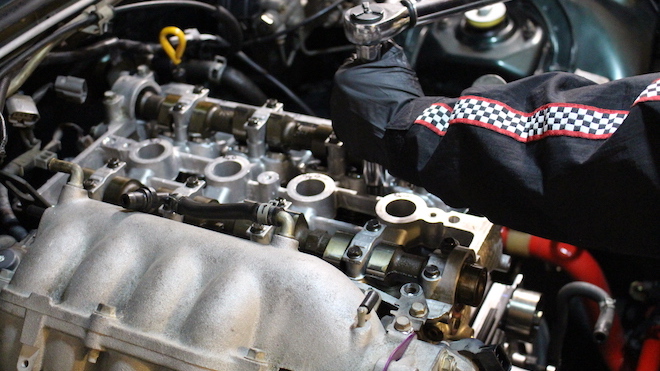
The East Street Spec Miata head came ready to install, complete with camshafts and the crucially important valve lash already set. A little attention to detail, and following some simple prep instructions, helps ensure good results.
"Make sure you clean the tops of the pistons," encourages Drago. "Make sure the head gasket is oriented correctly – there's an oil jet on top of the head, so be sure the gasket is not covering it. Put some new cam seals in it, time it correctly, install per the factory shop manual and you are good to go."
"I was surprised it took nearly an entire day to get the top end torn down, and another day to get it reassembled," says Isley. "While I had the engine compartment torn apart, I took the opportunity to clean it up. I'm certain I removed enough dirt on this 1999 Miata to gain an additional 5hp," she laughs.
If you don't know your car's service history, take advantage of having the engine torn down to take care of other service items, like replacing the timing belt, water pump and other associated bits – and this can also be a great educational tool. "I found the engine work to be interesting as I learned a lot about the various parts and what they do," Isley says, who, like many enthusiasts, knows the basics but has rarely disassembled a motor to this extent. "Installing the timing belt and adjusting the timing was by far the hardest part of the job as I wasn't sure how the whole adjustment process worked – but I knew it had to be right on."
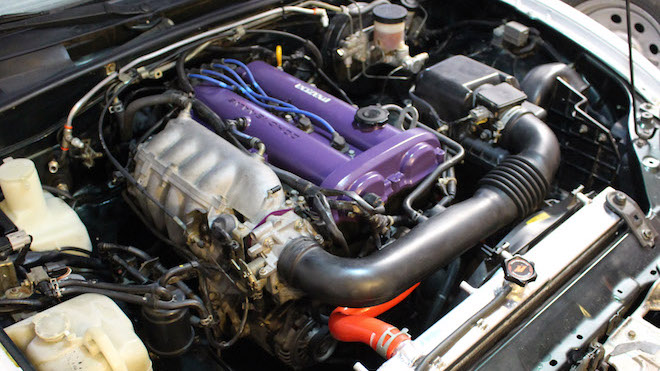
A couple more power adders included maximizing the timing and fuel pressure. To adjust the timing, you are allowed to slot the mounting holes on the OE timing trigger wheel or, as Isley did, you can opt for the adjustable unit from Mazda Motorsports. The trigger wheel is mounted behind the crank pulley, so swapping it during head installation makes sense.
Adjusting fuel pressure allows you to target an ideal air/fuel ratio for maximum power, and this is best done via an adjustable fuel pressure regulator. MiataCage.com offers a comprehensive regulator kit that allows easy fuel pressure tuning.
"This regulator is engineered to work the same way Mazda designed the original system to work, with one regulator, with a return back to the tank," explains Sean Hedrick, owner of MiataCage.com, "This ensures proper regulation of fuel pressure/pulse to the fuel injectors."
The MiataCage.com regulator requires removing the fuel pump assembly to plumb in new lines using the supplied hardware. The regulator tucks neatly away in the trunk, offers a fuel pressure gauge which is easy to read while making adjustments, and also has an output used for taking fuel samples during post-race impound.
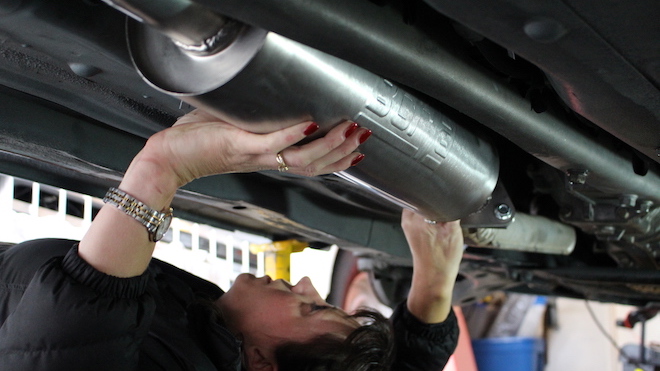
The factory exhaust manifold and its downpipe have to stay in place, but the catalytic converter and everything downstream can be replaced. Borla Exhaust offers a kit specifically for the Spec Miata, eliminating the need to fabricate a pipe to replace the catalytic converter; the fit is excellent, as is the sound. Borla also offers an optional secondary muffler for those racing at tracks with very stringent sound limits, and it can be installed or removed in minutes.
While making more power is fun, engine longevity is also important, so a cooling system upgrade was next. "Since cars in this class spend a lot of time drafting, I figured a bigger radiator would be a good idea," says Isley. "At the same time, I replaced the old, nasty coolant hoses."
Mishimoto offers a direct-fit, aluminum radiator for NB Miatas that improves cooling system efficiency by a reported 30 percent. The radiator features a dual-core design, TIG welded end tanks and a high-pressure radiator cap. A set of Mishimoto silicone hoses accent the radiator nicely and help ensure optimum cooling performance.
"With the front swaybar out of the way, installing the radiator was easy," says Isley. "It fit just like the stock one, and the original cooling fan bolted right up."
Another area to help improve durability and performance is the clutch. The OE clutch disc can be jettisoned for something lighter, helping the car eke out more acceleration. In this case, a unit from Advance Clutch Technology (ACT) was in order. ACT offers a light-yet-durable, four-pad, rigid race disc, and the only SM-legal (and SFI approved) alternative pressure plate.
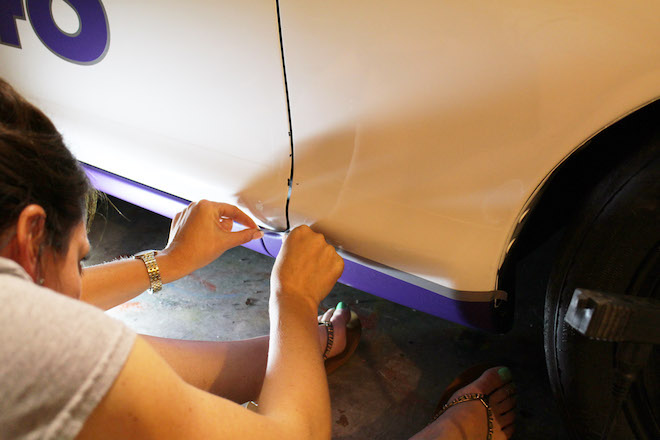
One real challenge with building a Spec Miata is making it stand out on a crowded racetrack, so a little vinyl came to the rescue. Starting with a car that the previous owner had basically repainted "appliance white," Isley had a blank canvas to work with. "I wanted a color that would add some pop and flair," she says. "I chose a vibrant Matte Royal Purple wrap film from 3M, and thought a silver border would look sharp, so I accented it with a 3M stripping tape."
The 3M 1080 Wrap Series Film is available in a rainbow of colors and textures, and is very easy to work with. "I had my numbers and class letters cut from the role of wrap film, and they turned out great," she explains. "Putting the film on the rocker panels and front spoiler was more challenging than anticipated due to the curves of the car, but a heat gun and patience were key. Putting the graphics on the car really got me excited – it meant the car was done."
Nearly done, that is...

Latest News



Comments
Comments are disabled until you accept Social Networking Cookies. Update cookie preferences
If the dialog doesn't appear, ad-blockers are often the cause; try disabling yours or see our Social Features Support.