Rear View LM24: How Tom Kristensen almost wasn’t
A connection between Le Mans legend Tom Kristensen and the wholly unremarkable Walt Disney World Speedway should not exist. But the Dane's link to the old and oft-forgotten Indy Racing League oval is where his incredible career as sports car racing's biggest name got its start. The link is also where one of America's sports car greats saw his professional driving career end.
Rear View LM24: Davy Jones' unwilling sacrifice
Twenty years later, Kristensen's known as "Mr. Le Mans," the nine-time winner of the great 24-hour race. In early 1997, Kristensen was broke, largely anonymous, and unsure where his future was headed. While toiling away in the European F3000 series, dreams of reaching Formula 1 had gone from vaguely possible to outright foolish; prospects of competing in America were slim, and returning to a life of obscurity in Japan, racing as one of a handful of foreigners – gaijins – held limited appeal.
And then Davy Jones crashed while practicing for the Indy Racing League's season opener at the 1.0-mile Walt Disney oval in Florida. The Chicago native, a star in sports cars and open-wheel racing, was coming off an incredible 1996 season where a second-place finish in the Indy 500 was followed by an amazing overall win at the 24 Hours of Le Mans.
As part of the Joest Racing program, Jones, Manuel Reuter and Alexander Wurz took a converted Jaguar XJR-14 with a turbo Porsche engine to victory, and his return trip to defend the win was already sealed. Unconscious against the wall in his Indy car, significant head trauma caused by the impact ensured Jones would spend the rest of the year in rehabilitation. One crash changed two lives in an instant, but only Jones was aware at the time.
As hard as it is to imagine today, Kristensen's name wasn't even close to being atop the list of replacements for Jones. Team owner Reinhold Joest, who would go on to lead Audi's immense mastery of Le Mans with Kristensen as the centerpiece, initially wanted nothing to do with the young open-wheeler.
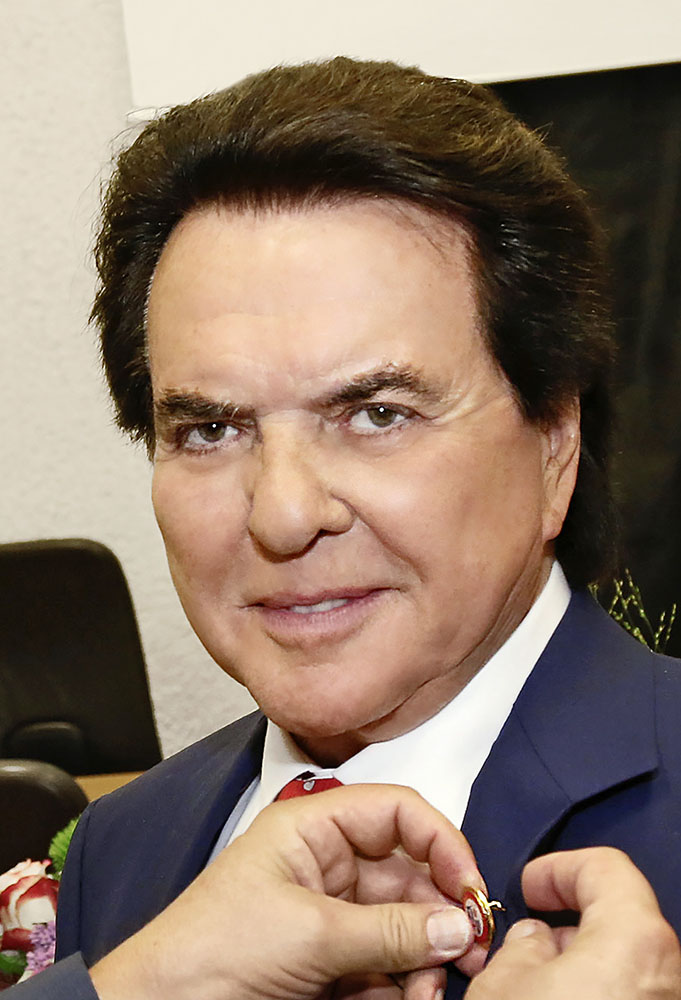
"He phoned several times every day," he said with a look of exasperation. "He called me and called me..."
Within the team, Kristensen had an advocate in Joest's right-hand man, Ralf Juttner. Although his manager wasn't making progress, Juttner was finding ways to walk his boss toward the unproven and unsponsored 29-year-old. Porsche had bankrolled the team's 1996 win, but that changed for 1997, which meant Joest was faced with a serious dilemma.
"Every evening, when everybody was gone, we would sit in his office and [Joest] would say, 'We need the money. We don't have the budget, we need the money,'" Juttner said. "I would say, 'Yes, but we won't win if we take a slow guy with money.' The next day, it was the other way around. Then he would say, 'Yeah, but we can't take him because we need that sponsorship...' It was going around like this for weeks."
If we look past his need for funding, which Kristensen didn't have, Joest's greatest concern wasn't on Kristensen's date of birth; the total lack of Le Mans experience was the lingering issue for the German team. A third party – a tiebreaker – helped Joest across the decision-making finish line.
"At the end of the day, it was 'Dominguez,' a good friend of Mr. Joest, who called me and said, 'What do you want? Experience? You don't need experience. At night, the old drivers, they can't see anything. The younger guys, they are used to that, they come from the disco at 3 o'clock in the morning,'" Juttner said. "It was funny."
With his team manager and his friend Dominguez refusing to back down, Joest recalls abandoning his first choice, the funded-but-underwhelming Spaniard Jesus Pareja, after finally accepting to meet with Kristensen.
"Once I had a chance to speak with Ralf, I said, OK, he can come and we will see him and talk," he added. "Then he came, a young boy, and then at the end of maybe two hours' time we said, OK, we will take the risk and give him the chance."
Although Joest was apathetic until the very last moment, Juttner had kept an eye on the young prospect and knew what they were getting.
"His versatility is quite astonishing," he said. "A lot of people talk about his nine Le Mans wins, but very easily forget that he was very good in DTM. He was good in Formula 3, he was good in Super Touring cars, he was good in Formula 3000. That was what he was doing when we met first in '97 and I saw he is one of the very few who were able to really step from one car to the other and be on the top level in completely different machines."
As it turns out, the key talent Juttner spotted within Kristensen had become a point of pride within his new driver.
"I considered being a race driver a proper job, so it was very good that people asked me to drive different things," Kristensen said. "I jumped at it with no second thought in the sense that I enjoyed racing. Of course, it helped me doing the different disciplines, front-wheel drive, rear-wheel drive, powerful, narrow tires, wide tires, whatever. Everything. It helped me.
"When I was in Japan is when it started. It was basically three-day weekends completely filled with racing different cars, which was good, giving me experience. At the same time, I could prove to my mom that I was making a living at being a racecar driver! That is how it sort of started. I loved being versatile. The other thing is having a little bit of fun and a little bit of adventure into your racing life as well."
Kristensen's adaptability would be put to the test as Le Mans approached. The need to replace Jones was known for months, but with the back-and-forth between Joest and Juttner on funded or fast drivers taking far longer than expected, a contract wasn't completed until a precariously late date.
"He joined us just a week before the race," Juttner said. "He came to our shop that Friday before the race ... the trucks were already gone, they were on the way to Le Mans, so he didn't know any of the team, he did know the car. Of course, he did not know the track..."
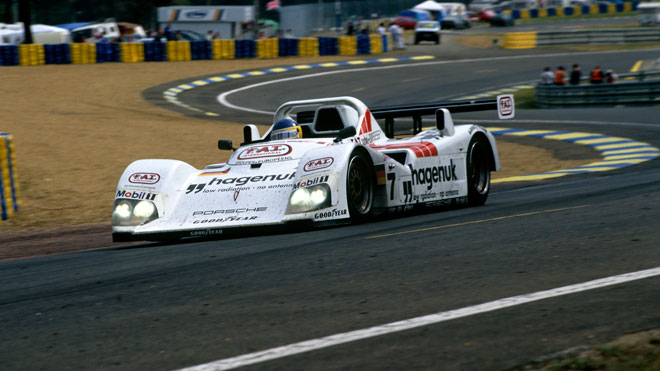
On the ensuing trip from Germany to France, Kristensen was treated to an unexpected revelation on how he was apparently destined to drive the No. 7 Joest Racing TWR Porsche WSC-95.
"It was nice in the airplane down to Le Mans," he said. "Reinhold Joest was in the plane sitting in the front with his copilot. He flies himself, obviously, with his copilot. I was with his wife, in the back. Lady Joest, at one stage, she goes, 'Reinhold, he really likes car 7. That is good that you come as a debutante to Le Mans in car 7. Then I mentioned I was born 7-7-67. And she was screaming! In the cockpit, I remember Reinhold was looking back to [see] what was going on. I guess that was a good omen. That is how it started."
Fortunately for Kristensen, Joest's vast experience at Le Mans driving a Ford GT40 and Porsches ranging from 911s to 917s also provided an educational foundation at La Sarthe.
"I said, 'Tom, when we're at Le Mans, I will show you the track and the tricks because I have many kilometers here,'" he said. "We spent a half a day together and went point for point and corner for corner. Then when he drove the first lap I said, 'Tom, you have all the time in the world. Take your time. Go step-by-step.'"
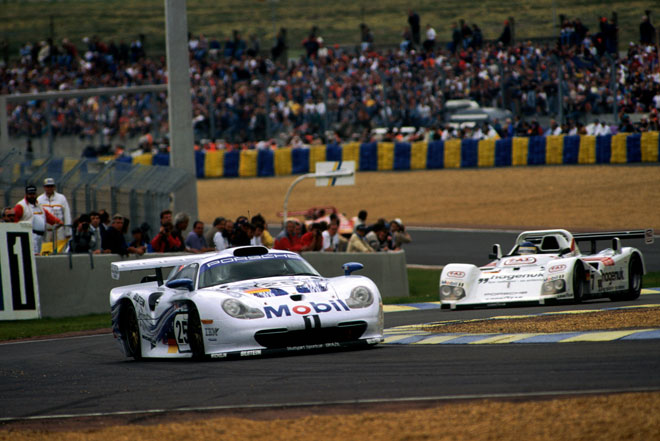
For Johansson (pictured, left), a Joest veteran dating back to the 1983 Le Mans race, welcoming Kristensen into the fold was easy.
"I knew Tom a little bit before Le Mans as well, obviously, partly him being Danish and me Swedish. It was a little bit more than a normal connection, I suppose," he said. "When the opportunity came up, of course, he was the new kid on the block because he didn't really have any experience in sports cars at that point.
"Me and Michele, obviously we were keen to try to help them along as quick as we could. I mean, it didn't take long for him to get acclimatized. Everybody knew he was already a fantastic driver with his record before he came to Le Mans and various categories of race he had done up until then, Formula 3000 and what have you."
Johansson took an even greater liking to him once practice got under way.
"He fit right in. He's a great guy anyway. There's no big ego or any agenda or anything. He is just a pure, hard-core racer, much like myself and Michele was," he said. "Just enjoyed racing without any major personal agendas. Right away it was a great driver combination and we all more or less liked the same setup on the car, and doing the same kind of speed. It worked out great from the very beginning."
Joest had two peerless drivers to lead the No. 7 at Le Mans, and then he had his rookie who was in the middle of his second season in F3000. While Alboreto and Johansson were solely focused on the big endurance race about to take place, Kristensen was logging more air miles in order to meet pre-existing open-wheel commitments. As the start of Saturday's 24-hour event approached, Joest's most inexperienced driver was woefully short on miles around the daunting 8.5-mile circuit.
"Doing 17 laps before I actually [got] in the car in the race, it was a very stressful week," said the master of understatement. "I mean, I had to fly to the Formula 3000 test between [Le Mans practice] Wednesday and Thursday. Thursday morning I was in Austria [for the test] and then coming back and doing my night laps ... 17 laps, and, you know, there was no simulator running at the time. There was hardly any data. There was no [computer] systems like they have today. It was very difficult to have no data to learn. It was my own experience and then from what Michele and Johansson said. It was different."
The No. 7 TWR-Porsche entry would earn pole position and set the fastest race of the lap on the way to a somewhat narrow victory. Joest's decision to take talent over cash was rewarded, but then there was that fastest lap... Twenty years later, it remains the one blemish on Kristensen's performance.
"From the beginning, he did an excellent job," Joest said. "He was careful and so on. But in the morning, I think it was about 3:30, it was his turn was coming and he jumped in the car. After the third lap, he did the fastest lap time at Le Mans and I said, 'Hey, no, no, no, that's not allowed. OK?' This was in the beginning of his experience and also a risk... But the end was excellent, what he delivered on the cleverness and feeling and speed, of course."
Prior to the admonishment, Kristensen enjoyed dipping into the throttle to get a feel for the potential of the open-top prototype.
"For sure it was a great, great relief to be fast during the night and coming into the sunrise and then doing the lap record and the fastest lap of the race," he said. "And then I was asked to do four stints. That is something unique. For sure, a foundation of my career at Le Mans. There's no doubt about that."
With his first Le Mans win in hand, that quadruple-stint performance would become a regular part of the arsenal in the decades that followed. Kristensen, the iron man, blindingly fast and precise for hours on end, would add six more wins in rapid succession from 2000-'06, another in 2008, and a final victory in 2013. Retirement following the 2014 season would close an era that will never be duplicated.
"I am just enjoying my time," Kristensen said of life outside the cockpit. "I think I really found the right time to make sure that I have a good future. I will miss it, but it is nice to be asked, 'Why have you stopped,' instead of, 'Maybe you should have stopped...'"
Closing the loop on Kristensen's first win in 1997, Johansson couldn't help but laugh at how far Mr. Le Mans has come since his debut.
"He's got a terrific sense of humor – it's sort of a bit mischievous and tongue-in-cheek," he said. "I remember after we won the race, within an hour, Reinhold's gone, Michele's gone, and me and Tom were sitting on our own, back at this little frickin' hotel, whatever they call those cheesy-ass hotels in France with nothing more than a shower and a bed. And we couldn't even get any food.
"We had this nasty old ham and cheese sandwich. That is all we could get our hands on. And we were sitting there like, is this it? We just won the f••••••g 24 Hours and we're sitting here nibbling away at a ham and cheese sandwich and a Coca-Cola? We just laughed at each other. This is ridiculous. We just won the biggest race in the world and we can't even get a fricking meal together!"

Latest News
Comments
Comments are disabled until you accept Social Networking Cookies. Update cookie preferences
If the dialog doesn't appear, ad-blockers are often the cause; try disabling yours or see our Social Features Support.