INTERVIEW: The court of King Kenny
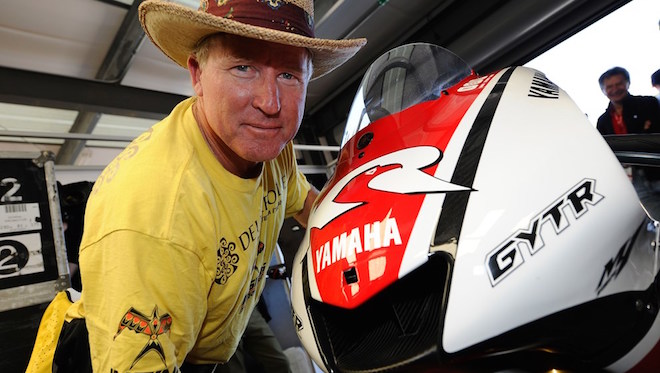
The day after the memorial service held for Nicky Hayden in Owensboro, Kentucky, this writer tracked down three-time 500cc World Champion Kenny Roberts, the man who, for all intents and purposes, established America as a motorcycle racing a global superpower
"Nicky Hayden was a racer," reflected Roberts of the 2006 MotoGP World Champion, who passed away on May 22, 2017 from injuries suffered in a tragic bicycle accident in Italy. "He raced dirt track, he raced anything with two wheels. That's what he lived for. It never ceased to amaze me, that kind of drive he had to do it. Nicky never wavered on any of that stuff. It's what he was born to do.
"I remember welcoming him into the club the day after he won the World Championship in '06. It's a very small club of Americans who are champions."
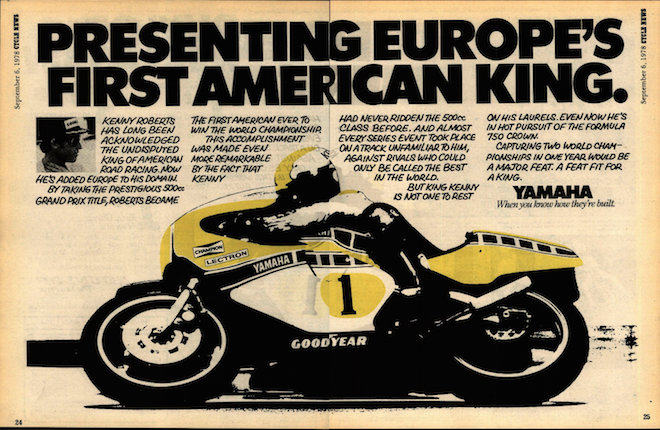
If there is anyone in this nation that knows about beating the world, it's "King" Kenny Roberts. Looking for a new challenge after running roughshod over the AMA Grand National Championship during the mid-1970s, Roberts made a decision to fly across the Atlantic to make a run at the 1978 500cc World Championship.
"I did not want to go to Europe – I wanted to win the 500cc World Championship," Roberts once said. "Most people said I couldn't. The 500 was the class. It was the ultimate thing to win if you were a road racer. I basically went to Europe to win it."
And with his dirt track-influenced rear wheel-sliding style, Roberts gracefully maneuvered the 500cc beasts he mastered through the well-worn corners of the world's great racetracks, and in the span of three years, won three consecutive 500c titles, and revolutionized the sport of road racing in the process.
Q: There has not been an American MotoGP World Champion since the late Nicky Hayden made it happen back in 2006. As far as road racing talent in the United States is concerned, where are we at right now?
KENNY ROBERTS: Well, unfortunately we disbanded the whole depth zone to do that, and the team involvement now is following money more than following young talent. The world changes, and we just didn't change with it. It's going to be a while. Somebody is going to have to pick out that special kid and then have a team and a stepping stone that myself and other people had at one time. There are going to be more Nickys, there is going to be more Kennys. It's just finding the recipe. If we want bad enough, we'll get it. If we don't want it bad enough, we'll settle for football and baseball.
Q: What's your take on 2017-spec MotoGP?
KR: Well, it couldn't be better. As far as a talent pool right now, it couldn't be better unless you're a newcomer. That's where it stops. All the factory bikes are taken. Sometimes it just involves talent, and until you can get the young talent somewhere where they can be seen as a young American, it's going to be kind of a struggle.
But the talent level now at the top, I mean, you can't say it's ever been better. You know, it was me and Barry Sheene at one time, and then [Freddie] Spencer and Eddie [Lawson] came up, and Wayne [Rainey] dominated, and there was [Kevin] Schwantz. Now you've got four or five guys that are capable of winning a race. The four-strokes, I think, made that a little easier at times, but also a little harder because it's so expensive now. It's not like they can take a 500 now and make it competitive.
Q: Who sticks out to you right now? Is there a racer on the MotoGP grid who, perhaps more than the others, reminds you of yourself back in the late 1970s?
KR: Maverick [Vinales]. Maverick has obviously set the bar up a little bit. He's on the right bike at the right time, and it's going to be hard for someone to take him out of that seat. And then you've got [Marc] Marquez. I mean, he's riding the wheels of the Honda. I think he struggles with the front end of that thing quite often, and if they can get back to getting that right, he's going to be a player. That guy rides 120 percent, no matter where he's at or what it is. That's good and bad. He's won three world championships, and it's not easy to do that.
Q: How about Valentino Rossi?
KR: Valentino is amazing. You have to look at the guy and go, "How do you do that?" I saw him at Austin and said, "Dude, how are you doing this? You know there is life after motorcycle racing." He said to me, "I don't what I'm going to do after that!".
It's amazing to see the kind of longevity the guy has had, you know? How does he get up every morning and go, "Okay, I'm going to be faster than everybody else." How does he do that for so long? And it looks like he's settling in well not being the fastest guy, to be honest. I don't know. I've never been in that position. I can't say anything about the longevity of what makes him tick and what makes him go out there and do what he does. You have to take your hat off to the guy. He's there all the time, and could very well walk away with this championship.
Q: When you first went over to Europe in 1978, were you ever intimidated? Even four decades later it seems extraordinary that were able to show up there and defeat everyone.
KR: Well, I think it started when I was younger. I was a horse guy, and I worked for this other guy after school. I had this little Shetland pony and he entered me in the Turlock Fair as American Saddlebred, which means that you drop with the horse and stop with it and all this other stuff. I had no idea of what I was in for. So they told me to go to stall 14. So I went to stall 14 and all these girls has big Quarter Horses and I had this little pony and they started snickering at me. And that's kind of what I felt in Europe – the kind of snickered at me over there.
It started then, and of course my veins popped out on my neck and that made me kick everybody's butt. They couldn't stop me. That horse deal reminded me of going to Europe that first time. It all came from that. It was like, "Hey, I'm here, I'm going to win and nothing is going to stop me." That was my attitude. For some reason, I never doubted my ability to ride a motorcycle. Whether I was the fastest that day or not, I never doubted my ability and that I would be the fastest guy on that motorcycle that day. And a couple of times, when things were just bad and when we were going through the development of the bike and stuff, I'd just never give up.
I just rode motorcycles my whole life. I emulated people. I emulated Mert [Lawwill]. I could ride like Mert, I could ride like Dick Mann, and I could ride like Cal Rayborn. That's just what I did. I did that every day. That whole section of my life was dedicated and imitated to being the best on a motorcycle. They tried to intimidate me for being an Okie from Muskogee, which is what they first nicknamed me - until the Spanish and the Italians named me "Martian" because they said I didn't come from this Earth because nobody could keep up with me.
I really didn't have any doubts. You know, this is what I was made for. I probably wouldn't have won the world championship the first year I went without having that 100 percent belief that I was going to be the fastest guy on the racetrack. And if I wasn't, why? There had to be a reason why I wasn't the fastest guy.
Q: Any recollections that really stand out from that period of time in your career?
KR: Just flicking the bike in sideways without shutting off is something special. There were times... there was the Imola racetrack that had this big fifth gear corner where [Ayrton] Senna was killed, and in qualifying in 1983 I took that corner in sixth gear. I told a few people I took that thing in sixth gear and they thought I was kidding. It was so close to the edge that I could feel the front tire trying to push off the track. And if that would have happened, I was dead. I took that thing in sixth gear, knee on the ground, just barely on the throttle, was something special.
Things like that turned me on. Those are the little things that I don't forget. I mean, I forgot a lot of stuff, but there are those little things that I don't forget. Like at Silverstone in '79, when I beat Barry the last time. I went through the corner before the last straight flat, and he couldn't do that. I knew that was my advantage, and I never showed him. I slowed down just enough before I got there to where I could take that thing flat to give me three bike lengths, and he couldn't pass me going down that straightaway. Had I not been able to do that, he would have caught me and passed me easily. It's just little things like that that you remember. That was special. That was something that nobody else that day could have done. That's kind of what drove me a lot of the time.
Q: It sounds like these moments you just spoke of mean more to you than a trophy, or even a GP win.
KR: Oh, yeah. Trophies, to me, didn't mean much. As a matter of fact, I'd give most of them away. I think it was the same thing for Nicky, and for my son, Kenny Junior. They just remembered highlights. They had that drive. They would think, "How could I emulate that and use it here? What do I have to do that's going to be special and above anybody else on this racetrack? What can I do where the other riders will say, 'Man, I can't believe you did that.'
That's what drove them and that's what drove me. It wasn't the press or how much money I made, it was the riders saying, "Man, I can't believe you did that." That was how I judged my talent – not [from] reading the newspapers. We didn't have internet then, thank God.
Q: How tight were you with Barry Sheene?
KR: We were good friends. We were very good friends to start with. We were as good as friends as we could be. You know, you're racing against that guy. You're only friendly with that guy to the point where you say, "Oh, that's bulls**t." You always had to be on your guard. You'd listen to what he said, and you'd put that in the computer,and let it rattle around and say, "That's bulls**t. I'm not listening to that."
There was a lot of stuff like that. In the papers, I couldn't wait to see what he said about me and if I said something about him. But if we got together after the race, we were fine. It was a rivalry, and of course we hated each other, but we respected each other's ability to ride a motorcycle. I could give him an inch and he'd give me an inch. Like he said, I was one of the guys he could trust every time to do the right thing. And I had that respect for him.
How fulfilling was it for you when your son Kenny Jr. won the World Championship in 2000?
KR: It was kind of like winning the World Championship. You can't explain it. The amount of pressure that was on that kid's back when he wasn't winning the championship on my motorcycles... He got frustrated, but he would never give up and he just kept going and kept going. He never complained. He never said, "This bike is crap. I need a better bike." He just kept going, and he won the World Championship. The whole thing was magical, and it just sticks out in my brain as something that needs a movie, really.

Latest News
Comments
Comments are disabled until you accept Social Networking Cookies. Update cookie preferences
If the dialog doesn't appear, ad-blockers are often the cause; try disabling yours or see our Social Features Support.
.jpg?environment=live)