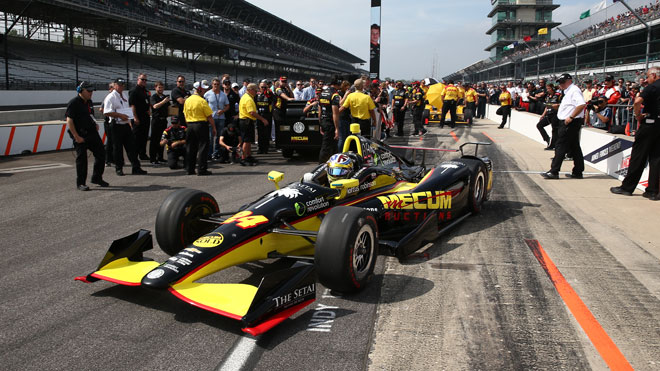
How Dreyer & Reinbold thrives as Indy part-timer
Eleventh, ninth, 14th, bang.
That last part was a bummer: during last year's race, Josef Newgarden checked up, Townsend Bell and Sage Karam went around him, Karam misjudged his line and found the wall. Just another entry on a 101-race-old list of reminders that the Speedway charges a heavy price for tiny misjudgements.
But on the whole, going part-time in 2013 hasn't stopped Dreyer & Reinbold Racing from performing pretty well against its full-time rivals when it rolls up at the Brickyard every May.
In an era defined by deep fields, smart teams and relative parity of equipment, conventional wisdom holds that the Speedway is a place that rewards experience. But if that's the case, how does a once-a-year team with only one car manage to compete with the regulars year after year?
"Doing Indy now is a little different [to when the team was full-time, between 2000 and 2012]," says co-owner Dennis Reinbold (pictured). "But we get up to speed pretty quickly, and get back into the groove pretty fast. We've had 36 cars in the Indy 500 over the years, so our familiarity is pretty good. We have basically all of our full-time guys that have been with us for quite a while still here, so that makes a difference. We don't show up with unproven people, so we know what to do.
"We're able to keep them pretty steady because we do Red Bull Global RallyCross, so we look at it as a full-time team, even though we're not doing a lot of the other [IndyCar] events."
It's difficult to overstate the value of that continuity, but the advantages of turning up at the Speedway with a well-drilled crew that knows how to work together are probably best illustrated by an insight into what it's like to try to compete without one. Larry Curry started recruiting for the Harding Racing program months ago, but last year, when he was running the hastily-assembled Lazier Partners entry, team personnel were changing on an almost day-to-day basis.
"That's very, very hard," he says. "Last year with the Lazier deal, I was the constant that was there every day; I had different guys working on the cars every couple of days. And that was challenging, to be polite."
For DRR though, continuity extends all the way into the cockpit, which has been occupied by Karam for three of the past four years. (Bell stepped in for the 2015 race, when Karam was with Ganassi).
"We have a lot of confidence in Sage, and he has a lot of familiarity with us," says Reinbold. "So we're not starting form scratch there. We're hopefully picking up where we left off. So we have trust in our driver, we have total trust in our crew because they've been there for such a long time. So we can get to the track and just start from where we were last year, and then work on improving further."
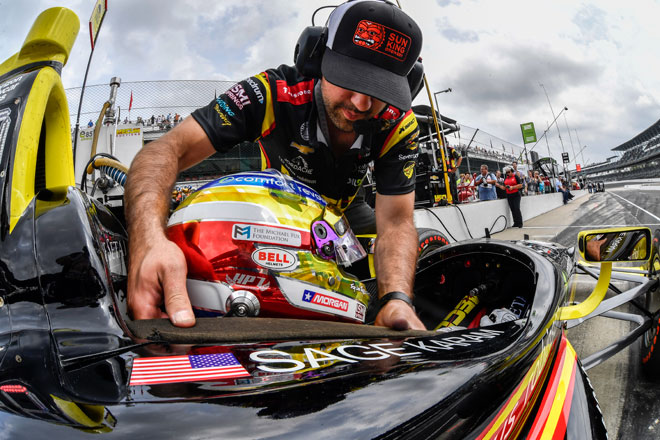
"We take that very seriously," says Reinbold. "In the last five years we got to the finals of the pit stop competition twice, and we got to the semi-finals twice, so we stay at it. And we've gained some nice spots during races because of [pit stops]."
Perhaps surprisingly, another area that poses relatively little concern is making the numbers add up. Reinbold makes the point that the Indy 500 forms the centerpiece of sponsorship proposals from many full-time teams, so in a sense, he's selling a similar promotional opportunity, but without having to absorb the expense of contesting the full schedule.
"Indy is the biggest sporting event in the world," he says. "I can't speak for others but we've been successful at selling sponsorship. We've got a lot of good sponsors – Mecum Auctions is obviously our primary sponsor, and several other people that have been with us for multiple years now. We'd like to try to make it like, if we do a good enough job and get them excited enough, we can make a call after this year's race and hopefully have them on board for next year.
"I think, due to the size of this event, it makes a lot of sense. I know full-time teams try to anchor their entire season – as I did before – as the bulk of the product that you're selling. It's a special place, and it's a big, big event that's so fun to be a part of that we've had good success in selling it."
Good success at selling, and a solid record of backing it up when things get real on Memorial Day weekend. In IndyCar terms, Dreyer & Reinbold is a part-time team – but it goes into the 500 with the same aim as the regulars.
"We're going there to win the race," says Reinbold. "That's the only reason we're showing up. We want to win that race.
"I'm not intimidated or scared or anything about what we have to do to go there and win. We just have to have everything fall our way to make it happen, and I think it's a very real possibility that a one-off team like us can go in there and take a win."

Latest News
Comments
Comments are disabled until you accept Social Networking Cookies. Update cookie preferences
If the dialog doesn't appear, ad-blockers are often the cause; try disabling yours or see our Social Features Support.
