Rear View: Jeff Andretti's life-changing 1992 500
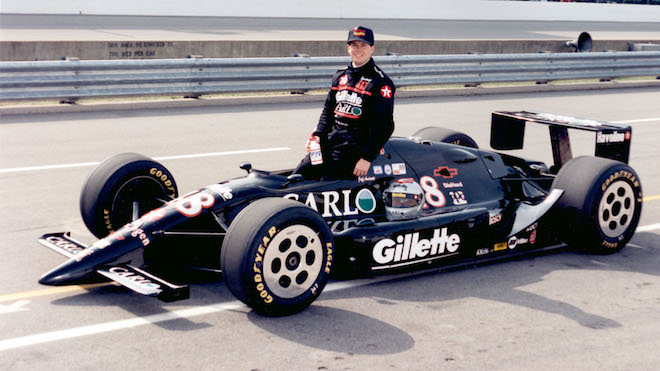
Jeff Andretti's life was changed forever at the 1992 Indy 500. Mario's youngest son, making his third start at the Speedway, suffered troubling injuries in a Turn 2 crash that flattened the front of his A.J. Foyt Racing Lola-Chevy.
With badly broken feet and ankles to free from the tattered, shortened chassis, it took 18 excruciating minutes to remove Andretti from the car and clean up the debris field. Remembered for unreasonably high number of crashes – 13 in total – caused in part by the frigid temperatures, Andretti's accident was the heavy counterweight that balanced the cheer and celebration that came with Al Unser Jr.'s first Indy 500 win.
"Well, to look back to that day and stuff, it just was a dark day for motorsports," Andretti said of the 25-year-old race. "It was bright for one individual and it was dark for a lot of others. But it's one of those years where, I guess you could say we learned a lot about safety with our cars. We knew that, obviously, there was an issue that we were overlooking as far as safety of the car."
A lot of drivers spun and crashed, including Jeff's father, but his accident was due to a mechanical failure. While it might not matter, considering the end result and physical damage that followed, at least Andretti knows his life-altering incident wasn't because he made a driving mistake.
"Yeah, we had a hub cage crack and come apart and the wheel just came completely off the car on entry to [Turn] 2," he said. "But, things happen. Parts break on cars, those are things that you can't foresee, they just happen. Again, that comes down to the danger that we accept in the sport, that stuff's going to break. Unfortunately, I was on the rear end of that stick, where the hubs broke on me, and I guess it writes itself after that."
Carbon fiber tubs were a vast improvement for driver safety in the early 1990s, but it took crashes like Andretti's to reinforce the need for rapid advancements in frontal impact resistance.
"The front of the cars were not as safe as we probably could have had them," he continued. "But, again, it's one of those things where, in those days, we were all about trying to keep the cars light and aerodynamic and everything. So they were getting away from the safety aspect of the cars and not even thinking about it because things weren't happening."
Searching for the only positive from the crash, Andretti says his pain helped – in small part – to advance the state of the art with open-wheel tub design.
"All of a sudden '92 happens and we got the feet injuries," he added. "Again, I try to put a positive spin on a negative. The good that came out of it is the fact that we changed the cars and made the cars safer, so other drivers don't ever have to experience what we've gone through."
The severity of Andretti's crash was enough to question whether he'd return to the cockpit. Of all the achievements in his somewhat brief career, fighting through the agony of rehabilitation allowed Andretti to make the Indy 500 grid in 1993.
"Oh yeah, I mean I worked my butt off to get back into the seat again," he said. "The first thing out of my mouth to Dr. Trammel was, 'Am I going to walk again?' 'Yes.' The next thing out of my mouth is, 'Well, when can I get back in the seat?' He said, 'Well, it's up to you.' When he said it's up to me, guess what? I accepted the challenge and I challenged myself and found I actually had an inner strength that I didn't even know I had. I fought really long and hard, and was able to come back to the speedway and be able to compete again at the level that I needed to."
Three-time Formula 1 world champion Nelson Piquet was the first to record the kind of crash that Andretti encountered in 1992. The Brazilian's accident came earlier in the month during practice, and with an uncommon bond bringing them together, Andretti was able to inspire his rival to make the same comeback in 1993.
"The cool part about that was I was able to get Nelson Piquet to come back too," he said. "Because him and I got hurt the same year, and I, in some way, gave him an extra push. Because he was going to call it quits in his career and I said, Absolutely not. I'm not going to have this three-time world champion call it quits over this, I said, 'You're going to come back to the speedway just like I am. We're going to compete here.' I'll be darned if we didn't do it. We sat down after the race and said, 'Yeah we did, didn't we? Yep, we managed to do it.'"
Andretti started 16th and finished 29th in his final 500 appearance, and went on to race sports cars and stock cars before hanging up his helmet at the end of the decade. He's stayed close to racing with driving education and racing-related marketing and youth education initiatives taking up most of his time these days.
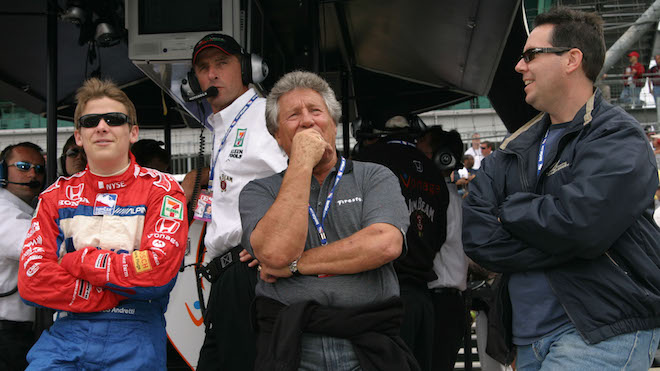
"We've created an online streaming television program called Andretti's FASTTRACK TV that's tied to S.T.E.A.M. education curriculum, that's actually used in the classroom around the country," he said. "We're going to start with middle-schoolers, but then we're going to be able to focus on high-school kids, middle-school kids, even down to the elementary level."
His IndyCar career was cut short, but you won't find a hint of bitterness in his voice when he recounts the 1992 Indy 500. Like the rest of his family, Jeff Andretti lives to fight.
"It just shows you that determination does pay off," he said. "If [there's] any message I could send to people, it's perseverance does pay off."
Listen to Andretti's full interview below.

Latest News
Comments
Comments are disabled until you accept Social Networking Cookies. Update cookie preferences
If the dialog doesn't appear, ad-blockers are often the cause; try disabling yours or see our Social Features Support.