Rear View: Goodyear's cruel '92 Indy 500 finish
It took many years for Scott Goodyear to fully appreciate his role in producing the closest finish in Indy 500 history.
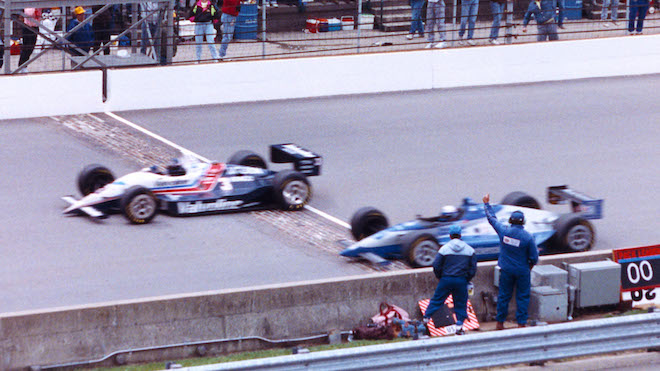
The 1992 runner-up, forever remembered for coming home 0.043 seconds behind Al Unser Jr., was too busy in the cockpit of his Walker Racing Lola-Chevy to understand that ABC's "Wide World of Sports" intro – the famed "Thrill of victory and the agony of defeat"– had come to life in the sprint to the finish line.
"At the time, I couldn't understand all the fuss, that everybody was thinking how cool it was back then," Goodyear said ahead of the race's 25th anniversary. "It was just non-stop ... I finished second. I lost. Like, why is everybody excited about this? I couldn't grasp hold of that."
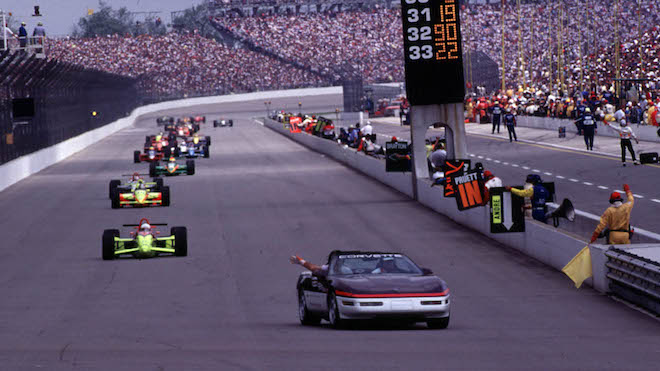
Going through the near-win process on two more occasions actually helped the genial Canadian to reconcile the 1992 finish. He was leading, moments from victory in 1995 when he passed the pace car on a restart and was later disqualified for failing to serve a penalty for the infraction. And in 1997, in a similar situation to 1992, he was dealt another cruel blow when his teammate Arie Luyendyk made a late pass for the win in 1997.
"And then many different scenarios happened over time to actually make me realize that, 'Hey, this is OK; this is pretty cool,'" he said. "I say that and I walk in tonight and I'm going for mail and opening some fan mail stuff that sits here. And there's stuff in there from 1992, the closest finish. There always is.
"To this day I still get 50 percent of fan mail for 1992, so that's incredible. For me, it absolutely has turned into being a life-changing moment. I guess it's become a little bit of my legacy in the sense of being second a couple times. Well, between '92 and '95 and '97."
If there's one truly amazing aspect to consider with Goodyear's prowess at the Indianapolis Motor Speedway, it's this: The 1992 Indy 500 was the 12th oval race of his career.
Trained in the art of road racing at home and in the United States, Goodyear honed his craft in the SCCA Formula Atlantic series – a precursor to today's Indy Lights championship – where he won the Eastern division championship in 1986. Unlike the rival SCCA Super Vee series, Atlantics shied away from ovals, which left Goodyear as an IndyCar hopeful with a big hole in his open-wheel development.
In a scenario identical to what Spencer Pigot has today with Ed Carpenter Racing, Goodyear entered the CART IndyCar series in 1987 as a part-time road and street course specialist. It wasn't until his first full season in 1990 that learning the art of oval driving was offered.
"I started racing ovals when I got to Indy cars," he said. "My first real oval experience was in an Indy car at Phoenix."
There was nothing to suggest Goodyear was destined for oval greatness at the end of his first test with O'Donnell Racing, a satellite team to Arie Luyendyk's Shierson Racing program, but he did learn one invaluable item before flying home.
"So after the first day I thought [I was doing OK]; I didn't know how far away I was from Arie, probably a half-second," he said. "I clearly remember the next day I got out and it was probably past 10 o'clock in the morning. I had understeer at [Turn] 1 and 2 and tried to cowboy the thing around. Promptly had the back end step out from underneath me and I busted into a wall and knocked myself out and made the car so it wasn't running anymore for the day.
"After that I thought, 'I am going to understand what these oval cars need, because I clearly can't overdrive it.' And really just started to program it. I tried to learn how to make these things work."
Known for his intelligence and fastidious ways, Goodyear treated oval driving like a problem to solve and found most of the answers that were missing at the Phoenix test. He'd return for the 1990 season opener at the one-mile oval and finish an impressive 10th.
Goodyear's second oval race – the Indy 500 – delivered another 10th-place finish. In fact, he finished 10th at each of the five ovals in the calendar that year using a year-old Lola chassis and second-tier Judd engines. Although Unser Jr. had grown up racing on ovals and carried vast experience into the 1992 showdown, it's fair to say Goodyear was something of an oval prodigy. A lack of oval mileage was the only thing his natural talent could not overcome leading up to lap 200.
"You know, Indy in '92, I had been to how many ovals in that time? Probably 12 in my life," he said. "And Al Jr. doing all his stuff in Super Vee and ovals. I think his [Indy 500] rookie year there was in 1983. So clearly, I didn't have the experience to be able to compete with Unser and Unser legacy – and especially Al Jr.
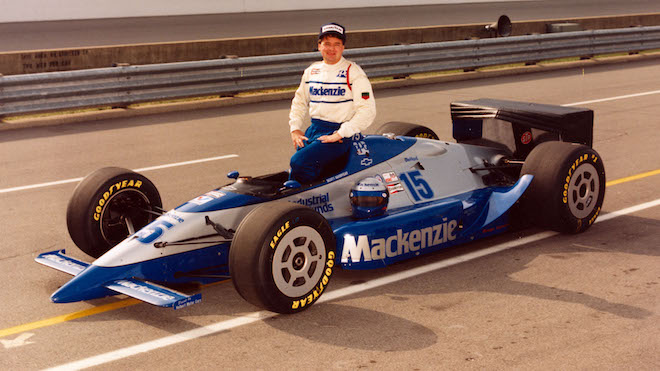
"I look back on the race now, [and] I don't want to say I didn't know what I was doing, but I didn't have the experience to know exactly where to place my car. Because I wasn't placing my car in the right spot, or setting it up well or didn't do all the things I learned to do a couple years later."
Goodyear's inexperience was exposed well before the final lap in 1992. With Michael Andretti running away with the race, Unser Jr. and Goodyear were left to fight over second place and swapped positions on a regular basis late in the race. Based on what he expected to take place with Andretti driving into Victory Lane, and the routine passing and repassing with Unser Jr., Goodyear made one mistake that would cost him dearly.
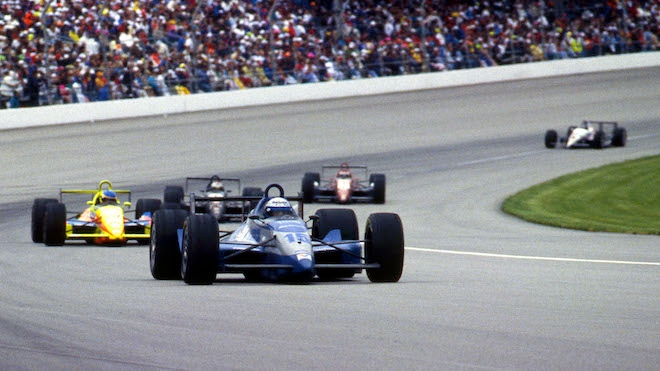
"And I was second at that time and I thought you know, how wide can I make the car? And all sorts of things go through your head and you know I start moving the car, watching the mirrors. He had a good run on me so I decide [I] can't do that. You let him go by. Because at that point and time you say OK, I will come back and get him."
When Andretti's car coasted to a halt on lap 189 and Unser Jr. inherited the lead, the folly of Goodyear's friendly decision was confirmed.
"At that time, we are running second now, moving into third," he said. "And then lo and behold however many laps it was later then Michael breaks down and now we are in second instead of first. So, I looked back at that in my very much rookie mode of driving ovals and think, 'Well, that wasn't very brilliant of me or very smart.' Not that I think I would have done anything different today."
As Unser Jr.'s blue and white Galles/KRACO Racing Galmer G92 spooled up its Chevy turbo V8 for the lap 194 restart, Goodyear's blue and silver Walker Racing Lola T92/00-Chevy was in the unenviable position of having to chase a driver with a family tradition to uphold.
The two protagonists fought and weaved throughout the final laps, and despite setting the record for the closest finish, Goodyear says there was never any doubt about who crossed the yard of bricks first.
"I clearly knew that I wasn't even past the start/finish line, because back then you could really see all the bricks when you went across them," he said.
Finally, by 2006, and while serving as a commentator for ABC, Goodyear was able to fully understand what Indy 500 fans felt and saw in 1992. High atop the front straight, looking down from a similar angle as the cameras that caught his drag race with Unser Jr., Goodyear was moved by Sam Hornish's 0.0635-second win over Marco Andretti.
"It took that long before I really understood exactly what everybody saw in 1992," he acknowledged. "I couldn't see it as a driver. Because to me, I still lost. I finished second."
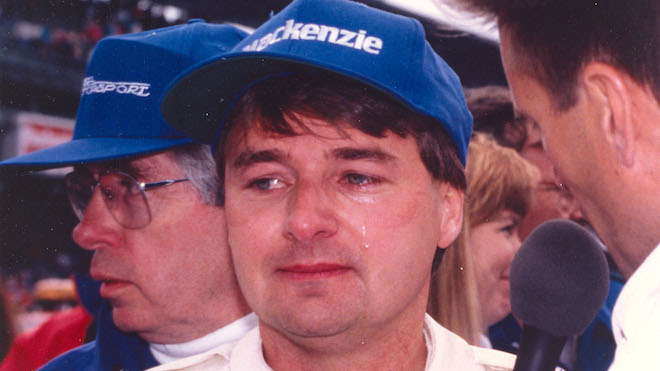
It's hard to ignore the lingering tone of sorrow when Goodyear speaks of his Indy 500 experiences. Getting over the runner-up finishes is one thing. Coming to terms with the fact that he never won is an entirely different realization. It involves overcoming remorse for missing out on a destiny he believes he was meant to fulfill.
The sting of three crushing losses have faded over the last three decades, but there's still a sense Goodyear is searching for the acceptance – or possibly forgiveness – for what transpired at Indy.
"We are still in the same house here in Indianapolis and we had it built by the same builder that Josie George used," he said. "In my office, I had them build shelves that were specifically in my mind just the right size for the Borg-Warner Trophy, [the] Baby Borg. Because in my mind I was going to win the thing. I just felt that. That was the reason I was put here.
"You get to a point when you are racing, that even after '95 with a disqualification, I know how to make the car go fast here, I know what it needs. I know how to work on the car. I can read traffic, I know other conditions, I know how to make the thing go to what I need to go. I felt confident as a driver that I was going to come back and have more opportunities."
Goodyear would retire after making four more attempts to win the Indy 500. An unfulfilling one-off with Team Cheever in 2001 closed the books on an amazing career that has been defined more for what didn't happen than all of the incredible things he achieved.
"You step away from it because you are getting too old and all that sort of stuff. And with me, being crashed out with my second broken back, I knew I was done," he said. "But it is what it is. As you get older, maybe it doesn't bother you as much and as life changes other things become important, I guess."
Twenty-five years on, the magnitude of Goodyear's 1992 performance continues to resonate with casual fans in his everyday life. Each reminder has provided a chance to speak with grace and humility.
"And you know the funniest thing that happened?" he said. "I will still go have lunches and meet people in business and things like that. They will sit there and they will look dead honest when they say this, because you know you can read the people well.
"And they go, 'Yeah, and what year did you win Indy again?' People just think because you are so close, or whatever the deal was, that you have won it. And some people go, 'Yeah, did you win it once or twice?' Because they were there or what have you.
"It's just the funniest thing. And sometimes you look at people and you go, no, no, no. You have to sort of correct them on it. It's the weirdest thing, honestly. I kind of chuckle about it sometimes."
Humor, as Goodyear confides, has been his chosen form of coping with Indy's heartless outcomes.
"Later that year in '92, the guy came from Sports Illustrated to do an article and at that time I had the [finish line] picture turned upside down in my office behind my head. So, the guy came and we talked all day," he said.
"We went for lunch and came back and chatted some more. And then he said, 'Just before I go, I have to ask you one question if you don't mind.' I said, 'Sure, what is that?' He goes, 'Do you know the photo is upside down on your wall?'
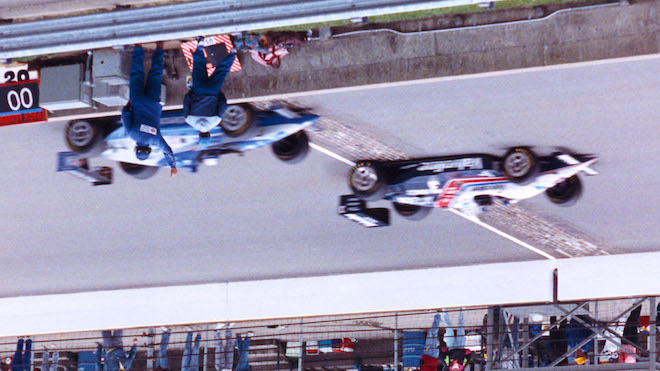
"I turned around and looked at it and I looked back at him and I go, 'Yeah, I do.' And he goes, 'Well, why is that?' And I go, that's because the blue and silver car is leading the blue and white car. And he broke out laughing. He goes, 'Really?' I said, 'Yeah.'"
Listen to the full interview with Goodyear below:

Latest News
Comments
Comments are disabled until you accept Social Networking Cookies. Update cookie preferences
If the dialog doesn't appear, ad-blockers are often the cause; try disabling yours or see our Social Features Support.