BUXTON: The Fine Line
"There is a fine line between recklessness and courage."
So sang Paul McCartney on the opener to his Grammy nominated 2005 album Chaos and Creation in the Backyard. It's a lyric and a song I've always enjoyed, and one I go back to often in moments such as the one witnessed on Sunday afternoon in Shanghai.
"Everyone thought I was completely mad!" Carlos Sainz Jr. laughed at the flag, drenched in sweat, a broad grin plastered across his face.
As the field flew past him at lights out and he tiptoed around the track, he'd questioned his decision. More so when he ran wide at Turn 1. Compounded when he then spun. Cemented when he clattered the barriers trying to get going again, a moment which 99 times out of 100 would have seen him eliminated from the race.
But the seeming recklessness of the decision would be vindicated moments later. Soon everyone was switching their strategies to be on the same tire as the man who'd fallen to last based on the courage of his convictions. He'd wind up seventh on the day, mixing it with the best three teams in the sport in a car which, in many other hands, would have no right to be where it so regularly finds itself.
But these performances are no longer surprising. They've become the normal expectations of a driver who is quickly gaining traction and plaudits as one of the very best in Formula 1.
The funny thing is, I never really rated Carlos Sainz Jr. in the early days. I first came across him when he was enduring a tough British F3 campaign. What was most disappointing was that he'd looked so good when he shot into Formula BMW and was crowned Formula Renault champion. The questionable nature of his racecraft pulled through from F3 to his GP3 campaign on which I commentated. For while Dany Kvyat – the man he'd beaten to Formula Renault honors – swept to the title, Carlos slumped to season's end in 10th place, over 100 points in arrears of the champion while racing for the same team. He'd go on to win World Series in 2014, pretty much obliterating the field, but it was that lack of consistency over his career that had left me somewhat underwhelmed by the time he arrived in Formula 1.
But in a little over two years, every single thing I've seen of him both on and off track has proven to me how wrong I was to ever doubt him. There exists today no doubt in my mind that Sainz has everything at his disposal to write history over the coming decade and more. He is an exceptional talent. One of the very finest in our sport today.
The motorsport world is fixated with the praise it heaps on Max Verstappen, and rightly so. The excitement he generates with the manner in which he races and the seemingly impossible, almost computer-game moves he is able to pull off, make him one of the most exhilarating racers we've witnessed in a generation or more. Verstappen is a driver who I've dubbed a "once in a lifetime talent" from the first time I ever saw him drive. Critically acclaimed in almost every quarter, there seems no end to the possibilities that stand before him.
And yet, there but for the grace of God, might Carlos Sainz have now stood.
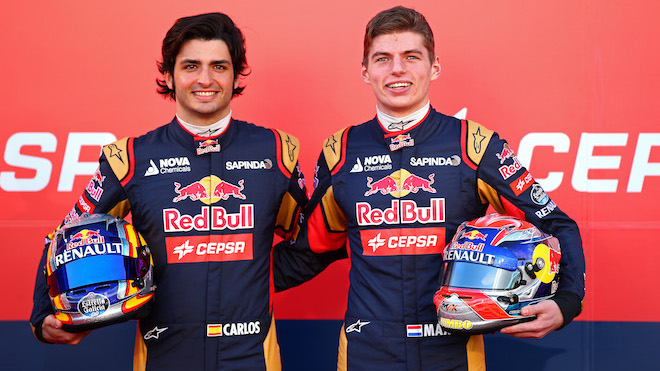
2015 saw both Verstappen and Sainz make their Formula 1 debuts for Toro Rosso. Over the course of that season their qualifying performances were matched almost equally, the balance tipped 10:9 in Verstappen's favor but with Sainz pulling out a season's-best fifth over Verstappen's sixth. In two-car finishes, again Verstappen edged it, but only just at 5:4. In terms of DNFs, it ran 7:5 in favor, if you can refer to it as such, for Sainz. Yet while each of Sainz's seven retirements in 2015 were caused by issues out of his control, two of Verstappen's five (Monaco and Silverstone) were self-inflicted.
Sainz qualified seventh on debut and scored points. Verstappen showed the world the overtaking prowess which would become his hallmark in Malaysia en route to his first points. Spain saw both drivers outqualify the Red Bulls, leading Helmut Marko to remark that the Toro Rosso drivers were "something extraordinary."
Verstappen's heroics, however, were what really made the headlines. His two hard-fought fourth-place finishes and the points that came along with his season-ending run of form saw him amass 49 to the Spaniard's 18. Just as Verstappen's form had started to rise, Sainz's had started to drop. While reliability undoubtedly played its part, Sainz himself suffered two heavy crashes at Russia and Austin just as his teammate was going on a consistent points-scoring run.
But to those who'd watched closely, and those within the team, it was clear that there was very little to separate the drivers by season's end. Indeed, with only one logical route out of Toro Rosso, the fact the two drivers were so closely matched had led to the beginnings of a rivalry between the duo, which came to a head in Singapore when Verstappen refused to follow team orders and allow the faster Sainz through.
The intensity of the rivalry only increased at the start of 2016, when this time Verstappen was the one who felt he should have been allowed past Sainz in Australia. Frustrated with the situation, he ended up hitting his teammate, ironically hurting his own race far more than that of the car ahead.
By the time the Russian Grand Prix came around, the competition between the two had become so intense that Verstappen's side of the garage broke free, kicked back against agreed-upon team policy in qualifying and set in place the circumstances which would result in Verstappen's move to Red Bull Racing and Franz Tost's Night of the Long Knives against those who'd dared to move against him in Sochi.
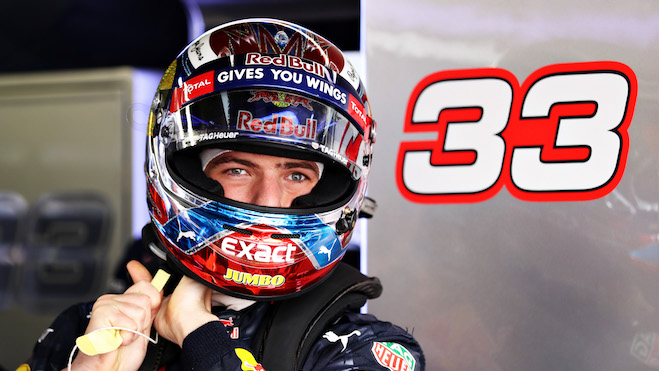
His father used the interest of Mercedes, the possibility of Ferrari sniffing, the pressure on Kvyat and the ever increasing turmoil with Sainz to not only move his son up to Red Bull Racing, but to lock in a contract that would see him secure until the turn of the decade. It was political bullying played out as managerial genius. And the timing was key. Because, if truth be told, they couldn't afford to stay partnered with Sainz much longer.
"Max has got confidence in himself and the car to go and make some moves that not everyone would risk," Toro Rosso technical director James Key explained at the end of 2015. "Carlos has also done a bit of that, maybe less visibly, but he's much more disciplined in the way he goes about things. So he thinks hard about what he's doing, what's coming up, and 'is it right to push now or do I need to wait, bring the tires in later and really push?' So he's thinking a little bit more and as a result is perhaps slightly less aggressive, but with a longer-term plan in mind in the race."
The noise coming out of the team was always very clear. Max and Carlos were evenly matched. While Max was more seat of the pants, Carlos was more measured and mindful. Both had their positives, neither was overall better or worse. The Senna/Prost comparison is all too easy to make and yet here, far more than in the Hamilton/Rosberg situation, lay teammates who truly fit that mold. Max couldn't afford to be seen to have an equal, or a driver who at times could outthink and outperform him. The move was set in motion. Max switched up and won on debut.
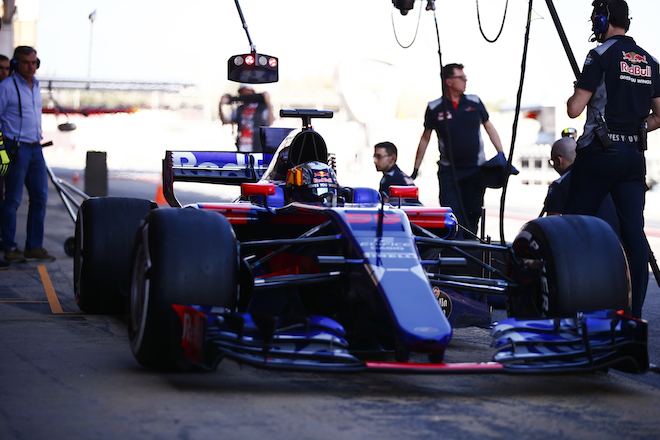
The question thus remains, might Sainz have been in the Red Bull by now with a more aggressive management structure? Based on how equally matched both Toro Rosso and Helmut Marko believed he and Max to be, there's every reason to think he might have been. But then Carlos wouldn't be Carlos if his support network acted in such a vociferous manner.
Just as Key described of the driver himself, off track and in his view of the future, Sainz and his family have a much clearer long-term view. There is a grace of understatement to him and his entire entourage that is both admirable and enviable in a world built upon ego and the desire to have everything yesterday. And what bolshiness a driver could possess when his father is inarguably one of the greatest competitors ever to have graced motorsport.
Carlos Sainz Sr. El Matador. A gentle giant of a man. Cashmere sweater, warm smile, kind eyes. Softly spoken, funny and engaging. "What a bloody legend," you agree as you walk off having finished your conversation. With a legend.
How different he is compared to so many to have achieved so much less. His humility is one of the greatest gifts he has passed to his son. The offspring of a world champion Carlos Jr. might be, but the sense of entitlement that feeds the ego of those still living in their fathers' shadows is nowhere to be seen here.
In Japan last season, Carlos had what remains probably his worst race in F1. When he arrived in the TV pen he came straight over to us and all I could do was ask what the hell had happened. He made no attempt to find an excuse. He gave no explanation. He simply apologized to every other driver on track for anything he'd done in potentially ruining their races. Gracious, honest and introspective. Not the qualities one usually finds at this level.
Can such grace coexist with the ruthlessness of the inner bastard one requires to be world champion? Only time will tell. But every other facet of the champion's armor is showing itself to be more honed by the day. Carlos Sainz Jr. is the real deal, and everyone in the paddock knows it.
Speaking with a Toro Rosso team member after the Chinese Grand Prix, we reflected on yet another giant-killing performance by the Spaniard, and the thrills and spills of a 2015 season many seem to have overlooked.
"Can you imagine having those two back together as teammates?" he grinned. "It's funny, but I don't recall Max getting as frustrated on the radio since being Daniel's teammate as he was when he was racing against Carlos. They were closer than people realize. Maybe too close."
Red Bull has a decision to make. And it must make it soon.
Carlos Sainz is too good a racing driver to be stuck in a B team. Red Bull knows it. But with every passing weekend, so too now does everyone else. Including Ferrari. Including Mercedes.
Ultimately, Red Bull has to ask itself whether it would rather have Sainz racing for it or against it. Three into two doesn't go and one way or another, Red Bull will be forced to lose a potential world champion at the end of 2017.
Do they keep him? Do they let him go? Which decision is reckless? Which, courageous?
It's a fine line.

Latest News
Comments
Comments are disabled until you accept Social Networking Cookies. Update cookie preferences
If the dialog doesn't appear, ad-blockers are often the cause; try disabling yours or see our Social Features Support.