F1's Whiting on faster cars, aero-boosting suspensions
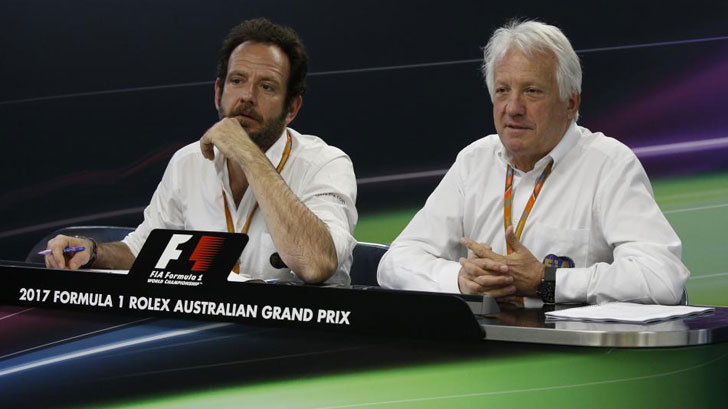
The FIA's Formula 1 Director Charlie Whiting (pictured at right with FIA Media Delegate Matteo Bonciani) met with the media Friday at the Australian Grand Prix and offered his assessment on a range of topics regarding the new cars and the FIA's governance.
Asked if he was concerned that the rise in speeds could lead to a call to slow the cars down on safety grounds, Whiting said he was confident the FIA would be able to "future-proof" F1 tracks where needed.
"Most circuits will need a little tweak. This circuit here has had tire barriers improved in four places; we’re finding similar things probably more on the older circuits, whereas Shanghai, Bahrain and those sort of places haven’t needed anything doing to them. But obviously the quite old circuits will need a bit of work and we’re going through that circuit by circuit, running simulations and seeing exactly what’s needed and where. We’re working our way through that.
"It was one of the briefs the Strategy Group gave us, that [the 2017 cars] should be the fastest ever. As I said, we’ve done a lot of work with all of the tracks but we’re also future-proofing them so we don’t have to keep coming back year after year, because we know the cars will get incrementally faster; it’s always happened that way. But we’re trying to make sure we don’t need to go back every year, so we are adding an element of future-proofing so we don’t need to do that."
Whiting indicated that concerns raised about the possibility that suspension systems were being used for aerodynamic gain in contravention of the rules had been exaggerated, although he said the governing body was keeping a close eye on the issue.
Marcin [Budkowski, FIA head of the F1 Technical Department] and Jo [Bauer, Technical Delegate] did a lot of work in Barcelona going through all the systems and the ones we've inspected so far have all been as we expected to be here, so we don't anticipate any problems.
"We've been aware of hydraulically operated suspension systems on cars for some time but it became clear they were being used for purposes other than suspension. So under the regulations where you are not allowed to have a suspension system that affects the aerodynamic performance of the car in anything other than an incidental way, we don't allow it. So that's the approach we have taken. We wanted to see whether suspension is genuinely suspension or whether it's there predominantly to affect the aerodynamic performance of the car. That's the change effectively. We have been focusing far more on that this year."
Asked how he could be conifedent teams were not using suspensions to obtain aero gains, Whiting responded: "Two basic things, really. We think that if a suspension system behaves asymmetrically there is not a very justifiable reason for behaving like that. So if a suspension system goes down at one speed and comes back at a different speed, there really shouldn't be any reason for that.
"Also, if there is any attempt to store any of the energy for later deployment, then we feel that's not really part of a proper suspension system and it is being done for other reasons. The onus is being put on the teams to demonstrate that their system has an incidental effect only. If they are not able to convince us of that then they can't use it."
Whiting offered the following explanation of the FIA's tweaks to the FIA's handling of on-track incidents:
"I think there will be a small change to some incidents which we saw last year that would maybe be handled slightly differently, simply because the so-called 'Verstappen rule' has gone, to the effect that before, we said any move under braking will be investigated. Now we have a simple rule that says effectively that if a driver moves erratically or goes unnecessarily slowly or behaves in manner that could endanger another driver, then he will be investigated.
"We have a broad rule now. What we did in Austin last year, if you remember, in response to comments from drivers is that we used the existing rules to put into the event notes we issue as how we were going to interpret the existing rules. And the interpretation simply was that drivers shouldn't move under braking and that's what gave rise to the penalty given to Seb [Vettel] in Mexico. That will be dealt with slightly differently in that the stewards will be invited to simply focus on every incident and judge it on its own merits. So each dealt with only on the basis of whether or not it was a dangerous maneuver, not necessarily because he moved under braking.
Finally, Whiting said that plans for inclusion of the "Halo" safety enhacement to F1 cockpits was still on-track for next year, although he added that the governing body was keeping open the option for a different solution.
"Yes, it is still on track. It was agreed by the Strategy Group and the Formula One Commission that there would be additional frontal protection for 2018. So far, the Halo is the only candidate solution that fits the bill," he said. "We are working on other solutions, for review, and after the 30th of April – which is the cut-off point for regulation changes – we'll just have to see. If something better comes up after that we'll have to look as how we approach it."
Presented by:


Latest News
Comments
Comments are disabled until you accept Social Networking Cookies. Update cookie preferences
If the dialog doesn't appear, ad-blockers are often the cause; try disabling yours or see our Social Features Support.