BUXTON: The Snapchat Rabbit Revolution
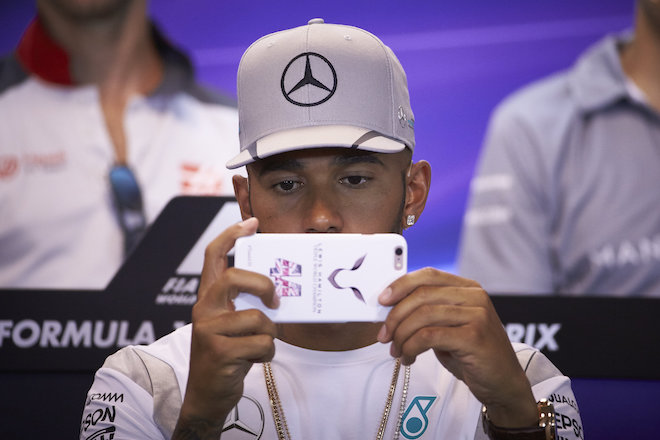
As storms in a teacup go, the furor surrounding the supposed disrespect shown by Lewis Hamilton toward the international media at this weekend's Japanese Grand Prix is going to take some beating. The British racer appeared disengaged and disinterested in the questions being asked of him in Thursday's press conference, preferring instead to concentrate on his Snapchat account and turning himself into a rabbit and Carlos Sainz into Bambi.
How very dare he.
A large section of the written press, notably the British, were aghast at Hamilton's attitude. Their ire peaked with renewed rage when he had the audacity to respond to a question as to whether he had a message for his fans after the controversy of Malaysia, by directing them to his Instagram account. On which, he'd posted a message to his fans after the controversy of Malaysia.
"I've put all my feelings on there," he noted. And with that, the press conference was over.
Hamilton would later go back onto social media, this time Twitter, to explain that he had simply grown tired of the format of the FIA press conference and was bored of the same old plodding questions.
And I couldn't agree with him more.
On very few occasions does one extol with glee the virtues of attending one's annual work conference. The very concept of a forum given over toward speeches and Q&As more often than not fills both the participants and attendees with a gloomy malaise. The same is true for a press conference. It is not usually an entertaining event. It is an occasion for information dissemination, and little else. Sure, movie premieres or product launches have some razzmatazz, but they are one-off specials. The regularity with which a sportsman such as Hamilton has to endure the rigmarole of the process can easily turn it into a dirge.
This is Lewis Hamilton's 10th year of Formula 1. With drivers on average appearing at the Thursday FIA Press Conference once every three races, someone in Hamilton's position can expect seven or more call-ups a year. Yesterday's appearance was thus likely to have been around his 65th. Add into that post-qualifying and post-race press conferences for the top three drivers, and Lewis Hamilton will have amassed well over 250 hours (and in all likelihood closer to 300) in these organized sessions in his career to date. That's over 10 full days. Minimum. Staring at the same faces. Answering the same questions. In the same stuffy room.
One could forgive him a touch of boredom.
Up until a few years ago, the FIA press conference was not televised. It was a print press event in which magazines and newspapers could amass the information with which they would write their weekend's articles. It was after this that the drivers were made available to the TV crews, for them to ask their own questions to camera.
Since the advent of F1-specific television stations, however, the need to provide more content has led to these conferences being broadcast live and unedited. But therein lies a major issue. The quotes garnered will now be in the public domain and no longer new or interesting when used in tomorrow's paper. As such, fewer and fewer questions were asked by the print press. And, knowing that they would only be leaving the print conference to face further time with TV crews immediately afterward, the drivers for the most part started to switch off.
All of which makes it simply six men sitting behind a desk looking bored. It is not entertainment or entertaining. Because it is an entirely pointless exercise.
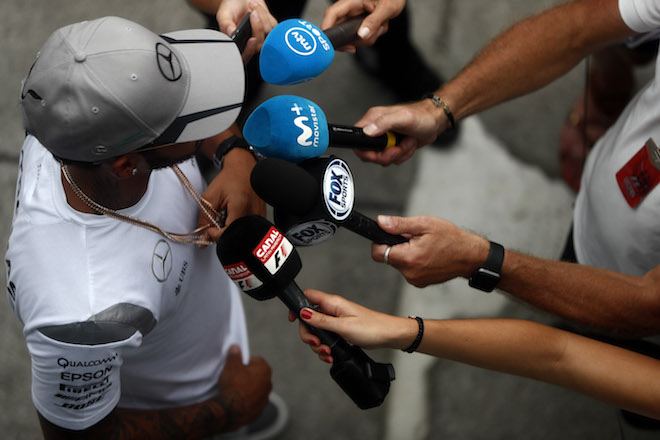
On numerous occasions this season, the drivers have been kept in the conference for upward of 40 minutes. Growing increasingly bored and frustrated, by the time they reach the TV crews most F1 teams have only a short space left in their media schedule. If lucky, the TV crews in these tight situations have been afforded quarter of an hour with the six drivers chosen for the press conference. With 26 accredited broadcasters, that equates to 34 seconds per driver, per broadcaster.
It is worth remembering that it is only the TV crews who pay for the right to broadcast the sport.
Should TV thus be given greater priority over print media? Arguably yes. A smaller and smaller percentage of the world receives its information through the printed format, with online and television accounting for by far the greatest chunk of eyeballs. But by the same token, the print press should be given the respect that their media time should under no circumstances be televised. The vast majority of print journalists attend races on their own dime and without big corporations behind them. Why should their previously exclusive time be taken away from them?
The situation is not aided by the division that exists in media accreditation, whereby it is FOM as promoter that accredits broadcasters and FIA as regulator which accredits print press. The uneasy alliance that exists between the two bodies means skirmishes regularly occur as part of a far larger battle within an ever raging war.
But the manner in which Formula 1 deals with the modern face of media reality lags not just a decade in arrears, but closer to three.
The fact that Hamilton was warned earlier in the year over his use of Snapchat and other social media accounts within the F1 paddock seemed laughable to those outside the sport, but is reflective of the realities of regulations written a generation before today's digitally reliant age.
There was talk this week that the drivers' briefings would be made public. But when one looks at what broadcasting the press conference has done to that once useful event, one dreads to think what a dire affair Friday afternoon's "Chat with Charlie" would become. And it shows, once again, a complete lack of imagination. It isn't good enough to simply try and televise that which already exists and expect that it will make good television. The product requires and deserves more thought than that.
Far from Lewis Hamilton being disrespectful in his actions in Japan, his small and at the time seemingly insignificant actions may come to have significant consequences. His unconscious protest has brought into clear view the lack of direction, thought and consensus which has kept the media face of the sport lagging behind the times.
We change sporting and technical regulations at the drop of a hat in search of improving the show. And yet the manner in which the media is permitted and regulated to operate on race weekends hasn't changed in decades.
Change in the way Formula 1 approaches media is long overdue and, with new owners soon to be at the wheel, more vital than ever. Because it doesn't matter how good the new regulations make the racing, if the sport can't promote itself adequately in the contemporary environment, no good will come of it.
RACER's Formula 1 coverage is presented by Grand Prix Tours. Feel the power and the glory of Grand Prix racing now via Grand Prix Tours' Pick 8 competition.
Presented by:


For Ford Racing NHRA Funny Car ace Austin Prock, it’s a family affair
Latest News
Comments
Comments are disabled until you accept Social Networking Cookies. Update cookie preferences
If the dialog doesn't appear, ad-blockers are often the cause; try disabling yours or see our Social Features Support.