MRTI: Reinventing the Ladder
Two years have passed since the world got its first look at the IL-15, the car that represented a long overdue refresh of the Indy Lights landscape. Already, the fruits of the labor that went into its development are becoming apparent: new teams have joined the series and grids are growing.
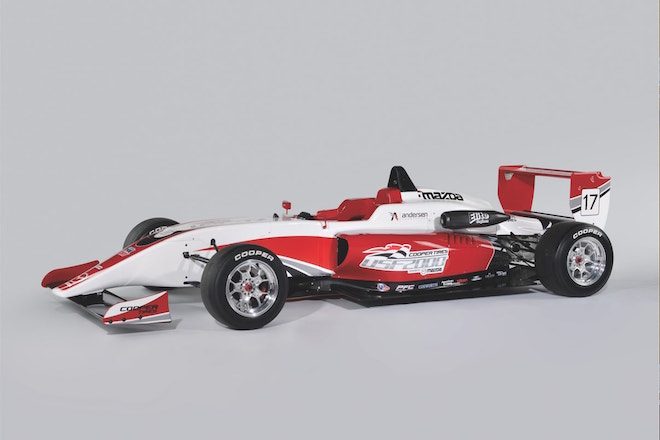
And now, meet its little sister. This time it's the first step on the Mazda Road to Indy ladder that's getting an overhaul, and in the new Tatuus USF-17, which will be rolled out for Cooper Tires USF2000 Powered by Mazda next season, young drivers striving for the Verizon IndyCar Series will have the opportunity to do so in a car that just might strike a better balance between cost and features than any other junior-level car on the planet.
To get a sense of how Andersen Promotions, which runs the Mazda Road to Indy, arrived at the USF-17, it's helpful to have a sense of what kind of starting point it had in the trusty, tube-framed Van Diemen that is currently in service. That context can be provided with one statistic: Team Pelfrey rookie Robert Megennis scored two podiums in the first four rounds of the current USF2000 season. But when the car design that Megennis was driving made its debut, he hadn't been born yet.
"For the chassis that we're currently using, the iteration that it's in now was new in 1999," says USF-17 project manager Scot Elkins. "So we're looking at an almost 17-year-old car, which in racecar terms is forever."
A rolling USF-17 chassis will cost $51,800, which is a full $20,000 less than the car it is replacing, despite boasting significant upgrades in safety, technology and performance. Key to the "more car for less money" approach was the decision to use the existing Formula 4 car as a platform, rather than starting with a completely clean sheet.
"At this level, price is very important," says Andersen Promotions owner and CEO Dan Andersen. "We were looking around at all the options and talking to different manufacturers, and designing a clean-sheet car carries a higher price point because of the invested cost by the manufacturer in order to do that.
"So we thought that utilizing the Formula 4, which is worldwide and is a price-controlled model, as a starting point would give us some economies built in. If we use some of the F4 components in our new car, those have already been designed, and there is already volume to support the price point that they're being offered at. So we can start from a much better price point.
"But in looking at F4 cars, I wasn't satisfied with the overall package in terms of safety or performance. So we started with that car as a basis to keep the costs reasonable, and then we developed it from there to give me what I wanted, which was a better-looking car, a better-performing car, and a safer car, than what the F4 class offers, while keeping it very close to an F4 price. It was fortunate for us that the F4 model was out there for us to tap into."
Tap into, and then develop almost beyond recognition. While the new USF2000 machine retains many basic components that are common to the F4, other areas of the car represent a radical departure. The chassis has been modified and strengthened to accommodate the demands of ovals, including full Zylon side intrusion panels and reinforced bulkheads. The current Mazda MZR 2 powerplant will be retained with minor modifications, while other upgrades include a six-speed paddle shift gearbox, four-way adjustable dampers, a Cosworth data system, and Performance Friction four-piston brakes.
The car was shaken down for the first time at Kentucky's NCM Motorsports Park in mid-June, with USF2000 driver coach Joel Miller getting the honor of being the first to put the USF-17 through its paces.
"It's kind of unique, because the components of the car have all been used somewhere else; they're just new [together] as a package," says Elkins. "And it worked pretty well during the shakedown. We had the chance to do some spring changes, plus some changes to the brake master cylinder, and we had the car reacting exactly the way we wanted it to, so that was fantastic."
It's too soon for the car to have really stretched its legs yet, but Andersen and Elkins have some clear performance targets in mind. "I'm a promoter," says Andersen. "So it's always nice to have the new car go faster than the old car..."
That shouldn't be a problem. At 175hp, it's similar to the current car in terms of power, but the new chassis is lighter, and there are bigger wheels and tires waiting to transfer all of those horses to the track surface. Andersen anticipates allowing the current cars to continue running as a B-class, and remains open to using engine mapping to create further speed differentiation between old and new.
The ultimate gauge for whether the MRTI has hit on the right formula will be how well it is received by the teams. Anderson Promotions ordered 30 of the new cars for delivery in 2016, with half to arrive in September, and the other half in December. The first shipment is sold out, and half of the second is also accounted for. And several existing teams are still yet to place orders because they are in the process of selling their current cars. In other words, many of the orders have come from outside the existing paddock.
"That means we have new people interested in racing on this platform," says Elkins. "And that's the reason you do a new car in the first place, right?"
To learn more, check out the July 2016 'Legendary Races' issue of RACER magazine.

Latest News
Comments
Comments are disabled until you accept Social Networking Cookies. Update cookie preferences
If the dialog doesn't appear, ad-blockers are often the cause; try disabling yours or see our Social Features Support.