SVRA: Brickyard Invitational - Return of the Indigo Twins
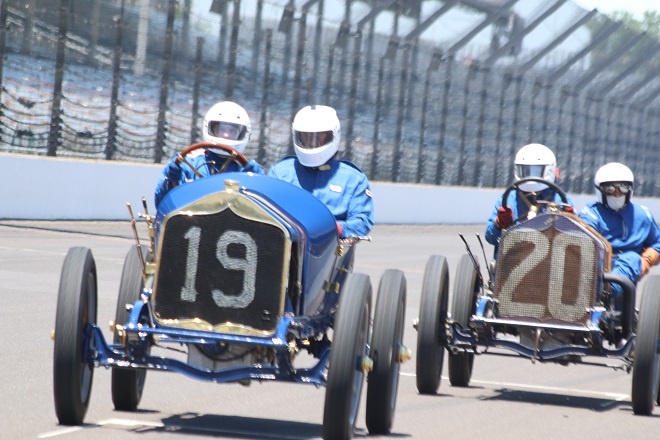
Charles Test (19) and Brian Blain (20) during Friday's oval exhibition runs. (photo: RIS Don Andersen).
One of the darlings of early 20th century Indianapolis was the National Motor Vehicle Company, a bustling factory in the Hoosier capital's burgeoning automotive industry. The city rivaled Detroit for automobile production at the time and National, along with Nordyke & Marmon, Cole and Marion, was among its leading manufacturers. Arthur C. Newby and Charles Test were founding fathers of the successful enterprise that employed hundreds of workers. Newby was also one of the four founders of the Indianapolis Motor Speedway in 1909. By 1910 Test was gone but Newby led the way and demonstrated the quality and reliability of the company's product through auto racing. His star drivers in 1910 were a pair of very close friends, Johnny Aitken and his younger teammate, Tom Kincaid.
Brickyard Invitational Video: Robin Miller with Paul Tracy
Related Stories
Aitken and Kincaid were top drivers of the era. Both had won several major American Automobile Association (AAA) races and the local newspapers embraced them as hometown heroes. Always eager to ballyhoo home teams to sell their papers – there were three major dailies in Indianapolis at the time – the two men were nicknamed, "The Indigo Twins." The moniker reflected not only the closeness and cooperation of the teammates but also National's team colors: midnight blue.
The fact that Aitken, two years older than Kincaid, was a mentor and even a kind of "big brother" to his 23-year-old teammate, gave all the more reason for the label. In May 1910 at the first Memorial Day weekend of racing at the newly paved Indianapolis Motor Speedway – already dubbed "The Brickyard" by locals – both Aitken and Kincaid picked off victories. It was a three-day weekend race meet chockfull of short sprint races – in that regard similar to this weekend's Brickyard Invitational. Aitken won two contests of 10miles while Kincaid picked off the Friday feature, the 100-mile Prest-O-Lite Trophy.
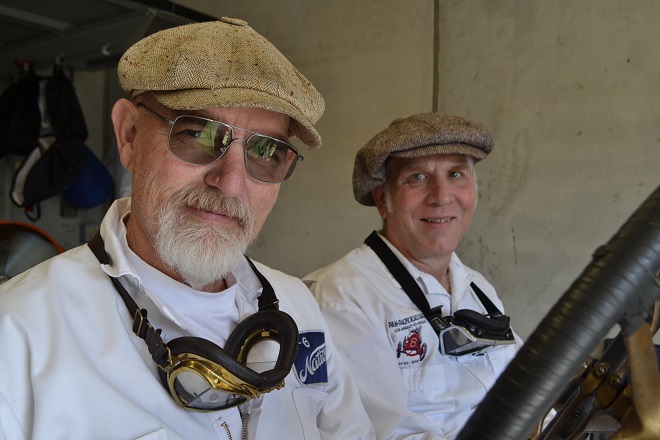
Fast-forward 106 years and a new set of "Indigo Twins" has arrived at the Brickyard with hugely relevant ties to both National and the Speedway's early days. Enter Brian Blain and Charles Test, the great-grandson and namesake of Art Newby's business partner mentioned above.
In this case Brian is the mentor and Charles is relatively new to the vintage racing game. Blain, the founding director of the Blain Motorsports Foundation, a non-profit dedicated to the preservation of racing history and especially important racecars demonstrating advances in technology, started vintage racing in 1983. He is a regular competitor with the SVRA and with a collection of over 20 cars he gets a vast range of driving experiences. At the recent Sonoma Historic Motorsports festival he not only had his 1911 National "40" on the track but also a 1969 Lola T-163 Can-Am racer.
"It's fun to experience different cars of vastly different design technologies," Brian says. "But I also notice similarities that are surprising. For example, the braking points for the National and some more modern cars can be very similar. The National has much lower horsepower but the brakes are almost non-existent so I have get on them at about the same point as with a car going maybe 80mph faster."
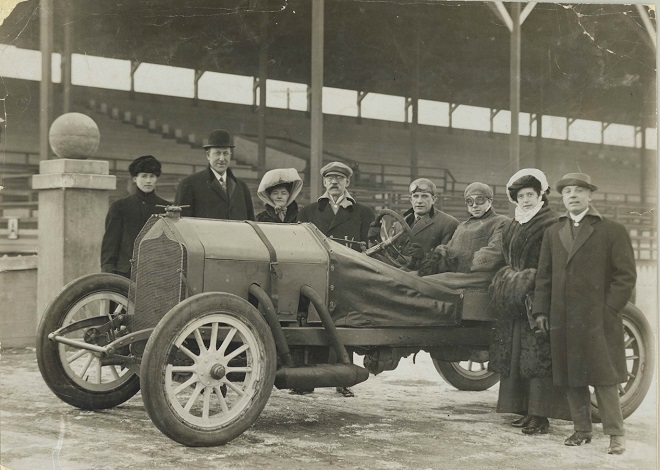
Blain's National, which he acquired in 1992, is pretty special. It is the same car that Charlie Merz drove to seventh place in the first Indianapolis 500 back in 1911. Racing cars of the day were not really purpose-built but actually chopped and slightly reconfigured stock cars. The machines were meant to be raced and that is what Blain is all about. While he is an advocate of the vintage racing culture that does not tolerate anything close to bump drafting, trading paint or optimistic pass attempts he still wants to push even his oldest racecar to its limits.
"We are really racing, this is no parade," Blain asserts. "And for me, I want to feel what it was like for Charlie Merz. I want to begin to imagine what he felt in 1911. I look at old photos of Charlie and think about what was going through his mind. Even daily things, such as concerns about his family or just what he wanted for dinner."
Blain also takes joy at the idea of sharing his cars and knowledge with spectators. He loves fans who try to imagine what it was like for the spectators of ages past to watch the amazing heroes of their time gun their roaring engines in anger and fly through turns with amazing cars at the brink of control. That's no surprise coming from a man who founded an official, government-registered foundation for the preservation of motorsports history.
He is so enthusiastic and so committed to sharing what he owns and knows he produces elaborate displays and events. Last September at the SVRA's Coronado Island Speed Festival in San Diego Blain created homage to the 100th anniversary of the Point Loma road race. That 1915 contest included many superstar drivers of the day such as Barney Oldfield, Bob Burman, Eddie Rickenbacker and Earl Cooper.
The downside of this passion is that his hard driving takes a toll on a 105-year-old machine. He had his Merz National at last year's Brickyard Invitational and all that driving in anger produced cracks in an engine cylinder and the crankcase. Pistons were scored too, and that meant expensive, custom-made replacements.
"It's getting really difficult to maintain the car," he says. "You break things and you have to go to a foundry. The cost is astronomical. It's the price you pay to play."
Blain has assisted Test in coming up to speed with vintage racing. Test, as the namesake of his great-grandfather, developed an understandable interest in the original Test's exploits as a successful and prominent businessman in Indianapolis over 100 years ago. He now races a second 1911 National in support of the Blain Motorsports Foundation. He is also the world's foremost historian on the National Motor Vehicle Company and hosts a free website full of information.
While the records of the National Charles Test drives are less detailed than the Merz car, both he and Blain believe it was raced. The difference is that it was a legitimate stock car that was stripped down to reduce wind resistance for racing.
"It was pretty common for these Nationals to be raced by their owners," Test explains. "They would strip down the body and enter it in local hill climbs or locally organized race meets on roads or horse tracks. Documentation of those events is sketchy at best. Also, a lot of times the owners did not want it known they raced the car because they believed it reduced the value if they ever tried to sell it."
Test isn't completely new to the game of climbing behind the wheel of a vintage racecar. He joined Blain in Sonoma two weeks ago and in April was at another SVRA event at Buttonwillow Raceway Park in Southern California. This weekend they re-emerge just in time to invoke the Indigo Twins of old.
National still has a presence in Indianapolis, but you have to know where to look. One interesting spot is wherever the National racecar that Joe Dawson drove to victory in the 1912 500 sits at the Indianapolis Motor Speedway Museum. It gets shuffled around a bit, but it is always on display. Donald Davidson, the Speedway's historian and this weekend's Brickyard Invitational grand marshal, never fails to point out that both Dawson's winner and the famous Marmon Wasp, the winner of the first Indianapolis 500, are among the most faithfully documented historic racecars in the world.
"We know exactly where both these cars came from and where they have been," Donaldson assures.
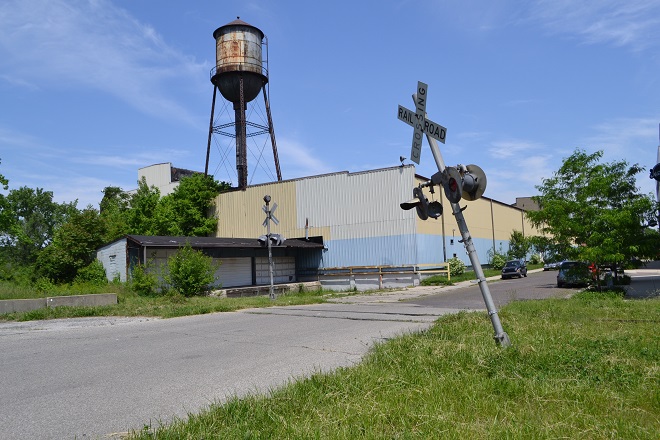
The winning National came from the same place as the two Nationals racing this weekend in the pre-war run group of the 2016 Brickyard Invitational. They came from the National Motor Vehicle Company factory at 1101-47 E. 22nd Street in Indianapolis. The building still stands, a portion of it used by an elementary charter school. At least three quarters of the structure, though, is vacant and in need of refurbishing. Its historic character begs for intervention.
As for the original Indigo Twins, fate was not kind. Tom Kincaid had less than two months to live after his Prest-O-Lite Trophy victory. He perished in a brutal accident on the backstretch of the Indianapolis Motor Speedway during test runs on July 7, 1910. Both Aitken and Newby, a man with a reputation for deep compassion, were stunned. They suspended racing operations for a while but returned with the announcement of plans for the inaugural Indianapolis 500 the next year.
Aitken raced in the initial "500," and even goes down in history as the first man to lead a lap of the historic race. He retired shortly after and then went on to manage the winning teams for drivers Joe Dawson and Jules Goux in the next two Indianapolis 500s. He returned to the wheel in 1916 and won the pole for the great race. That same year he also chased Dario Resta to the wire for the AAA's first Indy car national points championship – finishing in the runner-up spot. It is a little-known fact that he holds the all-time record for race victories at IMS with 15. His life ended not at the wheel of a racecar but as a casualty of the great flu pandemic of 1918.
To Brian Blain's point – and the mission of his foundation - the Brickyard Invitational gives everyone a chance to imagine what it was like in those days of the Heroic Age - what it was like for fans generations ago to marvel at the daring of the original Indigo Twins.

Latest News
Comments
Comments are disabled until you accept Social Networking Cookies. Update cookie preferences
If the dialog doesn't appear, ad-blockers are often the cause; try disabling yours or see our Social Features Support.