PRUETT: 24 Hours - Nine things to watch
Here are the key storylines to watch for in this year's 24 Hours of Le Mans:
THE OVAL IS BLEU
Ford. Ford. And more Ford. The Blue Oval's return to Le Mans is the biggest story of the event, and we expect the four-car team's presence to place a greater emphasis on the GTE-Pro class throughout the 24 hours of TV coverage.
That's a shame for the excellent LMP2 class, which usually puts on the best show, but with an icon like Ford back at the international sports car table, it's more than understandable.
If there's an adjustment to make on Ford's return, it could be in how the brand's history at Le Mans, and its iconic wins against Ferrari in the 1960s, carries no weight today. Ford vs. Ferrari? Not today. The only rivalry that matters in 2016 is of the Michigan kind.
Although Ferrari, Aston Martin and Porsche will be involved in the fight, the significance of Ford's return — and any success it may have — will be judged against Corvette Racing, its home state rival. Sports car fans from other countries might have an eye on the theoretical rekindling of the 1960s rivalry that made Le Mans so special, but in the USA, Le Mans 2016 is all about the Bowtie vs. the Blue Oval.
24 Hours of Le Mans resource guide
Complete 24 Hours of Le Mans coverage
UNSAVORY SIX
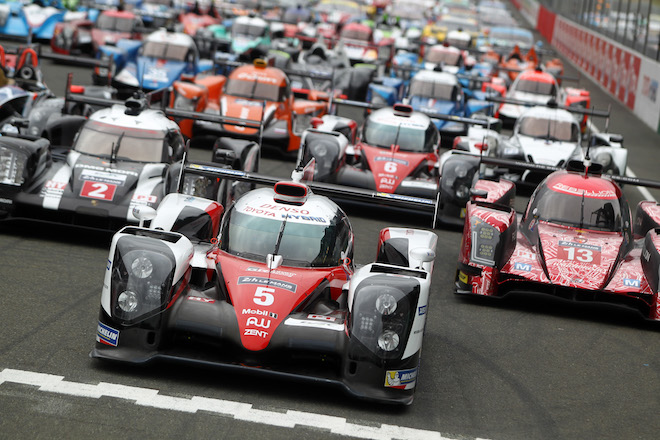
Coming out of the 2015 race where 11 LMP1 Hybrids served as the featured content, a drastic reduction to just two apiece from Audi, Porsche and Toyota is an unsavory change.
There are valid reasons for the decrease; the three factory Nissans are gone, and with the diesel emissions scandal that hit the Volkswagen Audi (and Porsche) Group last summer — and the pending fines, which are expected to be massive — Audi and Porsche tightened their belts and left their third entries behind.
Subtract three Nissans and one each from the German teams, and those 11 featured Hybrid prototypes turned into six for 2016.
OVERALL GROWTH
Even with the shrunken LMP1 Hybrid ranks, a pit lane expansion after the 2015 race that added garage spaces closer toward Turn 1 has allowed the ACO to increase the grid from 56 to 60 cars.
By the numbers:
2015's 14 LMP1s (Hybrid and standard) have become nine in 2016.
2015's 19 LMP2s have become 23 in 2016.
2015's nine GTE-Pros have become 14 in 2016.
2015's 14 GTE-Ams have become 13 in 2016.
And the return of the Garage 56 entry in 2016 has added the final car to the field, an LMP2 car with special controls fitted for quadriplegic driver Frédéric Sausset.
KICKED IN THE JOULES
We had a feeling what we were seeing for pole speeds in 2015 would be the last of their kind, and we were right. The ACO stepped in to slow its fearsome LMP1 Hybrids by taking away somewhere between eight to 10 percent of the fuel the six cars from Audi, Porsche and Toyota are allowed to consume per lap.
That's the big difference with today's top prototype class. The ACO regulates the size of the fuel tank for each P1 car, and then adds an additional layer of control by dictating how much fuel can be burned during each 8.5-mile lap of the circuit. They use fuel flow sensors to capture that information in real time, and if a car is caught using more than permitted, the driver can make it up on the next lap by "giving back" the overage, which means that lap will be slower than normal.
As rule makers continue to take fuel away from the internal combustion engines found in LMP1 Hybrids, manufacturers spend untold millions to claw back lap time and speed through other means. The engine-based performance loss has been partially mitigated through improved energy recovery systems — think of it as electric horsepower — and greater aerodynamic efficiency.
Those efforts were on display during the test day on June 5th as Audi's R18 topped the event with a 3:21.375 lap, and with a clear track and better conditions, drivers suggested more speed could be found. But with the new fuel reduction in mind, all three manufacturers would be hard-pressed to match last year's pole time of 3m16.887s, and provided they have a dry track and a clear lap, the 2016 pole is expected to be a few seconds slower than the lap record set in 2015.
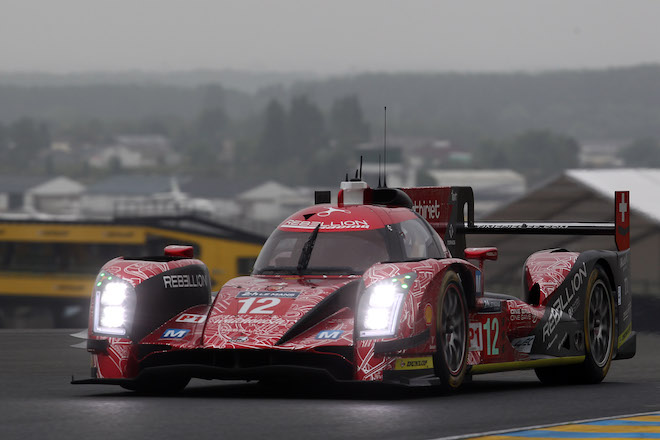
The 2015 test day was rarely dry, which makes a direct comparison hard, but if we look at the top speed set during qualifying, Audi's R18 led all LMP1s with at 341.3 kph/212 mph. In the morning and afternoon sessions on Sunday, the two non-hybrid twin-turbo 2.4-liter V6 AER-powered Rebellion R-Ones went 1-2. The No. 12 Rebellion posted a best of 336 kph/208.7 mph, the sister No. 13 posted a 334.9 kph/208.0 mph, and the best of the big hybrids went to an Audi R18 with a 332.9 kph/206.8 mph.
24 Hours of Le Mans resource guide
Complete 24 Hours of Le Mans coverage
Minus hybrid systems, the ACO makes sure those AER engines have plenty of power, and some of the P1 cars could have been carrying more downforce while searching for the best race setups, but it's still interesting to see the most advanced prototypes on the planet falling behind the second-tier LMP1s due to restrictive fuel regulations.
NEW CARS APLENTY
Audi has changed everything but its engine with the new 2016 R18. Toyota's TS050 is new from front to back. Ferrari's twin-turbo V8 488 and Ford's twin-turbo V6 GT are new to Le Mans. At a time where most sports cars undergo small year-to-year design evolutions, 18 percent of the grid will roll off on Sunday in models that weren't seen in 2015.
CURTAIN CALL
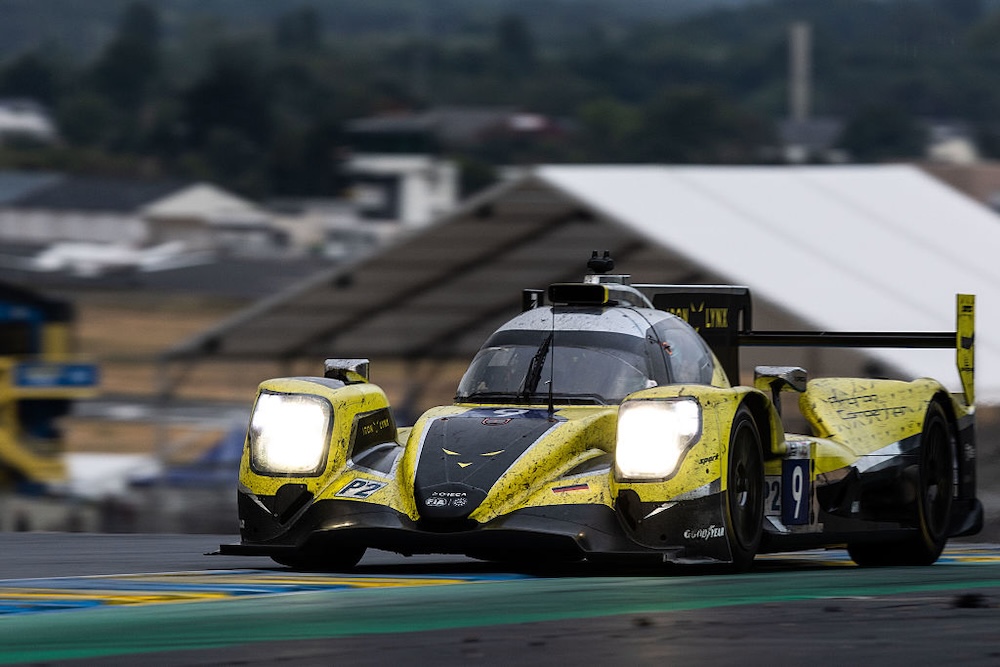
The LMP2 class is headed for its final race at Le Mans under the current technical regulations. The mix of open- and closed-top cars, multitude of engine types, and diversity in chassis constructors will give way to the ACO's new vision for 2017. Four chassis manufacturers (Dallara, Onroak, ORECA, and Riley/Multimatic), and a single V8 engine supplier (Gibson) will replace the impressive variety currently found in LMP2.
And provided a few American teams from IMSA's WeatherTech SportsCar Championship make the trip next year, some of IMSA's 2017 P2s, its "Daytona Prototype international" cars could add some spice.
Including the Garage 56 entry, 40 percent of the 2016 field is comprised of LMP2s. Will it be the same next year? We can only hope the ACO's new formula has the kind of response from team owners that the current formula inspired.
THE AMERICANS
Two dozen American drivers and 10 entries from the USA have brought a healthy dose of the Stars and Stripes to Le Mans.
France-loving teams like Corvette Racing, Krohn Racing, Risi Competizione, Scuderia Corsa and Tequila Patron ESM have become part of the Le Mans experience, and with first timers Michael Shank Racing and Ford Chip Ganassi Racing added to the roster, one out of every six cars in this year's race will bear the Stars and Stripes.
A SAFER WAY
A spate of nasty crashes at some of the fastest sections around Le Mans led the ACO to introduce SAFER Barrier technology for the first time. It's worth remembering the giant circuit is mostly comprised of public highways; only the interior Le Mans Bugatti circuit is active throughout the year.
Lining miles of public road with SAFER Barriers isn't feasible, which makes their newfound use at the Porsche Curves, where clashes between prototypes and GTs have become commonplace, one of the better uses of money and resources by the ACO.
KNOW THE ONES YOU LOVE
With those 60 cars on the grid, and three drivers per entry, Le Mans is loaded with some drivers that are familiar and, if we're honest, many you've probably never heard of ... and might never hear from again.
For every legend like Mark Webber there's three or four Nico Pieter de Bruijns, which made us think of a new drinking game: Le Mans driver or bad guy in a Jason Statham movie?
See if you can get these right:
1: Mok Weng Sun?
2: Pu Junjin?
3: Rémy Striebig?
4: Mathéo Tüscher?
5: Kirill Ladygin?
6: Keita Sawa?
(If you picked any of those six as bad guys in a Statham flick, go ahead and drink the beverage of your choice — it doesn't have to be alcohol. Believe it or not, those are actual drivers in the 2016 race.)

Latest News
Comments
Comments are disabled until you accept Social Networking Cookies. Update cookie preferences
If the dialog doesn't appear, ad-blockers are often the cause; try disabling yours or see our Social Features Support.