In RACER's Heroes V Issue: The Rocket
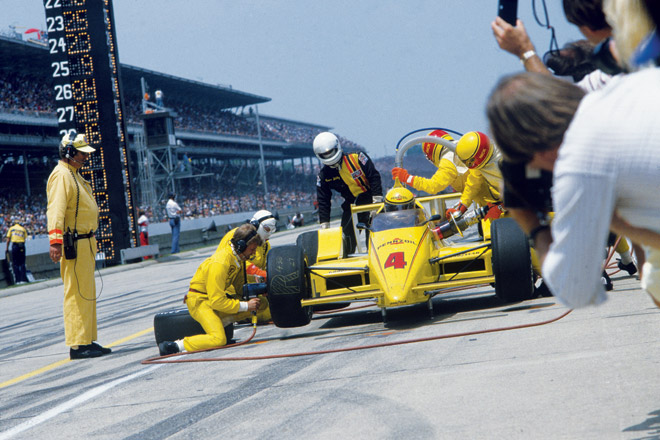
He wasn’t intimidating like A.J. Foyt, but he ran you just as hard and clean.
He wasn’t concerned about leading every lap like Bobby Unser, just the last few.
He wasn’t overtly aggressive like Mario Andretti, he just picked his spots.
He wasn’t balls-to-the-wall like Gordon Johncock, just brave when it counted.
He didn’t make straight A grades in school but, like Al Unser, his racing I.Q. was off the chart.
Rick Mears drew on the best characteristics of all those badasses, but mixed in his own special style for success to take his place alongside them.
And the story of how this unassuming desert fox became a household name, a four-time winner of the Indianapolis 500 and a part of racing royalty is one of the most improbable and inspiring since the wheel was invented.
“It still surprises me,” says Mears with a grin, standing in the Indianapolis Motor Speedway museum last winter as the Team Penske 50th Anniversary exhibit was unveiled. “I never dreamed of driving an Indy car. And when I finally did, I was out of my league. Then, after I started racing them, Penske was out of my league.
“I was at the right place at the right time. But it all happened so quickly.”
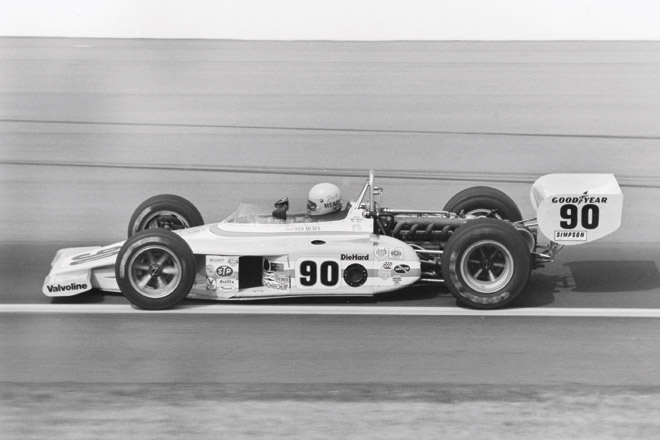
“One of my guys [Steve Richards] kept hounding me to go watch this Mears kid, so I finally did one day at Riverside, in a Super Vee, and he was impressive,” says Simpson, a pioneer of racing safety who drove Indy cars from 1968-’77. “Then I invited him to drive a Formula 5000 car I was testing at Willow Springs and he was quick. But what really got my attention was his car control.”
Simpson offered the 26-year-old native of Bakersfield, Calif., a 10-year-contract and Mears signed it with the hopes of possibly trying Indy cars some day. A few days later he was headed for the California 500 at Ontario Motor Speedway to drive Simpson’s Eagle.
Now mind you, those were the days of USAC where drivers usually had to run Milwaukee, Phoenix or Trenton (or all three) before being allowed to even take a rookie test at Indianapolis. Mears had never sat in an Indy car, let alone driven one.
“USAC pitched a bitch, so I had to guarantee I’d cover any damage Rick caused to other cars if he crashed,” continues Simpson. “USAC gave Rick 10 laps by himself and he ran 188mph, so they agreed to let him race.”
California cool in and out of the car, Mears qualified 20th of 33 and finished eighth.
“I had a week of practice and my approach was that this was my first race, so there were no expectations,” he recalled. “I figured I had to out-last people, run 500 miles and learn, so that’s what I did.”
Mears ran the final two races of 1976 (finishing ninth at Texas and Phoenix), then Simpson sold the Eagle to Art Sugai under the condition he hired his new client to drive it. The man who’d go on to conquer The Brickyard didn’t even make a qualifying attempt at Indy in ’77 because the car was so bad, so Simpson sold one of his McLarens to Teddy Yip, again with the understanding Rick would be driving it. A fifth at Milwaukee and sixth at Michigan got him noticed.
“Penske comes up and says, ‘Tell me about this Mears kid,’” recalls Simpson, “and I said he’s a helluva racecar driver and I’ve got a lifetime contract with him. He wanted to know how much money I wanted for his contract and I said I didn’t want anything except to make him a Penske driver. I didn’t say anything to Rick, but Roger and I had a deal before he went riding on the Colorado 500.”
The annual motorcycle trek in Colorado, hosted by Wally Dallenbach, is where The Captain asked Mears what he was doing in 1978. “He offered me a part-time ride, which I figured was better than 90 percent of the full-time deals,” recalls “The Rocket.” “I played hard to get for about five seconds and then signed.”
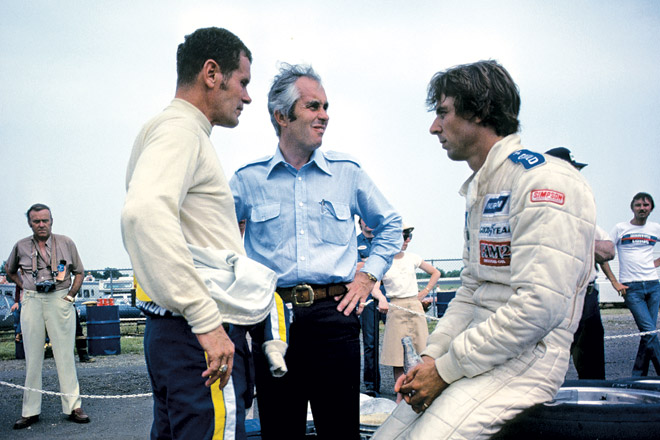
“I learned early on that A.J. and all those guys weren’t supermen; they put on their pants one leg at a time just like me,” he reasons. “Mario and Tom helped me a lot; both were straight shooters, and I always appreciated that.
“And Roger didn’t put pressure on me. He said to go out and just run and learn, because we had two other guys to go fast.”
Qualifying on the front row along with Sneva for the Indy 500 got things rolling, but two races later he scored his first Indy car win at Milwaukee. He then triumphed on the high banks of Atlanta and closed out the season with a victory at England’s Brands Hatch road course. Sneva took the championship, but Mears wasted very little time in showing his verve and versatility.
“Obviously we knew after a few races he was a keeper,” says Penske, who’d first offered the part-time gig to Pancho Carter. “And he was perfect for this team because of the kind of teammate and person he was.”
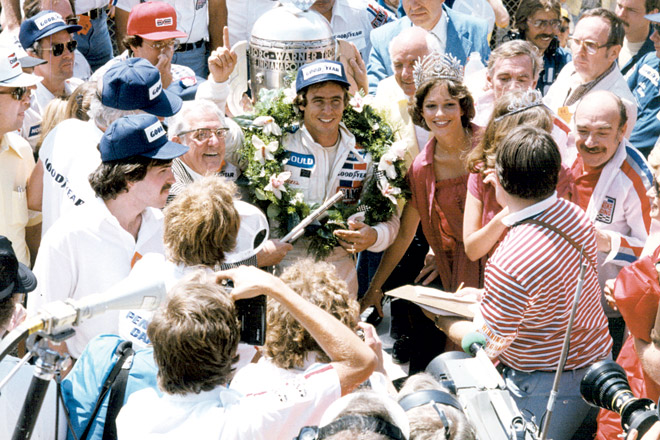
“I always say I didn’t really appreciate the first Indy win because I hadn’t grown up around Indy cars, didn’t ever expect to drive one anyway, and didn’t know the history,” says Mears. “But I knew what it meant to Roger right away.”
Read the complete version of this story in The Heroes V Issue of RACER magazine, on sale now.
Click here to take a video tour of the issue.
click here
, or to buy The Heroes V Issue online, click here. To learn where to buy RACER in your area,click here
.RACER is also available digitally for Apple, Android and Kindle Fire devices. RACER Digital has the complete content of the magazine's print edition formatted for mobile viewing. With RACER Digital, you'll have access to your RACER content all the time, wherever you are.
The RACER app can be found by searching for "RACER Magazine" in the Apple, Android or Amazon App stores. The app is free and includes issue previews and the RACER.com newsfeed. Individual issues can be purchased for $1.99 and an 8-issue annual subscription is $9.99. Back issues are also available.

Latest News
Comments
Comments are disabled until you accept Social Networking Cookies. Update cookie preferences
If the dialog doesn't appear, ad-blockers are often the cause; try disabling yours or see our Social Features Support.